
Narrative Tools,Truth,and Fast Thinking in National Memory:A Mnemonic Standoff between Russia and the West over Ukraine
2015-05-30 23:47:56JamesV.Wertsch
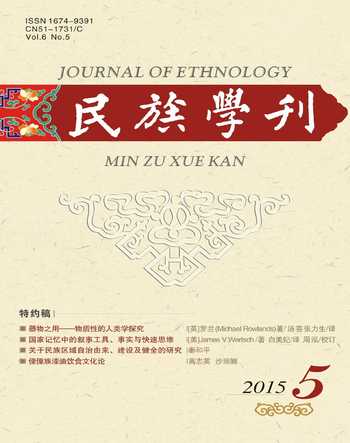
民族學刊 2015年5期
James V.Wertsch
(Department of Anthropology,Washington University in St.Louis,St.Louis,MO 63130,
USA; 2.Sociology Department,Beijing University,Beijing,100871,China; 3.Institute of
Ethnology and Anthropology,Chinese Academy of Social Sciences,Beijing,100871,China)
JOURNAL OF ETHNOLOGY, VOL.6,NO.5,07-14,2015(CN51-1731/C,in Chinese)
DOI:10.3969/j.issn.1674-9391.2015.05.02
Abstract:
In 2014,the U.S.and Europe found themselves in a surprisingly tense face-off with Russia over events in Ukraine.As these events unfolded,it became clear that what was involved went beyond the kind of realpolitik dispute over resources or ideology that had long vexed the relationship between Russia and the West.Instead,much of what Putin said during the tense standoff with the West over Ukraine was a straightforward reflection of an underlying national narrative that has been part of Russian culture for centuries. ?In order to understand Putins stance—and why it is wildly popular with large segments of the Russian population,it is crucial to understand the “social language”(Wertsch,2002)that they share as members of a “mnemonic community”(Zerubavel,2003).This is a social language built around a set of narrative tools that shape the speaking and thinking about the past and the present and that distinguish this mnemonic community from others.
We need to examine the narrative tools that shape Putins thinking,and need to consider how his thinking reflects his membership in the Russian mnemonic community. In many respects the deep divide that separates Putin from Western leaders reflects a more general divide between mnemonic communities and the narrative tools they employ.
The approach that I take to symbolic mediation draws on the writings of Vygotsky(1934,1978,1982),but it important to contextualize Vygotsky in a broader discussion that was going on in Russia,Germany,and Europe in the nineteenth and twentieth centuries. At several points in his writings,Vygotsky was quite explicit about the centrality of mediation(oposredstvovanie)in his thinking,and a focus on mediation,especially as it concerns “signs,” or “psychological tools,” can be found throughout his writings. Vygotskys ideas echo Cassirers in several important respects,and drawing on both yields some useful synergies.A crucial point where Cassirers line of reasoning goes beyond Vygotskys comes from his claim that using symbolic forms introduces the “curse of mediacy,” meaning that this use comes at a cost—a cost that often goes unrecognized.
Taken together,the ideas of Vygotsky and Cassirer suggest a world in which speaking and thinking are fundamentally shaped by the symbolic mediation,or cultural tools provided by historical,institutional,and cultural contexts.It is worth noting that in this approach cultural tools do not mechanistically determine human discourse and thinking.Instead,the very notion of a tool implies an active user and suggests an element of variability and freedom stemming from the unique contexts of performance.
Returning to Putins stance on the 2014 events in Ukraine,the first point to recognize is that what he said was fundamentally shaped by the narrative tools of his mnemonic community,and as such,it makes sense to include the power of these tools into our analytic effort. ? One of the most important shared narratives that binds the Russian mnemonic community together concerns repeated invasions by foreign enemies. This national memory has encouraged Russians to develop habits of emplotment,or “narrative templates”(Wertsch,2002),that lead them to interpret many events in similar way—namely,as threats.This underlying code has been used repeatedly by the Russian mnemonic community to make sense of events from the past,and it is also employed when interpreting current events.
Tense interpretive standoffs such as the one in 2014 over the Ukraine and Crimea are typically grounded in assumptions about the truth of “what really happened.” These “mnemonic standoffs”(Wertsch,2009)about events in the near or distant past are different from other sorts of disputes. When thinking and speaking about Crimea,Putin was not simply listing a series of facts or observations; he was organizing them in line with narrative tools of his mnemonic community,and this required the events to be grasped together into a familiar plot.He was able to grasp things together along the lines of what Frederic Bartlett(1932)might have called a specifically Russian “effort after meaning” based on the narrative template noted before.
In analyses of national memory,narrative templates are habits of speaking and thinking that have great power and operate in ways that often escape our notice.Research in cognitive science on “fast thinking”(Kahneman)and “intuition”(Haidt)have produced fundamental insights about conscious and nonconscious thinking are quite compatible with ideas about how narrative tools are employed by national communities,and they can be put to good use in analyzing them.
The central role of fast thinking and the associated tendency to jump to conclusions about the truth of ones account of the past mean that mnemonic standoffs such as that between Russians and the West over Ukraine may be expected to be the rule rather than the exception.The psychological processes involved are powerful and lead to overconfidence in our account in part because they operate below our level of conscious reflection.The combination of narrative tools and the nonconscious habits of thought associated with them is so powerful that we can find ourselves taken by surprise when someone comes up with a completely different interpretation of “what really happened.” The disconnect can be so great as to give rise to comments about how others are “operating in a different reality,” but such comments may also mean we do not understand the logic of another partys perspective.
A great deal of research in the psychology of memory suggests that the first exposure to information or the first discussion or rehearsal of an event after it happens can have a profound effect on what is remembered,so profound in fact that people sometimes report still having a memory of an event even though they have information that convinces them that this memory is inaccurate.Is something like this behind the fact that we appear to be so locked into stories about past events that we have an extraordinarily hard time seeing anothers perspective? Such questions are highly speculative,but they appear to be a fruitful place for collaborative investigations that would bring together scholars from a wide range of disciplines to address one of the most mysterious and most dangerous phenomena we see at work in international relations today.
Key Words: ? Russia ; Ukraine; mnemonic community; narrative tools
References:
See page 13-14 in the No.5 of this journal.
- 民族學刊的其它文章
- The Priest and the King in Hierarchy: on Louis Dumont餾
- Understanding the Origin,Founding and Characteristics of Ethnic Regional Autonomy
- The End of Zhang Zhung Kingdom in the Northwestern Areaof the Qinghai—Tibet High Plateau and Its Continuation in the Southeastern Area
- What Do Artifacts Do?
- 心理量表在民族高校大學生
- 基于NVivo質性分析的羌族災后心理復原力的影響因素研究