MONEYAND MATRIMONY
2015-03-24 03:10:42BYSUNJIAHUI孫佳慧
漢語世界 2015年3期
BY SUN JIAHUI (孫佳慧)
MONEYAND MATRIMONY
BY SUN JIAHUI (孫佳慧)
A look at the skyrocketing costs and profits of tying the knot
在中國, 結(jié)婚為什么這么貴?
It’s supposed to be a cause for celebration—a wonderful expression of eternal love cemented in traditions and customs, symbolically linking one human being to another. The ritual of marriage in China echoes through the ages, so, the question is, how has it turned into a money pit? Today, weddings can cost millions of RMB, and expectations for that glamorous day are rising not falling—much to the chagrin of the lucky two and the revelers.
It is said that girls plan their weddings from childhood, putting pillowcases on their heads to act as veils. Little do they know that every step along their fairytale—the clothes, fl owers, wedding car, the colorful stage, the cake, the champagne—is a wallet-shredding nightmare, and a fairly recent nightmare at that.
According to Time-Weekly, Shanghai ranked fi rst on the wedding spending list, with the average cost reaching 230,000 RMB. And other fi rst-tier cities like Beijing and Shenzhen didn’t fall far behind. Take Beijing as an example, catering for a 35-table banquet will run at about 120,000 RMB, and once you add in the wedding dress, the car, and all the various trimmings of your modern, urban wedding in China, it averages out to around 200,000 RMB. According to the China Wedding Industry Development Report, an average of 12,000 USD is spent on each wedding nationwide. For a young couple starting out, this is a horri fi c expense.
“We never expected an expensive wedding, but everywhere wanted money, you don’t even knowwhere the money goes. In the end, the only thing left was my wedding dress, everything else was gone,” says Wang Ying, recently married in October of last year. “We were over budget on everything. Even the bridal bouquet cost hundreds.”
This isn’t to say that there aren’t still cheap, traditional weddings throughout the country, but China’s rise over the past few decades has turned the wedding business into a full-blown industry. In the vanguard are the tuhao, China’s famous tacky rich.
In Fujian Province, it’s not all that rare to see a bride adorned with more than fi ve kilograms of gold, a custom but also the tuhao team colors—dozens of bracelets, rings, and jewelry of all kinds. The marriage of a ceramic magnate in Jinjiang involved an eight-day extravaganza, with a dowry valued at more than 100 million RMB. Other weddings seem to exist for the purpose of impressing the revelers; in Ningbo, Zhejiang Province, 81 iPhone 5s were sent as gifts to guests at a wedding. A recent wedding in Wuhan featured a Maserati, an Audi, and a bright-pink Ferrari, all accompanied by models and choreographed dancers.
While everyone seems to have a good time, it’s important to take a break and realize that things weren’t always like this. In the 1960s, the must-have items for a wedding were called the“36 legs” (三十六條腿), meaning that newlyweds should prepare wood furniture before a wedding—beds, tables, chairs, wardrobes—all this with the expectation that the total number of furniture legs would add up to a predetermined lucky number. And that was largely it, even dinner with close friends and family was optional in the halcyon days of 1960s China.
As with everything in China, things changed after the Reform and Opening Up, and the wedding industry began to take hold. This began with the “Three Big Items” (三大件) essential for a wedding—a watch, a sewing machine, and a bicycle. Later, a radio was added and it was collectively called “Three Revolve, One Sound” (三轉(zhuǎn)一響). The estimated cost for this, together with the“36 legs”, would be about 420 RMB.
By the 1980s, the “Three Big Items”ballooned again: a refrigerator, a color television, and a washing machine, adding up to about 3,000 RMB. Wedding dinners began to become a normal occurrence, but certainly not extravagant ones. And, ten or 20 RMB in a red envelope was a generousenough gift.

A one-hundred-table banquet hall used primarily for weddings in Yunnan Province
It may not sound like much, but, considering income levels at the time, those must-haves were not as cheap as they sound. As the economy developed, expectations for weddings skyrocketed. Those “Three Big Items”have been relegated to history, giving rise to the weddings we know today—Western-style wedding gowns, luxury cars, exquisite bridal make-up, and wedding photos all took hold—and the wedding industry with all of its facets and niches took hold with it.
These niches evolved into specialized sectors: master of ceremony services, venue decoration, photography, tailoring, hairdressing, and many more.
However, today, the trend is for a one-stop-shop (albeit an expensive one) for all your wedding needs.
“We cooperate with hotels, wedding dress shops, and even other wedding planning companies. So, a planning company doesn’t need too many staff members. Usually two planners can handle a wedding. It is a kind of resource sharing,” says Ms. Gao, who works with a top wedding planning company.
This holistic approach is what makes the wedding planning industry so pro fi table, producing and selling ideas. In China, themes can mainly be divided into three categories: Chinese-style, Western-style, and amix between Chinese and Western. A common Chinese-style theme wedding with red bridal dresses and traditional rituals may cost about 20,000 RMB, covering the MC, make-up, video recording, photography, and the venue layout—along with a tailored theme like“Double Happiness” (雙喜).
Gao claims that there is a 50 percent pro fi t margin in most weddings for wedding planners, adding that she doesn’t think it’s particularly extravagant even though she herself assisted in a Shanxi Province wedding with budget of over ten million RMB. “You can’t just think about the price; the point is the performance-price ratio. Sometimes I understand customers’ need for perfectionism.”
Part of the reason for the high margins is that most themes are recyclable. Around half of all the Western-style motifs are centered around themes like “Summer Fragment” or “Love in Bloom”, both of which use similar, recyclable items. Also, lucky couples celebrating in the Chinese style shouldn’t be surprised if their wedding planner comes up with a theme around“Happiness” or “Red”. If you’re not a fan of either of these, it’s going to cost you.
There is, however, an upside to all the preparation, the boring atmosphere, perfunctory congratulations, and piles of leftovers: the economy.
According to the Wedding Services Market Research Report from IBIS World published in January, 2015, revenues from the wedding services industry in China reached 22 billion USD in 2014—roughly the nominal GDP of Cyprus. For the past fi ve years, annual growth has been around 5.1 percent, and over half of all couples use these types of services when they get married. With China’s large population and high marriage rate, the market potential for this revenue stream is virtually limitless.
There is, perhaps, no better place to witness China’s wedding extravagance than a wedding expo, a tradition that began as recently as 2005. Held every year in different places around the country, it features the full range of wedding products and services available, including photography studios, wedding planners, bridal gown designers, rental services, hotel agents, and restaurant banquet hall representatives. It’s a platform to promote their brands and for buyers to collect information. Wherever held, it attracts hundreds of thousands visitors.
But, the question remains as to why China was so fast, after all the austerity of the recent past, to build an industry out of weddings.
The answer is what you would expect—traditional beliefs surrounding marriage in China indicate that marriage is one of the most important events in life. Throughout history, a grand wedding was essential for justifying a marriage, and if the wedding was too simple or crude, the two families might be breaking the rules of etiquette and decency, making weddings a serious status symbol. In this sense, the extravagance of weddings in general moves only one way: up.
Culturally, and this is for many cultures around the world, the wedding centers on the bride, seen as something the prospective groom gives the bride. This expectation is also a factor in the ballooning costs of weddings. “You are taking a wife who will accompany you for the rest of your life, money spent on a wedding is just a tri fl e compared with that. I think this is evidence of my love,” says hopeful groom Li Liang, who is getting married this year, hoping to blow the roof off for his betrothed. Parents are another cause of wedding extravagance. It is often said that parents spend half of the money, invite more than half the guests, and do more than half of the preparation work. Sometimes the newlyweds don’t even know the guests in their own wedding, and the guests just express their good wishes to the parents. In many ways, a wedding is no longer the most important event in life for the young couples, rather for their parents.
“We didn’t want a luxurious wedding that badly, but our parents insisted. They would have felt humiliated if our wedding wasn’t good enough,” Wang Ying says. In this, little has changed since the days of yore. Marriages were often dominated by parents who arranged the partners to begin with. Filially, children followed their parents’orders to get married without even meeting their future husband or wife.
Forgetting for a moment the incredible prices and pressure on the newlyweds and family, a few words must be said of the guests. Even though the parents often monopolize the guest list, an omitted invitation can end a friendship, and considering the all-encompassing power of the hongbao, if someone actually wants to come to your wedding, you’d better give them an invitation.

A promotional deal from a jewelry company displaying a bride wearing 3.5 kilograms of gold in Fuzhou, Fujian Province
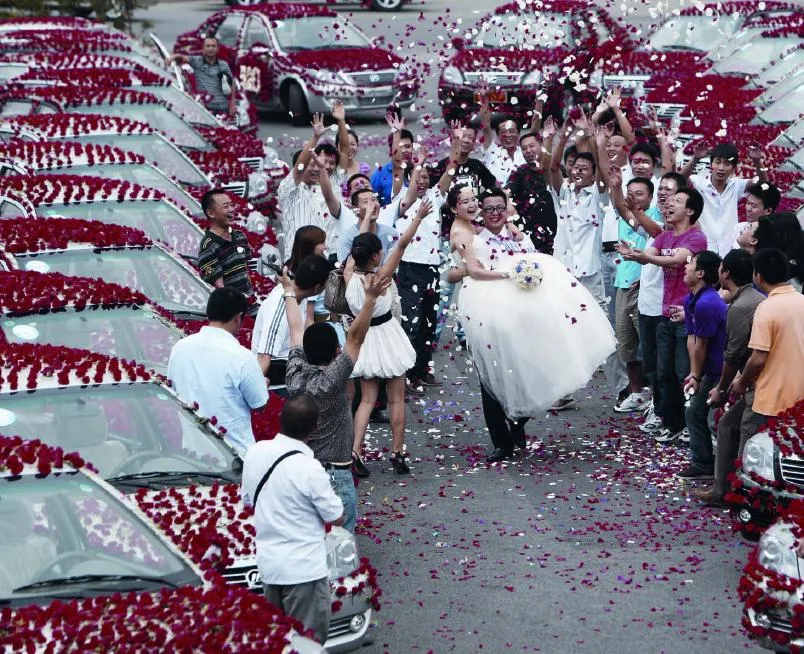
A whopping 99,999 roses were used at this wedding in Chongqing, along with 30 wedding cars
It’s not just the happy couple who break the bank for their weddings; a great deal of pressure is put on the guests to cough up cash. In China, the conventional gift for a wedding is unimaginative—cash in a red envelope, or hongbao. The general rule is, the closer you are to the couple, the more money you need to fork out, and this can put tremendous strain on the revelers. The lovingly crafted wedding invitations are often called“red bombs”.
The hongbao are reason enough to have a wedding; a larger wedding means more hongbao.

This Wenzhou wedding features four Ferraris, four Lamborghinis, eight Rolls-Royces, and ten Bentleys

This wedding in Harbin features sports cars, vintage cars, two Hummer limos, 12 Lincoln limos, and a fleet of 20 Benz vehicles in their massive procession
It’s important to remember that the happy couple burning money on their wedding have themselves been through the hongbao gauntlet many times before.“It’s just like a kind of unscheduled deposit. You give money many times, and when you get married, you get to withdraw it just once. I understand this pattern, and I also hope to take back my money when I get married,” says Hu Qipeng who is currently suffering under the strains of four wedding invitations.“If three friends get married in a same month, my salary runs dry.”
Alas, even the in fl ow of red envelopes often does not cover the cost of weddings. In many cases, weddings are tools to fl aunt wealth, bringing us full circle back to the tuhao. You don’t have to look far for weddings that are simply beyond the pale. Stories of extravagance—a coal boss from Shanxi who spent 70 million on a wedding complete with three rented airplanes, a Party of fi cial who was sacked for spending 1.6 million RMB on his son’s wedding, a fl eet of 30 Rolls Royce Phantoms in Hebei Province—show little sign of slowing down.
But, not everyone is following this trend. Many young people born in the 1980s and 1990s are trying to pull marriage back to an acceptable extreme. In 2008, the term “naked marriage” (裸婚) emerged, referring to marriages without a new house, car, or grand wedding. Some say the naked marriage has been made inevitable by the increased housing prices in recent years on top of the cost of a wedding. But, those doing it see it as a challenge to the established order. For these lucky few, the “l(fā)ess is more” concept is a deeply-held conviction, making a simple wedding something of which to be proud.
In 2012, Liu Bing, a student in Nanjing University married classmate Yan Jizhang. The bride was picked up from her dorm, the banquet was held in the campus park, and the bridesmaid and the best man were the roommates. Everything was simple, even the wine was poured into disposable paper cups. A similar wedding at Southwest University in 2013 cost a total of 400 RMB, with the campus golf carts serving as the wedding cars and 22 bicycles making up the team of escorts. The wedding went viral online, with many expressing quite a great deal of envy at the simplicity and low cost.
Even though statistics point to a snowballing wedding industry, the new generation seems keen to throw off both the cost of lavishness and the burden of tradition. But, for now, the wedding industry stands strong and ready to pro fi t off the couple’s special day to the tune of billions of RMB. So, how much does it cost to get married in China? The pedantic answer is a nine RMB certi fi cate fee paid to the Bureau of Civil Affairs; the rest is up to the special couple.