PINEAPPLE RICE
2015-03-24 03:10:48
漢語世界 2015年3期
PINEAPPLE RICE
A s w e et, sou ther n ho liday tradi t i on t o sat e you r palat e
酸甜可口的傣家菠蘿飯
One bonus of China’s vast landmass is that you can fi nd diverse cuisines from various latitudes. If you yearn for a bite of the tropics, then you should de fi nitely turn to the Dai cuisine (傣菜), which has its roots in the Dai autonomous prefecture of Xishuangbanna at the southern edge of Yunnan Province. Living deep among the palm trees and rainforest, the Dai ethnic group shares strong links with Thai ethnic groups in Laos and Thailand, and their cultures have a lot in common; in China they are known for their folk arts, brown-skinned beauties, and, perhaps above all else, their food, which features stunningly distinct spices and tastes.
Yu Nanwen is the hostess of a restaurant in Gadong Village (嘎棟鄉), located in Jinghong City, the capital of Xishuangbanna, where Dai restaurants are concentrated. Locals fl ock here to experience authentic Dai cuisine.
But, Yu says it’s not easy to run a Dai restaurant: “Dai food is delicious but very troublesome to make. Most dishes involve many complicated steps.”
Yu recommends pineapple rice as a good way to start.
The dish is purple sticky rice (紫糯米) steamed in a hollowed pineapple. However, as simple as it sounds, Yu says that, in her childhood, it was always a festive treat. Even though now she makes it on a daily basis, it used to be made only during the Water-Splashing Festival (潑水節) or for special guests. This may have to do with the rareness of the purple sticky rice. For their daily staple food, the Dai ethnic people traditionally have white sticky rice instead of the purple option, because the latter is produced in limited regions in Yunnan—only Mojiang and Xishuangbanna—and is harvested only once a year.
In recent years the purple sticky rice has become more well known and gradually won favor across the country. It is largely appreciated for its fl avor, but there have also been claims that it has medicinal qualities. There is a saying in Traditional Chinese Medicine (TCM) that, “black bene fi ts the kidneys” (黑入腎). In the abstract, rather unscienti fi c style of TCM, dark purple is lumped in with the color black and, therefore, food of this color—sesame, black beans, grapes, mulberries, and, of course, the purple sticky rice—is perceived as bene fi cial to the kidneys.
The pineapple container is natural for Dai chefs; it is a long-standing tradition to use fresh plants as cooking containers. For example, they often have rice steamed in bamboo sections, and in a cooking method called baoshao (包燒, literally “wrap and roast”), the food is wrapped in a palm leaf and roasted on charcoal. Aside from being pleasing to the eye, it is important to integrate the fragrance and taste of the container or wrapper into the food itself. The same goes for pineapple rice.
At fi rst glance, it may seem that the Dai pineapple rice resembles the Thai version, but they are distinctly different. The Thai pineapple rice is salty in taste; contains a variety of ingredients like shrimp, green beans, and pepper; and the mixture is stir-fried with oil. The Dai version, on the other hand, is sour-sweet, oil-free, simply consisting of rice and pineapple, and in Yu’s words, “It tastes much fruitier.”
To make the dish, it is ideal to have purple sticky rice and pineapples common to Yunnan and Southeast Asia, which in China are referred to as “the eye-less pineapple” (無眼菠蘿) because they are sweeter, fl eshier, and do not have holes under the skin. But the most important thing is to remember that, on a Dai table, the pineapple rice is not a staple food, just a delightful after-dinner dessert; so, be sure to make it in a festive, joyous mood, the key to all good desserts.– GINGER HUANG (黃原竟)
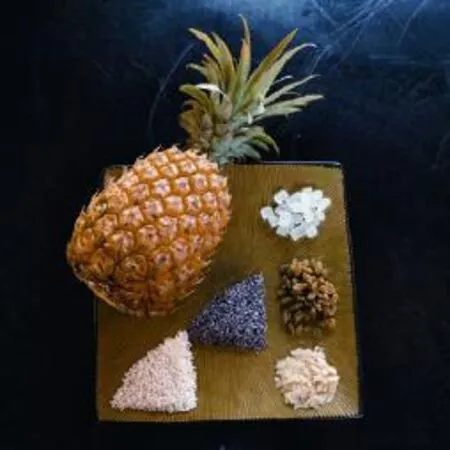
Soak the sticky rice overnight and steam it for 30 minutes. Cool it for later use. Dissolve the sugar in about 100ml of hot water. Cut off the top of the pineapple and save it for a plate decoration later.
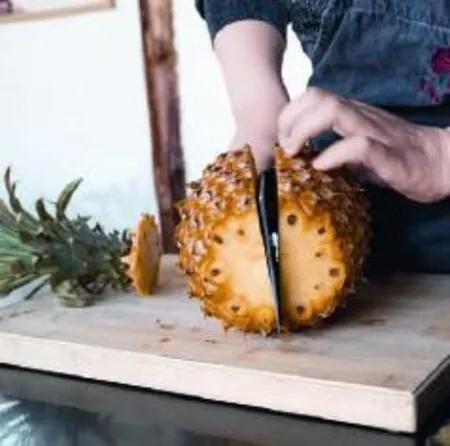
If your steamer pot is tall enough, hollow the pineapple by spooning out its flesh. But if you have a smaller steamer, cut the pineapple vertically into two even halves so that they can be contained.
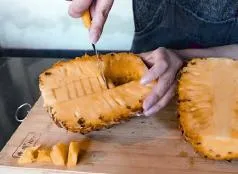
The core of the pineapple is harder than the flesh and not good for the dish. Carve it out with a knife; you can divide it into several sections first in order to remove it with more ease. Make sure you leave a rim about 1.5cm thick and do not cut too close to the skin.
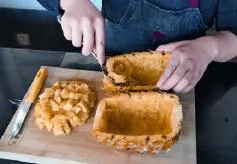
Now, spoon or cut the flesh of the pineapple, making its skin into two bowls; again, be particularly careful to keep the rim at about 1.5cm thick. Cut the flesh into small cubes of 1cm.

Blend 1/2 of the pineapple mince, sugar, raisin, almond slices, and sticky rice well.

Stuff the blend into the pineapple bowls and flatten the surface. Place the pineapple in the pot when the water starts to boil, steam for 20 minutes, and serve.