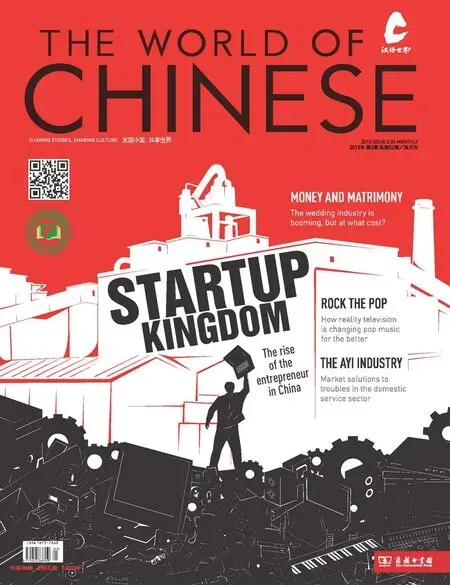
ROCK THE POP
2015-03-24 03:10:42BYTERENCEHSIEH謝燕輝
漢語世界 2015年3期
關(guān)鍵詞:流行音樂
BY TERENCE HSIEH (謝燕輝)
ROCK THE POP
BY TERENCE HSIEH (謝燕輝)
Ho w real it y T V i s changi n g th e C hi n ese mu si c in du st r y
真人秀電視節(jié)目是如何改變中國流行音樂產(chǎn)業(yè)的?
Welcome to the Hunan Satellite Television station, located in the Xingsha District of Changsha, Hunan Province. It’s fi lming day.
The giant doors of the 1,300-square-meter studio open in the dark, cavernous room, featuring a stage lit up by hundreds of stage lights of varying colors. In the back of the room, 500 audience members, sitting in rows organized by age, await with hushed breath for the next act to begin.
The blaring lights dim and then fl ash, enhanced by the smoke machine in the back. A woman’s silhouette walksout, her face darkened by the spotlight trained on her from behind. People gasp as they strain to see beyond her darkened frame, backlit by the overhead lights. Amidst all this chaos, Kubert Leung takes his seat at his mobile workstation, a desk piled high with computers, mixers, equipment, and microphones situated stage left of the embedded glowing circle on the shiny black stage that surrounds each singer like a glowing halo. As the music director for Hunan Satellite Television’s hit pop music reality show I Am a Singer (《我是歌手》), Leung is in charge of a 50-something team of musicians and must be able to make instant adjustments according to the needs of the singers. At this particular moment, Taiwanese pop-star Huang Liling, known otherwise by her stage name as A-Lin, is about to begin her tune. The lights bring her face into view; the crowd roars in approval.
Leung’s band is formed from a surprisingly small but notable collection of musicians who make up the backbone of the pop industry in China. Leung, a Hong Kong native, is both a songwriter, producer, and performer who has produced and written for the likes of Faye Wong and many others in the Canto and Mandopop industry. Among the various band members, with names like Eason Chan, Jay Chow, Candy Lo, and Cui Jian, regularly come up in conversation as old friends and familiar faces.
A-Lin turns to send Leung a short nod—she’s ready to go. Kubert’s thumb hits the spacebar of the Macbook that serves as the central nervous system of this band, initiating the click track that keeps everyone together; beside him, pony-tailed concert master Jin Haiyin raises his bow in anticipation as the fi rst notes of piano introduction from keyboardist Liu Zhuo’s electric rig soar through everyone’s in-ear monitors. The band strikes, the room reverberates with the power of drummer Hao Jilun’s ampli fi ed kick, and guitarist Tommy Chan’s angry open-A power chord. A-Lin raises the microphone to her lips. It’s on.
As an industry once considered stagnant, rife with plagiarism and piracy, China’s music reality television programming is breathing new life into pop music, creating an image that is both fresh and marketable.
The idea behind I Am a Singer is remarkably simple: pit former has-beens against each other to see who can stay a fl oat while allowing the audience to vote for their top favorites, forcing each singer to put out their best every week. The current season features Chinese musicians from many different nationalities, including Singapore and Malaysia. While seven initial contestants begin in episode one, others take their place as they are eliminated. Season three initially featured an ethnically diverse crew of seven singers, including Tibetan singer Han Hong, Sun Nan, Hong Kong crooner Leo Ku, Singaporean national treasure Kit Chan, Huang Liling from Taiwan, R&B artist Tiger Anson Hu, and pop idol Jane Zhang.
I Am a Singer is just one of a breed of shows that are revitalizing China’s music industry, and international soft power game. CCTV-3’s Sing My Song (《中國好歌曲》) consists of three phases: an audition phase, a battle phase, and a fi nal production phase, where producers and songwriters are teamed up to create original music. Producers choose contestant songwriters through a blind audition process, where the producer must make an instant decision to pass on or take a song. If two or more producers choose the same song, the singersongwriter has the fi nal choice of producer. Zhejiang Satellite Television’s The Voice of China (《中國好聲音》) features judges who pick teams of contestants who face off against each other through performances and have featured such high pro fi le judges as Wang Feng, A-Mei, Andy Lao and Yang Kun. It has been reported that the latest season will also feature Jay Chou.
The unprecedented growth of Chinese pop culture has roots in other Asian nations, crisscrossing the Asian peninsula; while many pop music shows in China derive from Korea and Japan, the roots of “C-Pop” began in 1930’s Shanghai as a collaboration between American Jazz trumpeter Buck Clayton and later-excoriated playwright and composer Li Jinhui (黎錦暉). Clayton and his band the Harlem Gentlemen were featured at theShanghai Canidrome Ballroom along the French Concession and regularly socialized with the likes of Chiang Kai-shek and his wife Soong Mei Ling. After reputedly being fi red from the Canidrome for a bar fi ght with someone whom he described as a racist American marine, Clayton and his band found another opportunity to perform at a club more suited toward the growing middle class petit bourgeoisie of Shanghai that was less interested in American jazz. Working closely with Li, Clayton began to take Chinese folk melodies and perform them as jazz arrangements. While Clayton left just before the Sino-Japanese War began full-scale in 1937, Li would continue to write music for young Chinese starlets, sending them to the top of the charts until the end of the Chinese Civil War in 1949. Li would become a casualty of the Cultural Revolution and his music banned in China for being soft and pornographic but his legacy would live on through the Chinese Diaspora in Hong Kong and Taiwan, where his style, known as shidaiqu (時代曲, era music) formed the aesthetic backbone of what we know today as Chinese pop.

KUBERT LEUNG(梁翹柏)
Kubert Leung is a songwriter, producer, and musician. Leung came to prominence in 1984 with the band Life Exhibition, and is considered one of the pioneers of the Cantopop ballad. Leung graduated from New York University with a degree in film scoring in 1997, and has won several awards for his music on and off film, including a nomination for his song “Blood Brothers”at the 2011 Hong Kong Film Awards. Leung currently serves as the music director for the TV shows I Am a Singer, Rising Star (《中國正在聽》), and as a producer and director for former I Am a Singer contestant and vocalist Zhou Bichang.
While Hong Kong and Taiwan were able to commoditize their music industries after 1949, the Chinese mainland found itself in a much more sticky predicament after the Cultural Revolution ended in 1976; intellectual property law often con fl icted with the rampant economic development in the era of economic reform and beyond, and in the digital age this trend has
largely continued.
The internet has long been lamented as a haven for digital piracy, and China’s search engines have been no exception to the rule. The total recorded music legally purchased by Chinese users in 2011 was outspent by that of Thailand, another country high in digital piracy but with a signi fi cantly smaller population. In April 2007, a Chinese court allowed the International Federation of the Phonographic Industry (IFPI) to represent international record labels Universal, Warner Brothers, and Sony BMG in a domestic lawsuit against internet search engines Baidu and Sogou for providing free hyperlinks to MP3 fi les for users in China to the tune of nine and 7.5 million USD respectively. While the IFPI lost the initial lawsuit, Chinese courts have heard over 300 cases since then, of which the IFPI has won 90 percent.
Because of their episodic nature and the way they are delivered through digitally-streamed online portals, Chinese pop music television has the power to change the way music is produced and sold in China. Not only do they generate massive advertisement revenue for their sponsors and host TV stations, they spawn subcategories of shows that continue to generate revenue simply from name-brand recognition. For example, agents for each vocalist on I Am a Singer take part in a separate competition that derives from the main arc in a show called I Am a Manager. While viewers tune in to shows, audio content is freely streamed from searchengines for users to listen after the broadcast.

Finalists perform in the final round of I Am a Singer by Hunan Satellite Television
Now fi nished with its third season, I Am a Singer commands the lion’s share of views on both Hunan Satellite TV network and nationally. While the show has its roots in Korea, where it fi rst came to popularity, it’s quickly grown into the Chinese mainstream as staple. According to CSM, China’s state media monitor, over 30 percent of all television viewers in China were tuned in to the season fi nale. This massive in fl ux of viewers has given Hunan Satellite TV the chance to turn on the revenue fl ow, partnering with QQ, Xiami, LeTV, and several other large digital giants to deliver content and advertising to viewers. I Am a Singer was sponsored by LIBY, the Guangzhou-based detergent monolith to the tune of 235 million RMB per season. LIBY’s massive bill wasn’t spent in vain: sales of detergent surged 66 percent in the fi rst half of 2013, according Nielsen’s China branch.
The explosion of pop music television hasn’t been without problems, though—Super Girls (《超級女聲》), one of the fi rst shows in China to gain a large mainstream following, was cancelled in 2011 due to, among various other reasons, the unof fi cial opinion that the text-to-vote system was politically problematic. As such, TV shows with voting are currently limited to the jurisdiction of the audience present in the studio for that particular episode. How to create marketable and commoditized content for contestants after appearing on a show like I Am a Singer still remains an issue, and somewhat ironically, certain shows have even been sued by competitors for infringement of aesthetic or intellectual property rights.
Of course, there’s always more than meets the eye, especially when it comes to exporting culture. The growth in popularity of Chinese pop television overseas has giventhe Chinese state a de fi ning way to develop diplomatic soft power in its dealings with the international community. Television has long been considered a tool for diplomacy by the Chinese government; CCTV, the state-run media bureau, now has programming running in the Middle East, Africa, and America, while the state information bureau recently co-hosted a three-part show with the Discovery Channel on fi lming from inside the “hidden” China.

HUANG LILING(黃麗玲)
Huang Liling, known by her stage name A-Lin, is a vocalist from Taiwan of Amis decent. She has eight recorded albums to date and stars on the latest season of I Am a Singer, China’s hit TV show. Huang has won several notable awards, including a Golden Melody Award for Best Female Singer.
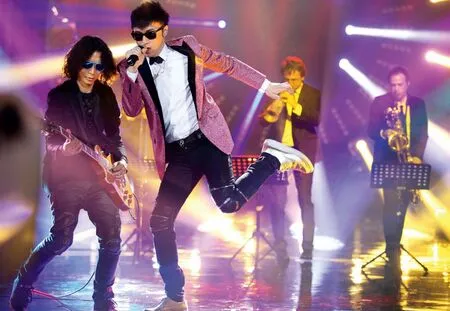
Hong Kong singer Leo Ku in the third season of I Am a Singer
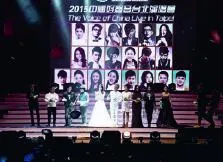
Finalists of The Voice of China perform a gig in the Taipei Arena
While the positive portrayal behind music television is less political, it is just one thread within a wide-spanning narrative to rede fi ne Chinese culture within the context of the modern, global consumer market. In other words, China aims towards the status of a cultural cornucopia by putting its best foot forward. I Am a Singer featured The One, the victor of Korea’s second season, as well as artists from Singapore. The messages are always overwhelmingly positive—musicians coming together from across the world take part in a friendly but competitive atmosphere to bring out the best in Chinese pop culture. Singers often choose to sing songs that are familiar to Chinese audiences, and as such, pay homage to China’s modern age of music.
In I Am a Singer’s third season, competitors Tan Weiwei, Sunnan, Han Hong, A-Lin, and Li Jian all chose music that featured minority and folk musicians, instruments, melodies, and costumes as frequently as the sappy pop ballads of yesteryear. Aiming to bring awareness to the beauty of the music of her three favorite non-Han cultures, winner and contestant Han Hong brought Mongolian, Tibetan, and Uyghur musicians to the stage over the course of the season. Through this tribute to 20th century Chinese society, and to select parts of its traditional history, I Am a Singer is, in a sense, the best of China’s musical culture, translating into a unique and valuable export that’s not only valued in currency but in in fl uence.
As the last notes of her heart-throbbing aria leave her lips, A-Lin lowers the microphone. There’s a long pause as people, dazed and confused, come out of the hypnosis that she’s cast on the audience. The crowd rises to their feet, the applause thunderous and the cheers undying. Grown men are bawling; someone hiccups uncontrollably in the nosebleeds. As if momentarily dazed by the strength of her own voice, she comes back to earth, down from the metaphorical high of her last notes and turns to Leung, hand to her heart in a curt but reverent bow that shares her gratitude for such a euphoric performance and walks off the stage, a smile on her face. She’s nailed it. Leung smiles back. For a moment, he seems to be thinking about the emotional and metaphysical place her music came from. All of a sudden the blaring lights dim and then fl ash again, signaling another round. Jolted from his pleasant dream, Leung reaches for the keyboard as the next contestant walks out onto the spotlight. One, two, three...
猜你喜歡
中國音樂學(xué)(2021年4期)2022-01-12 06:25:28
新世紀(jì)智能(高一語文)(2021年4期)2021-07-28 02:12:54
河北畫報(2021年2期)2021-05-25 02:07:16
河北畫報(2021年2期)2021-05-25 02:07:10
云南教育·中學(xué)教師(2019年11期)2019-08-13 07:19:20
新聞傳播(2018年4期)2018-12-07 01:09:18
海峽姐妹(2017年11期)2018-01-30 08:57:31
中國音樂教育(2017年12期)2017-05-20 09:28:42
北方音樂(2017年4期)2017-05-04 03:40:39
絲路藝術(shù)(2017年6期)2017-04-18 13:59:17