CATCHING A RIDE
2015-01-29 22:02:24ByYuLintao
Beijing Review
2015年1期
By+Yu+Lintao
A significant China-Thailand railway cooperation deal recently signed during the Fifth Summit of the Greater Mekong Sub-region (GMS) Economic Cooperation put the sub-regional cooperation platform on the map. The GMS Economic Cooperation Program, which was launched in 1992 by six countries along the Mekong River—Cambodia, China, Laos, Myanmar, Thailand and viet Nam, is aimed at pooling joint efforts to improve regional infrastructure, thereby enhancing trade, investment and economic growth. Though previously not a widely known mechanism, the program is becoming a model that China utilizes to promote its good-neighborly policy.
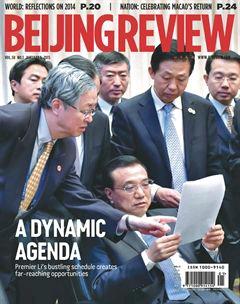
The China-Thailand railway cooperation deal, which has been met with setbacks due to administration alterations in Thailand, will help better connect countries within the GMS. While attending the GMS summit in Bangkok on December 20, 2014, Chinese Premier Li Keqiang praised the deal as the expansion, extension and further confirmation of the previous agreement that the Chinese and Thai governments reached in 2013.
With the deal, China and Thailand agreed to jointly build Thailands first standard-gauge railway lines with a total length of more than 800 km. The project is estimated to cost around $10.6 billion and will connect northeast Thailands Nong Khai Province, Bangkok and eastern Rayong Province.
Li also voiced hopes that the cost-effective new railway lines can be extended to other GMS neighbors.
Observers believe that the railway deal and Chinas new aid proposal go far beyond promoting multilateral interconnectivity and also represent a vast opportunity for GMS countriesdevelopment while partnering with the fastgrowing China.
Accessing rapid growth
GMS is serving as the land bridge between China and Southeast Asia as well as China and South Asia. All GMS nations are developing countries striving to readjust their industrial structure and open to the outside world, but poor transportation infrastructure and the lack of interconnectivity have been a bottleneck hindering their economic development. Following the concrete achievements made for infrastructure connectivity between China and its GMS neighbors, regional cooperation and integration will be continuously deepened.
The railway lines will contribute to the rapidly growing regional economy, said Lei Zhuning, Deputy Director of the Southeast Asia Research Institute under the yunnan Provincial Academy of Social Sciences.
“With the continuous improvement of regional transportation facilities, the pace for building a GMS economic corridor will be further sped up. Regional exchanges at government and non-government levels in the GMS have been quite popular these years, so the new lines, once connected, will further bolster that fervor,” Lei noted.
Song Qingrun, a research fellow of Southeast Asian studies with the China Institutes of Contemporary International Relations, said that like an artery, the planned Thailand railway will pump the economic development of the countrys southern and northern regions as well as push forward GMS regional integration. For instance, the Nong Khai Province could become a gateway for transporting Thai products to China and elsewhere in the world, as well as an attraction for tourists from Laos.
The new lines in Thailand, likely to be connected with the railway linking China and Laos in the future, form a key project of the Trans-Asian Railway and will help build a fast transportation network within the GMS.
They will not only help attract more Chinese tourists to the region to boost tourism along the routes, but also bolster logistics in the region, bringing more investment in GMS countries and forming bigger markets as a result, Song said.
There are strong voices in academic circles of GMS countries calling for a greater role of China in the economic development of the region, especially in terms of infrastructure construction.
In an interview with xinhua News Agency, Professor Tang Zhimin, Director of China ASEAN Studies of the Bangkokbased Panyapiwat Institute of Management, said that as profitable as they are, GMS projects like the east-west and north-south economic corridors have not yet fully met the needs of this subregion because of the lack of infrastructure. “China has always been an active participant in GMS initiatives. In the future, we expect it to grow into a responsible leader in the mechanism,” he added.
Pornchai Trakulwaranont, Deputy Director for Administration of Thailands renowned Thammasat University, said that of all the fields of GMS cooperation, infrastructure has seen the greatest achievements over the past two decades. He hopes the China-led Asian Infrastructure Investment Bank will serve as a more secure source of financial support for infrastructure development in the region.
While benefiting regional countries, observers believe the China-Thailand railway deal will serve as a model of the bulk export of Chinas core technology and equipment to Southeast Asia and South Asia.
Moreover, once the new railway reaches the Gulf of Thailand, it will offer new routes for Chinas marine logistics to directly enter the Indian Ocean. On a broader scale, the GMS economic cooperation, with a total trade volume of$150 billion in 2013, will further enrich Chinas partnership with the Association of Southeast Asian Nations.
Benefiting neighbors
Besides the railway deal, Li also announced a large amount of aid for regional countries during the GMS summit. The details of the offer include $1 billion for infrastructure interconnectivity, $490 million in grants for poverty alleviation and $10 billion in special loans. China also promised to invest $16.4 million in dredging waterways along the Mekong River and preventing natural disasters.
Su xiaohui, Deputy Director of the Department of International and Strategic Studies at the China Institute of International Studies, held that Chinas generosity during the GMS summit fully demonstrates its goodneighborliness diplomacy featuring closeness, sincerity, sharing and inclusiveness.
“On the basis of reciprocity and mutual benefit, China is weaving a closer network of common interests with its neighbors through concrete cooperation and aid, striving to upgrade their common interests to a new high,”Su said.
Though first initiated by the Asian Development Bank, Chinas role in promoting the GMS cooperation is apparently on the rise in recent years with its rapid economic growth. The past two decades have witnessed a flurry of China-backed initiatives on promoting GMS cooperation, which now covers 10 fields: transportation, energy, agriculture, environmental protection, human resources, urbanization, tourism, trade facilitation, information and transnational economic cooperation.
The latest GMS summit, under the theme of Committed to Inclusive and Sustainable Development in the GMS, has provided a strong impetus for the sub-regional cooperation by identifying 92 priority investment projects and passing an investment framework plan from 2014 to 2018 totaling $30 billion.
Song said that with a record high investment volume, the plan has proposed a comprehensive blueprint that will provide momentum to the inclusive and sustainable development of GMS. China, as the biggest country with rich experience for economic development, will continue to play the leading role for the sub-regional cooperation, he added.
In addition to economic cooperation and assistance, China has also strengthened security cooperation with GMS countries in recent years. It is spearheading concerted efforts to maintain peace and security in the Asian sub-region that is currently plagued by an array of transnational crimes such as drug smuggling and human trafficking. Following the killing of 13 Chinese sailors in the opium-producing Golden Triangle in 2011, China has initiated and conducted regular joint patrols with Laos, Myanmar and Thailand on the Mekong River to secure safety along the busy trading route.
登錄APP查看全文