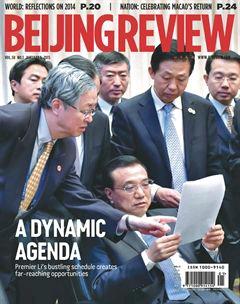
A BUSY AND FRUITFUL TRIP
2015-01-29 22:01:20ByBaiShi
Beijing Review
2015年1期
By+Bai+Shi
Premier Li Keqiang has put his effective salesmanship to use in exporting Chinas manufacturing and technology industries. Whenever he pays a visit to a foreign country, he spares no effort to promote Chinese enterprises to the host country.
According to incomplete statistics by the Paper, a Shanghai-based Internet media outlet, Li earned deals worth about $140 billion for Chinese businesses through his five diplomatic tours in 2014, mostly in the railway industry.
During his tour in Serbia on December 16-19, Li again impressed his Central European counterparts with his efficient and practical working style, as well as Chinas competitive advantage in infrastructure construction. In less than four days in Belgrade, capital of Serbia, Li held a flurry of meetings with leaders of 16 Central and Eastern European (CEE) countries and sealed a host of deals on economic cooperation and cultural exchange.
Swift and practical
Lis schedule in Serbia was intensive. The premier attended the Fourth China-CEE Economic and Trade Forum and the Third China-CEE Leaders Meeting. But Li did not limit himself to delivering a speech at the multilateral meeting of China-CEE leaders. Through close talks with the leaders of each CEE country, the premier listened to their ideas on how to further promote China-CEE cooperation.
During the leaders meeting, participants agreed to enhance connectivity and pledged to continuously improve China-Europe international railway container transportation, encourage relevant parties to facilitate cus- toms clearance, create new logistics routes and hubs, and strengthen cooperation in infrastructure development.
To boost trade and economic cooperation, Li proposed setting up a new framework for joint investment and financing between China and CEE countries as a way to serve the real economy.
After the meeting, China and the 16 CEE countries jointly issued the Belgrade Guideline for their cooperation, citing priorities in the fields of infrastructure, trade, investment, finance, technology and culture.
“The Belgrade Guideline shows that the cooperation between China and CEE countries is practical and broad,” said Kong Tianping, a researcher at the Institute of European Studies under the Chinese Academy of Social Sciences (CASS).
Lis fruitful Serbian tour was rooted in the strong demand for infrastructure construction in Balkan countries and Chinas sufficient funds and experience in the field. The cooperation will have a win-win outcome, Kong said.
Building an express passage
In 2013, Li and CEE leaders reached an action plan at the Second China-CEE Leaders Meeting in Bucharest, capital of Romania, outlining the blueprint of China-CEE cooperation.
The Belgrade Guideline further upgraded the cooperation mechanism between China and CEE partners, said Liu Zuokui, a researcher at the Institute of European Studies under the CASS. According to him, a highlight of the upgraded cooperation is demonstrated through the agreement on strengthening connectivity.
In Belgrade, Li proposed extending the China-proposed Silk Road Economic Belt and 21st Century Maritime Silk Road to Central Europe.
The CEE countries possess natural and good quality harbors, which can be used to transport large number of goods if linked with traffic arteries including railways and highways. Both sides can rely on the Hungary-Serbia Railway, the Piraeus Port of Greece and others to create a new channel of rail-sea intermodal transportation between Asia and Europe, Li said.
China and CEE countries will focus on infrastructure construction to boost connectivity and share the benefits of Chinas ambitious One Belt and One Road initiatives that aim at fostering common development between China, Europe and Asia, Liu said.
On December 17, 2014, China, Serbia, Hungary and Macedonia agreed to build a land-sea express passage that links Piraeus Port in the south and the Hungarian capital of Budapest in the north, stringing the Macedonian capital of Skopje and Serbias Belgrade.
The planned express passage includes two major projects—the construction of the Hungary-Serbia railway and the expansion of Piraeus Port, the largest harbor of Greece.
Li said that the land-sea express route will be “an extension and upgraded version” of the planned Hungary-Serbia railway running through Belgrade and Budapest to connect China.
Its estimated that the planned land-sea express passage, upon its completion, will save at least seven to 11 days for cargo deliveries between China and Central Europe, compared with the current route.
Chinese and Central European leaders had already started their work on opening a new route a year ago. In November 2013, Premier Li and his Hungarian and Serbian counterparts agreed to rebuild and modernize the old Hungary-Serbia railway during their meeting in Bucharest.
With the help of Chinas railway technology, the Hungary-Serbia railway will speed up to 200 km per hour from the current 40-60 km per hour. The trip from Budapest to Belgrade will take two and half hours, compared with the current time of over eight hours.
During his visit to Greece last June, Li and Greek Prime Minister Antonis Samaras made a tour at the container dock of the China Ocean Shipping Co. (COSCO) in Piraeus Port. In a bid to promote the prosperity of the port, the two sides agreed to expand the business of COSCO in Piraeus.
In 2008, COSCO was permitted to obtain franchise rights at Pier 2 and Pier 3 of Piraeus Port. On December 20, 2014, Greeces parliament approved an agreement on expanding COSCOs facilities in Piraeus. According to the newly approved agreement, COSCO will invest 230 million euros ($281 million) in the expansion project of the Pier 3. Upon its completion, the throughput of containers at COSCOs docks will increase to 4.75 million TEUs from 3.16 million TEUs in 2013.
The Greek side has also expressed willingness to sign a customs clearance treaty with China at an early date, which will provide convenient conditions for the throughput in Piraeus.
Indispensable ties
Enhancing economic cooperation between China and CEE countries will be an important supplement to the close ties of China and the EU, said Zhou yongsheng, a professor at China Foreign Affairs University in Beijing.
“There is a Chinese saying that ‘roads must come before wealth. This clearly demonstrates the importance of infrastructure. Focusing on infrastructure construction and investment cooperation is just one feature of Lis diplomacy,” Zhou noted.
The project of the land-sea express passage is very important for Greece, Macedonia, Hungary and Serbia. Furthermore, the passage will further link the Mediterranean and the Danube. As CEE leaders said, the route will enhance regional connectivity and is in line with the interests of the region as well as the EU and the whole of Europe, Zhou stressed.
“With the new route, trade between China and CEE countries will enjoy a signifi-cant leap, and transportation will also be more convenient and fast,” Zhou said.
According to Zhang Jian, Director of the Institute of European Studies under the China Institutes of Contemporary International Relations, maintaining sound ties with CEE countries is an indispensable part of Chinas foreign policy toward the EU.“China treats ties with both CEE countries and the rest of Europe equally,” he said.
The EU is Chinas largest trading partner. China has established a comprehensive strategic partnership with the EU. On November 20-21, 2013, both sides reached the ChinaEU 2020 Strategic Agenda for Cooperation at the 16th China-EU Summit, which outlines the future development of their ties.
Chinas further investment in CEE countries will help promote the integration of the EU, Zhang said.
The EU has long been committed to offering aid to CEE countries for economic growth. Chinas investment in the fields of infrastructure, agriculture and manufacturing will lift the development of CEE countries, advancing the balanced development of Europe as a whole. If Central and Eastern Europe can enjoy fast development, it will bring more opportunities for Western Europe, Zhang noted.
Among the 16 CEE countries, five of them are not yet EU member states. These five countries also have a strong demand to strengthen economic ties with China.
Over the past year, around 80 percent of cooperation items reached by China and CEE countries in the Bucharest Action Plan have been implemented, said Chen yurong, a senior research fellow and Director of the Department for European-Central Asian Studies under the China Institute of International Relations.
Despite uncertainties in the global economy, China and CEE countries have just begun their cooperation and there is huge potential ahead, Chen said.
登錄APP查看全文