THE CHINESE OF SYDNEY
2015-01-05 08:52:04BYTYLERRONEY
漢語世界 2015年5期
BY TYLER RONEY
THE CHINESE OF SYDNEY
BY TYLER RONEY
From Nimrod in 1848 to the suburbs of today, China is part of Sydney
悉尼的唐人街充滿了商業氣息,這里也是眾多華人的生計所在;雖然時不時受到當地排外情緒的侵擾,但這卻也并未改變什么,他們想要的不過只是自然而平淡的生活
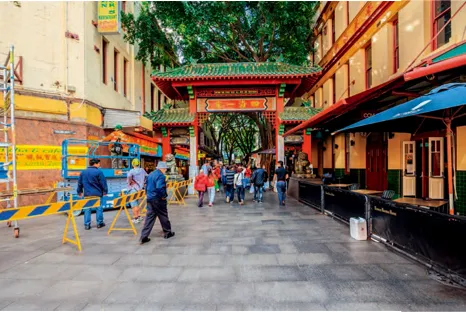
Tourists to Sydney inevitably make their way from the beautiful beaches of Bondi to the quaint hilly streets of Chinatown, bustling with visitors and signs for Chinese dentists and tea rooms. But, predictably, while you will find almost entirely Chinese run shops, they peddle souvenirs rather than culture. Lydia sits in the heart of Chinatown, working at a shop selling Australian bits and pieces, from didgeridoos to kangaroo-testicle bottle openers, spouting Putonghua to Chinese customers as they browse the knickknacks. “My family came here 35 years ago from Taiwan,” she says.“Yes, I speak Putonghua. It’s for the customers.”
As with every Chinatown, it’s more about capitalism than culture. You’re likely to hear Mandarin being shouted at Thai restaurants where, rather than the yellow stars of revolution on the Chinese flag, you’ll see sun-washed portraits of the King Rama IX and Queen Sirikit. Diners don’t care (or don’t know); good food is good food. But, the history of the Chinese in Sydney is more than restaurants and Chinese signs. Indeed, Chinese immigrants have been an indelible part of the city’s history before even the convict era had ended.
The first documented Chinese settler to Sydney was Mak Sai Ying (麥世英), who arrived in 1818 and then proceeded to perform one of the most noble professions in the world in the then quiet area of Parramatta: owner of a public house. His descendants are still Australians today. Labor was needed when the convict system ended in 1840, a gap that was filled by Chinese immigrants aboard the Nimrod that docked at Miller’s Point in 1848where 121 Chinese passengers disembarked. By 1852, over 1,500 had arrived, and when the gold rush came, many abandoned farms as indentured laborers in favor of prospecting.
As the history of any immigrant population goes, soon followed racism and xenophobia. Restrictions in 1861, 1881, and 1888 all tried to stem the tide of the “Chinese deluge”, but to no avail. Anti-Chinese sentiment was fueled by disease when lepers and smallpox sufferers would turn up due to the short trip from China’s shores. Chinese immigrants got the blame for opium addiction, robbery, racketeering, plague, and cheap labor.
Today, you can still see much of the damning and shaming in the more right-wing corners of Australia—but the opium and smallpox fear mongering has been traded for arguments about house prices. Nick Folkes is the Chairman of the Party for Freedom and calls Chinese investment“economic genocide”. His attitude is hardly representative, but there is a loud contingent of anti-Chinese sentiment still in Australia. Folkes has been videoed burning the Chinese flag, held protests, and distributed flyers with the tagline“Stop the Chinese Invasion”.
The Chinese invasion he speaks of can be seen in the sleepy streets of Hurstville in Sydney, a quiet suburb made up of 39 percent Chinese-born migrants with over half claiming Chinese ancestry, according to the Australian Bureau of Statistics.The Sydney Morning Heraldhas called it, “The Real Chinatown”. It’s the only place in Sydney where people of Chinese ancestry are in the majority, though places like Rhodes, Burwood, and Allawah are close. People of Chinese ancestry, according to the most recent 2011 census, make up 7.9 percent of the population of Sydney (though this figure is likely higher today), and Chinese-born migrants make up a total of four percent. If it’s an invasion, it’s a terribly quiet one.
One of the many arguments against Chinese investment and inclusion is that Chinese people don’t assimilate to Australian culture, a strange argument in perhaps one of the most cosmopolitan cities in the world. If one were looking for a cultural area where China differs from Australia, there is perhaps no better place to look than smoking. A pack of cigarettes in Beijing will run you as low as five RMB, while the same pack in Sydney costs around 100 RMB. Smokers, now huddled around bins and in alleys due to the new restrictions in Sydney, speak in whispers about how you can get cheaper cigarettes: the Chinatown Smoke Shop. There, you will find Scott.
“Go back to Beijing? No, my family is here,” Scott says, in his early 20s, handing three packs of Marlboros to a Chinese patron. “Maybe I’ll go to visit my grandmother, but my life is here, always.”Scott and his family moved to Sydney five years ago from Beijing and like most others have integrated seamlessly into the cut and thrust of Sydney life.
Michael Huang, 40, who hails from a small town in Guangdong Province, makes his living in the tourism industry, marching up and down the Sydney International Airport, soliciting surveys on holiday experiences.“I think if you want to come to Sydney, you need to know what kind of lifestyle you want. If you want the city life, Chinese cities are better; shops are open later and you have more entertainment. But in Sydney, it’s more relaxed, more natural.” Michael speaks excitedly about his beach-going, bush-walking, and gardening. “It’s not like Beijing, where if you want to go to the park it’s crowded.”
Michael also participates in Australian politics as a voter, opting for Liberal over Labour, citing too many people on benefits and economic development. Michael also puts very little importance on the fear mongering over house prices. “I think housing prices are fine, compared to China. Well, compared to Beijing, and other first [-tier] cities, the house prices here are really cheap.”
Prime Minister Tony Abbott—known for being, shall we say, candid—told Angela Merkel that Australia’s policies with China are driven by “fear and greed”. But, far from the halls of Canberra, the Chinese migrants and citizens are living very much the same as they always have—the open Australian economy acting as a new frontier for hopeful investors, workers, and students. Many Chinese immigrants to Sydney keep their culture and customs, but the story of the Chinese in Sydney is the same as immigrants everywhere: people sought a home and found one.
猜你喜歡
風流一代·青春(2018年4期)2018-04-19 16:18:48
風流一代·青春(2018年3期)2018-03-15 17:07:26
風流一代·青春(2018年2期)2018-02-26 15:27:06
風流一代·青春(2017年6期)2018-02-14 19:28:55
風流一代·青春(2017年5期)2018-02-14 09:32:37
少年博覽·小學高年級(2016年12期)2017-01-16 12:48:35
特別文摘(2016年19期)2016-10-24 18:38:15
37°女人(2016年5期)2016-05-06 19:44:06
爆笑show(2016年1期)2016-03-04 18:30:28
爆笑show(2015年6期)2015-08-13 01:45:40