Notes on the reduviid subfamily Phymatinae (Hemiptera:Heteroptera:Reduviidae)from Guizhou Province,China
2014-11-25 02:59:24ZHAOPingCUIJianXinZHANGHuaJian
環境昆蟲學報 2014年4期
ZHAO Ping,CUI Jian-Xin,ZHANG Hua-Jian
(1.College of Environment and Life Sciences,Kaili University,Kaili 556000,Guizhou Province,China;2.Department of Plant Protection,Henan Institute of Science and Technology,Xinxiang 453003,Henan Province,China)
1 Introduction
The ambush bug is an unusual group in the family Reduviidae for the specialized structural characters and is easily distinguished with other reduviid subfamilies by the following characters:body surface strongly ossified,apical antennal segment dilated,fore leg chelae or mantid-like to adapt for preying (Figs.1-8).The ambush bugs usually hide in blossom and scrubs to wait for catching the preies.Forty-five species under nine genera and three tribes in the reduviid subfamily Phymatinae have been recorded in China (Hsiao & Liu,1979;Hsiao & Liu,1981;Liu,1988;Putshkov & Putshkov,1996;Cui et al.,2006).Guizhou Province situates in the Yunnan-Guizhou Plateau.Only one ambush bug has been reported in Guizhou prior to the present study (Zhao et al.,2013).In the recent insect collecting trip from Weining Caohai National Nature Reserve and Leigong Mountain National Nature Reserve of Guizhou in the southwest of China we found three new record ambush bugs to Guizhou,China.Four species under three genera and two tribes in the reduviid subfamily Phymatinae from Guizhou,China are redescribed and photographed in the present paper.
2 Materials and Methods
This study is based on the material deposited in Kaili University,Guizhou Province,China.All species were photographed with the aid of the UV-CTS optical confocal microscope image processing system.Morphological terminology follows that of Cui et al.(2006).Measurements were obtained using a calibrated micrometer.Body length was measured from the apex of head to the tip of the abdomen or to the hemelytra if hemelytra surpassing the abdomen in resting position.Maximum width of pronotum was measured across humeral angles.All the measurements are in millimeters.
3 Systematics
Subfamily Phymatinae Laporte,1832
Phymatinae Laporte,1832:14.Type genus:Phymata Latreille,1802.
Macrocephalidae Amyot & Serville,1843:291.Type genus:Macrocephalus Swederus,1787.
Key totribes of subfamily Phymatinae Laporte,1832 from Guizhou Province,China
1.Fore leg mantid-like;head and pronotum without many spines (Figs.1-6)...Macrocephalini Amyot & Serville,1843
2.Fore leg chelae-like;head and pronotum with many spines (Figs.7,8)...Carcinocorini Handlirsh,1897
3.1 Tribe Macrocephalini Amyot & Serville,1843
Macrocephalini Amyot & Serville,1843:291.Type genus:Macrocephalus Swederus,1787.
3.1.1 Amblythyreus Westwood,1842
Amblythyreus Westwood,1842:28 (as subgenus of Macrocephalus;upgraded by Amyot & Serville,1843:291).Type species by original designation:Macrocephalus (Amblythyreus) rhombiventris Westwood,1842.
Paramblythyreus Bianchi,1899:223,224 (syn.Maa &Lin,1956:126).Type species by original designation:Paramblythyreus potaninae Bianchi,1899.
(1)Amblythyreus chapa Kormilev,1962 (Figs.1,2)
Amblythyreus chapa Kormilev,1962:352,356;Hsiao& Liu,1981:385;Putshkov & Putshkov,1996:180;Cui et al.,2006:801;Zhao et al.,2013:95.
Redescription.Color.Body dorsally yellowish green,with brown to blackish brown markings;body ventrally yellowish green,apical part of abdomen brown;when it is dead,the body gradually change into yellowish brown.Dorsal surface of head,middle part of anterior pronotal lobe,lateral pronotal angle,basal margin and two basal round markings of scutellum,median transversal strip of abdomen blackish brown to black;most of posterior pronotal lobe,fore wing,posterior angle of seventh connexival segment,eighth connexival segment brown;antennae yellowish green,inner side of first antennal segment black;scutellum (except basal part)yellowish green.
Structure.Body nearly rhombus-shaped.Head elongate,cylindrical,about two times as long as its width,and shorter than pronotum in length;first antennal segment cylindrical,fourth segment longest.Pronotum distinctly laterally rhombus-shaped dilated,anterior margin deeply concave,posterior margin somewhat convex,lateral margin broad;lateral pronotal angle sharp;posterior pronotal lobe with shallow punctuations;anterior angle of propleuron short,spine-shaped produced;scutellum tongueshaped,apical part wide and round.Basal 1/3 of fourth connexival segment angularly laterally produced and round.
Measurements [in mm,♀(n=1)].Body length 14.14,maximum width of abdomen 8.83.Head length 2.41;length of anteocular part 0.83;length of postocular part 0.97;length of synthlipsis 0.83;distance between ocelli 0.48;length of antennal segments Ⅰ∶Ⅱ∶Ⅲ∶Ⅳ=0.76 ∶0.41 ∶0.55 ∶1.38,length of rostral segments Ⅰ∶Ⅱ∶Ⅲ=1.17 ∶0.83 ∶ 0.43.Length of anterior lobe of pronotum 1.14;length of posterior lobe of pronotum 2.07;maximum width of thorax 5.66;length of scutellum 2.55;length of hemelytron 9.10.
Materials examined.1 ♀,China,Guizhou,Shibing,Yuntai Mountain,2012-Ⅵ-17,Zhao Ping leg.
Distribution.Guizhou (Shibing),Sichuan(Baoxing),Hainan;Vietnam.
(2) Amblythyreus potaninae (Bianchi,1899)(Figs.3,4)
Paramblythyreus potaninae Bianchi,1899:226.
Amblythyreus potaninae (Bianchi,1899):Maa &Lin,1956:126;Hsiao & Liu,1981:383;Putshkov & Putshkov,1996:181;Cui et al.,2006:801.
Redescription.Color.Dorsal surface of head,first to third antennal segment,anterior pronotal lobe,lateral margin of pronotum,three longitudinal stripe of posterior lobe,basal part of scutellum,posterior angle of second,fifth and sixth connexival segments,posterior half of third segment,fourth segment,anterior margin of fore wing black;eyes,ocelli,fourth antennal segment,ventral surface of second to third antennal segments reddish brown;posterior pronotal lobe,corium of fore wing (except black markings)dull reddish brown;posterior 2/3 of seventh connexival segment,membrane of fore wing dark brown;ventral surface of first antennal segment,scutellum (except basal part),ventral and lateral surface of body,legs (except tibiae and tarsi pale red),connexivum (except black markings)yellowish.
Structure.Body elongate-ovoid,abdomen nearly rhombus-shaped;body clothed with yellowish granules.Head somewhat longer than wide,shorter than pronotum in length;first antennal segment cylindrical,fourth segment longest.Anterior margin of pronotum feebly concave,lateral pronotal angle round,posterior margin nearly straight;anterior angle of propleuron spine-shaped produced;posterior pronotal lobe slightly rough with several punctuations and wrinkles;scutellum tongue-shaped and subequal to 1/2 of abdomen in length,apical half wide and round.Posterior-lateral angle of each connexival segment nearly right-angled,third and fourth connexival segments slightly angularly laterally produced and round.
Distribution.Guizhou (Weining),Yunnan(Yongping,Dali,Lijiang),Sichuan (Batan,Suifu,Xiangcheng);India.
3.1.2 Cnizocoris Handlirsch,1897
Cnizocoris Handlirsch,1897:213.Type species by subsequent designation:Cnizocoris davidi Handlirsch,1897
Leptothyreus Bianchi,1899:223,228 (syn.Maa &Lin,1956:119).Type species by original designation:Leptothyreus jakowlewi Bianchi,1899.
(3)Cnizocoris potanini (Bianchi,1899)(Figs.5,6)
Leptothyreus potanini Bianchi,1899:230.
Cnizocoris potanini (Bianchi,1899):Hsiao & Liu,1981:381;Putshkov & Putshkov,1996:182;Cui et al.,2006:804.
Redescription.Color.Body pale yellowish brown to yellowish brown.Antennae,eyes,pleuron of thorax,broad longitudinal strip on two sides of ventral surface of abdominal sternum,apical part of abdomen,veins and apical part of corium,red;pronotum,scutellum,tibia with scattered red;longitudinal marking outside ocelli,lateral pronotal angle,membrane of fore wing blackish brown;rostrum,ventral surface of head,fore leg,sternum of thorax,mid and hind legs (except tibia and tarsus),connexivum,anterior margin of fore wing yellowish to yellow.
Structure.Body narrow-ovoid;abdomen ovoid;body clothed with lots of small round tubercles.Head elongate,two times as long as its width,subequal to pronotum in length;first antennal segment cylindrical,second segment sub-globular,third segment pear-like,fourth segment longest.Anterior angle of propleuron spine-shaped produced;posterior pronotal lobe with rough punctuation,lateral pronotal angle short spineshaped,posterior margin somewhat convex;scutellum short tongue-shaped,basal half nearly laterally parallel,apical half wide and round.Posterior-lateral angle of each connexival segment right-angled and somewhat produced laterally.
Measurements[in mm,♀(n=1)].Body length 9.66,maximum width of abdomen 3.66.Head length 1.73;length of anteocular part 0.53;length of postocular part 0.80;length of synthlipsis 0.53;distance between ocelli 0.27;length of antennal segments Ⅰ∶Ⅱ∶Ⅲ∶Ⅳ=0.53 ∶0.40 ∶0.33 ∶1.40,length of rostral segments Ⅰ∶Ⅱ∶Ⅲ=0.80∶0.73 ∶0.33.Length of anterior lobe of pronotum 0.93;length of posterior lobe of pronotum 1.20;maximum width of thorax 2.93;length of scutellum 1.40;length of hemelytron 6.13.
Materials examined.1 ♀,2013-Ⅶ-27,China,Guizhou,Leigong Mountain National Nature Reserve,Leishan,Fangxiang,Qiu Yangyue & Xu Hao leg.
Distribution.Guizhou (Leishan),Shaanxi(Qinling),Sichuan (Baoxing).
3.2 Tribe Carcinocorini Handlirsh,1897
Carcinocorini Handlirsh,1897:143.Type genus:Carcinocoris Handlirsh,1897.
3.2.1 Chelocoris Bianchi,1899
Chelocoris Bianchi,1899:224,233.Type species by original designation:Chelocoris handlirschi Bianchi,1899.
(4) Chelocoris yunnanus Hsiao & Liu,1979(Figs.7,8)
Chelocoris yunnanus Hsiao & Liu,1979:171,174;Hsiao & Liu,1981:388;Putshkov & Putshkov,1996:184;Cui et al.,2006:799.
Redescription.Color.Body yellowish brown to reddish brown.Ventral and lateral surfaces of head and thorax,ventral surface of fore femur,coxa pale yellowish brown;apical and lateral margins of scutellum,posterior-lateral margin of pronotum,basal half of corium,spines and tubercles of head and pronotum,mid and hind tibiae (except sub-basal and apical annulations dark brown),irregular markings of mid and hind femora (mid and hind femora dark brown)cream white;markings of dorsal surface of head,middle part of scutellum,posterior margin of third segment,fourth segment and anterior half of fifth segment of connexivum,tubercles on margin of connexivum dark yellowish brown;head vertex,pronotum,apical half of corium,scutellum with scattered red.
Structure.Body elongate-ovoid,abdomen nearly rhombus-shaped;body clothed with lots of tubercles and spines.Posterior lobe of head dorsally with two lines of small spine,anterior lobe dorsally with a lines of spines and between eyes with two spines;first antennal segment cylindrical,second segment subglobular,third and fourth segments pear-like;antennae with small tubercles,first segment subapically with 2-3 small spines,second and third segments subapically with a spine.Anterior pronotal lobe with distinct long spines;posterior pronotal lobe with rough punctuation,and with small spines on two median longitudinal ridges,lateral pronotal angle short spine-shaped,lateral margin with long spines,posterior angles with several small spines;posterior margin nearly straight;scutellum sub-angular,basal half nearly laterally parallel,apical half gradually narrowed;legs with spines and tubercles.Margin of connexivum with small tubercles;fourth connexival segments slightly angularly laterally produced and round.Inner cell of hemelytron subequal to outer cell at base in length.
Measurements [in mm,♀(n=8)].Body length 7.17-7.93,maximum width of abdomen 4.138-4.14.Head length 1.3-1.59;length of anteocular part 0.62-0.68;length of postocular part 0.55-0.69;length of synthlipsis 0.55;distance between ocelli 0.21;length of antennal segments Ⅰ∶Ⅱ∶Ⅲ∶Ⅳ=0.34-0.41∶0.21∶0.21∶0.69-0.76,length of rostral segments Ⅰ∶Ⅱ∶Ⅲ=0.55-0.69 ∶0.48-0.62 ∶0.24-0.34 .Length of anterior lobe of pronotum 0.69-0.79;length of posterior lobe of pronotum 0.97-1.07;maximum width of thorax 2.76-2.97;length of scutellum 1.59-1.79;length of hemelytron 4.90-5.45.
Materialsexamined.1♀,2013-Ⅳ-28,7♀,2013-Ⅶ-28,China,Guizhou,Weining,Weining Caohai National Nature Reserve,Zhao Ping & Zhang Huajian leg.
Distribution.Guizhou (Weining),Yunnan(Xiaguan,Dali Cang Mountain,Weixi),Sichuan(Luding,Tatsienlu).
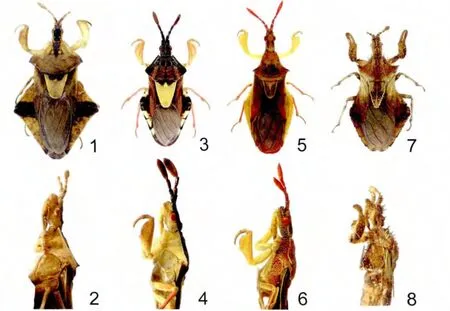
Figures 1-8 1,2,Amblythyreus chapa Kormilev,1962,♀;3,4,Amblythyreus potaninae (Bianchi,1899),;5,6,Cnizocoris potanini (Bianchi,1899),♀;7,8,Chelocoris yunnanus Hsiao & Liu,1979,♀.1,3,5,7,Habitus,in dorsal view;2,4,6,8,head and pronotum,in lateral view.
We sincerely thank Mr.Niu Xinwei of China Agricultural University for the photograph taking of the reduviid specimens.
Amyot CJB,Serville JGA.Histoire Naturelle des Insects.Hémiptères[M].Pairs:Libraire Encyclopédique de Roret,1843,i-1xxvi,1-675.
Bianchi V.Ad cognitionem Phymatidarum mundi antique [J].Ezhegodnik Zoologicheskago Muzeya Imperatorskoi Akademii Nauk,1899,4:221-236.
Cui JX,Cai WZ,Rabitsch W.The ambush bugs of China:taxonomic knowledge and distribution patterns (Heteroptera,Reduviidae,Phymatinae)[J].Denisia,2006,19:795-812.
Handlirsh A.Carcinocoris,ein neuès Hemipteren-Genus und Bemerkungen über die Raubbeine der Insecten[J].Verhandlungen der Zoologisch-Botanischen Gesellschaft in Wien,1897,47:23-26.
Hsiao TY,Liu SL.New species and new records of Phymatidae from China (Hemiptera-Heteroptera)[J].Acta Entomologica Sinica,1979,22:169-174.
Hsiao TY,Liu SL.Phymatidae.In:Hsiao TY,et al.A Handbook for the Determination of the Chinese Hemiptera-Heteroptera II [M].Beijing:Science Press,1981,374-389.
Kormilev NA.Notes on Phymatidae in the British Museum (N.H.)(Hemiptera-Heteroptera)[J].Annals and Magazine of Natural History,1962,5 (13):349-367.
Laporte FL de.Essai d’une classification systématique de l’ordre des Hémiptères (Hétéroptères Latr.)[J].Magasin de Zoologie,1832:1-16,1833:17-88.
Liu SL.Two new species of Phymatidae from China (Hemiptera-Heteroptera)[J].Entomotaxonomia,1988,10:71-74.
Maa TC,Lin KS.A synopsis of the Old World Phymatidae (Hemiptera)[J].Quarterly Journal of Taiwan Museum,1956,9:109-154.
Putshkov VG,Putshkov PV.Family Reduviidae Latreille,1807-assassin-bugs.In:Aukema B,Rieger C,eds.Catalogue of the Heteroptera of the Palaearctic Region volume 2 Cimicomorpha I[M].Amsterdam:The Netherlands Entomological Society,1996,148-265.
Westwood JO.Description of a new subgenus of exotic hemipterous insects[J].Transactions of the Entomological Society of London,1842,3:28-31.
Zhao P,Yuan JL,Pan J.Investigation and faunal analysis on Reduviidae in Yuntai Mountain in Guizhou Province[J].Guizhou Agricultural Sciences,2013,41:95-99,227.[趙萍,袁繼林,潘娟.貴州云臺山獵蝽科昆蟲調查及區系分析[J].貴州農業科學,2013,2:95-99,227]
猜你喜歡
今日農業(2022年1期)2022-11-16 21:20:05
今日農業(2022年3期)2022-11-16 13:13:50
今日農業(2022年2期)2022-11-16 12:29:47
今日農業(2021年14期)2021-11-25 23:57:29
鄉村地理(2019年2期)2019-11-16 08:49:28
小小藝術家(2019年6期)2019-06-24 17:39:44
鄉村地理(2018年3期)2018-11-06 06:50:10
貴茶(2018年6期)2018-05-30 09:53:50
貴茶(2018年6期)2018-05-30 09:53:36
今古傳奇·故事版(2016年15期)2016-09-07 06:57:32