高校周邊消費環境對大學生消費的影響研究
——基于廣州市龍洞八所高校的調查
2014-09-19 03:36:18張玉剛林偉英
社會工作與管理 2014年5期
張玉剛,林偉英
(廣東工業大學管理學院,廣東 廣州,510520)
高校周邊消費環境對大學生消費的影響研究
——基于廣州市龍洞八所高校的調查
張玉剛,林偉英
(廣東工業大學管理學院,廣東 廣州,510520)
通過對高校周邊消費環境和大學生消費之間關系的分析,結合對廣州市龍洞地區八所高校周邊消費環境和大學生消費現狀的調查及目前的研究現狀,可以認定:高校周邊消費環境與大學生消費二者是相輔相成的,要創建良好的高校周邊消費環境、促進大學生養成文明節約、綠色低碳消費習慣,需要政府、高校、家庭、社會和輿論多措并舉才能實現。
消費環境;大學生;影響
高校周邊消費環境指分布于高校附近,針對在校大學生并對其生存和發展有一定影響的、外在的、客觀的消費環境,包括經營日用化妝品、衣服飾品、數碼產品、風味美食、休閑娛樂等的商家。消費環境作為校園周邊環境中最活躍的元素之一,對大學生特定消費心理、消費行為的產生和正確消費取向、消費結構的形成有著舉足輕重的影響,并以潛移默化、耳濡目染的方式影響著大學生的思想和行為,從而影響著高校的大學生思想道德建設,因而引起了人們的普遍關注。[1-4]
一、高校周邊消費環境與大學生消費現狀分析
為進一步了解大學生的消費狀況,研究高校周邊消費環境對大學生消費心理和消費行為的影響,分析高校周邊消費環境與大學生消費心理和消費行為之間的關系,筆者對廣州市龍洞地區8所高校的在校大學生做了問卷調查。本次調查一共發放問卷600份,回收有效問卷511份,回收有效率為85.2%,所調查學生具體數據見表1。問卷利用SPSS13.0軟件進行了統計分析。
(一)高校周邊消費環境分析
1.周邊消費環境存在布局和消費趨向引導不合理現象
目前,高校周邊消費環境中飲食方面比例占的最大,書店、精品店比例卻很少,兩者比例的失衡不利于對大學生消費趨向的正確引導,也不利于高校周邊環境文化底蘊的營造。在對高校周邊消費環境滿意度調查時,滿意度最高的是餐飲,其次為大型超市,滿意度最低的是教育培訓,其次是書店(圖1)。

表1 所調查學生的分布情況
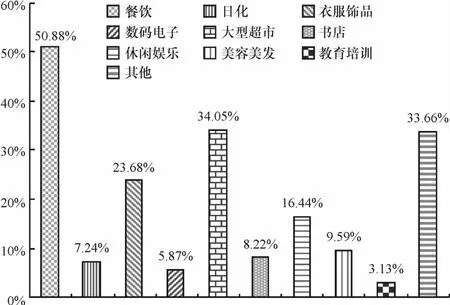
圖1 大學生對高校周邊消費環境滿意度調查
筆者通過對聚集了8所高校的廣州龍洞地區的消費環境的調查發現,餐飲占據較大份額(約60%),在“龍洞美食廣場”聚集的餐館就有上百家,既有中式餐館的湘菜、粵菜、客家菜、粥店等,也有洋快餐肯德基、麥當勞等;其次是服裝、美容美發、眼鏡店、電子消費類、休閑娛樂、旅店、大型超市等;書店、咖啡吧、精品店、學習培訓等營造文化底蘊和有利于大學生自身發展的消費場所卻只有寥寥數家。筆者分析,一方面是由于該地區主管部門對校園周邊環境文化底蘊的營造和大學生合理消費的引導重視不足;另一方面是當前電子商務的快速發展對現實環境中的書店、精品店等消費環境沖擊較大。
2.周邊消費環境衛生狀況堪憂,與高素質的大學生群體格格不入
調查發現,高校周邊消費環境的衛生狀況不佳,這也是大學生反映比較突出的一個問題。廣州龍洞步行街上,人們消費后的食品包裝、一次性餐具隨地可見,到了晚上,廣州龍洞步行街更是臟亂差。一些學生不但不努力維護環境,反而熟視無睹,更有甚者將垃圾、大量食物隨處丟棄,表現出不文明不節約的消費行為。成為環境臟亂差的“貢獻”者,對高校周邊消費環境健康發展和大學生形成高品位的消費群體產生不利影響。這種現象產生的原因,第一,是人們從眾心理和公德意識的缺乏;第二,是人們對文明節約和綠色低碳消費的意識還很淡薄;第三是當地主管部門對環境的整潔衛生保護和維護重視不夠、措施不到位。
(二)大學生消費現狀分析
1.消費來源以家庭供給為主,勤工儉學、獎學金等方式為輔
部分學生表示,他們已經通過勤工儉學、獎學金、校外兼職等方式來進一步拓展消費來源,但消費主來源的單一性還是沒有改變。調查顯示,選擇家庭為消費來源的大學生占了84.54%(見表2),這與以往的研究結果基本一致。[5]在調查中,有6.26%的學生(見表2)通過勤工儉學來獲取生活費用,多數大學生都有過勤工儉學、校外兼職的經歷。這些都表現出了當前大學生有很強的自立傾向,希望通過自己的雙手賺得生活費,而不是依賴于學校、社會和親友。
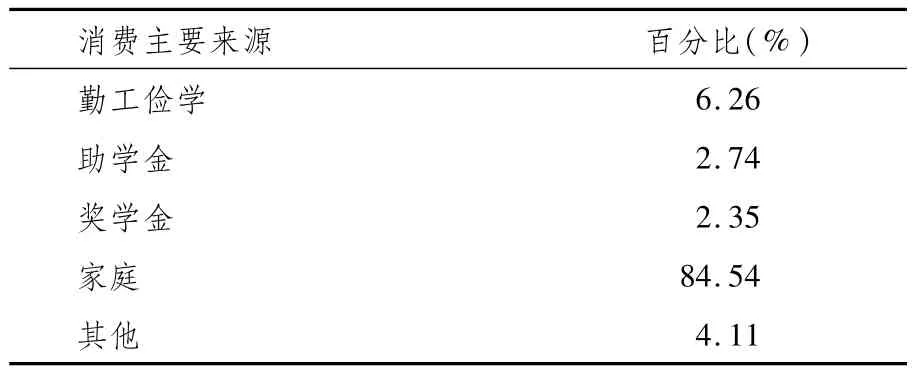
表2 大學生消費的主要來源
2.消費水平總體適中、合理,但有奢侈型消費傾向
從圖2可以看出,大學生消費水平總體適中、合理。63.60%的學生月消費支出在800元以下,但也近40%的學生月消費在800元以上,更有7.24%的學生在1 200元以上。由此可見,雖然當前大學生大部分消費是現實、合理的,但高檔和奢侈型消費在大學生消費中占有很大比例。

圖2 大學生月均消費額調查
3.消費結構不合理,重享受性消費
調查中,絕大部分(89.63%)的學生認為,飲食消費占據主要消費項目,這也符合常理,民以食為天,大學生也不例外。而且調查發現,大學生對吃已經不是填飽肚子那么簡單了,走出食堂到校外就餐現象越來越普遍。
由于大學生普遍對流行元素比較偏愛,表現出一些追逐時尚潮流、盲目攀比的消費。如調查發現,超過一半的學生認為購物(50.10%)、交通和通訊(62.23%)占據主要消費項目,說明現今智能手機的普及,交通的便利以及網絡信息的發達,使大學生很大部分的精力和財力用在了打電話、上網、微博、外出游玩等趕時髦、圖享受上,這也使大學生的行為認知表現出缺乏思考和實用主義、快餐文化的特征。同時,也導致與家人、老師以及學生間的日常交流減少,同學間的大小矛盾不斷出現。
另外,有32.68%的學生認為休閑娛樂消費占據主要消費項目,而學習培訓卻只有26.42%(圖3),說明大學生重享受性消費,輕自我發展類消費。在調查大學生在戀愛方面的消費時,有70.84%的被調查者表示尚為單身,并沒有戀愛方面的消費,說明多數大學生在校期間能夠把主要精力和財力放在學業上,正確處理情感問題。
4.出現了自控能力不夠、透支消費、信用意識缺乏等現象
調查顯示,45.40%的學生反應自身消費偏高(圖4),這說明大學生的消費支出無計劃,自控能力欠缺。很多大學生第一次遠離父母,獨立地支配自己的各種費用。他們的消費往往沒目標、沒計劃,而且具有明顯的模仿性和攀比性。盡管大學生每人的生活費用支出不同,但大多數學生每月生活費基本沒有盈余,而其中的很多消費都存在著從眾的傾向和心理。[6]
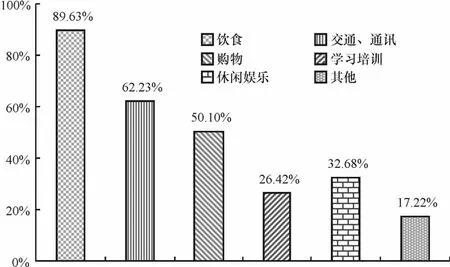
圖3 對大學生每月消費項目的調查

圖4 大學生對自身每月消費狀況的感覺
另外,調查發現,時下一些銀行的信用卡業務把大學生作為其龐大的消費群體。大學生在缺乏償還能力和對個人信用認知水平較低的狀態下刷卡消費,在享受刷卡快感的同時卻帶來了一系列的遺留問題。還有個別大學生的極端享樂主義不僅使他們荒廢學業,長期的攀比消費還使他們形成畸形的消費心理,或者在消費欲望的強烈驅使下,有可能采取極端的惡性行為,如搶劫、盜竊等來達到消費目的,最終走上犯罪道路。對金錢、財富只知索取和享受,不懂得創造和回報社會,從而造成大學生道德感、責任感的喪失、價值觀偏差等。
二、高校周邊消費環境與大學生消費的關系分析
大學生從消費心理到形成消費行為,是一個消費購買的決策過程。這在很大程度上反映了大學生購買決策起決定作用的自身特點,如文化教養、心理素質等。
調查顯示,目前高校大學生的消費主流是理性的、科學的,但近年來受高校周邊不良消費環境的影響,大學生中出現了種種非理性的消費表現。[7]有學者認為,個人消費心理的養成和消費行為的結果是其與周圍環境相互交流和影響的結果,如張熙鳳、夏永林和吳旻認為,教育的缺失以及社會大環境負面的影響導致大學生形成不合理的消費觀念和消費行為以及大學生消費社會化的缺失與不成熟。[1,8]王智騰認為,高校周邊房屋租賃、KTV、臺球室、游戲廳、棋牌室等的生意火爆現象,形成了“趨利”“享樂”的高校周邊消費經營的氛圍,容易導致大學生理想信念模糊、社會責任感的缺失,而且對高校思想政治工作產生消極的影響。[9]
通過上述對高校周邊消費環境和大學生消費現狀的調查分析,也可以看出二者之間具有相輔相成關系。調查也顯示,53.62%的學生認為,個人的消費習慣與周邊的消費環境有很大關系(圖5)。這也與當前的研究現狀論述基本一致。

圖5 大學生的消費習慣與高校周邊消費環境的關系
如高校周邊有些商家經營不規范、亂設攤點、夜間大排檔的經營將道路圍得水泄不通、衛生狀況和產品質量差等現象,不但影響學校的作息安排和學生的寢食規律,也對學生的飲食健康安全帶來了隱患,最終不利于學生身心的健康成長。又如,某些商家在店鋪的設計上,忽略了年輕人追求新穎獨到的特點,在外觀整體上給人的印象就不深刻。其次,商家在推出的產品上難以做到精益求精以及推陳出新,且管理理念落后,店鋪經常更換,不但不利于周邊良好經營秩序的保持,也給大學生的日常消費帶來了不便。
另外,大學生不良消費所產生的高額費用也會增加家庭經濟負擔,很可能會造成家庭成員的矛盾;對整個社會來說,不良消費還會增加社會的不安定因素,造成資源浪費、生態破壞,與建設節約型社會、和諧社會的目標和要求背道而馳。
三、多措并舉,創建良好的高校周邊消費環境,促進大學生形成文明節約、綠色低碳的消費習慣
通過了解當前高校周邊消費環境和大學生消費現狀,以及分析二者之間的關系,并結合目前的研究現狀,筆者認為,為創建良好的高校周邊消費環境,促進大學生文明節約、綠色低碳消費習慣的養成,需要政府、社會、家庭、高校和學生自身等各方共同努力,多措并舉,才能實現。
(一)政府提供相關政策和資金支持,高校周邊主管部門科學布局和強化管理
首先,政府牽頭積極鼓勵和指導當地主管部門從有利于大學生科學合理消費,增強當地人文氛圍和居民素質考慮,對高校周邊消費環境進行調整、規劃、設計,科學布局高校周邊消費環境的種類,適當調整消費類型的比例。如可增加一些特色店和休閑店,提供交流、看書、喝茶、聊天、聽音樂的地方;其次,政府和當地主管部門應規范市場經營行為,強化管理,提升運營活動的衛生安全質量,如堅決取締無證和違規經營的場所,縮短夜間營業時間,提高產品質量等;再次,商家可多設置一些大學生可以兼職的崗位,這既為大學生提供勤工儉學的機會增加收入,又可以減少人力的經營成本,實現雙贏;最后,政府還應制定相關財政稅收政策,以扶持和鼓勵企業從事綠色產品的研發和推廣等。[10]
(二)高校應積極參與高校周邊環境建設,以開設選修課、拓展第二課堂等方式對大學生進行教育和引導
第一,高校要充分認識到周邊環境對高校教育的重要性,積極參與高校周邊環境建設,為周邊經濟發展出謀劃策,提供智力和人力支持,并與當地主管部門保持良好溝通和互動。
第二,高校應加強大學生社會責任感、公民道德意識等的教育和宣傳,并以小見大,在形成良好消費習慣的同時,提高大學生的人文素養。如陳凱等針對大學生綠色消費行為和認知方面的不足,建議在高校層面加強綠色消費教育和宣傳,引導大學生形成文明節約、綠色低碳的消費觀念和消費行為。[10]
第三,開設有關科學理財和綠色消費的選修課,讓大學生從理論上也認識到文明節約、綠色低碳消費的重要性。孫杰等建議高校開設有關理財知識和理財基本技能的講座和課程,幫助大學生養成可持續消費和符合人類健康和環境保護標準的消費意識和成熟的消費觀。[11]調查也顯示,有58.71%的學生覺得很有必要開設有關理財的選修課(圖6)。

圖6 對于高校開設有關理財和綠色消費相關課程必要性的調查
第四,引導大學生舉行扮靚高校周邊消費環境的“大掃除”等相關的團日活動,用自己的行動,使校園周邊的消費環境更美麗,更高雅。
(三)家庭在消費理念、消費習慣方面對孩子進行影響和熏陶
家人的熏陶教育和家庭的消費習慣對大學生形成良好的消費理念和消費方式有著潛移默化、耳濡目染的作用,如張熙鳳和夏永林提出了從家庭、學校和社會環境上教育、引導大學生合理消費的“三位一體”的對策,并認為家庭的影響是最重要的。[1]因此,在日常生活中家庭應直接或間接地教育和引導孩子形成勤儉節約和科學合理的消費習慣。
(四)社會和輿論應積極倡導和大力宣傳文明節約、綠色低碳的消費趨向
在社會和輿論層面,應大力宣傳、積極引導大學生形成文明節約、綠色低碳的消費習慣,使“節約光榮、浪費可恥”觀念深入人心。[7]同時,也需在增強消費的文化底蘊上多下功夫。企業應加大綠色產品的設計和研發,并可通過廣告宣傳或公共關系等營銷活動,引導顧客進行綠色消費,[10]如近期央視播出的《文明天下》系列節目,不但曝光了一批鋪張浪費現象和不良習慣,也展示了許多文明節約、綠色低碳的消費舉動,產生了很好的社會反響和效果。
(五)大學生本人應厲行勤儉節約
大學生自身應該身體力行,自覺養成文明節約、綠色低碳的消費習慣和消費行為,使自身的人文素質和綜合素質不斷增強,并通過自身行動影響身邊人。如孫杰等倡議大學生環保選購、理智消費和通過DIY的方式,“變廢為寶”,創造綠色財富。[11]
[1]張熙鳳,夏永林.當代大學生消費社會化的缺失及其對策分析[J].商業時代,2010(20):27—28.
[2]原曉苑.大學生消費存在的問題和輔導員的引導作用[J].中國校外教育:理論,2009(3):36—37.
[3]荊桂英,王旭.金融危機下大學生消費心理與行為的調查[J].商業經濟,2009(11):119—120.
[4]秦正興,郭娟娟,王小麗,等.高校周邊環境對大學生成長的影響分析[J].現代商貿工業,2009(16):213—214.
[5]劉金勇,邊策,金天星.部分高校大學生消費現狀調查及其引導[J].河北大學學報:哲學社會科學版,2007,32(6):120—123.
[6]張敏,劉雪峰,鄭福勝.大學生從眾心理與行為的研究與分析[J].現代教育科學,2009(4):123—125.
[7]陳瑜玲,黃學茨,黃海霞.當代大學生消費觀存在的問題及其引導[J].廣東工業大學學報:社會科學版,2005(增刊):366—367.
[8]吳旻.芻論高校學生消費心理及消費行為[J].消費導刊,2007(6):8.
[9]王智騰.高校周邊環境對思想政治工作的影響及對策——基于寧波市各高校的調查[J].寧波大學學報:教育科學版,2011,33(3):83—85.
[10]陳凱,肖敏.大學生綠色消費認知、態度、意愿以及行為的調查分析——以北京地區大學生為例[J].企業經濟,2012(3):160—163.
[11]孫杰,王莉詩,袁佩,等.大學生消費調查及綠色消費觀念引導對策研究——基于武漢6所高校學生的消費情況調查[J].中國商貿,2012(14):251—252.
(文字編輯:鄒紅 責任校對:王香麗)
Abstract:This paper first reviews three historical stages of socialwork development in Hong Kong in relation to helping young people overcome the employment problems:from periphery to core,from singleness to comprehensiveness and ultimately breaking through the bottleneck.Then the paper applies the concepts of human capital(micro),social capital(mezzo)and demand insufficiency(macro)to summarize the models employed by social workers in Hong Kong.In the aspect of human capital,socialworkers help unemployed young people in accordance with their learning ability and motivation,provide one-stop employment services,and assist students in career planning.In the aspect of social capital,socialworkers enhance the employment opportunities for the vulnerable young people and reconstruct their social network.In addition,socialworkers solve the supply problem by creating jobs,delivering services to cultivate entrepreneurship and self-employment of young people and developing social enterprises.Thesemodels have some implications for social work in Mainland China.First,the integration of social capital investment can be effective in promoting youth employment.Second,socialworkers can cooperate with enterprises and public institutions and even create short-term jobs for young people.Last but not the least,the effective employment service should focus on the process of assessment,training,consultation and follow-up.However,all of these are premised on the development of socialwork agencies specializing in employment services for young people in Mainland China.
Key words:Hong Kong;young people;employment services;social work
Abstract:The institutionalization,specialization and professionalization of socialwork is conducive to social construction.In Shenzhen social work is run by nongovernmental organizations,the services of which are purchased by the government.In Guangzhou socialwork is characterized by cooperation between civil administration on the one hand and colleges and social organizations on the other,which proceeds in two ways:
government contracting professional social work organizations to undertake the entire package of comprehensive community services and street-level government funding social work organizations.Guangzhou and Shenzhen are devoted to the localization of socialwork and the innovation of their respectivemodels,exploring new approaches to building happy and harmonious Guangdong.
Key words:socialwork;model;route
Abstract:This paper takes the children of ruralworkers as the object of research,describes their sense of belonging to the city they live in,and explores the factors influencing their sense of urban belongingwith regression analysis.The study finds that their sense of urban belonging is of a contradictory nature,with relatively high degrees but low levels.The social factors underlying this situation include contact desire,nostalgia,adaptation to urban life,attitude,participation and social acceptance.Themost fundamental factor that affects their urban attachment is the current residence registration system and a consequent series of system arrangements relating to education,urban management,etc.
Key words:the children of ruralmigrantworkers;sense of urban belonging;residence registration system
Abstract:Interviews and questionnaires among socialworkers in Guangzhou,Shenzhen and Dongguan,who can represent the whole picture of Guangdong Province,reveal the following findings.Job satisfaction of social workers in Guangdong Province is high in general;there is significant variations among the three cities:job satisfaction is the highest in Dongguan and the lowest in Shenzhen;salary and benefits,professional identity and social identity are the threemajor factors that influence social worker’s job satisfaction.Therefore,we should continually raise the salary of social workers and,by promoting professionalization,imple-menting socialwork policies and stepping up publicity efforts,progressively improve professional identity and social identity of social workers so as to stabilize a socialwork force.
Key words:socialworkers;job satisfaction;factors
Abstract:In recent years,the development of social work organizations in Guangzhou is of a blowout type because of the huge investment by the government.Through participant observation,the authors find that the social work organizations in Guangzhou face the following dilemmas in their operation:their organizational structure exhibitsmore homogeneity than localization,their staff are inadequate and suffer an occupational burnout,they lack long-term and scientific planning,their source of fund is single and inefficient,and they have not yet established a credit and supervision mechanism.These problems are testified to in the family comprehensive service center in G street.The authors put forward the following countermeasures:putting emphasis on performance evaluation and raising the minimum limit of tolerance zone,establishing a credit and supervision mechanism and creating a transparent and open environment,and increasing working staff and promoting open communication.
Key words:socialwork organization;family comprehensive service center;administration
Abstract:The currentmigrant children welfare policy in China covers all areas ofmigrant children’s lives,guarding their basic rights such as survival,development and protection.However,the policy is not free from problems.For example,it fails to form a national and clearly targeted children welfare policy framework under the guidance of the Children Welfare Law;it lacks a set of institutional arrangements for the safety of children in terms ofmigrant children survival policy;it lacks relevant regulations for prohibiting the abuse of children in terms ofmigrant children protection policy;and it lacks relevant policies for the children’s participation in social life in terms of migrant children development policy.Some recommendations are thus made for constructing the framework ofmodern migrant children welfare policy in China.The construction should be based on the theoretical basis of development-oriented social welfare policy,take into account of factors affectingmigrant children welfare,such as family,school,community and legislation,and design a top-level strategy formigrant children’smid-and long-term developmentaswell as a setof bottom-level policies concerning investment in human capital,employment support,and humanistic care.
Key words:development;migrant children;welfare policy
Abstract:Villagers’autonomy,dating back to the 1980s,has developed vastly in rural China.It has,no doubt,brought huge changes to the countryside.In the process,however,it has also resulted in serious damage ofminority interests due to some obsolete ideology,inadequate legal system,negligence of the interests of theminority,and lack of administrative restriction.A solution to the problems ofminority interests can startwith constructing relevant systems,nurturing village cadres’law-abiding consciousness and villagers’rights protection consciousness,and establishing a supervision and restriction mechanism so as to achieve a favorable environment for reducing the damage ofminority interests.
Key words:villagers’autonomy;minority interests;damage;countermeasure
Abstract:Relatives of cancer patients suffer increasing pressure,as they have to face the patients’pain and take long-term care of them.This study selects some relatives of cancer patients at a tumor hospital in H province and explores how to positively reduce their pressure with a team offering relief services to them.Through professional reflection of thewhole process it discovers that professional services should be based on the needs of the clients,socialworkers should bemore conscious of their professional role,and they should play the role of integrating various resources in order to achieve a better effect.
Key words:team work;cancer patients’relatives;pressure reduction;social work
Abstract:Taking“Peer Education Group‘Nirvana Rebirth'”as an example,this paper presents an introduction to peer education in community rehabilitation in its five aspects:analysis and forecast,service projects,service implementation,summative evaluation and professional reflection.The case shows the intervention process called“construction of meaning of life”.Starting from the perspective of advantage and meaning construction theory,it uses themethod of group socialwork to train peer counselors and prompt rehabilitation personnel to realize“self-help,mutual aid and return to society”through the three paths of“self discovery”,“emotional experience”and“meaning construction”.
Key words:peer education;meaning construction;community rehabilitation;peer counselors;socialwork
Abstract:As the rules and regulations formanaging large-scale instruments in universities across the country demonstrate,themainstream method of running large-scale instruments in universities is to provide open access,specialmanagement and paid service.A management committee for large-scale instruments is founded and special staffers,who are certified,are appointed to take charge of the operation.Revenuemanagement is not intended for profit,the fees paid by customers consisting of consumable supplies cost and service fee,and the shared revenue is distributed according to the specific situation of instrument use.Despite the positive efficiency achieved,there are still some problems,such as lack of support for sustainable development and lack ofmotivation for opening the facilities to the public.To improve the work,an alliance for largescale instrument sharing,a performance evaluation system,a platform for information filing and retrieval and service booking,and relevant regulations should be established.
Key words:large-scale instrument;open access and sharing;income allocation;consideration
Abstract:Based on an analysis of the relationship between consumption surroundings of college campus and students’consumption habit and an investigation into students’consumption in eight colleges and consumption environment in Longdong,Guangzhou City,this article points out that the consumption environment around college campuses and the consumption of college students are mutually influenced and proposes that multiple measures,involving the government,college,family,society and public opinion,are needed to create a good consumption environmentaround college campuses and promote students to develop a consumption habit that emphasizes civilization,thrift,greenness and low carbon.
Key words:consumption environment;college students;effect
Soft M atter Application and SocialW ork Service in W eight Loss:A New Horizon of SocialWork Service
CHENG Zheng-dong1,2
(1.SoftMatter Center,Guangdong Provincial Key Laboratory on Functional Soft Condensed Matter,School of Materials and Energy,Guangdong University of Technology,Guangzhou,510006,China;2.Artie McFerrin Department of Chemical Engineering,Texas A&M University,TX 77843-3122,USA)
Scientific methods can broaden the scope of socialwork service and promote its sustainable development.The close relationship of softmatter with our daily life sets up a bridge between softmatter science and social work.The recent study of childhood obesity reveals its close correlation with the children’s bad dietary habits formed at their early life with excessive consumption of sugar overloaded in soft drinks and juices.The difficulty in weight control lies in how to achieve energy balance of the body when the physiology of the body is at the so-called energy expenditure threshold value because of less physical activity undertaken.The functional foodsmight provide an effective tool for weight control.The currentmain task of social work service is to progress from the public-rescue service towardsmulti-level specialization and professionalization.The research and development of softmatter will further the scientific basis for social work and become a catalyst for its sustainable development.
socialwork;softmatter;child obesity;habit
The M odels and Their Im plications of SocialW ork Intervention in Youth Em ployment Services in Hong Kong
LEIJie,HUANGWan-yi
(School of Sociology and Anthropology,Sun Yat-sen University,Guangzhou,Guangdong,510275,China)
On the Guangzhou&Shenzhen M odel of SocialW ork and its Optim ization
TONG Yuan-zhong
(Department of Sociology,Guangdong University of Finance&Economics,Guangzhou,Guangdong,510320,China)
On the Factors Influencing the Children of M igrant W orkers’Sense of Urban Belonging
ZHAO Chuan-fang
(SocialWork Research Center,Ministry of Civil Affairs,Beijing,101601,China)
On Job Satisfaction of SocialW orkers and Its underlying Factors in Guangdong Province
WEILi-zhen,WANG Jing
(School of Management,Guangdong Baiyun University,Guangzhou,Guangdong,510450,China)
An Adm inistrative Perspective on the Difficulties of SocialWork Organizations in Guangzhou and the Associated Countermeasures
TAN Lei,ZHU Yuan-yuan,HE Jian-dong
(School of Politics and Law,Guangdong University of Technology,Guangzhou,Guangdong,510090,China)
On China’s M igrant Children W elfare Policies in the Perspective of Development
ZHOU Xiao-yan
(School of Humanities,Northeast Petroleum University,Daqing,Heilongjiang,163318,China)
On the Damage of M inority Interests in Villagers’Autonom y and Countermeasures
LIJing
(Institute of Public Administration,Guangxi University,Nanning,Guangxi,530004,China)
Analysis of“Cancer Patients’Fam ilies Decom pression Group”
SU Guang,HUANG Hong,WU Yu-bao
(Department of Humanities and Social Sciences,Heilongjiang Institute of Technology,Harbin,Heilongjiang,150050,China)
Transformation from“Recipients”to“Helper”:A Case Study of Community Rehabilitation in Shanghaiw ith“Peer Education Group‘Nirvana Rebirth'”
YE Xiong1,PENG Shao-feng2
(1.Shanghai Narcotics Control Volunteers Association,Shanghai,200030,China;2.Social and Public Administration School at East China University of Science and Technology,Shanghai,200237,China)
On Large-scale Instruments in Universities:The M anagement of Public Sharing and the System of Income Allocation
DU Yun-xiang,CHEN Xue-hui
(Laboratory and Facility Management Division,Guangdong University of Technology,Guangzhou,Guangdong,510006,China)
On the Effect of Consum ption Surroundings of College Cam pus on Students’Consum ption:An investigation into Eight Colleges in Longdong,Guangzhou City
ZHANG Yu-gang,LINWei-ying
(School of Management,Guangdong University of Technology,Guangzhou,Guangdong,510520,China)
G641
A
1671-623X(2014)03-0085-05
2013-03-18
■基金課題:2011年廣東工業大學青年基金項目“高校周邊消費環境對大學生行為的影響——以龍洞附近九所高校為例”(405120003)。
張玉剛(1982—),男,漢族,碩士,講師;主要研究方向:思想政治教育和就業指導。
■引文格式:張玉剛,林偉英.高校周邊消費環境對大學生消費的影響研究——基于廣州市龍洞八所高校的調查[J].社會工作與管理,2014,14(3):85—89.
猜你喜歡
品牌研究(2022年26期)2022-09-19 05:54:46
中老年保健(2021年12期)2021-08-24 03:30:40
中國傳媒大學學報(自然科學版)(2021年1期)2021-06-09 08:43:00
中國生殖健康(2020年6期)2020-02-01 06:28:50
海峽姐妹(2019年3期)2019-06-18 10:37:10
下一代英才(酷炫少年)(2019年3期)2019-03-25 02:34:18
中國生殖健康(2019年11期)2019-01-07 01:28:02
黃河之聲(2017年14期)2017-10-11 09:03:59
中國火炬(2013年7期)2013-07-24 14:19:23
中國火炬(2010年9期)2010-07-25 11:45:09