污損性管棲多毛類生態特點及研究展望
2014-08-08 02:15:12李韻秋曹文浩胡碧茹
生態學報 2014年21期
嚴 濤,張 慧,李韻秋,曹文浩,胡碧茹
(1. 中國科學院南海海洋研究所熱帶海洋生物資源與生態重點實驗室,廣州 510301;2. 中國科學院大學, 北京 100049; 3. 國防科學技術大學理學院,長沙 410073)
污損性管棲多毛類生態特點及研究展望
嚴 濤1,2,*,張 慧1, 2,李韻秋3,曹文浩1,胡碧茹3
(1. 中國科學院南海海洋研究所熱帶海洋生物資源與生態重點實驗室,廣州 510301;2. 中國科學院大學, 北京 100049; 3. 國防科學技術大學理學院,長沙 410073)
污損性管棲多毛類屬環節動物門,主要由龍介蟲科(Serpulidae)、螺旋蟲科(Spirorbidae)、纓鰓蟲科(Sabellidae)和蟄龍介科(Terebllidae)4科55種組成,以華美盤管蟲(Hydroideselegans)、內刺盤管蟲(H.ezoensis)、龍介蟲(Serpulavermicularis)和克氏無襟毛蟲(Pomatoleioskraussii)等種類為優勢種,通常成批的附著在物體表面,嚴重影響人工設施的安全和性能。污損性管棲多毛類的分布具有明顯的地域性和季節性,并與深度有關。今后工作應進一步開展管棲多毛類基礎生物學研究,探討外來種的入侵及影響,豐富和發展生態和分類等方面的研究內容。
污損性多毛類;種類組成;分布;附著
管棲多毛類隸屬環節動物門,一般生活在自身分泌的棲管中,營固著和濾食生活,具有生長速度快、繁殖能力強、生命周期較短等特點,常常是污損生物群落初期階段的優勢種類群[1- 4]。根據其形態結構的差異,污損性管棲多毛類可分為龍介蟲科(Serpulidae)、螺旋蟲科(Spirorbidae)、纓鰓蟲科(Sabellidae)及蟄龍介科(Terebllidae)四大類群[3]。
污損性管棲多毛類的附著會堵塞養殖網箱和海水管道、增加浮標重量、增大船底粗糙度進而增加航行阻力和燃料消耗,而且蟲體死亡后石灰質管也不易自然脫落[4- 8]。另外,棲息附著在船底和壓水艙內壁的污損性管棲多毛類,還可隨著船舶活動越洋擴散到新的海區,甚至成為危害極大的外來入侵種,導致當地原有生物群落結構發生變化[9- 10]。
本文根據已有文獻資料,綜合分析了世界各海區污損性管棲多毛類的種類組成、分布狀況和附著特點,并對潛在的研究熱點和發展方向進行了初步探討,以期人們能更好地了解其生態特點及研究進展狀況,為相關的科學研究和治理措施的制訂、控制和減輕其可能產生的危害、合理開發利用海洋資源和保護生態環境提供借鑒。
1 種類組成
主要污損性管棲多毛類涵蓋4科55種,主要有華美盤管蟲(Hydroideselegans)、內刺盤管蟲(H.ezoensis)、分離盤管蟲(H.diramphus)、白色盤管蟲(H.albiceps)、克氏無襟毛蟲(Pomatoleioskraussii)、龍介蟲(Serpulavermicularis)、多孔旋鰓蟲(Spirobranchuspolytrema)、五犄旋鰓蟲(S.tetraceros)和乳蟄蟲(Thelepuscincinnatus)等種類。表1列出了世界各大洋主要污損性管棲多毛類的名錄。
1.1 龍介蟲科
龍介蟲科的很多種類都是常見的海洋污損生物[11],其棲息于自身分泌的石灰質管中,體對稱,前端具一對特化的漏斗狀鰓冠,鰓絲常具兩排小羽枝,背中線的一個鰓絲末端膨大成封閉管口的殼蓋。軀干部由至少5個剛節的胸區和許多體節的腹區組成,胸區的背剛毛通常為具翅毛狀剛毛或槍刺狀或呈鰭刺狀,腹剛毛為齒片狀(梳狀);腹區剛毛的分布與胸區相反,背剛毛為齒片狀,腹剛毛翅狀或喇叭狀[12]。主要種類有華美盤管蟲、內刺盤管蟲、分離盤管蟲、白色盤管蟲、管蓋盤管蟲(Hydroidesoperculatus)和盤管蟲(H.sanctaecrucis)[13- 15]。
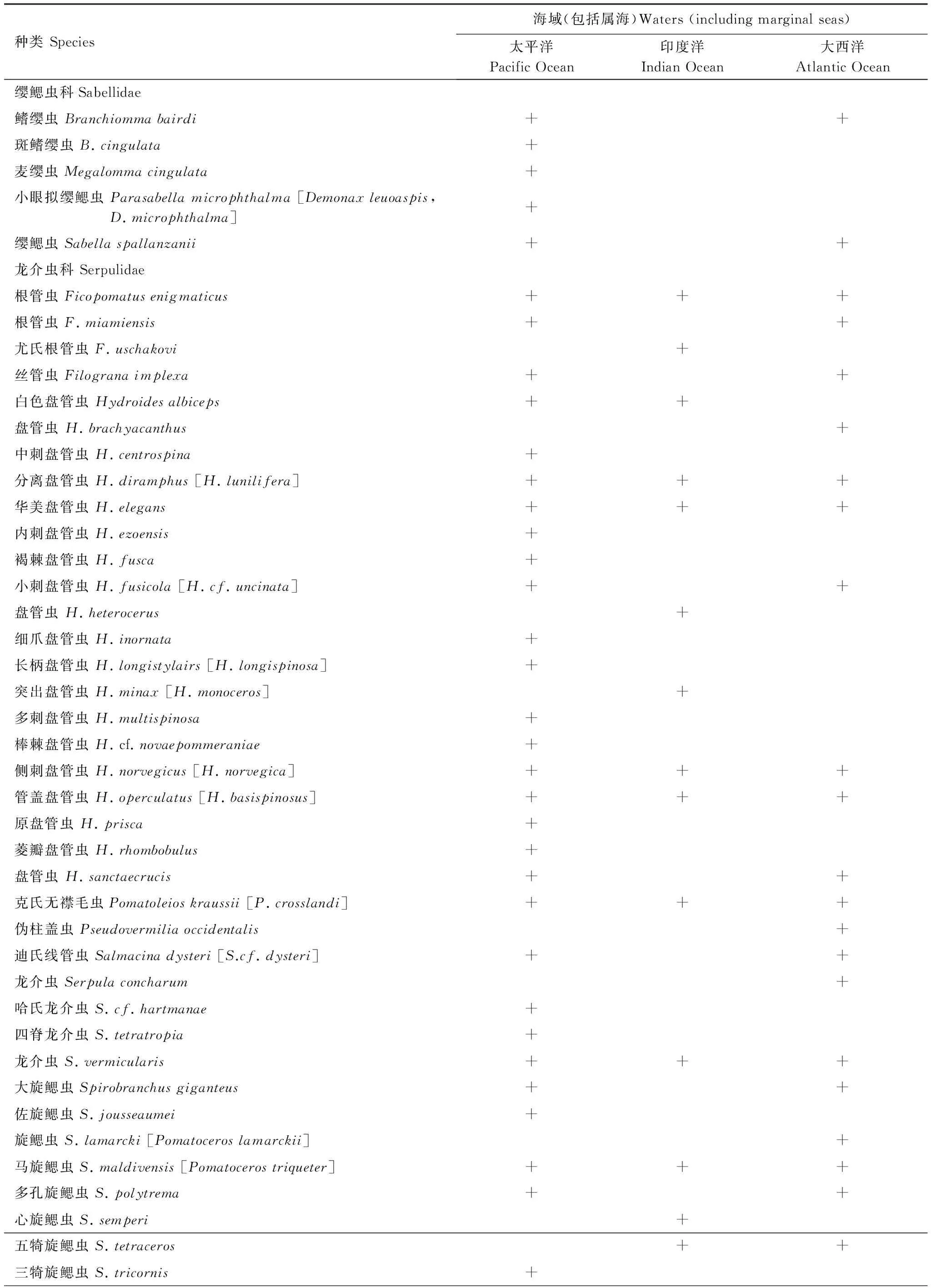
表1 各大洋主要污損性管棲多毛類名錄
1.2 螺旋蟲科
螺旋蟲科的成員依靠石灰質棲管附著,其蟲體小,不對稱,具有螺旋狀圓形石灰質殼管;體前端具鰓冠,軀干分為胸區和腹區,前者常具3—4剛節,第1剛節常無腹齒片剛毛,其余均具背剛毛和腹齒片剛毛;后者雖具背齒片剛毛和腹剛毛,但分布與胸區相反;有的鰓絲特化成石灰質殼蓋,呈圓錐狀或內陷的圓柱狀,殼蓋柄無小羽枝[16]。隸屬螺旋蟲科的污損性管棲多毛類主要種類為紋章環旋蟲(Circeisarmoricana)、有孔右旋蟲(Dexiospiraforaminosus)、薄片右旋蟲(D.lamellosa)和日本右旋蟲(D.nipponica)[17]。
1.3 纓鰓蟲科
纓鰓蟲科的種類具有泥質、革質或膠質蟲管,無殼蓋,具有兩個有溝觸角和1對膜狀唇位于鰓葉間。鰓冠位于體前端,由兩個半圓形或螺旋狀鰓葉組成,鰓葉上有很多鰓絲,鰓絲上有很多橫排小羽枝。軀干部呈光滑圓柱狀(其中胸區短且具背翅毛狀剛毛和腹齒片或者鉤狀剛毛枕;腹區很長,且剛毛的分布與胸區相反,具背齒片枕和腹翅毛狀剛毛),尾部則為圓錐狀[16]。常見污損性種類主要有纓鰓蟲(Sabellaspallanzanii)、麥纓蟲(Megalommacingulata)、斑鰭纓蟲(Branchiommacingulata)[3]。
1.4 蟄龍介科
蟄龍介科種類具粘有沙和泥的粘液性棲管,體前端具許多不能縮入口中的有溝觸手,口背腹面具觸手葉。軀干部分為較粗大的前區(疣足為雙葉型,有時具腹面腺墊,鰓和側葉常位于前3體節上;背剛毛呈翅毛狀,腹剛毛齒片狀)和僅具腹足葉和腹齒片的后區(無背足葉和背剛毛或僅具不發達的小背足葉,尾節無肛須)[12]。蟄龍介蟲科主要污損性種類為乳蟄蟲、側口乳蟄蟲(Thelepusplagiostoma)、刺毛乳蟄蟲(T.setosus)、扁蟄蟲(Loimiamedus)、似蟄蟲(Amaeanatrilobata)、蟄龍介蟲(Terebellaverrilli)[18- 20]。
2 世界各海區管棲多毛類分布狀況
污損性管棲多毛類的種類繁多,分布范圍廣,由于環境因素和地理位置的差異,其種類組成及分布狀況在各海區又表現出一定的差異和特點。本文按從東向西,從北往南的順序,對世界各大洋及其屬海(即太平洋、印度洋、大西洋)的污損性管棲多毛類進行探討。
2.1 太平洋海域
在東太平洋海域,污損性管棲多毛類以盤管蟲屬的多樣性最高[21],盤管蟲(Hydroidesbrachyacanthus)、鰭纓蟲(Branchiommabairdi)等種類是墨西哥馬薩特蘭港常見的污損生物[22],華美盤管蟲和分離盤管蟲為加拉帕戈斯群島海域管棲多毛類優勢種[23]。在珍珠港海域,華美盤管蟲是污損人工設施的重要種類,且四季均可附著[2];日本北部沿海則以內刺盤管蟲為主[14]。澳大利亞海域1—3月份附著量最高的種類是側刺盤管蟲(Hydroidesnorvegicus)[24],盤管蟲(H.sanctaecrucis)和纓鰓蟲估計是由船舶攜帶的外來入侵種[10, 25]。
黃、渤海的污損性管棲多毛類均以內刺盤管蟲和華美盤管蟲為主,其次為龍介蟲(Serpulavermicularis)、有孔右旋蟲和小刺盤管蟲(H.fusicola)等種類[26]。另外,在渤海污損生物群落中,還會有馬旋鰓蟲(Spirobranchusmaldivensis)和三犄旋鰓蟲(S.tricornis)出現;而棒棘盤管蟲(Hydroidescf.novaepommeraniae)、絲管蟲(Filogranaimplexa)、乳蟄蟲、刺毛乳蟄蟲和斑鰭纓蟲則是黃海污損生物群落的重要組成[14,26- 27]。
東海沿岸海區污損性管棲多毛類以內刺盤管蟲、分離盤管蟲、華美盤管蟲、克氏無襟毛蟲、龍介蟲(Serpulavermicularis)、斑鰭纓蟲等種類為主,另還有扁蟄蟲、側口乳蟄蟲、似蟄蟲和三犄旋鰓蟲等種類出現[19,28- 31]。在舟山群島海域,常見的種類為乳蟄蟲、內刺盤管蟲、有孔右旋蟲和華美盤管蟲[18, 32];而在臺灣基隆八斗子港和屏東大鵬灣,優勢種是斑鰭纓蟲和巖螺旋蟲(Spirorbisrupestris),其次為華美盤管蟲[31]。
南海污損性管棲多毛類的優勢種是華美盤管蟲,其次為白色盤管蟲、長柄盤管蟲(Hydroideslongistylairs)、龍介蟲(Serpulavermicularis)、多孔旋鰓蟲、有孔右旋蟲、左旋蟲(Spirorbispapillatus)和斑鰭纓蟲等23個種類[13, 33- 36];另外,在南海北部近海離岸深水設施上,還有華美盤管蟲、龍介蟲(Serpulavermicularis)、褐棘盤管蟲(Hydroidesfusca)、分離盤管蟲、馬旋鰓蟲、三犄旋鰓蟲、迪氏線管蟲(Salmacinadysteri)、克氏無襟毛蟲、扁蟄蟲8個等種類出現[14, 37]。
2.2 印度洋海域
白色盤管蟲、華美盤管蟲、克氏無襟毛蟲、五犄旋鰓蟲和側刺盤管蟲均是印度洋海域重要的污損性管棲多毛類[13, 38],其中阿拉伯海沿岸在7—9月份以華美盤管蟲和管蓋盤管蟲的附著量最大,另一常見的污損性種類是尤氏根管蟲(Ficopomatususchakovi)[39]。在維沙卡帕特南海域,浮標、碼頭、防波堤和船舶底部常被龍介蟲(Serpulavermicularis)、華美盤管蟲、分離盤管蟲、突出盤管蟲(Hydroidesminax)、盤管蟲(H.heterocerus)、心旋鰓蟲(Spirobranchussemperi)等種類附著污損[40]。
蘇伊士運河的污損性管棲多毛類優勢種為華美盤管蟲、分離盤管蟲、克氏無襟毛蟲、龍介蟲(Serpulavermicularis)、馬旋鰓蟲和五犄旋鰓蟲[41]。隨著華美盤管蟲在9月份大量出現,分離盤管蟲、克氏無襟毛蟲、龍介蟲(S.vermicularis)和五犄旋鰓蟲等數量會顯著減少,且春季以華美盤管蟲和克氏無襟毛蟲的數量居多[42]。至于紅海海域,常見污損性管棲多毛類為克氏無襟毛蟲,另還有華美盤管蟲、五犄旋鰓蟲、馬旋鰓蟲和龍介蟲(S.vermicularis)等種類出現[41]。
2.3 大西洋海域
北海常見的污損性管棲多毛類為側刺盤管蟲、馬旋鰓蟲、龍介蟲(S.vermicularis)和絲管蟲[43],其中馬旋鰓蟲在其南部的油氣平臺導管架底部和近海風力發電設施混凝土基座大量附著[44- 45]。地中海北部的亞得里亞海和利古里亞海,主要的污損種類是馬旋鰓蟲、側刺盤管蟲和龍介蟲(S.vermicularis)[46- 47];而在東部的梅爾辛灣和伊斯肯德倫灣,前者克氏無襟毛蟲的生物附著量極大,而后者碼頭樁柱上則常見分離盤管蟲[8]。華美盤管蟲和分離盤管蟲在地中海應是外來種,可能由船舶經直布羅陀海峽攜帶而來[48]。
在巴哈馬群島海域,水下約1700 m、接近海底的試板會被龍介蟲科和纓鰓蟲科生物附著[49];在墨西哥灣北部的近海石油平臺導管架上,則有蟄龍介蟲和刺毛乳蟄蟲等種類出現[20,50]。盤管蟲(Hydroidessanctaecrucis)和五犄旋鰓蟲是加勒比海地區常見的污損性管棲多毛類[23],而且其南部海域的人工設施則還會被偽柱蓋蟲(Pseudovermiliaoccidentalis)污損[51]。另外,在阿拉伊阿爾港浮標可觀察到大旋鰓蟲(Spirobranchusgiganteus)的附著[52],而馬德普拉塔港污損性管棲多毛類通常以根管蟲(Ficopomatusenigmaticus)和華美盤管蟲為主[53]。
3 附著特點
污損性管棲多毛類分布和污損狀況具有明顯的地域性和季節性特征。在中國沿海,華美盤管蟲是東海和南海的污損性管棲多毛類優勢種,而渤海則以內刺盤管蟲和華美盤管蟲為主。再有,龍介蟲在南海為優勢種,但在東海和黃海的附著量明顯減少[54];至于渤海,該種生物僅在個別海區偶爾出現[26]。
污損性管棲多毛類的附著在黃渤海海域集中于6—10月份[55- 56],東海為5—10月份;南海則全年均有附著,但仍以5—9月份的附著量較大,且種類也非常豐富[54, 57]。然而,在阿拉伯海的芒格洛爾海域,6—8月份卻未觀察到管棲多毛類的附著,其附著高峰出現在冬春季,尤其在4月份[58]。
污損性管棲多毛類很多種類的分布與溫度帶呈現密切關系。盤管蟲(Hydroidessanctaecrucis)和分離盤管蟲分布在環熱帶或者亞熱帶海域[21],白色盤管蟲則是印度洋和太平洋中熱帶及亞熱帶海域的常見種[13];內刺盤管蟲多分布在溫帶海域[54],華美盤管蟲則廣泛分布在溫帶、亞熱帶和熱帶海域,為全球性的主要污損生物[3],扁蟄蟲為環熱帶、亞熱帶種類[48, 59]。
污損性管棲多毛類從潮間帶至深海均有分布[7,60- 62],其中沿岸海域主要為克氏無襟毛蟲、華美盤管蟲、盤管蟲(H.brachyacanthus)等種類[5, 8]。華美盤管蟲和分離盤管蟲主要附著在10 m以淺水層,五犄旋鰓蟲多出現在水下11—25 m[8, 13]。扁蟄蟲從潮間帶至100 m水層均有分布[59],而在水下200 m處出現馬旋鰓蟲的幾率比較大[8]。
船舶、碼頭、養殖設施及航運通道等處常出現污損性管棲多毛類[13],其中港口鄰近海域尤以華美盤管蟲為主[63]。管蓋盤管蟲和克氏無襟毛蟲多附著于船體底部[8],而分離盤管蟲和華美盤管蟲等種類則傾向選擇碼頭和水產養殖設施[3, 8]。側刺盤管蟲的附著主要在船底,尤其龍骨部位附近[3];管蓋盤管蟲、旋鰓蟲(Spirobranchuslamarcki)和克氏無襟毛蟲等種類常附著在繩索和輪胎上,在碼頭燈塔基座附著數量較多的是旋鰓蟲和克氏無襟毛蟲[8]。盤管蟲(Hydroidessanctaecrucis)主要分布在表層(人工設施水下1—5 m處)[13, 64]。
在北海海域,群居的絲管蟲常附著在60 m以深水層的近海設施結構上,其棲管相互纏繞粘結,形成半球形或平鋪的薄層狀群落,通常前者直徑可達50 cm、高為20 cm,而后者直徑多為30—50 cm、但高度僅2 cm;另外,呈半球狀的鄰近群落還會逐漸融合在一起,形成更大的生物群落[43]。至于獨居的側刺盤管蟲、龍介蟲、馬旋鰓蟲等種類,在各水層均有分布,且其棲管可為后來污損生物提供穩固的附著基質[43]。
側刺盤管蟲的生長速度很快,尤其在水溫較高的月份。其分泌的棲管約呈圓形,壁薄且脆,緊密粘附在基底上;但在密集附著的水體環境中,棲管可脫離附著基表面生長[24]。在澳大利亞新南威爾士海域,側刺盤管蟲除了冬季的幾個月份外均可繁殖附著[24]。在地中海東部海域,克氏無襟毛蟲的繁殖附著一般均在夏季[8]。因此,水溫較高的夏季應是污損性管棲多毛類繁殖附著的高峰期。
4 研究展望
污損性管棲多毛類種類繁多,分布廣泛,以龍介蟲科和螺旋蟲科的成員為主(尤其是龍介蟲科的盤管蟲屬),繁殖附著期通常在水溫較高的夏季,熱帶海域則全年均可附著。水溫和深度是影響種類分布的關鍵因素,而且設施類型及其部位的差異也會對其附著產生一定的影響。了解污損性管棲多毛類的生態特點,既可為防污工作提供依據,也有利于掌握其在污損生物群落中的地位及作用,為揭示海洋生態系統內在本質規律積累基礎資料。
幼蟲生物學及其培養技術是許多研究工作的基礎。然而,污損性管棲多毛類幼蟲生長發育及附著變態等方面的研究,目前仍限于華美盤管蟲、內刺盤管蟲等少數優勢種類[65- 67]。開展污損性管棲多毛類各階段幼蟲形態特征研究,闡明其變態附著的具體過程及作用機理,掌握環境因子對其生長發育及附著變態的影響,解決大批量培養問題,不僅有助于豐富和發展海洋生物學知識,還可為構建污損性管棲多毛類防除測試模型、開發新型防污技術奠定基礎。
外來種入侵與人類活動導致某種生物來到新的棲息環境有關,甚至可能造成生態災害[68]。某些污損性管棲多毛類的適應能力強、分布范圍廣,可通過船舶攜帶擴散。由于新環境中可能缺乏相應的制約因素,可能會導致外來物種不受控制而大量增殖,甚至危害當地原有生態系統的平衡。故隨著海洋航運行業的發展,應加強外來污損性管棲多毛類的檢測、監測及防治研究,并探討其與當地物種之間的關系。
污損生物通常來源于當地及鄰近海域底棲生物群落的幼蟲和孢子,故其群落結構特點及形成發展趨勢應直接與當地海區底棲生物狀況密切相關[69]。開展污損性管棲多毛類生態調查研究,分析各海域其優勢種群的生物學特點,探討其與群落中其他生物種類之間的關系,揭示其在污損生物群落形成及發展中的作用,弄清關鍵影響因子,將可為了解和掌握其在海洋生態環境系統中的演替變化規律創造條件。
分類定種是生物學研究領域的基礎,基于傳統分類方法是依據生物體的形態結構特征,故具有一定的局限性,這不僅可能引發學術爭議(比如華美盤管蟲和側刺盤管蟲是否為同一種類[70]),甚至可能導致種類鑒定的不準確,從而獲得錯誤的信息和結論。利用現代分子生物學技術,可從分子水平開展污損性管棲多毛類種類鑒定工作(即DNA分類學),將表型相似種或者近緣種進行準確的區分,從而為進一步的生態研究和環保工作奠定基礎。
隨著海洋開發從近海向大洋、由淺海往深水拓展,在大洋深處和寒帶海域進行勘探、調查和從事各種經濟活動的機會也日益增多,這必將伴隨著越來越多人工設施的出現。基于海洋腐蝕和生物污損現象是影響海洋設施結構安全和使用壽命的重要因素,因此,開展深海環境和寒帶海域海洋設施上污損性管棲多毛類種類組成、結構特點及其潛在影響等方面研究具有重要的理論和現實意義,也應是今后的研究熱點。
[1] Carpizo-Ituarte E, Hadfield M G. Stimulation of metamorphosis in the polychaeteHydroideselegansHaswell (Serpulidae). Biological Bulletin, 1998, 194(1): 14- 24.
[2] Nedved B T, Hadfield M G.Hydroideselegans(Annelida: Polychaeta): a model for biofouling research // Flemming H C, Murthy P S, Venkatesan R, Cooksey K, Eds. Marine and Industrial Biofouling. Berlin Heidelberg: Springer, 2009: 203- 217.
[3] Huang Z G, Cai R X. Marine Fouling and Its Prevention Volume 1. Beijing: China Ocean Press, 1984: 283- 286.
[4] Tong B F. The formation of the calcareous habitat tube byHydroidesezoensisOkuda (Serpulidae, Polychaeta). Marine Science, 1983, (6): 36- 39.
[5] Ben-Eliahu M N, Ten Hove H A. Serpulids (Annelida: Polychaeta) along the Mediterranean coast of Israel-New population build-ups of Lessepsian migrants. Israel Journal of Zoology, 1992, 38(1): 35- 53.
[6] Bastida-Zavala J R. Serpulids (Annelida: Polychaeta) from the eastern Pacific, including a brief mention of Hawaiian serpulids. Zootaxa, 2008, 1722: 1- 61.
[7] Ten Hove H A, Kupriyanova E K. Taxonomy of Serpulidae (Annelida, Polychaeta): the state of affairs. Zootaxa, 2009, 2036: 1- 126.
[8] Melih Ertan ?inar. Serpulid species (Polychaeta: Serpulidae) from the Levantine coast of Turkey (eastern Mediterranean) with special emphasis on alien species. Aquatic Invasions, 2006, 1(4): 223- 240.
[9] Thorp C H, Pyne S, West S A.HydroidesezoensisOkuda, a fouling serpulid new to British coastal waters. Journal of Natural History, 1987, 21(4): 863- 877.
[10] Lewis J A, Watson C, Ten Hove H A. Establishment of the Caribbean serpulid tubewormHydroidessanctaecrucisKr?yer [in] M?rch, 1863, in northern Australia. Biological Invasions, 2006, 8(4): 665- 671.
[11] Wang J J, Huang Z G. Fouling polychaetes of Hong Kong and adjacent waters. Asian Marine Biology, 1993, 10: 1- 12.
[12] Yang D J, Sun R P. Marine Polychaete Annelids from the waters off China. Beijing: China Agriculture Press, 1988: 287- 319.
[13] Sun Y N, Ten Hove H A, Qiu J W. Serpulidae (Annelida: Polychaeta) from Hong Kong. Zootaxa, 2012, 3424: 1- 42.
[14] Sun R P, Yang D J. Study onHydroides(Polychaeta: Serpulidae) from waters off China I. Studia Marina Sinica, 2000, 42: 116- 135.
[15] Sun R P, Yang D J. Study on Serpulidae (Polychaeta: Sabellida) from waters off China II. Studia Marina Sinica, 2001, 43: 184- 208.
[16] Yang D J, Wang Y L, Ma X T. Oceanic Invertebrates in North China. Beijing: Higher Educational Press, 1996: 177- 184.
[17] Sun R P, Yang D J. Study on Serpulidae and Spirorbidae (Polychaeta: Sabellida) from the waters off China III. Studia Marina Sinica, 2001, 43: 209- 227.
[18] Huang Z G, Li C Y, Zhang L X, Li F R. Studies on the ecology of fouling and boring organisms in Zhoushan waters, China. Acta Oceanologica Sinica, 1979, 1(2): 299- 310.
[19] Lin H S, Wang J J, Zheng C X, Li R G, Zheng F W, Lin J H, Huang Y Q, He X B, Jiang J X. Ecological research of marine fouling in Dongshan Bay, China. Acta Oceanologica Sinica, 2012, 34(6): 160- 169.
[20] Fotheringham N. Observations on the effects of oil field structures on their biotic environment: Platform fouling community // Middleditch B S. Environmental Effects of Offshore Oil Production: The Buccaneer Gas and Oil Field Study. New York and London: Plenum Press, 1981: 179- 208.
[21] Bastida-Zavala J R, de León-González J A. A new species ofHydroides(Polychaeta: Serpulidae) from western México. Journal of the Marine Biological Association of the UK, 2002, 82(3): 389- 393.
[22] Tovar-Hernández M A, Méndez N, Villalobos-Guerrero T F. Fouling polychaete worms from the southern Gulf of California: Sabellidae and Serpulidae. Systematics and Biodiversity, 2009, 7(3): 319- 336.
[23] Bastida-Zavala J R, Ten Hove H A. Revision ofHydroidesGunnerus, 1768 (Polychaeta: Serpulidae) from the eastern Pacific Region and Hawaii. Beaufortia, 2003, 53(4): 67- 110.
[24] Ferguson Wood E J, Allen F E. Common Marine Fouling Organisms of Australian Waters. Melbourne: Navy Office, Department of the Navy, 1958: 3- 23.
[25] Currie D R, McArthur M A, Cohen B F. Reproduction and distribution of the invasive European fanwormSabellaspallanzanii(Polychaeta: Sabellidae) in Port Phillip Bay, Victoria, Australia. Marine Biology, 2000, 136(4): 645- 656.
[26] Wang J J. Polychaete foulers along coast of Yellow Sea and Bohai Sea. Marine Science Bulletin, 1991, 10(5): 52- 58.
[27] Wu B L, Chen M. On the occurrence ofFilogranaimplexaBerkeley (Polychaeta, Serpulidae) in the Yellow Sea, with notes on its larval development. Acta Oceanologica Sinica, 1979, 1(2): 282- 291.
[28] Zhou S Q, Ke C H, Lin D P. Studies on the ecology of fouling community in Daguanban reclamation area of Luoyuan Bay. Marine Science Bulletin, 2001, 20(3): 29- 35.
[29] Huang Z G, Cai R X, Xu Y Y. Studies on the ecology of fouling organisms in the Pingtan Island. Journal of Oceanography in Taiwan Strait, 1982, 1(1): 87- 92.
[30] Wang J J, Huang Z G, Li C Y, Zheng C X, Lin N, Yan S K. Study on fouling organisms in marine cage culture area of Xiamen harbour. Acta Oceanologica Sinica, 1996, 18(5): 93- 102.
[31] Huang Z G, Chen L S. Preliminary study on the biofoulings in two harbours of Taiwan Province of China. Acta Oceanologica Sinica, 2002, 24(6): 92- 98.
[32] Cai R X, Chen S Q, Xue J Z, Lu J P. The ecology of fouling organisms in Gouqi waters, Zhoushan. Donghai Marine Science, 1994, 12(3): 42- 56.
[33] Zhang H H, Liang C Y, Wu J F, Guo G X, Zhang Z C, Jia X P. Fouling organism in marine cage culture area in Dapeng Bay, South China Sea. Journal of Fishery Sciences of China, 2003, 10(5): 414- 418.
[34] Zheng C X, Huang Z G, Li C Y, Lin S, Wang J J, Yan S K, Zheng D Q. Fouling organisms in Daya Bay Pearl Culturing Farm. Chinese Journal of Applied Ecology, 1991, 2(2): 146- 152.
[35] Huang Z G, Li Z Y, Morton B, Leung T Y. Biofouling of cage mariculture zones in the southern waters of Hong Kong. Asian Marine Biology, 1999, 16: 77- 99.
[36] Yan S K, Huang Z G. Study of fouling organisms in Daya Bay, China. Biofouling, 1990, 2(3): 229- 237.
[37] Yan Y, Yan W X, Dong Y, Wang H J, Yan T, Liang G H. Fouling polychaeta from northern part of south china sea. Marine Science Bulletin, 1995, 14(6): 40- 45.
[38] Javed M, Mustaquim J. The occurrence of fouling organisms on navigational buoys in the Manora Channel, Pakistan // Thompson M F, Tirmizi N M. The Arabian Sea Living Marine Resources and the Environment. Rotterdam: A A Balkema, 1995: 99- 106.
[39] Swami B S, Udhayakumar M. Seasonal influence on settlement, distribution and diversity of fouling organisms at Mumbai harbour. Indian Journal of Marine, 2010, 39(1): 57- 67.
[40] Mohan P C, Aruna C. The biology of serpulid worms in relation to biofouling // Thompson M-F, Nagabhushanam R, Sarojini R, Fingerman M. Recent Developments in Biofouling Control. Rotterdam: A A Balkema, 1994: 59- 64.
[41] Ghobashy A F A, Ghobashy M A F. Marine fouling studies in Egypt A-Serpulids. Egyptian Journal of Aquatic Research, 2005, 31(2): 89- 102.
[42] Emara A M, Belal A A. Marine fouling in Suez canal, Egypt. Egyptian Journal of Aquatic Research, 2004, 30: 189- 206.
[43] MTD Ltd. Appraisal of Marine Growth on Offshore Installations. London: Marine Technology Directorate Limited, 1992: 8- 13.
[44] Hardy F G. Fouling on North Sea platforms. Botanica Marina, 1981, 24: 173- 176.
[45] Kerckhof F, Rumes B, Jacques T, Degraer S, Norro A. Early development of the subtidal marine biofouling on a concrete offshore windmill foundation on the Thornton Bank (southern North Sea): first monitoring results. International Journal of the Society for Underwater Technology, 2010, 29(3): 137- 149.
[46] Relini G, Relini M. Macrofouling on offshore structures in the Mediterranean Sea // Grag K L, Grag N, Mukerji K G. Recent Advances in Biodeterioration and Biodegradation. Calcutta: Naya Prokash, 1994: 307- 326.
[47] Relini G. Fouling of different materials immersed at a depth of 200m in the Ligurian Sea // Proceedings of the 4th International Congress on Marine Corrosion and Fouling. France: Centre de Recherches et d′Etudes Océanographiques, Boulogne, 1976: 431- 443.
[48] Zibrowius H. Ongoing modification of the Mediterranean marine fauna and flora by the establishment of exotic species. Mésogée, 1991, 51: 83- 107.
[49] DePalma J R. A study of deep-ocean fouling // Proceedings of the 2nd International Congress on Marine Corrosion and Fouling. Athens: Technical Chamber of Greece, 1968: 595- 600.
[50] Lewbel G S, Howard R L, Gallaway B J. Zonation of dominant fouling organisms on northern Gulf of Mexico petroleum platforms. Marine Environmental Research, 1987, 21(3): 199- 224.
[51] Gobin J F. Free-living marine polychaetes (Annelida) inhabiting hard-bottom substrates in Trinidad and Tobago, West Indies. Revista de Biología Tropical, 2010, 58(1): 147- 157.
[52] Skinner L F, Tenório A A, Penha F L, Soares D C. First record ofSpirobranchusgiganteus(Pallas, 1766) (Polychaeta, Serpulidae) on Southeastern Brazillian coast: new biofouler and free to live without corals? Pan-American Journal of Aquatic Sciences, 2012, 7(3): 117- 124.
[53] Bastida R, Trivi De Mandri M, Lichtschein De Bastida, Stupak M. Ecological aspects of marine fouling at the Port of Mar Del Plata (Argentina) // Proceedings of the 5th International Congress of Marine Corrosion and Fouling. Madrid: Editorial Garsi, 1980: 299- 320.
[54] Yan T, Liu S S, Cao W H. Marine biofouling on aquaculture facilities in the coastal waters of China and prevention methods. Marine Science Bulletin, 2008, 27(1): 102- 110.
[55] Cao S M, Zhang C R, Zhang G F, Wu Y J. Study on species composition of fouling organisms on mariculture cages. Journal of Dalian Fisheries University, 1998, 13(4): 15- 21.
[56] Cao S M, Zhou Y B, Mou H M. Study on species composition and distribution of fouling organisms in the waters of Dalian coast. Journal of Dalian Fisheries University, 1999, 14(4): 36- 42.
[57] Zhang L X, Huang Z G, Li C Y, Zheng C X. Ecological study on fouling organisms in Xisha Islands. Acta Oceanologica Sinica, 1984, 5(Supp): 847- 858.
[58] Menon N R, Katti R J, Shetty H P C. Biology of marine fouling in Mangalore waters. Marine Biology, 1977, 41: 127- 140.
[59] Meng F, Hong X G, Wu B L. Studies on Polychaeta of the Hainan Island watersⅡ. Journal of Oceanography of Huanghai & Bohai Seas, 1994, 12(1): 35- 51.
[60] Kupriyanova E K, Badyaev A V. Ecological correlates of Arctic Serpulidae (Annelida, Polychaeta) distributions. Ophelia, 1998, 49(3): 181- 193.
[61] Kupriyanova E K, Nishi E. Serpulidae (Annelida, Polychaeta) from Patton-Murray Seamounts, Gulf of Alaska, North Pacific Ocean. Zootaxa, 2010, 2665: 51- 68.
[62] Kupriyanova E K, Nishi E. New records of the deep-seaNogrobsgrimaldii(Serpulidae: Annelida). Marine Biodiversity Records, 2011, 4: 1- 4.
[63] Ko?ak F, Ergen Z, ?inar M E. Fouling organisms and their developments in a polluted and an unpolluted marina in the Aegean Sea (Turkey). Ophelia, 1999, 50(1): 1- 20.
[64] Bastida-Zavala J R, Ten Hove H A. Revision ofHydroidesGunnerus, 1768 (Polychaeta: Serpulidae) from the Western Atlantic Region. Beaufortia, 2002, 52(9): 103- 178.
[65] Qiu J W, Qian P Y. Combined effects of salinity and temperature on juvenile survival, growth and maturation in the polychaeteHydroideselegans. Marine Ecology Progress Series, 1998, 168: 127- 134.
[66] Cao S M, Xu H, Liu P L, Li J, Sun W S. Effects of temperatures on growth, development and metamorphosis ofHydroidesezoensislarvae. Journal of Dalian Fisheries University, 2009, 24(6): 531- 535.
[67] Cao S M, Liu R C, Li X J, Hao S, Xu H. Effects of salinity on fertility, hatching rate, survival and metamorphosis inHydroidesezoensislarvae. Journal of Dalian Ocean University, 2013, 28(2): 133- 137.
[68] Zenetos A, ?inar M E, Pancucci-Papadopoulou M A, Harmelin J G, Furnari G, Andaloro F, Bellou N, Streftaris N, Zibrowius H. Annotated list of marine alien species in the Mediterranean with records of the worst invasive species. Mediterranean Marine Science, 2005, 6(2): 63- 118.
[69] Yan T, Yan W X, Dong Y, Wang H J, Yan Y, Liang G H. Marine fouling on floating installations west of Dongsha Islands, the northern South China Sea. International Biodeterioration & Biodegradation, 2009, 63(8): 1079- 1087.
[70] Ramadan S E, Kheirallah A M, Abdel-Salam K M. Marine fouling community in the Eastern harbour of Alexandria, Egypt compared with four decades of previous studies. Mediterranean Marine Science, 2006, 7(2): 19- 29.
參考文獻:
[3] 黃宗國, 蔡如星. 海洋污損生物及其防除(上冊). 北京: 海洋出版社, 1984: 283- 286.
[4] 童保福. 石灰蟲石灰質棲管形成的研究. 海洋科學, 1983, (6): 36- 39.
[12] 楊德漸, 孫瑞平. 中國近海多毛環節動物. 北京: 農業出版社, 1988: 287- 319.
[14] 孫瑞平, 楊德漸. 中國近海盤管蟲屬(多毛綱: 龍介蟲科)的研究Ⅰ. 海洋科學集刊, 2000, 42: 116- 135.
[15] 孫瑞平, 楊德漸. 中國近海龍介蟲科(多毛綱: 纓鰓蟲目)的研究Ⅱ. 海洋科學集刊, 2001, 43: 184- 208.
[16] 楊德漸, 王永良, 馬繡同. 中國北部海洋無脊椎動物. 北京: 高等教育出版社, 1996: 177- 184.
[17] 孫瑞平, 楊德漸. 中國近海龍介蟲科和螺旋蟲科(多毛綱: 纓鰓蟲目)的研究Ⅲ. 海洋科學集刊, 2001, 43: 209- 227.
[18] 黃宗國, 李傳燕, 張良興, 李福榮. 舟山海區附著生物與鉆孔生物生態研究. 海洋學報, 1979, 1(2): 299- 310.
[19] 林和山, 王建軍, 鄭成興, 李榮冠, 鄭鳳武, 林俊輝, 黃雅琴, 何雪寶, 江錦祥. 東山灣污損生物生態研究. 海洋學報, 2012, 34(6): 160- 169.
[26] 王建軍. 黃渤海沿岸污損生物中的多毛類. 海洋通報, 1991, 10(5): 52- 58.
[27] 吳寶鈴, 陳木. 黃海的絲管蟲FilogranaimplexaBerkeley及其幼蟲發育. 海洋學報, 1979, 1(2): 282- 291.
[28] 周時強, 柯才煥, 林大鵬. 羅源灣大官坂圍墾區附著生物生態研究. 海洋通報, 2001, 20(3): 29- 35.
[29] 黃宗國, 蔡如星, 許由焰. 平潭附著生物生態研究. 臺灣海峽, 1982, 1(1): 87- 92.
[30] 王建軍, 黃宗國, 李傳燕, 鄭成興, 林娜, 嚴頌凱. 廈門港網箱養殖場污損生物的研究. 海洋學報, 1996, 18(5): 93- 102.
[31] 黃宗國, 陳麗淑. 臺灣省兩個港灣污損生物初步研究. 海洋學報, 2002, 24(6): 92- 98.
[32] 蔡如星, 陳樹慶, 薛俊增, 盧建平. 舟山枸杞水域的污損生物生態. 東海海洋, 1994, 12(3): 42- 56.
[33] 張漢華, 梁超愉, 吳進鋒, 郭根喜, 張湛才, 賈曉平. 大鵬灣深水網箱養殖區的污損生物研究. 中國水產科學, 2003, 10(5): 414- 418.
[34] 鄭成興, 黃宗國, 李傳燕, 林盛, 王建軍, 嚴頌凱, 鄭東強. 大亞灣珍珠養殖場的污損生物. 應用生態學報, 1991, 2(2): 146- 152.
[37] 嚴巖, 嚴文俠, 董鈺, 王華接, 嚴濤, 梁冠和. 南海北部近海污損生物中的多毛類. 海洋通報, 1995, 14(6): 40- 45.
[54] 嚴濤, 劉姍姍, 曹文浩. 中國沿海水產設施污損生物特點及防除途徑. 海洋通報, 2008, 27(1): 102- 110.
[55] 曹善茂, 張叢堯, 張國范, 鄔玉靜. 海洋貝類養殖網籠污損生物類群的研究. 大連水產學院學報, 1998, 13(4): 15- 21.
[56] 曹善茂, 周一兵, 牟紅梅. 大連市沿海污損生物種類及分布的研究. 大連水產學院學報, 1999, 14(4): 36- 42.
[57] 張良興, 黃宗國, 李傳燕, 鄭成興. 西沙附著生物生態研究. 海洋學報, 1984, 5(增刊): 847- 858.
[59] 孟凡, 洪旭光, 吳寶鈴. 海南島海區的多毛類Ⅱ. 黃渤海海洋, 1994, 12(1): 35- 51.
[66] 曹善茂, 徐赫, 劉鵬亮, 李建, 孫文山. 不同溫度對內刺盤管蟲幼蟲生長發育及變態的影響. 大連水產學院學報, 2009, 24(6): 531- 535.
[67] 曹善茂, 劉瑞成, 李校建, 郝帥, 徐赫. 鹽度對內刺盤管蟲受精, 孵化及幼蟲存活, 變態的影響. 大連海洋大學學報, 2013, 28(2): 133- 137.
An overview of fouling sedentary polychaetes
YAN Tao1,2,*, ZHANG Hui1, 2, LI Yunqiu3, CAO Wenhao1, HU Biru3
1KeyLaboratoryofTropicalMarineBio-resourcesandEcology,SouthChinaSeaInstituteofOceanology,ChineseAcademyofScience,Guangzhou510301,China2UniversityofChineseAcademyofSciences,Beijing100049,China3CollegeofScience,NationalUniversityofDefenseTechnology,Changsha410073,China
Sedentary polychaetes are conspicuous with numerous species in marine environments. They can also be a major component of fouling communities. As fouling organisms, they can be divided into four families (Serpulidae, Spirorbidae, Sabellidae and Terebllidae) with a total of 55 species identified, of which the dominant species areHydroideselegans,H.ezoensis,H.diramphus,H.norvegicus,H.operculatus,Pomatoleioskraussii,Serpulavermicularis,Spirobranchuspolytrema,S.tetraceros,FicopomatusenigmaticusandThelepuscincinnatus.
Sedentary polychaetes usually live in tubes, which they themselves secrete. Tubes are either attached to surfaces or to each other forming tangled batches; such tubes are difficult to remove even when the occupying worms have died. Their larvae can settle on various underwater man-made substrata, and post-settlement tube growth may cause serious impairment problems such as adding weight to buoys, decreasing ship speed (more fuel consumption, so increasing CO2emission), blocking seawater pipelines and aquaculture nets.
Fouling sedentary polychaetes are widely distributed in tropical, subtropical and temperate waters. However, they are not homogeneously distributed over the different biogeographical regions. In the Pacific Ocean the common species areHydroideselegans,H.ezoensis,H.centrospina,H.longistylairs,H.multispinosa,H.prisca,Serpulacf.hartmanaeandS.tetratropia. WhereasFicopomatususchakovi,Hydroidesheterocerus,H.minaxandSpirobranchussemperiare only found in the Indian Ocean andHydroidesbrachyacanthus,Serpulaconcharum,SpirobranchuslamarckiandPseudovermiliaoccidentalismainly occur in the Atlantic Ocean.
Fouling sedentary polychaetes range from shallow coastal habitats to deep water. However, most previous work is restricted to coastal waters as studies in the deep ocean are rare. Moreover, different species prefer particular substrata. For examplePomatoleioskraussiiandHydroidesoperculatustend to settle on the hulls of ships, whereasH.ezoensisandH.diramphusare generally abundant on quay and aquaculture equipment. Understanding their settlement processes is likely to contribute to the development of novel antifouling technology.
Sedentary polychaetes are appropriate representative animals to evaluate the impact of environmental factors on marine ecological systems and from the viewpoint of antifouling studies, they are also ideal testing models. Therefore, further work should be focused on the aspects of larval development and settlement mechanisms of the dominant species. Moreover, with the increase in oceanic development and utilization activities, more man-made facilities now occur in deeper and colder waters. Lack of information on fouling sedentary polychaetes in such environment means urgent further studies are now necessary.
Due to the limitations of traditional taxonomic methods it is sometimes difficult to identify related polychaete species effectively. Modern genetic technology should provide the answers. Furthermore, some sedentary polychaetes can be easily transported by ship to new environments. As such alien invasive species they can cause serious ecological problems. Based on the reasons mentioned above future work should address the issues of taxonomy and invasive species.
fouling sedentary polychaetes; species composition; distribution; settlement
國家自然科學基金(41176102,31100260); 廣州市科技計劃項目(2013J4300046); 廣東省海洋與漁業科技推廣專項重點項目(A201101F03)
2013- 11- 02;
2014- 04- 08
10.5846/stxb201311022651
*通訊作者Corresponding author.E-mail: yantao@scsio.ac.cn
嚴濤,張慧,李韻秋,曹文浩,胡碧茹.污損性管棲多毛類生態特點及研究展望.生態學報,2014,34(21):6049- 6057.
Yan T, Zhang H, Li Y Q, Cao W H, Hu B R.An overview of fouling sedentary polychaetes.Acta Ecologica Sinica,2014,34(21):6049- 6057.