
In this issue
2014-04-04 02:53:39
上海精神醫學 2014年4期
In this issue
[Shanghai Arch Psychiatry. 2014; 26(4): 178-180. doi: http://dx.doi.org/10.3969/j.issn.1002-0829.2014.04.001]
We are pleased to announce that theShanghai Archives of Psychiatry(SHARP) is now indexed on Pubmed Central so all full-text articles are available free of charge both in hmtl and pdf format when searching Pubmed. As of the beginning of this year we also upload a free online Chinese version of the journal to our Chinese website about one month aer the English edion is released, making us the only English-Chinese dual language journal in psychiatry. Finally, we have just opened our new English-language website at www. shanghaiarchivesofpsychiatry.org
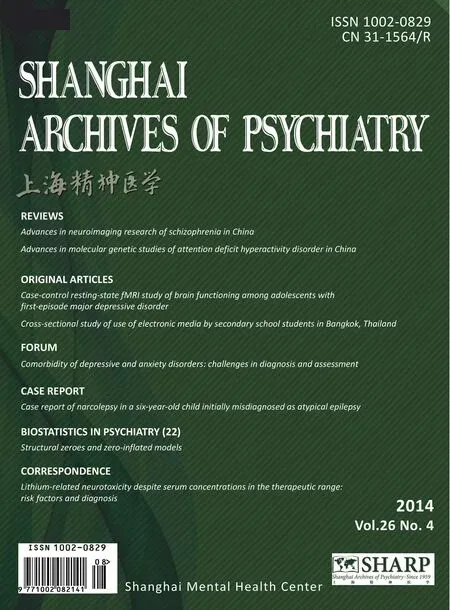
This issue starts with a comprehensive review by Liu and colleagues[1]of neuroimaging studies in schizophrenia conducted in mainland China. The cost of the equipment and the technical expertise needed to conduct such research meant that China was a lile slow in entering this excing area of research but starting in the mid-1990s China has rapidly made up ground. Chinese researchers are now acve parcipants in the international effort to understand the complex relationships between the clinical manifestations of schizophrenia and abnormalities in the structure and functioning of the brain. The review summarizes the results of over 100 neuroimaging studies in China– many of which have only appeared in Chinese –and provides thumbnail descriptions of each study in four tables covering magnetic resonance imaging (MRI) studies, task-based functional magnetic resonance imaging (fMRI) studies, magnec resonance spectroscopy (MRS) studies, and diffusion tensor imaging (DTI) studies. The review includes a summary of the currently ‘hot’ topic among Chinese researchers in the field – structural and functional brain networks– and ends with an extensive list of the methodological and cross-disciplinary issues that need to be addressed in the future.
The second paper in this issue is a review by Gao and colleagues[2]of molecular genetic studies of attention deficit hyperactivity disorder (ADHD) among Han Chinese samples in mainland China and elsewhere. The review considers the full range of candidate gene studies (in the dopaminergic noradrenergic, and serotonergic systems), endophenotype studies, genome wide association studies (GWAS), and pharmacogenomic studies. There are no findings that convincingly demonstrate genec di ff erences between Han Chinese individuals with ADHD and persons of other racial groups with ADHD. As is true in studies in other racial groups, the findings among Han Chinese samples have been inconsistent: the numerous studies have not identified high heritability genes associated with ADHD. The authors discuss the possible reasons for these disappoinng fi ndings and the steps that need to be taken to help move the fi eld forward.
The first original article by Gong, Hao and colleagues[3]reports on a case-control study that assessed resting-state functional magnetic resonance imaging (fMRI) results between 15 adolescents with untreated first-episode depression and 16 normal controls. Adolescent depression – a frequent precursor to adult depression – is a major public health problem associated with substantial disability and, via its association with suicide, death. Given that this condition occurs in individuals whose emotional regulatory mechanisms are sll developing, the biological processes involved in the onset and course of the disorder may be somewhat di ff erent from that seen in adult depression. But there are relavely few funconal brain imaging studies about adolescent depression, so this study adds to the growing literature in the area. Another advantage of such studies with drug-na?ve, first episode subjects is that they exclude three factors that may confound results of studies about the association of brain functioning and depression among adults: normal brain changes with age, the effect of prior depressive episodes, and the effect of using antidepressant medication. In this paper the authors use the amplitude of low frequency fl uctuaons (ALFF) measure to compare the funconing of different regions of the brain between cases and controls and identified ten regions 20 voxels or larger that had significantly different levels of activity (at thep<0.005 level). In six of these regions activity was significantly greater in the depressed subjects than in controls (posterior cingulate gyrus, leinferior temporal gyrus, right superior temporal gyrus, right insula, right parietal lobe, and right fusiform gyrus) and in four of the regions the opposite was the case (bilateral cuneus, the leoccipital lobe, and the lemedial frontal lobe). Most of these areas are involved in emotional regulation. These results are similar to, but not identical with, previous imaging studies of adolescent depression.
The second original article by Kiatrungrit and colleagues[4]presents the results of a survey of the use of various types of electronic media in a representave sample of middle school and high school students in Bangkok, Thailand. There is growing concern about thenegative social, psychological, and health effects on adolescents from the excessive use of electronic media and of the inappropriate sexual and violent content readily available to the many adolescents who use these devices.[5]Most of the research in this area has been conducted in high-income countries, but the problem is of equal concern in the rapidly developing urban areas of middle-income countries where most youth have daily access to a bewildering array of electronic devices. Using a public health approach to the problem, the fi rst step is to understand the magnitude of the problem. This involves assessing (a) the time adolescents use different media, (b) the types of content they access using the media, and (c) the long-term e ff ects on health and behavior of di ff erent paerns of media usage. Given the diversity of media, the mulple purposes for which the different media are employed, and the constantly changing pattern of media usage in adolescents this is, to say the least, a methodological challenge. The authors have started this journey by adapng a survey about media usage in adolescents developed by the Kaiser Family Foundaon in the United States for use in Thai teens. Despite several methodological problems in the study (discussed by the authors), the main fi ndings are sobering: almost all 768 respondents had constant access to mulple electronic media, oen in their own bedrooms; 27% reported using electronic devices more than 12 hours each day; and only 19% reported having household rules about duraon of media use that were regularly enforced. They found some differences in the pattern of media use by age and gender but the expected relationship of heavy media use and poor academic performance was not present. Thus, before imposing restrictions on adolescent access to media –which may not be enforceable – we need a clearer idea about the mechanism via which the presumed negave outcomes (anxiety, depression, substance abuse, violence, self-harm etc.) occur.
The Forum by Wu and Fang[6]discusses mixed anxiety and depressive syndromes, an issue that generated heated debate during the preparation of DSM-5. They report that this comorbid condition is frequently missed in clinical settings in China, largely because of the hecc environment in many psychiatric outpatient departments in China and because of the continuing effect of the ‘hierarchical’ approach to diagnosis – inially promulgated during the DSM-III era– by which ‘less important’ diagnoses were considered irrelevant in individuals who met criteria for a more severe condition. In research settings attempts to overcome these problems by using western structured diagnostic instruments like the SCID found that the comorbidity paern is di ff erent in China than reported elsewhere; compared to depressed patients in the United States, Chinese depressed patients are much more likely to have comorbid generalized anxiety disorder (56% vs. 21%) and much less likely to have comorbid social anxiety disorder (4% vs. 29%). For depressed patients with subthreshold, but clinically significant anxiety symptoms, the authors believe that the addition of the ‘anxious distress’ specifier to the major depressive disorder diagnosis in DSM-5[7]may help identity a subgroup of depressed patients who would benefit from treatments targeted at both types of symptoms. The real world is populated by individuals with amalgams of mulple diagnosis so our diagnosc systems need to augment the hierarchical dichotomous approach with more nuanced, dimensional approaches to the understanding and management of these comorbid condions.
The case report by Zhou and colleagues[8]is an example of how clinicians can miss a diagnosis, even when the symptoms are fairly typical, if they occur in an individual who is younger or older than the usual age of onset. The paent was a six-year-old girl whose parents reported all four cardinal symptoms of narcolepsy --paroxysmal sleep, cataplexy, hypnagogic hallucinaons, and sleep paralysis – but she was misdiagnosed as having atypical epilepsy (despite the absence of EEG evidence) and a variety of other diagnoses by several internists and neurologists at eight hospitals over a period of 10 months before the correct diagnosis was con fi rmed by conducng a Mulple Sleep Latency Test (MSLT) and an overnight polysomnography (PSG). She responded rapidly to treatment with methylphenidate. To decrease the incidence of this type of misdiagnosis, the authors recommend that children who report persistent excessive dayme sleep of unknown eology should be administered the MSLT and PSG to rule out narcolepsy.
The Biostatistics in Psychiatry piece by He and colleagues[9]considers ‘structural zeros’, an issue that is usually left unaddressed by mental health researchers when they report psychosocial and behavioral data. Structural zeros occur when some subjects in a sample are not at risk for an outcome of interest; for example, the number of times the individual attended church in the last year in a population where a substantial proportion of respondents are atheists. Analytically these types of zero responses need to be dealt with differently than ‘random zeros’ – responses that are zero due to sampling variability (e.g., number ofmes professed Catholics attended church in the last year). Collapsing these two types of zeros in an analysis can lead to incorrect conclusions. The arcle describes one method for dealing with this problem – the zero-in fl ated Poisson (ZIP) regression model.
The fi nal piece in the issue is a leer by Megarbane and colleagues[10]from France discussing the case report on lithium neurotoxicity despite low lithium serum concentration published in a previous issue.[11]They provide a summary of the toxicological understanding of such cases and disagree with the suggeson of some researchers that these cases demonstrate the need to abandon the traditional method of monitoring lithium levels – serum lithium levels—and replace it with other measures such as the lithium concentraon of red blood cells (RBC) or the RBC-to-plasma lithium rao.
1. Liu DT, Xu YF, Jiang KD. Review of advances in neuroimaging research of schizophrenia in China.Shanghai Arch Psychiatry.2014; 26(4): 181-193. doi: http://dx.doi.org/10.3969/ j.issn.1002-0829.2014.04.002
2. Gao Q, Liu L, Qian QJ, Wang YF. Advances in molecular genec studies of aenon de fi cit hyperacvity disorder in China.Shanghai Arch Psychiatry.2014; 26(4): 194-206. doi: hp://dx.doi.org/10.3969/j.issn.1002-0829.2014.04.003
3. Gong Y, Hao LL, Zhang XY, Zhou Y, Li JQ, Zhao ZM, et al. Casecontrol resng-state fMRI study of brain funconing among adolescents with first-episode major depressive disorder.Shanghai Arch Psychiatry.2014; 26(4): 207-215. doi: hp:// dx.doi.org/10.3969/j.issn.1002-0829.2014.04.004
4. Kiatrungrit K, Hongsanguansri S. Cross-seconal study of use of electronic media by secondary school students in Bangkok.Shanghai Arch Psychiatry.2014; 26(4): 216-226. doi: hp:// dx.doi.org/10.3969/j.issn.1002-0829.2014.04.005
5. Hancox RJ, Milne RJ, Poulton R. Association between child and adolescent television viewing and adult health: a longitudinal birth cohort study.Lancet. 2004; 364: 257–262. doi: hp://dx.doi.org/10.1016/S0140-6736(04)16675-0
6. Wu ZG, Fang YR. Comorbidity of depressive and anxiety disorders: challenges in diagnosis and assessment (Forum).Shanghai Arch Psychiatry.2014; 26(4): 227-231. doi: hp:// dx.doi.org/10.3969/j.issn.1002-0829.2014.04.006
7. Zimmerman M, Chelminski I, Young D, Dalrymple K, Walsh E, Rosenstein L. A clinically useful self-report measure of the DSM-5 anxious distress specifier for major depressive disorder.J Clin Psychiatry. 2014; 75(6): 601-607. doi: hp:// dx.doi.org/10.4088/JCP.13m08961
8. Zhou JQ, Zhang X, Dong ZW. Case report of narcolepsy in a six-year-old child inially misdiagnosed as atypical epilepsy.Shanghai Arch Psychiatry.2014; 26(4): 232-235. doi: hp:// dx.doi.org/10.3969/j.issn.1002-0829.2014.04.007
9. He H, Tang W, Wang WJ, Crits-Christoph P. Structural zeroes and zero-in fl ated models.Shanghai Arch Psychiatry.2014; 26(4): 236-242. doi: http://dx.doi.org/10.3969/ j.issn.1002-0829.2014.04.008
10. Megarbane B, Hanak AS, Chevillard L. Lithium-related neurotoxicity despite serum concentrations in the therapeutic range: risk factors and diagnosis.Shanghai Arch Psychiatry.2014; 26(4): 243-244. doi: http://dx.doi. org/10.3969/j.issn.1002-0829.2014.04.009
11. Peng J. Case report on lithium intoxication with normal lithium levels.Shanghai Arch Psychiatry. 2014; 26(2): 103-104. doi: http://dx.doi.org/10.3969/ j.issn.1002-0829.2014.02.008
A full-text Chinese translaon will be available at www.saponline.org on September 25, 2014.
- 上海精神醫學的其它文章
- Lithium-related neurotoxicity despite serum concentrations in the therapeutic range: risk factors and diagnosis
- Structural zeroes and zero-inflated models
- Case report of narcolepsy in a six-year-old child initially misdiagnosed as atypical epilepsy
- Comorbidity of depressive and anxiety disorders:challenges in diagnosis and assessment
- Cross-sectional study of use of electronic media by secondary school students in Bangkok, Thailand
- Case-control resting-state fMRI study of brain functioning among adolescents with first-episode major depressive disorder