
Lithium-related neurotoxicity despite serum concentrations in the therapeutic range: risk factors and diagnosis
2014-12-08 06:44:44BrunoGARBANEAnneSophieHANAKLucieCHEVILLARD
上海精神醫學 2014年4期
Bruno MéGARBANE*, Anne-Sophie HANAK, Lucie CHEVILLARD
?Correspondence?
Lithium-related neurotoxicity despite serum concentrations in the therapeutic range: risk factors and diagnosis
Bruno MéGARBANE1,2,3,4*, Anne-Sophie HANAK2,3,4, Lucie CHEVILLARD2,3,4
We would like to comment on the interesting case report of lithium intoxication reported by Jing Peng.[1]An 18-year old female with mania developed confusion,trembling extremities, slurred speech, increased muscle tension, and hyperactive tendon reflexes 20 days after initiating treatment with routine dosages of lithium bicarbonate. When admitted to the hospital due to her acute neurological condition, her serum lithium concentration was in the therapeutic range (0.57 mmol/L).Most of her symptoms spontaneously reversed one week after stopping the lithium.
Since its approval by theFood and Drug Administra-tionin 1970 as treatment for bipolar disorders, several studies have addressed lithium-related neurotoxicity and the related risk factors; these studies all emphasize the relatively narrow therapeutic index of lithium. With the exception of intentional ingestion of large doses of lithium as an act of self-harm (resulting in ‘acute intoxication’ in untreated individuals or ‘acute-onchronic intoxication’ in currently treated individuals),toxicity during prolonged treatment with lithium(‘chronic intoxication’) usually results from progressive lithium accumulation due to renal dysfunction,underlying diseases, low sodium intake, and drug–drug interactions such as loop diuretics, angiotensinconverting enzyme inhibitors, or non-steroidal antiinflammatory drugs.[2]The recommended and routinely used tool to attribute any observed neurotoxicity to lithium is the measurement of serum lithium concentration: concentrations of 0.4-0.8 are considered therapeutic, concentrations of 0.8-1.2 mmol/L are considered safe, concentrations between 1.5-2.5 mmol/L may be associated with mild toxicity, concentrations between 2.5 and 3.5 mmol/L result in severe toxicity,and concentrations greater than 3.5 mmol/L are lifethreatening.[2]
Like Dr. Peng’s patient,[1]rare cases of lithium toxicity have been reported in patients with normal serum concentrations, sometimes labelled ‘lithium supersensitivity’ or ‘lithium-related idiosyncratic reaction’. Strayhorn and Nash first reported thirty-six such cases, 10 of whom had lithium concentrations <1.1 mmol/L.[3]Lithium-related neuropsychiatric symptoms are polymorphous and may be difficult to differentiate from other disorders, so before concluding that lithium is responsible for the observed neurotoxicity, coexistent confounding pathologies including fever, infection,metabolic disturbances, and epilepsy have to be ruled out. Cases of lithium-related toxicity in the presence of serum lithium concentrations in the therapeutic range may unmask hitherto undetected and potentially treatable neurological pathologies, such as cerebral infarctions or tumors,[4]so there may be value in conducting brain imaging to exclude this possibility in such cases.
The elderly are particularly vulnerable to chronic intoxication.[2]Dr. Peng’s patient was relatively young,but most reports indicate that older individuals are at greater risk than younger individuals of lithiuminduced neurotoxicity in the presence of lithium serum concentrations in the normal range.[5]Age-related development of cognitive impairment, disabling tremor,peripheral nerve palsy, extrapyramidal signs, and other alterations in neurological conditions may increase the prevalence and severity of lithium-induced toxicity.Pre-existing minimal brain damage suggested by a past history of epilepsy or electroencephalographic(EEG) abnormalities (more commonly observed in patients treated with lithium who do not have mood disorders[6]) may also increase the risk of lithium-related toxicity. Conversely, the use of lithium may increase the prevalence or severity of pre-existing or age-dependent neurological conditions: it is well-known that the prevalence and severity of hand tremor significantly increases with age in lithium-treated patients,[5]and one commonly encountered situation at the bedside isthe onset of lithium-induced seizures in patients with temporal lobe epilepsy.
Drug-drug interactions of concurrently administered psychoactive medications are another major cause of lithium toxicity,[3,5,6]though this was not the case in Dr. Peng’s patient.[1]Interaction with neuroleptics may increase lithium toxicity, either via apharmacodynamic mechanismsuch as the observed synergy of lithium with thiorazidine-related anticholinergic effects or via apharmacokinetic mechanismsuch as the hypothesized phenothiazine-induced increase in the intracellular distribution of lithium.[6]
One hypothesis that could explain lithium neurotoxicity in the presence of therapeutic serum levels of lithium is that serum concentrations do not necessarily parallel brain concentrations. Recent experimental studies have shown that lithium accumulates in the brain, especially with chronic treatment.[7]Moreover the distribution of lithium in the brain is not uniform, with reported increased uptake in the white matter, the pons, and the brainstem. Rapid increases in dosage, particularly when initiating treatment with lithium, may lead to the rapid accumulation of lithium in some areas of the brain, which could result in toxicity despite therapeutic serum levels. Various mechanisms that could cause alterations in cerebral hydration and, thus, toxicity have been suggested, including the effects of lithium on the antidiuretic hormone, on the thyroid stimulating hormone, and on the brain uptake of glucose.[6]Alternatively, increased distribution of lithium or decreased removal of lithium from pathological tissue in localized brain areas may result in islands of high lithium-concentration that induce neurotoxicity.[4]
Some authors suggest that the lithium concentration of red blood cells (RBC) or the RBC-to-plasma lithium ratio may better predict toxicity than serum lithium levels, and that these measures are a better index of the reversal of toxicity when lithium treatment is discontinued, particularly if toxicity occurs at therapeutic serum levels.[6]However, we disagree with this view.Given the substantial inter- and intra-individual variability of these measures reported in recent studies, we strongly believe that neither RBC lithium concentrations nor the RBC-to-plasma lithium ratio offer any clinical advantage over plasma lithium concentrations alone in patients with suspected toxicity.[2]Thus, as concluded by Dr.Peng,[1]suspicion of lithium-induced toxicity in a lithiumtreated patient, even in the absence of increased serum concentrations, requires repeated detailed clinical examinations and serial EEGs. Lithium should thereafter be discontinued and monitoring maintained until the neurological status reverts to normal.
Acknowledgments
The authors would like to thank Mrs. Alison Good(Scotland, United Kingdom) for her helpful review of the manuscript
Conflict of interest
The authors declare that they have no conflict of interest related to this manuscript
Funding
No funding support was obtained for preparing this letter.
1. Peng J. Case report on lithium intoxication with normal lithium levels.Shanghai Arch Psychiatry.2014; 26(2): 103-104.doi: http://dx.doi.org/10.3969/j.issn.1002-0829.2014.02.008
2. El Balkhi S, Megarbane B, Poupon J, Baud FJ, Galliot-Guilley M. Lithium poisoning: is determination of the red blood cell lithium concentration useful?Clin Toxicol (Phila).2009; 47(1):8-13
3. Strayhorn JM Jr, Nash JL. Severe neurotoxicity despite‘therapeutic’ serum lithium levels.Dis Nerv Syst.1977; 38(2):107-111
4. Kemperman CJ, Gerdes JH, De Rooij J, Vencken LM. Reversible lithium neurotoxicity at normal serum level may refer to intracranial pathology.J Neurol Neurosurg Psychiatry.1989;52(5): 679-680
5. Flint A. Ageing as a risk factor for lithium neurotoxicity at therapeutic serum levels.Br J Psychiatry.1993; 163: 555-556
6. Bell AJ, Cole A, Eccleston D, Ferrier IN. Lithium neurotoxicity at normal therapeutic levels.Br J Psychiatry.1993; 162: 689-692
7. Hillert M, Zimmermann M, Klein J. Uptake of lithium into rat brain after acute and chronic administration.Neurosci Lett.2012; 521(1): 62-66. doi: http://dx.doi.org/10.1016/j.neulet.2012.05.060

Dr. Bruno Mégarbane obtained a MD degree from Paris-Descartes University in 1997 and a PhD degree in toxicology from Paris-Descartes University in 2005. Currently, he is working as a senior physician in the department of Medical and Toxicological Critical Care and the research team leader in INSERM U1144 in Lariboisière Hospital, University Paris-Diderot in Paris, France. He is also the president-elect of the European Association of Poisons Centers and Clinical Toxicologists (EAPCCT),and Vice-President of the French Society of Clinical Toxicology. His clinical research focuses on severe human poisonings (including investigation of prognostic factors and improvement in antidote use)and his laboratory research focuses on the variability of psychotropic drug-related toxicity (including opioid-induced respiratory depression).
[Shanghai Arch Psychiatry. 2014; 26(4): 243-244.
http://dx.doi.org/10.3969/j.issn.1002-0829.2014.04.009]
1Assistance Publique – H?pitaux de Paris, H?pital Lariboisière, Laboratoire de Toxicologie biologique, Paris, France2Inserm, U1144, Paris, France
3Université Paris Descartes, Paris, France
4Université Paris Diderot, Paris, France
*correspondence: bruno-megarbane@wanadoo.fr
A full-text Chinese translation will be available at www.saponline.org on September 25, 2014.
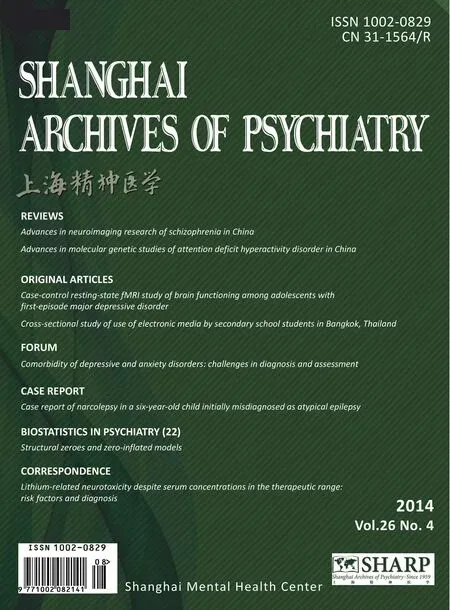
- 上海精神醫學的其它文章
- Structural zeroes and zero-inflated models
- Case report of narcolepsy in a six-year-old child initially misdiagnosed as atypical epilepsy
- Comorbidity of depressive and anxiety disorders:challenges in diagnosis and assessment
- Cross-sectional study of use of electronic media by secondary school students in Bangkok, Thailand
- Case-control resting-state fMRI study of brain functioning among adolescents with first-episode major depressive disorder
- Advances in molecular genetic studies of attention deficit hyperactivity disorder in China