
DEADLY DIRT
2014-02-25 06:25:06BYTERENCEHSIEH謝燕輝
漢語(yǔ)世界 2014年3期
BY TERENCE HSIEH (謝燕輝)
DEADLY DIRT
BY TERENCE HSIEH (謝燕輝)
China's polluted soil makes for a dangerous future
潛伏在土壤里的威脅
Imagine going to the store and buying a loaf of bread that makes you so sick that you nearly die. After barely recovering, you discover that the wheat was grown on soil that was contaminated by dioxin, a poisonous chemical agent that was spilled by a battery factory across the road from the farm. What's more, the farm is only a half a mile down the road, and you discover that the soil under your house and the groundwater beneath it are also poisoned by dioxin. Your children return from playing outside covered in chemical burns, and your most recent visit to the doctor reveals that there are several tumors growing on your back. Of course, you might think that this is just a bit of scaremongering, but the truth is that China's soil pollution problems are growing by the
day—the situation is bad, very bad.
Awareness of pollution of all sorts, airborne and otherwise, has intensif i ed across China as well as in coverage by international media. While these efforts have mainly focused on airborne pollutants caused by vehicles, coal burning, and dangerous chemical runoffs, soil pollution is lesser-known but equally-terrifying environmental obstacle facing modern China. While the term “soil pollution”indicates the contamination of arable land, it also covers the contamination of waterways, crops, potable water sources, and ultimately the air.
While other types of pollution can cause immediate and serious health issues, soil pollution poses some of the most serious developmental, public health, and political risksfor China's immediate and long term future. A 2013 white paper by the Ministry of Health noted that nearly 13 million tons of harvested crops were contaminated each year and estimated that eight million acres of Chinese farmland were considered too contaminated for farming. In other words, up to one sixth of all arable Chinese farmland is too polluted to grow crops. Cadmium, a metal used to coat wires and zinc batteries, has been found in high levels in both soil and rice across China, up to 46 times the accepted levels of cadmium and lead, culminating in a huge drop in the price of domestically-grown rice across southern China. Cadmium poisoning can cause liver, kidney, and other vital organ shutdowns and is responsible for a variety of cancers as well as skeletal softening. A separate white paper by the Guangzhou Food and Drug Administration indicated that eight out of 18 samples of rice were contaminated by cadmium across the city, and another study by Nanjing Agricultural University indicated that up to 10 percent of all rice across China failed to meet the standards for levels of cadmium alone.
Unfortunately, cadmium isn't the only thing contaminating the soil. Improper use of pesticides and makeshift fertilizers has also poisoned the soil in China. Pepsi and Coca Cola have both been named as top water polluters by Beijing authorities, with a lot of such pollutants ending up in the local soil. A 2009 report by the Department of Environment Engineering at Zhejiang University showed high levels of the extremely toxic chemical, dioxin in the soil of Taizhou, a center for the waste trashing of consumer electronics.
SINCE CONTAMINATED SOIL IS INCREDIBLY DIFFICULT TO FIX, REMEDIATION IS EXPENSIVE AND TIME-CONSUMING
As is the case in many developing countries, China's agricultural areas are surrounded by factories. Soil pollution occurs most often when industrial factories producing or using chemicals that contain heavy metals or other harmful materials dump or spill their byproducts either into waterways or onto soil, or simply when fertilizer is improperly synthesized and applied. An off i cial from the Ministry of Agriculture estimates that up to 65 percent of soil is used improperly, polluting rivers and lakes. The chemical waste, in turn, settles in the soil. Whileone immediate effect of contaminated soil is the poisoning of agriculture, the chemicals, in turn, may pass through into the water system, polluting underground water reservoirs for drinking and irrigating crops outside the immediate damage radius, thereby spreading the area of effect. Heavy metals are absorbed easily through contact: children playing are easily affected by toxic chemicals in the soil through skin contact or by breathing in toxic dust. And, while symptoms may not initially show, their development over years may cause genetic defects for future generations living on a plot of land.
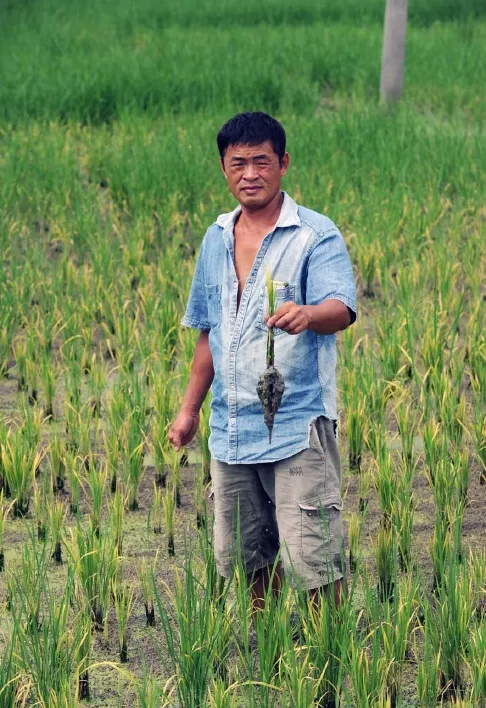
Lao Wu from Guangdong Province holds up a ruined rice seeding, destroyed by heavy metals such as chromium, copper, and nickel
Furthermore, contaminated soil doesn't return to healthy soil even after the pollutants have stopped inf i ltrating the soil; cadmium and its sister heavy metals are extremely diff i cult to remove from the soil and may stay for years. What's worse, it is just as hard to remove cadmium from the human body too.
Since contaminated soil is incredibly diff i cult to fi x, remediation is expensive and time-consuming. Contamination may be removed through physical, chemical or biological methods, which may include dredging, soil removal, oxidation, groundwater treatment, or the use of vegetation to remove contaminants.
Still, the process is long and laborious. As such, resolving the soil pollution issue is not only critical to China's public health, but also an issue of national security, as arable (and livable) land is scarce. Indeed, solving this issue is and should be a priority. This year, China started plans to tackle the soil pollution that plagues the country, a problem that a government off i cial claimed had already rendered eight million acres of land unable to produce crops—that's about the size of Belgium. However, Beijing is a long way from solving the problem, a difficulty that will be both complex and extremely expensive. Also, there is the dreaded question as to whether the government's plans for clean up and legislation on soil pollution will ever be able to catch up with the almost absurd rate at which it is growing. In February, premier Li Keqiang declared a “war on pollution”, and in the case of soil contamination, Beijing thus far is out-maneuvered and outgunned.
The resulting food, water, and air contamination that occurs because of soil contamination is yet another huge thorn in the party's side. Can the government keep food, potable water, and land for housing safe from poisonous substances? The answer is a no-brainer: cleaning-up must remain a top priority of the state. Whether you're a government off i cial or a peasant in the countryside makes no difference: everyone drinks the same water and eats the same food. The time to act is now.
