
DREAM IN THE JUNGLE
2014-02-25 06:44:46TEXTANDPHOTOGRAPHSBYGINGERHUANG黃原竟
漢語世界 2014年3期
TEXT AND PHOTOGRAPHS BY GINGER HUANG (黃原竟)
DREAM IN THE JUNGLE
TEXT AND PHOTOGRAPHS BY GINGER HUANG (黃原竟)
Finding peace and humility with a Bulang village in the rainforest
雨林深處的一個布朗族家庭收留了一個背包客,引發了一連串的歡笑、淚水和沉思
In early April, the tropical heat douses the city of Jinghong in a lazy languor. Dogs idly sleep under the branches of gigantic glazed palms. By half past one, the restaurants that were open at noon close and the streets are empty, quiet, with not so much as a taxi in sight. The entire city, despite its modern look, takes the time to have a prolonged midday snooze. Sitting on an aged bamboo armchair by the Mekong River, looking at the verdant yard of a hostel, the languid summer air relaxed me into a stupor. There was almost nowhere I wanted to go—I had already explored nearby villages, hot springs, and forests, that's when the young receptionist, perhaps to save me from actually melding with the chair, said,“Maybe you would like Zhanglang (章朗).”
Flicking through a guidebook, Zhanglang, Yunnan Province, seemed to be an ancient Bulang ethnic (布朗族) village—an ethnicity I had never encountered before. It was only 100 miles west of Jinghong, and the description in the guide was smaller than a postage stamp. Riled by curiosity, I decided to raise myself out of my seemingly eternal slumber in the bamboo armchair and hit the road once more. With no direct route, I fi rst took a bus to Menghai (勐海), the town nearest to Zhanglang, leaving the modern city ofJinghong in the rearview mirror and rattling furiously onto a road that threaded through a vast rainforest. However, the dry season was lasting longer than it was supposed to, and the forest looked dusty and dry, even depressed somehow. After an hour and a half, I arrived in Menghai. The town, like so many newly-developed Chinese towns, was ill-planned, badly-built, and dirty. The main street seemed to consist almost entirely of motorcycle repair garages, and even the occasional restaurant seemed to take on the air of the garages, gloomy and dank.

A typical Bulang ethnic residence in Zhanglang village
WHEN, AFTER TWO HOURS, THE MAP FINALLY INDICATED I WAS ARRIVING IN ZHANGLANG, I WAS EXHILARATED BY THE SIMPLE PROSPECT OF WATER
The next day, I took a privately-run mini van further west, getting off halfway to look at a 300-year-old octagonpagoda (景真八角亭) constructed to resemble Siddhartha's hat. I was having a good time, listening to the soothing sound of the wind stroking the bells that hung around the gray wooden pagoda and tried my best to interpret the frescos painted on the temple walls, which were, it seemed, all about the life of Siddhartha Gautama. The temple that once surrounded the pagoda was—like so many things—destroyed during the Cultural Revolution and rebuilt in 1978. Coming to terms with this often frustrated me during my travels. Such destruction is omnipresent. No matter how remote and offbeat the destination—regardless of the ethnicity, culture, and temperament of the local people—the temples were always destroyed during the peculiar havoc that was the Cultural Revolution.

Yuban posing for the camera, leaning on her neighbor's bamboo cattle pen
When I left the pagoda, I hitchhiked on a motorcycle driven by a local man who didn't understand Han Chinese. I asked him tentatively,“Zhanglang?” and he nodded. Fifteen minutes later, he put me down at a gas station at a fork in the road and pointed to one of the paths. I couldn't understand his dialect, but checking the map on my phone, I could see I was some nine kilometers away from Zhanglang. As I walked, the concrete road soon disappeared, giving way to a cobbled road, and then a dirt path. The mountains and valleys turned greener and gently rolled onwards. The land was clearly resident to a very hardworking people, and the entire valley appeared to have been turned into tea plantations.
I failed to hail another ride. Occasionally, a motorcycle would roar by, but they were always overloaded with women and children or goods. Having underestimated the time it would take me to get to the village, I didn't even fi ll my water bottle before I left, only bringing along a Snickers bar for food. When, after two hours, the map fi nally indicated I was arriving in Zhanglang, I was exhilarated by the simple prospect of water.
The village was of a singular rustic charm. It was tiny, and I walked through it in two minutes. Cottages clustered closely, most of them have two-storey wooden structures. The bottom storeys, supported by pillars alone, were without walls and used as shelter for livestock, as well as for the storage of logs and fi rewood. The second storeys were windowless and almost totally in the shadow of the massive, slanting roofs that were covered in small, black square tiles. They all looked weather-beaten but were still well-maintained and neat. The village was exceptionally still. For a moment I even wondered if it was abandoned. Thus, I walked up and down the path, looking for any living human I could fi nd. Finally, I heard the faint din of chatting from one of the cottages. I gingerly approached, and saw three old women sitting on the fl oor in the middle of what was clearly a merry conversation. All three of them were dressed in their own ethnic dress: their heads wrapped in black clothes, while wearing black coats and a black, ankle-length skirt wrapped by a blue waistband.
“Hello. Do you have any water?” I asked timidly. They looked at me inquisitively, but didn't understand. I took out my bottle and piteously showed them that it was empty. Then the oldest woman stood up, and gestured for me to follow her.
As she walked, she started to talk to me in a slow drawl as if I were another woman from her village. We went into her cottage, up the creaking steps, and came to the second storey. The attic was spacious, but the roof hung very low, the only source of light was what seeped through cracks in the planks. The room was meant to be used as a sitting room and kitchen. The kitchen was a small ring of cinder on the ground with a tin pot supported by an iron tripod.
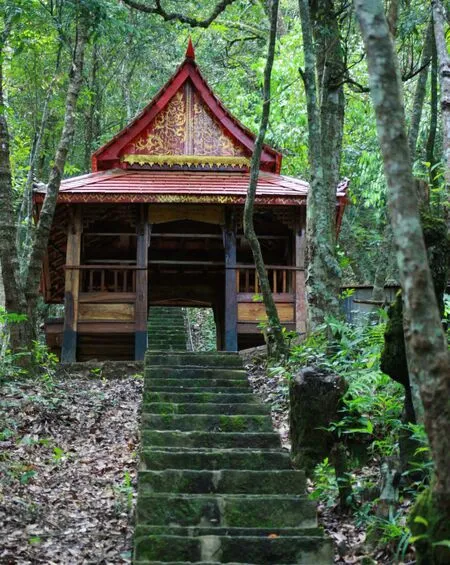
A gate leading to the Buddhist temple in Zhanglang village
She gave me hot water from a thermos, and then, as if reading my mind, offered me food—rice and salt, which obviously was her lunch too. She was an elegant lady despite her age and was extraordinarily fl exible, a woman who—through miming and a smattering of Mandarin words—I was able to discover had recently suffered a seriousinjury to her foot. I was not used to sitting on the fl oor, and soon my legs and back became numb and stiff, while she sat comfortably, nimbly bending to fetch anything within her reach. Without enquiring anything about where I came from or why I was here, she offered me her couch for the night as naturally as if I was her own family, which, oddly, made me feel slightly paranoid. While we conversed ineff i ciently and with great diff i culty, the wooden stairs thundered, and a little girl in a school uniform came up. She was about 10 years old, and had large expressive eyes.“She speaks Han. She learned it from school,” the old lady said. Her name was Yuban, and we talked brief l y before I remembered the Snickers in my backpack and gave it to her. She opened it and asked me what it was, and then put it aside. “You don't eat candy?” I asked. “I am keeping it for my brother. He will come later,” she said. The brother soon turned up, shorter than the girl, but they looked very alike. I later learned they were twins.

Spices and herbs sold in Xiding's Thursday market
“THERE ARE A LOT OF MICE. THEY ARE NOT AFRAID OF PEOPLE AND RUN AROUND IN THE ROOM AT NIGHT. IT'S BETTER WITH THE LIGHT ON. WE DON'T WANT YOU TO BE SCARED.”
Yuban and her brother stayed for a while and then as they were leaving, I don't know exactly how, my lodging changed from the old lady's cottage to Yuban's home. My little patron's home was two kilometers away in another village. The people of the two villages used to both reside in the fi rst village, but the fi rst village was so ancient that the government, concerned about overpopulation, subsidized some of the villagers and had them build new cottages in a new settlement. Her house was similar to the house of the old lady, only simpler. The attic was almost bare, the only furniture being two wide benches in a corner, one of which would serve as my bed. The planks that made-up the fl oor extended out of the attic, making a platform where they could wash clothes and bathe. A water tap rose from the ground to the platform like a tall fl ag pole. There was no toilet—or, rather, the toilets were anywhere outside where you could hide yourself well. The only electricity went to a pair of light bulbs.
As soon as she put down her backpack, Yuban announced: “We are running out of time. I have to hurry. I need to sweep the fl oor, wash the clothes, feed the pigs, and cook rice before my parents come back.” So, she briskly set about her chores. The water for washing clothes immediately turned dark, as their garments were soaked in mud; Yuban washed them quite unscrupulously. I guess she didn't have the time, and, I suspect, modern standards of hygiene are more a product of our cramped, dirty cities. Then, she hoisted a bucket of porridge, which I later learned was made from banana branches, downstairs and poured it into a large tire cut into halves; three small black pigs hurried over and enjoyed their meal while contently swaying their tails. I was in awe of her eff i ciency, and as much as I wanted to, I could do little to help.
At about six, I fi nally met her parents coming back from the fi elds. Her mother had brown skin, big bright eyes, round and tight arms, not to mention the elegant, steady pace that can often seen on people who have only ever walked barefoot. The father was a short, lean man. Both were just 32 years-old. They each came back with a gigantic bag of fresh tea leaves on their backs. Yuban yelled something at them like a chirping bird, and they smiled at me and nodded and didn't say anything. In this quiet and familiar way they accepted me as their guest. She started a fi re and cooked us dinner, which was rice stir-fried in oil and soy sauce. Also, I got an egg—theyfried the only egg they had for me. Over the next few days, I noticed that they had no vegetables and very little fruit in their daily diets.

Yuban and her brother skillfully pick tea, for which they are paid 20 RMB per kilogram
In the evening, they went out and came back with a bed cover. “We borrowed it from a neighbor for you,” mother Yu said. The bench that was to be my bed already had a mat and a blanket, and I felt bad for the inconvenience. When I woke the next day I noticed that the light was on all night. I asked them why, and the mother said, “There are a lot of mice. They are not afraid of people and run around in the room at night. It's better with the light on. We don't want you to be scared.”
The next day, they awoke when it was still dark. “We are going to help another family harvest their sugar cane. We will come back late,” mother Yu told me. Yuban and her brother, too, were going to help another neighbor to pick tea leaves. Of course, Yuban brought me along because she was worried about me hanging around on my own, and also: “You can earn a lot of money if you pick tea leaves with us. Mother said you will need money because you go to a lot of places.” The pay was 20 RMB per kilo of tea leaves. We arrived at a small patch of tea farms in a deep wood. However, I, of course, was the slowest picker as I couldn't quite discern younger tender leaves from older ones. I also couldn't stop Yuban and her brother secretly smuggling leaves from their own bags into mine whenever they got the chance so that I would be paid more. It was humbling, almost devastating generosity.
With their kind help, I earned 20 RMB, and the twins earned 30 RMB each. We fi nished the work in early afternoon and played in the woods for the rest of the day. They made two signif i cant discoveries: that there was empty ground comfortably matted with thick leaves and that my phone could record voices. The recorder made them hysterically happy. They shrieked at it, listened to their own shrieking and rolled on the ground in laughter. Then they started to sing songs in their own language. This time they became a serious duo, and I listened in amazement. After they had fun recording their voices, Yuban dragged me to the village's grocery store, insisting on buying me a snack. Truly, I felt like the most immature among us. There was only one grocery shop in the village, which was owned by a Han man who sold very limited goods. Yuban carefully chose a soy sauce egg for me.
The next day was a Thursday, the day when all thevillagers go shopping in the Xidingxiang market, about 12 kilometers away. Yuban was excited and said she was going to buy a pair of dancing shoes, as they were choreographing a dance at school. She also looked forward to buying steamed buns and having rice noodles in a restaurant.
We got up at six and found the neighbors already gathering. There was only one mini van in the village, owned by the grocery store proprietor. Most families traveled on motorcycles. We divided ourselves into several groups and got on motorcycles, waving and hailing to each other, and headed to market like a large troop of soldiers, albeit undisciplined soldiers. It was a bustling market, where handicrafts like knives made by local blacksmiths mingled with cheap modern products like plastic sandals. It was also a signif i cant occasion to socialize. People greeted each other heartily; liveliness and joy seemed to infect everyone.
Among the stalls, one that occupied a conspicuous corner was particularly loud. A Han ethnic man was selling electronic kitchenware such as kettles, pressure cookers, and induction cookers—all things that seemed unnecessary for the average Bulang household, as they didn't have many electronic plugs in their homes. The man announced: “We have a big promotion. These sets of kitchenware are worth 999 RMB. But on this special day, we have a lucky draw. If you are lucky enough to get a coupon, you can get them for only 299 RMB!” The man enthusiastically displayed how the induction cooker could bring the water to a boil in just a few minutes. He quickly drew a solid crowd that looked at the products with curious eyes. He didn't need to urge them to partake in the lucky draw, and, naturally, almost everybody was lucky enough to get a coupon. The villagers were overjoyed at this good luck. Seeing Yuban's mother's interest, I was concerned. These products were of dubious quality, the pressure cooker in particular looked dangerous. They couldn't even read the manuals, which were in the Han language; this is all besides the fact that their electricity fees would spike if they managed to fi nd a use for it.
On returning, we were again faced with the problem of too many people and too few vehicles. After some discussion, they squeezed me into the mini van. I sat next to the driver with a mother and a seven year-old boy on the other side. Six people—four adults, a child, and a baby—succeeding in squeezing into the back row. The van, on the verge of bursting with double the sensible capacity of passengers, bumbled homeward amongst much laughter.
Later that night, Yuban asked me to read her Chinese textbook with her. Her school only had two grades: the second and the fourth. There were only two teachers, and the locals didn't care much about schooling. In order to make the parents send their children to school, the local government gives the parents a reward. Yuban took her homework very seriously. She started by reading a Chinese lesson called “Carole and Her Kitten”. The lesson, an obvious copy from an English text, began with,“Carole has always wanted a kitten. Father tells her, ‘Let's put an advertisement in the newspaper.'”
She circled alien words like “newspaper” and“advertisement”. Even if I wanted to explain these to her, I doubt I could. When she read, she painstakingly emphasized every character. I soon realized that the whole article meant nothing to her. How, to a girl whose family owned no electronic appliances besides two light bulbs, could it be meaningful? Advertisements, doorbells, desserts, pianos, and other accoutrements of a Western urban family were all left unexplained. We moved on to another lesson entitled “Beijing Turns Bright”, which was about the beauty of our capital city when the lights are on at night—the ring roads, the lawns, the fountains. As I read it to her, not knowing why, I almost became angry: the ring roads and neon lights and Tian'anmen Square, it felt quite ridiculous to make Yuban think, in this setting, that these were beautiful.
After we fi nished the lessons, we walked hand in hand to one of the neighbors who owned a television. It was a moonless night, but the children were used to the darkness. They watched a Chinese animation calledBoonie Bears, but they didn't seem as interested in the TV show as in being in a big crowd, playing with other children. On our way back, I lifted my eyes and saw the Big Dipper shining down brightly above my head. In all my life, I had never seen stars loom so large and bright in front of me, putting Yuban's lesson “Beijing Turns Bright” to shame, for that is something Beijing no longer has and may never have again.
Upon leaving, Yuban shied away from me, and when she had to bid me farewell, she said “bye” and then simply walked out of the house. She was crying. As I sat gloomily on the bus back to Menghai, a monk in orange robes came up and sat besides me. He was 18-year-old, living on the border of China and Myanmar and was on his way to a secularizing ritual in Jinghong. He complained that, until ritual took place, he was still a monk. “Where have you been?” he asked. I told him Zhanglang. Much to my surprise he knew the name and smiled, “Oh, they have really good tea.” He was right, of course, they do have good tea, and so very, very much more.
