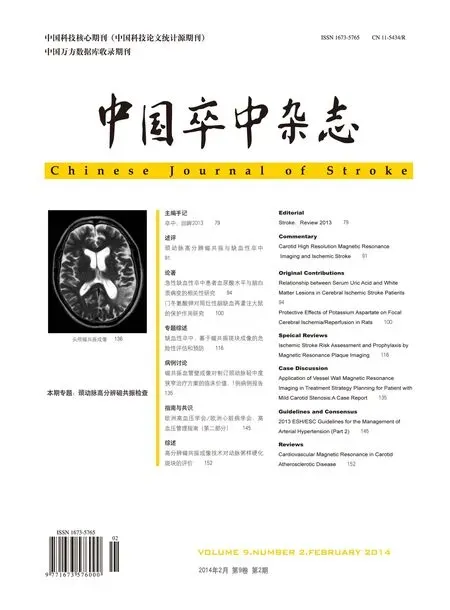
磁共振斑塊成像技術臨床應用的現在與未來
2014-01-21 12:51:21趙錫海宋焱李飛宇苑純
中國卒中雜志 2014年2期
關鍵詞:研究
趙錫海,宋焱,李飛宇,苑純,4
卒中現已成為我國城市居民致死性疾病的首要原因,如何有效預防與控制卒中是我國目前亟待解決的公共健康問題之一。缺血性卒中(ischemic stroke,IS)的主要責任病變是腦動脈粥樣硬化易損斑塊。因此,早期識別頸動脈易損斑塊并對其進行有效治療是卒中預防的關鍵。高分辨率磁共振(magnetic resonance,MR)斑塊成像技術自20世紀90年代研發至今,已被廣泛應用于頸動脈易損斑塊成像的相關研究中。MR斑塊成像技術能夠準確定性、定量分析頸動脈斑塊的負荷和成分特征,被認為是現階段識別頸動脈易損斑塊的最佳無創性影像學手段。研究顯示,應用MR斑塊成像獲得的腦動脈易損斑塊特征,對于卒中的病因學診斷、責任病變治療、預后判斷和二級預防均具有重要價值。隨著MR斑塊成像技術的進一步發展,其臨床應用前景會更為廣闊。
1 MR斑塊成像識別腦血管易損斑塊,有效預防缺血性卒中
腦血管粥樣硬化易損斑塊破裂引發的血栓栓塞,是IS的主要病因之一。因此,早期識別易損斑塊并對其進行有效干預,有利于IS的預防。引發卒中的責任病變多發生于腦組織上游的動脈血管床,如顱內動脈和顱外頸動脈等。Wong等[1]研究發現,中國人群IS患者中46.6%存在顱內大動脈狹窄,而西方人群IS多為顱外頸動脈易損斑塊所致。此外,一項小樣本研究顯示,國人癥狀性頸動脈斑塊更多表現為大脂質核、少鈣化[2]。這些中西方人群顱內外動脈粥樣硬化發病的差異可能與遺傳、環境、飲食、他汀類藥物使用等因素有關。因此,需要針對中國人群的發病特征制訂IS的預防策略。
目前,臨床上常應用各種血管成像技術[如超聲(ultrasound,US)、計算機斷層掃描血管造影(computed tomography angiography,CTA)、磁共振血管造影(magnetic resonance angiography,MRA)、數字減影血管造影(digital subtraction angiography,DSA)]測量動脈管腔狹窄程度,以此判斷病變的嚴重性。然而,由于動脈存在正性重構效應,僅依據管腔狹窄程度常低估動脈粥樣硬化病變的嚴重性[3]。近年有研究表明,多數易損斑塊僅造成管腔輕度狹窄[3-5]。Dong等[6]研究發現,狹窄程度為0%的無癥狀頸動脈中,6%~8%存在易損斑塊。因此,學者建議對動脈管壁進行直接成像,通過識別斑塊內部的成分特征評價斑塊的易損性。
MR斑塊成像技術在評價腦血管易損斑塊方面具有重要價值。與組織病理學對照研究顯示,MR二維、高分辨率斑塊成像幾乎能夠識別易損斑塊的所有組織學特征,如大脂質核薄纖維帽、斑塊內出血、炎癥反應與新生血管化等[7-11]。目前,有學者推薦應用三維成像技術對頸動脈進行成像,與二維技術相比,其縱向覆蓋范圍可以擴大至250 mm,且掃描時間明顯縮短[12]。對于顱內動脈易損斑塊成像,多數學者沿用顱外頸動脈MR斑塊成像技術[13-18]。有研究發現,癥狀性大腦中動脈斑塊更多表現為正性重構效應[16],斑塊內出血發生率達19.6%[18]。然而,由于顱內動脈位置深在、管徑小管壁薄、部分節段走行迂曲或缺乏脂肪和腦脊液等天然信號對比,對其管壁成像具有一定的挑戰。目前有學者研究開發三維管壁成像技術[19-20],以加快掃描速度、提高空間分辨率、更好抑制復雜血流,這也是顱內動脈易損斑塊成像的未來發展方向。
早期識別易損斑塊對于IS的預防具有重要意義。大量橫斷面研究證實,斑塊內出血、纖維帽破裂、表面潰瘍、大脂質核等頸動脈復雜斑塊磁共振表現特征與腦血管癥狀密切相關[21-25]。有學者發現,對于無癥狀人群,頸動脈斑塊內出血、纖維帽破裂、大脂質核等斑塊特征對于腦血管事件具有一定的預測價值[26-28]。一系列前瞻性研究顯示,頸動脈存在斑塊內出血或纖維帽破裂的腦血管病患者具有較高的復發風險[29-31]。
應用常規手段對IS患者進行篩查,仍有30%~40%的患者找不到明確原因[32],稱為隱源性卒中。近來有學者對32例頸動脈存在偏心性斑塊(<50%狹窄)的隱源性卒中患者進行MR管壁成像,發現12例(37.5%)存在易損斑塊[33]。另有研究證實,一部分隱源性卒中患者其主動脈弓存在易損斑塊[34]。這些研究結果提示我們,一部分“隱源性卒中”患者通過MR管壁成像有可能找到責任病變。
2 MR斑塊成像優化再血管化治療方案
根據《顱外段頸動脈狹窄治療指南》,癥狀性頸動脈重度狹窄的患者需要進行頸動脈內膜剝脫術(carotid endarterectomy,CEA)或頸動脈支架植入術(carotid artery stenting,CAS)[35]。血管的狹窄程度和斑塊纖維帽破裂是決定患者是否需要手術治療的兩個主要指征。DSA是頸動脈粥樣硬化患者手術適應證選擇的主要影像學檢查方法。DSA檢查的優勢在于可以清晰、動態地觀察主動脈弓至顱內的血管床的病變情況,并可以將檢查與治療融于一體。但DSA對動脈粥樣硬化病變的評估主要是判斷血管狹窄程度,而對斑塊形態學特點及組成成分的判斷能力有限,即使可以顯示斑塊纖維帽破裂,其敏感性和特異性也較低[36-37]。
在斜矢狀位管壁成像序列的輔助下,頸動脈MR斑塊成像能夠較為準確地識別頸動脈斑塊潰瘍[38]。有學者[39]就磁共振成像(magnetic resonance imaging,MRI)和DSA對頸動脈粥樣硬化患者手術適應證的選擇能力進行了比較,發現MR管壁成像較DSA可以更準確地判斷管腔狹窄程度,更敏感地檢出潰瘍斑塊,從而有助于協助臨床醫生準確地確定患者是否需要手術治療。尤其是當患者管腔狹窄程度為50%~70%時,是否需要手術治療更主要地取決于是否存在斑塊表面潰瘍。此時,MRI對斑塊表面潰瘍的精確檢出則有助于醫生制訂治療方案。
頸動脈MR斑塊成像可能有助于選擇再血管化治療的手術策略。對于頸動脈癥狀性重度狹窄的患者選擇CEA還是CAS手術治療一直存在爭議。有研究表明,斑塊內的不穩定成分(如脂質核和斑塊內出血),與CAS術中微栓子的形成有密切的關系[40]。因此,通過MR斑塊成像準確分析易損斑塊特征,有可能預防圍術期新發梗死。Yamada等[41]通過分析斑塊與胸鎖乳突肌的信號干擾比值(signal to interference ratio,SIR),發現當SIR≥1.25時,CAS手術出現微栓子的概率要明顯高于CEA。研究者分析認為,這種信號強度的斑塊多為富含脂質核或具有斑塊內出血等成分,并提出對于這種類型的斑塊適宜選擇CEA。如果該結論能通過大樣本的前瞻性研究得到進一步證實,則可借助MR成像對斑塊成分的分析,得以指導手術方案的選擇,提高患者的預后。
3 MR斑塊成像監測頸動脈斑塊他汀類藥物治療療效
對于頸動脈粥樣硬化輕中度狹窄的病變,臨床一般采用他汀類藥物治療。MR斑塊成像因其無創、無X線電離輻射、可重復性好等優勢,是目前評價頸動脈斑塊藥物治療療效最為可靠的手段。Corti等[42]最早應用MR成像觀察辛伐他汀治療頸動脈斑塊的療效,經過2年的治療,斑塊的體積明顯縮小、管腔增大。West等[43]則應用MR斑塊成像觀察股淺動脈斑塊在單獨使用依澤替米貝和聯合使用他汀后的變化,結果發現,單獨使用依澤替米貝并沒有抑制斑塊的進展,而在聯合使用他汀藥物的患者中,MR上測得的斑塊體積在2年內沒有進展。在Kawahara等[44]的研究中,應用MR斑塊成像監測胸主動脈和腹主動脈斑塊體積藥物治療前后的變化,結果發現阿托伐他汀和羥乙磷酸鹽聯合使用的效果要優于單獨使用阿托伐他汀。有研究者對接受了半年他汀治療的動脈粥樣硬化患者同時應用超聲和MR評估頸動脈斑塊的治療效果,結果發現,超聲測得的頸動脈內中膜厚度在治療前后并無顯著性變化,而MR測得的斑塊體積則明顯縮小,提示MR檢查在評價他汀類藥物療效方面可能比超聲更有優勢[45]。
近些年來隨著3.0 T磁共振成像設備的廣泛應用,除了斑塊形態外,MR還能夠準確定量分析斑塊內成分,如脂質核、纖維帽、出血等。在一項利用MR監測他汀類藥物長期治療頸動脈粥樣硬化病變的研究中,研究者發現,經過3年的治療,頸動脈斑塊內脂質核的體積和比例均明顯縮小。其中治療的第一年和第二年斑塊脂質核體積逐漸縮小,而到了第三年,脂質核體積并未繼續縮小,這可能會對未來臨床制訂他汀類藥物長期治療計劃有所幫助[46]。此外,MR還可以使用一些特異造影劑觀察斑塊內特定成分在藥物治療過程中的變化,如用超小順磁性超氧化鐵顆粒(ultrasmall superparamagnetic iron oxide,USPIO)觀察斑塊內巨噬細胞的情況。Patterson等[47]研究表明,在使用阿托伐他汀治療后,頸動脈斑塊對于USPIO的攝取在12周內出現了下降,提示斑塊內炎癥反應減弱。最近,有學者應用動態增強MR技術觀察頸動脈斑塊炎癥在他汀類藥物治療前后的變化,經過1年的治療,Ktrans值明顯下降。這一點提示他汀類藥物可能會降低斑塊新生血管化的程度[48]。
盡管MR斑塊成像對動脈粥樣硬化斑塊治療具有一定的指導意義,但患者是否具有遠期獲益、能否明顯降低腦血管事件還需大規模、前瞻性研究提供循證醫學證據。尤其是對于那些輕中度狹窄但具有易損斑塊特征的粥樣硬化病變(如大脂質核、斑塊內出血),需要臨床加以關注。
1 Wong KS, Li H, Chan YL, et al. Use of transcranial Doppler ultrasound to predict outcome in patients with intracranial large-artery occlusive disease[J]. Stroke,2000, 31:2641-2647.
2 Saam T, Cai JM, Cai YQ, et al. Carotid plaque composition differs between ethno-racial groups:An MRI pilot study comparing mainland Chinese and American Caucasian patients[J]. Arterioscler Thromb Vasc Biol, 2005, 25:611-616.
3 Falk E, Shah PK, Fuster V. Coronary plaque disruption[J]. Circulation, 1995, 92:657-671.
4 Saam T, Underhill HR, Chu B, et al. Prevalence of American Heart Association type VI carotid atherosclerotic lesions identified by magnetic resonance imaging for different levels of stenosis as measured by duplex ultrasound[J]. J Am Coll Cardiol, 2008, 51:1014-1021.
5 Zhao X, Underhill HR, Zhao Q, et al. Discriminating carotid atherosclerotic lesion severity by luminal stenosis and plaque burden:A comparison utilizing high-resolution magnetic resonance imaging at 3.0 tesla[J]. Stroke, 2011, 42:347-353.
6 Dong L, Underhill HR, Yu W, et al. Geometric and compositional appearance of atheroma in an angiographically normal carotid artery in patients with atherosclerosis[J]. AJNR Am J Neuroradiol, 2010,31:311-316.
7 Cai JM, Hatsukami TS, Ferguson MS, et al.Classification of human carotid atherosclerotic lesions with in vivo multicontrast magnetic resonance imaging[J]. Circulation, 2002, 106:1368-1373.
8 Saam T, Ferguson MS, Yarnykh VL, et al. Quantitative evaluation of carotid plaque composition by in vivo MRI[J]. Arterioscler Thromb Vasc Biol, 2005, 25:234-239.
9 Chu B, Kampschulte A, Ferguson MS, et al.Hemorrhage in the atherosclerotic carotid plaque:A high-resolution MRI study[J]. Stroke, 2004, 35:1079-1084.
10 Kerwin WS, O'Brien KD, Ferguson MS, et al.Inflammation in carotid atherosclerotic plaque:A dynamic contrast-enhanced MR imaging study[J].Radiology, 2006, 241:459-468.
11 Kerwin W, Hooker A, Spilker M, et al. Quantitative magnetic resonance imaging analysis of neovasculature volume in carotid atherosclerotic plaque[J]. Circulation,2003, 107:851-856.
12 Balu N, Yarnykh VL, Chu B, et al. Carotid plaque assessment using fast 3D isotropic resolution blackblood MRI[J]. Magn Reson Med, 2011, 65:627-637.
13 Swartz RH, Bhuta SS, Farb RI, et al. Intracranial arterial wall imaging using high-resolution 3-tesla contrast-enhanced MRI[J]. Neurology, 2009, 72:627-634.
14 Li ML, Xu WH, Song L, et al. Atherosclerosis of middle cerebral artery:Evaluation with high-resolution MR imaging at 3T[J]. Atherosclerosis, 2009, 204:447-452.
15 Niizuma K, Shimizu H, Takada S, et al. Middle cerebral artery plaque imaging using 3-tesla high-resolution MRI[J]. J Clin Neurosci, 2008, 15:1137-1141.
16 Xu WH, Li ML, Gao S, et al. In vivo high-resolution MR imaging of symptomatic and asymptomatic middle cerebral artery atherosclerotic stenosis[J].Atherosclerosis, 2010, 212:507-511.
17 Xu WH, Li ML, Gao S, et al. Plaque distribution of stenotic middle cerebral artery and its clinical relevance[J]. Stroke, 2011, 42:2957-2959.
18 Xu WH, Li ML, Gao S, et al. Middle cerebral artery intraplaque hemorrhage:Prevalence and clinical relevance[J]. Ann Neurol, 2012, 71:195-198.
19 Qiao Y, Steinman DA, Qin Q, et al. Intracranial arterial wall imaging using three-dimensional high isotropic resolution black blood MRI at 3.0 tesla[J]. J Magn Reson Imaging, 2011, 34:22-30.
20 Natori T, Sasaki M, Miyoshi M, et al. Evaluating middle cerebral artery atherosclerotic lesions in acute ischemic stroke using magnetic resonance T1-weighted 3-dimensional vessel wall imaging[J]. J Stroke Cerebrovasc Dis, 2013, [Epub ahead of print].
21 Parmar JP, Rogers WJ, Mugler JP, et al. Magnetic resonance imaging of carotid atherosclerotic plaque in clinically suspected acute transient ischemic attack and acute ischemic stroke[J]. Circulation, 2010, 122:2031-2038.
22 Homburg PJ, Rozie S, van Gils MJ, et al.Atherosclerotic plaque ulceration in the symptomatic internal carotid artery is associated with nonlacunar ischemic stroke[J]. Stroke, 2010, 41:1151-1156.
23 Sadat U, Weerakkody RA, Bowden DJ, et al. Utility of high resolution MR imaging to assess carotid plaque morphology:A comparison of acute symptomatic,recently symptomatic and asymptomatic patients with carotid artery disease[J]. Atherosclerosis, 2009,207:434-439.
24 Yuan C, Zhang SX, Polissar NL, et al. Identification of fibrous cap rupture with magnetic resonance imaging is highly associated with recent transient ischemic attack or stroke[J]. Circulation, 2002, 105:181-185.
25 Saam T, Cai J, Ma L, et al. Comparison of symptomatic and asymptomatic atherosclerotic carotid plaque features with in vivo MR imaging[J]. Radiology, 2006,240:464-472.
26 Takaya N, Yuan C, Chu B, et al. Association between carotid plaque characteristics and subsequent ischemic cerebrovascular events:A prospective assessment with MRI--initial results[J]. Stroke, 2006, 37:818-823.
27 Singh N, Moody AR, Gladstone DJ, et al. Moderate carotid artery stenosis:MR imaging-depicted intraplaque hemorrhage predicts risk of cerebrovascular ischemic events in asymptomatic men[J]. Radiology,2009, 252:502-508.
28 Mono ML, Karameshev A, Slotboom J, et al. Plaque characteristics of asymptomatic carotid stenosis and risk of stroke[J]. Cerebrovasc Dis, 2012, 34:343-350.
29 Kurosaki Y, Yoshida K, Endo H, et al. Association between carotid atherosclerosis plaque with high signal intensity on T1-weighted imaging and subsequent ipsilateral ischemic events[J]. Neurosurgery, 2011,68:62-67; discussion 67.
30 Yamada N, Higashi M, Otsubo R, et al. Association between signal hyperintensity on T1-weighted MR imaging of carotid plaques and ipsilateral ischemic events[J]. AJNR Am J Neuroradiol, 2007, 28:287-292.
31 Lindsay AC, Biasiolli L, Lee JM, et al. Plaque features associated with increased cerebral infarction after minor stroke and TIA:A prospective, case-control, 3-T carotid artery MR imaging study[J]. JACC Cardiovasc Imaging, 2012, 5:388-396.
32 Amarenco P. Underlying pathology of stroke of unknown cause (cryptogenic stroke)[J]. Cerebrovasc Dis, 2009, 27 Suppl 1:97-103.
33 Freilinger TM, Schindler A, Schmidt C, et al.Prevalence of nonstenosing, complicated atherosclerotic plaques in cryptogenic stroke[J]. JACC Cardiovasc Imaging, 2012, 5:397-405.
34 Stone DA, Hawke MW, LaMonte M, et al. Ulcerated atherosclerotic plaques in the thoracic aorta are associated with cryptogenic stroke:A multiplane transesophageal echocardiographic study[J]. Am Heart J, 1995, 130:105-108.
35 中華醫學會外科學分會血管外科學組. 顱外段頸動脈狹窄治療指南[J]. 中國實用外科雜志, 2008, 28:913-915.
36 Streifler JY, Eliasziw M, Fox AJ, et al. Angiographic detection of carotid plaque ulceration. Comparison with surgical observations in a multicenter study.North American Symptomatic Carotid Endarterectomy Trial[J]. Stroke, 1994, 25:1130-1132.
37 Rothwell PM, Gibson R, Warlow CP. Interrelation between plaque surface morphology and degree of stenosis on carotid angiograms and the risk of ischemic stroke in patients with symptomatic carotid stenosis.On behalf of the European Carotid Surgery Trialists'collaborative group[J]. Stroke, 2000, 31:615-621.
38 Yu W, Underhill HR, Ferguson MS, et al. The added value of longitudinal black-blood cardiovascular magnetic resonance angiography in the cross sectional identification of carotid atherosclerotic ulceration[J]. J Cardiovasc Magn Reson, 2009, 11:31.
39 Song Y, Chen M, Zhou C, et al. Comparison of cardiovascular MRI and DSA in the selection of stent-treatment for carotid atherosclerosis patients[J].Zhonghua Yi Xue Za Zhi, 2011, 91:1625-1629.
40 Henry M, Henry I, Klonaris C, et al. Benefits of cerebral protection during carotid stenting with the percusurge guardwire system:Midterm results[J]. J Endovasc Ther, 2002, 9:1-13.
41 Yamada K, Yoshimura S, Kawasaki M, et al. Embolic complications after carotid artery stenting or carotid endarterectomy are associated with tissue characteristics of carotid plaques evaluated by magnetic resonance imaging[J]. Atherosclerosis, 2011, 215:399-404.
42 Corti R, Fayad ZA, Fuster V, et al. Effects of lipidlowering by simvastatin on human atherosclerotic lesions:A longitudinal study by high-resolution,noninvasive magnetic resonance imaging[J].Circulation, 2001, 104:249-252.
43 West AM, Anderson JD, Meyer CH, et al. The effect of ezetimibe on peripheral arterial atherosclerosis depends upon statin use at baseline[J]. Atherosclerosis,2011, 218:156-162.
44 Kawahara T, Nishikawa M, Furusawa T, et al. Effect of atorvastatin and etidronate combination therapy on regression of aortic atherosclerotic plaques evaluated by magnetic resonance imaging[J]. J Atheroscler Thromb,2011, 18:384-395.
45 Migrino RQ, Bowers M, Harmann L, et al. Carotid plaque regression following 6-month statin therapy assessed by 3T cardiovascular magnetic resonance:Comparison with ultrasound intima media thickness[J]. J Cardiovasc Magn Reson, 2011, 13:37.
46 Zhao XQ, Dong L, Hatsukami T, et al. MR imaging of carotid plaque composition during lipid-lowering therapy:a prospective assessment of effect and time course[J]. JACC Cardiovasc Imaging, 2011, 4:977-986.
47 Patterson AJ, Tang TY, Graves MJ, et al. In vivo carotid plaque MRI using quantitative T2*measurements with ultrasmall superparamagnetic iron oxide particles:A dose-response study to statin therapy[J]. NMR Biomed,2011, 24:89-95.
48 Dong L, Kerwin WS, Chen H, et al. Carotid artery atherosclerosis:Effect of intensive lipid therapy on the vasa vasorum--evaluation by using dynamic contrastenhanced MR imaging[J]. Radiology, 2011, 260:224-231.
猜你喜歡
體育科技文獻通報(2022年3期)2022-05-23 13:46:54
天津外國語大學學報(2021年3期)2021-08-13 08:32:18
遼金歷史與考古(2021年0期)2021-07-29 01:06:54
科技傳播(2019年22期)2020-01-14 03:06:54
遼金歷史與考古(2019年0期)2020-01-06 07:45:20
民用飛機設計與研究(2019年4期)2019-05-21 07:21:24
電子制作(2018年11期)2018-08-04 03:26:04
汽車工程學報(2017年2期)2017-07-05 08:13:02
國際商務財會(2017年8期)2017-06-21 06:14:14
電子制作(2017年23期)2017-02-02 07:17:19