
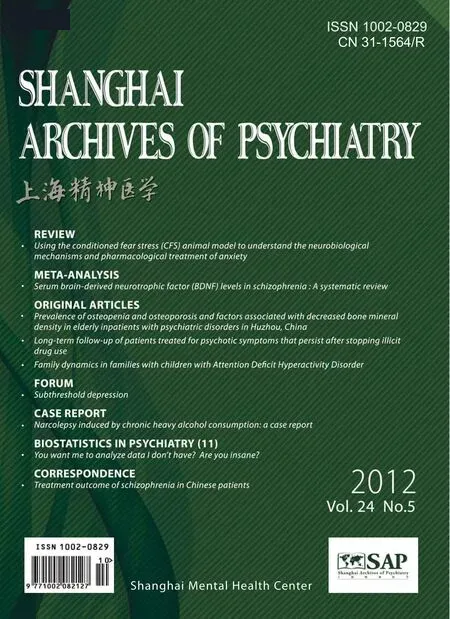
Narcolepsy induced by chronic heavy alcohol consumption: a case report
2012-07-08 02:15:19XinyuanWANG
上海精神醫學 2012年5期
Xinyuan WANG*
· Case report ·
Narcolepsy induced by chronic heavy alcohol consumption: a case report
Xinyuan WANG*
Summary: Narcolepsy is a chronic neurological disorder, characterized by uncontrollable excessive daytime sleepiness, cataplectic episodes, sleep paralysis, hypnagogic hallucinations, and night time sleep disruption. The paper reviewed the related literature and reported a case of long-term drinking induced narcolepsy which was significantly improved after treatment with paroxetine and dexzopiclone.
1. Case description
1.1 Preadmission history
The patient was a 39-year-old married male of Han ethnicity who worked as a daytime truck driver. In 2005, because of work-related stress he began to drink heavily in the evenings, consuming 250 to 500 ml of spirits. He was often intoxicated and typically slept only 3 to 4 hours before waking to start work the following day. He subsequently developed acute daytime drowsiness for periods of 10 minutes at a time while walking or driving. He also started experiencing episodes of sudden loss of motor power while fully conscious (cataplexy) that lasted for a few seconds at a time. And he had nighttime insomnia and nightmares. The symptoms were initially relatively mild, but he did have a car accident during an episode of narcolepsy. Over the next 3 years the symptoms gradually got worse; the intensity and frequency of episodes appeared related to the amount of alcohol he consumed. After 3 years of these symptoms he changed to a less stressful driving job and was able to gradually decrease his drinking without serious withdrawal symptoms. Over the subsequent 2 years the frequency of acute daytime drowsiness and cataplectic episodes decreased somewhat, but his nighttime insomnia remained. A two-week admission to a neurology inpatient service over this period did not result in any improvement in his condition.
1.2 Psychiatric admission and follow-up
In October 2011 he was voluntarily admitted to our hospital. He reported a 10-year history of alcohol abuse that had fluctuated in severity over time but he had completely stopped alcohol consumption 2 years previously because he felt drinking exacerbated his narcolepsy and cataplexy. Other than expressing worry about his narcolepsy and cataplexy there were no positive findings on the routine mental status examination on admission. He had elevated blood lipids but routine blood chemistry, CT, MRI, EEG and EKG examinations found no other abnormalities. A full sleep study found a total sleep time of 451 minutes, sleep efficiency of 83% (without sleep apnea), and a REM latency of 10.5 minutes; the percentage of REM was 69.8%, the percent lucid intervals was 17.5%, and the percentages of S1, S2 and S3 sleep were 3.8%, 0.5% and 8.4%, respectively.
Given an admission diagnosis of narcolepsy, the patient was treated with 20 mg paroxetine each morning and 3 mg dexzopiclone each evening. After one week of treatment, the number of both narcoleptic episodes and cataplectic episodes decreased. After one month of treatment the symptoms had resolved completely so he was discharged. He remained off alcohol after discharge. He continued the paroxetine and dexzopiclone for two months after discharge and then gradually stopped the medications. However, one month later the narcoleptic and cataplectic symptoms returned so he restarted the paroxetine (but not the dexzopiclone) and continued to take it daily. His narcoleptic and cataplectic symptoms resolved, his nocturnal sleep normalized (7 to 8 hours per night without nightmares), and he was able to return to fulltime work. The improvement has continued to the present – 6 months after restarting the paroxetine.
2. Discussion
Narcolepsy is a rare, chronic nervous system disease that usually includes acute daytime drowsiness, episodic cataplexy, sleep paralysis, hypnagogic hallucination and a disrupted sleep cycle. In a report of 35 patients with narcolepsy, Bai and colleagues[1]found that most patients had cataplexy, sleep paralysis and hypnagogic hallucinations and that the duration of the paroxysmal daytime sleep, which varied considerably, was longer in those with an earlier age of onset. Several abnormalities on the polysomnography examination (i.e., sleep EEG study) are indicative of narcolepsy:[2]a) sleep latency shorter than 10 minutes; b) REM latency shorter than 20 minutes; c) multiple sleep latency test (MSLT) showing an average sleep latency shorter than 5 minutes; or d) two or more episodes of sleep beginning with REM.
Narcolepsy was first reported and named by Gelineau in 1880 but the etiology remains unknown. It can be hereditary (in 10 to 30% of cases) or occur following various results to the central nervous system including cerebral trauma, viral infection, immune dysfunction, brain tumors, multiple sclerosis, or severe emotional stress. Chronic heavy alcohol use can cause widespread damage to the central nervous system so it may also be a cause of narcolepsy. The exact mechanism for inducing paroxysmal sleep is uncertain, but studies have shown that stimulation of the posterior hypothalamus inhibits the reticular activating system and, thus, induces sleep.[2]The finding of early initiation of REM suggests that melatonin may play a role in the disorder.[3]Some patients have elevated dopamine D2 receptor and L-dopa (the metabolite of dopamine) and increased serotonin activity in the amygdaloid nucleus or the corpus striatum. Many individuals with narcolepsy have a specific HLA-2 allele (human leukocyte antigen DQB1*0602 allele).[4]
The patient described in this case report had several of the cardinal symptoms of narcolepsy: a) uncontrollable excessive daytime drowsiness; b) cataplexy (which was more serious with emotional excitation); c) disrupted nocturnal sleep; and d) REM latency of less than 20 minutes. These clinical characteristics are similar to those described in the literature and are listed as diagnostic criteria of narcolepsy in the 1997 International Classification of Sleep Disorders.[5]Despite a long history of drinking, the patient had stopped drinking two years prior to admission, so at the time of admission he did not have a concurrent diagnosis of alcohol abuse, alcohol dependence or alcohol withdrawal.[6]
The treatment of narcolepsy is mainly symptomatic, aimed at suppressing symptoms and improving patients’quality of life.[7]The most common modalities include stimulants and behavioral therapy to reduce acute daytime drowsiness, antidepressants to decrease episodes of cataplexy and other REM-related symptoms, and sedatives to improve the quality of nocturnal sleep.[8-10]In this case the combination of the antidepressant paroxetine (a selective serotonin reuptake inhibitor) and dexzopiclone (a non-benzodiazapine hypnotic) controlled the symptoms but – despite full withdrawal from alcohol – the narcolepsy and catalepsy symptoms recurred when the medications were stopped so the patient had to be continuously treated with paroxetine. This suggests that chronic heavy alcohol use precipitated the initial episodes of narcolepsy and catalepsy – perhaps by inhibiting the central nervous system’s reticular activating system – but was no longer necessary to sustain the disorder after it had started. Alternatively, it is also possible that the alcohol abuse and narcolepsy were initially independent comorbid conditions.
Acknowledgment
The patient provided written informed consent to publish this case history.
1. Bai XL, Wang ZY. Clinical feature of 35 patients with narcolepsy.Chin J Nerv Ment Dis2000; 26(4): 252-253. (in Chinese)
2. Song YB, Wei JL. Analysis of 23 cases of narcolepsy.China Prac Med2010; 5(32): 56-57. (in Chinese)
3. Sandyr R. The Pineal gland catalepsy and multiple sclerosis.Int J Neurosei1995; 83(3-4): 152-153.
4. Overeem S, Mignot E, van Dijk JG, Lammers GJ. Narolepsy: clinical features, new pathophysiologic insights, and future perspectives.J Clin Neurophysiol2001, 18(2): 78-105.
5. Pan JY.Clinical Diagnosis and Therapy for Sleep Disorders.Guangzhou: South China University of Technology Press, 2001: 142-143. (in Chinese)
6. International Statistical Classification of Disease and Related Health Problems 10th Revision (ICD-10) Version for 2010. http://apps.who.int/classifications/icd10/browse/2010/en#/V [Accessed 31 August, 2012]
7. Zhang Y, Shen F. Progress and therapy for narcolepsy.J Med Res2010; 39 (9): 117-118. (in Chinese)
8. Dauvilliers Y, Arnulf I, Mignot E. Narcolepsy with cataplexy.Lancet2007; 369 (9560): 499-511.
9. Billiard M. Narcolepsy: current treatment options and future approaches.Neuropsychiatr Dis Treat2008; 4(3): 557-566.
10. Nishino S, Okuro M. Emerging treatments for narcolepsy and its related disorders.Expert Opin Emerg Drugs2010; 15(1): 139-158.

Dr. Xinyuan Wang graduated from Xinjiang Medical University in 1985 and received a Master’s of Medical Science in 2002. He is currently a chief psychiatrist and head of the Sleep Research and Treatment Center at the Urumuchi Mental Health Center. He is an executive member of the Xinjiang Society of Psychiatry and a member of the Expert Committee on Sleep Disorders of the Chinese Medical Association. His current research interests are in the various sleep disorders that occur in individuals with other psychiatric disorders.
10.3969/j.issn.1002-0829.2012.05.010
The Fourth Hospital of Urumqi, Urumuqi, Xinjiang Province, China
*correspondence: wxyuan01@126.com
- 上海精神醫學的其它文章
- Treatment outcome of schizophrenia in Chinese patients
- You want me to analyze data I don’t have? Are you insane?
- Understanding subthreshold depression
- Differentiation of various forms of depression
- Distinguishing subclinical (subthreshold) depression from the residual symptoms of major depression
- Are subsyndromal symptomatic depression and major depressive disorder distinct disorders?