
Are subsyndromal symptomatic depression and major depressive disorder distinct disorders?
2012-07-08 02:15:19ZhenghuiYIYiruFANG
上海精神醫(yī)學(xué) 2012年5期
Zhenghui YI, Yiru FANG*
· Forum ·
Are subsyndromal symptomatic depression and major depressive disorder distinct disorders?
Zhenghui YI, Yiru FANG*
Subthreshold depression
Depressive conditions that do not meet full symptomatic or duration criteria for a major depressive disorder (MDD) are of considerable interest to both clinicians and researchers.[1-4]The fourth edition of the American Psychiatric AssociationDiagnostic and Statistical Manual of Mental Disorders(DSM-IV) provides descriptions of several types of subthreshold depressive states including dysthymia, minor depression and recurrent brief depression; but many individuals with subthreshold depression and associated impaired functioning do not meet DSM-IV diagnostic criteria for any of these disorders.[3]To cover these cases Judd and colleagues[4]proposed the concept of ‘Subsyndromal Symptomatic Depression’ (SSD) for individuals without depressed affect or anhedonia who have two or more (but less than five) of the other seven symptoms of depression that have been present for most of the time for at least two weeks and that are associated with impaired social functioning.[3,4]The appropriate diagnosis and treatment of individuals with this type of subthreshold depression will require a better understanding of the relationship between SSD and MDD. Are they independent disorders or is SSD a transitional state on the road to MDD?
SSD is a relatively common condition. Based on the Epidemiological Catchment Area study in the United States, Judd and colleagues estimated a 12-month prevalence of SSD of 8.4% in the general population; the prevalence in women was double that in men and was particularly high in women who were unmarried and unemployed.[5]A study in Australia reported a 12.9% prevalence in the general population and found that the quality of life for persons with SDD was intermediate, between that for persons without any depressive symptoms and that for persons who met criteria for MDD.[6]A survey of people aged 60 and above in Singapore found that SSD was more common in individuals with a lower socioeconomic status and was often associated with cognitive impairment, anxiety, poor physical health, and poor social functioning.[7]
The clinical presentation of SSD is similar to that for other types of depressive disorders.[5]Common symptoms include sleep disturbances (44.7%), prolonged fatigue (42.1%), repetitive thoughts of death (31%), and difficulty concentrating (22.7%). Atypical symptoms such as weight gain, slowed thinking and hypersomnia are somewhat more common in individuals with SSD than in those with minor depression. Risk of suicide is lower among SSD patients than in patients with minor depression or major depressive disorder.[5]
In China, Li and colleagues[8]report that common symptoms in SSD include hypersomnia, fatigue, difficulty concentrating, increased appetite, and slowed thinking. These symptoms are also common in physical illnesses, so many individuals with SSD seek treatment from the internal medicine departments of general hospitals, which delays the diagnosis and treatment of the SSD. Li and colleagues also compared SSD and MDD and found no differences in the reported quality of marriage and in the rates of suicide attempts.[8]However, they also reported individuals with SSD were more likely than those with MDD to be female, had a higher educational level, were more likely to seek treatment from departments of internal medicine (rather than from mental health services), and had fewer days out of role but more days in which they felt unproductive in the prior year.[8]
Research on SSD in China has also considered potential biological markers that could distinguish it from other depressive conditions. Cheng and colleagues[9]found that abnormal sympathetic skin responses are more likely to occur in SSD patients than in normal controls. Using the classification of gene expression profiles from peripheral blood leukocytes, Yi and colleagues[10]found that the gene expression profiles in SSD patients were differentfrom those in healthy control subjects and from those in MDD patients; based on these findings they built a 48-gene expression signature model that could potentially serve as diagnostic biomarkers of SSD and MDD. Studies from Professor Yiru Fang’s team[11,12]conclude that the etiological mechanism of SSD involves neuroendocrine, neuroimmune, and neurotrophic factors that influence several components in the neurotransmission process including neuroreceptors, G protein, intraneuron signal transmission, gene translation, and the synthesis of proteins and neuropeptides. Their findings support the hypothesis that SSD is related to abnormalities in neuron apoptosis. They find underexpression of Bcl-12 and brain-derived neurotrophic factor (BDNF),[11,12]which are directly related to the differentiation and survival of neurons and to synaptic development.[13]
A three-year follow-up study conducted 15 years ago found that the remission rates in SSD (defined as no symptoms or only one symptom of depression) are similar to those in MDD (57% remitted in both groups).[14]Despite this parallelism, some researchers now think SSD should be considered a stand-alone condition that may or may not co-exist with MDD. Research from our team in China supports this view. Significant heterogeneity between SSD and MDD in personality traits, neurobiochemical characteristics,[15]and gene expression suggests that they do not belong to the same spectrum of disease and should therefore be treated as independent mental disorders.
1. Baumeister H. A clinical significance criterion is essential for diagnosing subthreshold depression.Am J Psychiatry2010; 167(7): 866.
2. Ayuso-Mateos JL, Nuevo R, Verdes E, Naidoo N, Chatterji S. From depressive symptoms to depressive disorders: the relevance of thresholds.Br J Psychiatry2010; 196(5): 365-371.
3. Karsten J, Hartman CA, Ormel J, Nolen WA, Penninx BW. Subthreshold depression based on functional impairment better defined by symptom severity than by number of DSM-IV symptoms.J Affect Disord2010; 123(1-3): 230-237.
4. Judd LL, Rapaport MH, Paulus MP, Brown JL. Subsyndromal symptomatic depression: a new mood disorder?J Clin Psychiatry1994; 55(Suppl): 18-28.
5. Judd LL, Akiskal HS, Paulus MP. The role and clinical significance of subsyndromal depressive symptoms (SSD) in unipolar major depressive disorder.J Affect Disord1997; 45(1-2): 5-18.
6. Goldney RD, Fisher LJ, Dal Grande E, Taylor AW. Subsyndromal depression: prevalence, use of health services and quality of life in an Australian population.Soc Psychiatry Psychiatr Epidemiol2004; 39(4): 293-298.
7. Chuan SK, Kumar R, Matthew N, Heok KE, Pin NT. Subsyndromal depression in old age: clinical significance and impact in a multi-ethnic community sample of elderly Singaporeans.Int Psychogeriatr2008; 20(1): 188-200.
8. Li YY, Tu JY, Shi YC, Ji JL. Sub-syndromal Symptomatic Depression.Chinese Mental Health Journal2002; 12(10): 66-69. (in Chinese)
9. Cheng J, Chen HM, Wang LN, Li H. Study of sympathetic skin response of subsyndromal symptomatic depression.Journal of Clinical Electroneurophysiology2007; 16(1): 33-34. (in Chinese)
10. Yi Z, Li Z, Yu S, Yuan C, Hong W, Wang Z, et al. Blood-based gene expression profiles models for classification of subsyndromal symptomatic depression and major depressive disorder.PLoS One2012; 7(2): e31283.
11. Li ZZ, Zhang C, Hong W, Yuan CM, Yi ZH, Wang ZW, et al. Bcl-2 gene expression in subsyndrome depression.Chin J Nerv Ment Dis2011; 37(5): 307-308. (in Chinese)
12. Li ZZ, Yu SY, Hong W, Wang ZW, Yuan CM, Yi ZH, et al. Brainderived neurotrophic factor expression in peripheral leukocytes of patients with subsyndromal symptomatic depression.Chin J Psychiatry2011; 44(1): 3-6. (in Chinese)
13. Kuipers SD, Bramham CR. Brain-derived neurotrophic factor mechanisms and function in adult synaptic plasticity: new insights and implications for therapy.Curr Opin Drug Discov Devel2006; 9(5): 580-586.
14. Maier W, G?nsicke M, Weiffenbach O. The relationship between major and subthreshold variants of unipolar depression.J Affect Disord1997; 45(1-2): 41-51.
15. Li YY, Tu JY, Chen DY, Ji JL. The biology study of subsyndromal depressive symptoms.Chin J Nerv Ment Dis2003; 29(2): 130-132. (in Chinese)

Dr. Zhenghui Yi graduated from Hunan Medical University in 1992 and subsequently received a Masters and Ph.D. from Shanghai Jiao Tong University, majoring in Mood Disorders and Mental Health. He is currently Vice-director of the Division of General Psychiatry and Director of the Program on Co-morbid Conditions in the Division of Mood Disorders at the Shanghai Mental Health Center of the Shanghai Jiao Tong University. His primary research interests are in the molecular genetics of mood disorders and schizophrenia.
10.3969/j.issn.1002-0829.2012.05.006
Division of Mood Disorders, Shanghai Mental Health Center, Shanghai Jiao Tong University School of Medicine, Shanghai, China
*correspondence: yirufang@yahoo.com.cn
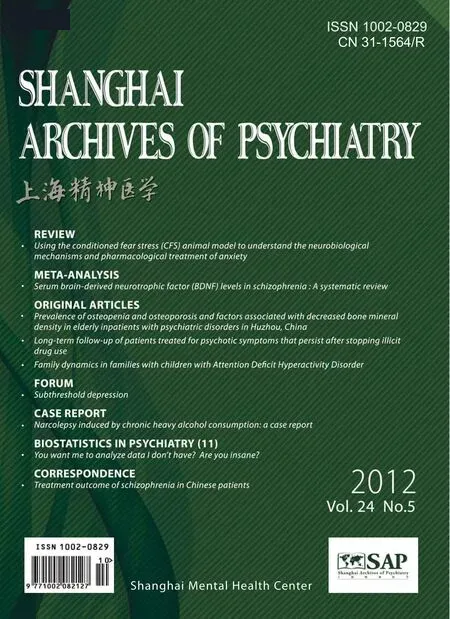
- 上海精神醫(yī)學(xué)的其它文章
- Treatment outcome of schizophrenia in Chinese patients
- You want me to analyze data I don’t have? Are you insane?
- Narcolepsy induced by chronic heavy alcohol consumption: a case report
- Understanding subthreshold depression
- Differentiation of various forms of depression
- Distinguishing subclinical (subthreshold) depression from the residual symptoms of major depression