高效多功能空氣凈化機對可吸入顆粒物、氣態甲醛和白葡萄球菌的凈化效果測試
2012-04-17 07:59:02張宗久張陽德李異凡
中國現代醫學雜志 2012年10期
謝 天,張宗久,張陽德,李異凡
Air quality,especially indoor air quality(IAQ),is an important determinant of human health,comfort and productivity.People are exposed to numerous ambient pollutants originating from the building and people’s activities,such as particulates,volatile organic compounds,and harmfulmicroorganisms.These pollutants can reduce the IAQ and cause various types of adverse health effects[1].
Ambient inhalable particulates(IP)are generally defined as particulates being less than 10 mm in aerodynamic diameter,and cause a variety of adverse cardiovascular reactions,including increased vascular tension,atherosclerosis,autonomic nervous effects and oxidative stress[2-3].Recent epidemiological studies have linked IP exposure to increased the morbidity and mortality rates for cardiovascular diseases.According to statistics released in February 2004 by the Division of Air Pollution in the Department of Pollution Prevention and Control in Chinese Ministry of Environmental Protection,particulatematter(PM)is currently themost significant component of air pollution in Chinese cities.
Gaseous formaldehyde is major volatile organic compound of indoor air contaminants,exists extensively in modern building materials and household products. The removal of gaseous formaldehyde is vital for improving the IAQ and human health due to the asthma attacks and carcinogenic risk[4].
The IAQ in hospitals generally meet a higher standard than which in other living environments.Microbial aerosols are themajor cause of airborne infections in hospitals,and therefore the focus of hospital air-quality testing and disinfection procedures.The traditional static methods for disinfecting air,such as ultraviolet exposure,ozone disinfection,or formaldehyde fumigation,can only temporarily disinfect the air because of ineffectiveness in removing the PM including IP.The normalmedical activities would cause the number of bacterial colonies in the disinfected air to increase again[5-7].Modern medical science requires hospitals to continuouslymaintain clean indoor air,especially in medical practices.Traditional disinfection methods cannot meet these modern medical requirements.Developingmethods that are safe,effective and economical for disinfecting air to reduce the infection rate inside hospitals has always been a concern for bothmedical and disinfection professionals[8].
Methods for dynamic air purification and disinfection have been developed in recent years,in particular air purifiers and laminar flow systems.However, because of the high cost to production and maintenance,the laminar-flow air-cleaning systems are not practicable for wide use in hospitals and homes under current economic conditions in China.Air purifiers have been used to disinfect and purify air in cycles and attracted the attention of many researchers.Remarkably,an integrated adsorption/electrostatic-field air purifier possesses the electrostatic surface to adsorb PM and bacteria from the air,the high-voltage electricity to kill the bacteria,and the activated-carbon surface to adsorb gaseous formaldehyde and other toxic gases.Because the purification system combines the advantages of physical adsorption and electrostatic field with continuous ventilation,the purifier satisfies the need for continuous air purification in an active environment.In addition,the purification efficiency of the purifier is higher than that ofmost other air purifiers[9].However,ithasa disadvantage in the chemical elimination of organic compounds.Researchers recently discovered that using photocatalysis to degrade organic compounds yieldedmore satisfactory results[10-11].
The objective of this study was to evaluate the effectiveness of the newly independently-developed multifunctional air purifier(ID purifier)and the commercial adsorption/electrostatic-field TA100 air purifier(TA100 purifier)in removing IP,gaseous formaldehyde and staphylococcus albus,in the simulated the indoor air in hospital environment.
1 M aterials and methods
1.1Air-purificationsystems
Two air purifiers,ID purifier and TA100 purifier, were tested in this study,which are both capable of purifying air at a rate of 100 m3/hr.ID purifier is the independently-developed multifunctional air purifier, which incorporated a fan,a dual-zone high-voltage electric field,a TiO2-based nano-photocatalysts chamber and the long-term activated carbon fiber filters(Figure).The purifier has been designed to combine multiple purification technologies to reduce the levels of PM,harmful gases and pathogens in indoor air.The TA100 air purifier was commercial adsorption/electrostatic-field air purifier(Broad Air Conditioning Co.,Ltd.of Changsha,China).
1.2Experimentalenvironment
To test the efficiency of removing IP or gaseous formaldehyde,the purifiers were installed in identical on-site simulation air laboratories each with the space volume of 60(5×4×3)m3.Experiment room A was used as a control,room B was used to test the ID purifier,and room C was used to test the TA100 purifier. The purifiers were placed in the experimental rooms at a height of 0.8 m.The temperature in each of the experiment rooms was between 13.5℃and 13.8℃, the relative humidity was between 58.8%and 59.7% and the air pressure was 102.4 kPa.
To test the efficiency of removing staphylococcus albus,the purifierswere installed in three aerosol laboratorieseachwith the space volume of60(5×4×3)m3. The same experiment group as above-mentioned was carried.The temperature in each laboratory was between 20℃and 22℃,and the relative humidity was between 56%and 65%.
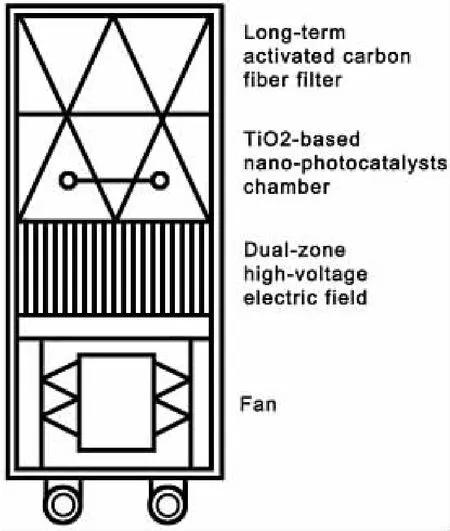
Figure The new ly independently-developed multifunctional air purifier used in this study
The results were evaluated against the standards set in the Disinfection Technique Guide(2002 edition) and the GB/T18883-2002 Indoor Air Quality Standard Implementation Guide.
1.3EfficiencyofremovingIP
The IP mainly containing silica were raised by the electric fans for one hour.The concentrations of IP in the air of each of the experiment rooms weremeasured before and after purification for one or two hours by the piezoelectric-balance dustmeter(model 3511).The percentage efficiency of the removing IP was calculated using the following formula:Purification efficiency(PE,%)=(V0-Vt)/V0×100%where V0=the concentration of IP before purification;Vt=the concentration of IP at the given time point during purification.
1.4Efficiencyofremovinggaseousformaldehyde
The formaldehyde with analytical-reagent grade was volatilized by the electric fans for one hour.The concentrations of gaseous formaldehydeweremeasured before and after purification for one or two hours by the formaldehyde analyzer(model 4160).The percentage efficiency of the removing gaseous formaldehyde was calculated using the following formula:PE(%)= (V0-Vt)/V0×100%where V0=the concentration of gaseous formaldehyde before purification;Vt=the concentration of gaseous formaldehyde at the given time point during purification.
1.5EfficiencyofremovingStaphylococcusalbus
Ten milliliter of Staphylococcus albus 8032(provided by the Academy of Military Medical Sciences) was atomized by the sterilized sprayers.The FA-1 multistage air samplers were placed in 1 m above the floor in the center of each experiment room,and the air flow of vacuum pump was adjusted to 28.3 mL/min. Three replicated samples were collected over a period of 10 seconds at the same time in each experiment room.The agar plate cultures carrying the samples were incubated for 48 hours at 37℃.After incubation,themicrobial colonies on each plate were quantified in terms of colony-forming units per cubic meter of air.The percentage efficiency of the removing staphylococcus albus was calculated using the follow-ing formula:PE(%)=(V0-Vt)/V0×100%where V0= the concentration of staphylococcus albus before purification;Vt=the concentration of staphylococcus albus at the given time point during purification.
1.6Statisticalanalysis
At least three replicateswere done for each condition.Data were represented as a mean±standard deviation.A two-way ANOVA was used to determine the purification effects of purifiers,operation time,and their possible interaction.APvalue of<0.05 was considered significant.Statistical analysis was done with the SPSS package(version 13.0;SPSS S.L., Madrid,Spain).
2 Results
2.1EfficiencyofremovingIP
As shown in Table 1,the steady-statemass concentrations of IP in the test room were 0.29~0.30mg/m3before purification.When the TA100 purifier was operated in the room C for one hour,the mass concentration significantly reduced from(0.30±0.03)mg/m3to (0.16±0.05)mg/m3[(46.13%±9.99%)PE].After two
hours,the mass concentration in the room C had de
creased to(0.07±0.01)mg/m3[(76.43±9.03)%PE]. The mass concentration in room B was(0.27±0.04) mg/m3before the ID purifier was operated,and then decreased to(0.12±0.03)mg/m3[(54.56±7.37)%PE]at one hour and to(0.05±0.02)mg/m3[(81.07±9.42)% PE]at two hour.In the IP removal tests,the ID purifier was shown to be more effective than the TA100 purifier in removing the mass concentration of IP, reaching the mean purification efficiency in excess of 81.07%(P<0.05).
2.2Efficiencyofremovinggaseousformaldehyde
As shown in Table 2,the concentration of gaseous formaldehyde did not naturaly reduce in control group.When the ID purifier was operated,the concentration of gaseous formaldehyde was significantly decreased from(0.34±0.05)mg/m3to(0.11± 0.01)mg/m3[(66.93±6.62)%PE]at one hour and (0.05±0.01)mg/m3[(84.97±4.34)%PE]at two hour. When the TA100 purifier was operated,%PE was (25.65±4.30)%at one hour and(65.22±6.84)%at two hour.The%PE for the removal of gaseous formalde-hyde of the ID purifier was even higher than that of the TA100(P<0.05).

Table 1 Purification efficiency for removal of IP(x±s D)

Table 2 Purification efficiency for removal of gaseous formaldehyde(x±s D)

Table 3 Purification efficiency for removal of staphylococcus albus(x±s D)
2.3Efficiencyofstaphylococcusalbusremoval
The results of the tests carried outwith Staphylococcus albus were shown in Table 3.The natural death rate of staphylococcus albus in the control room A was 46.76%.When the ID purifier was operated in the room B for one hour,the concentration of staphylococcus albus significantly reduced from(2.96±0.03) ×105CFU/m3to(2.54±0.03)×102(99.91%PE).Two hours after both the ID purifier and the TA100 purifier were operated,the concentration of aerosols of staphylococcus albus had decreased significantly, reaching 99.99%PE and 99.59%PE respectively.
3 Discussion
Several traditional air-purification methods,including physical adsorption,electrostatic adsorption, chemical elimination and UV disinfection,are designed to solve the problems of indoor air,but they have some drawbacks.Physical adsorption systems only filter particles,without being able to remove harmful gases and bacteria.Electrostatic adsorption systems require regular cleaning in order to hold the efficiency of dust collection[12].Chemical elimination products sometimes cause secondary contamination.Ozone disinfection involves a high level of oxidization,which can cause upper respiratory tract inflammation[13].In addition,it was reported that after 20 minutes of ozone disinfection in a closed hospital operating room,the bacteria counts for the air were 4.16 times and 3.38 times higher than the hygiene standards after a first and a second operation,respectively[14].After air has been disinfected using any of thesemethods,the concentrations of bacteria,breathable particulates and formaldehyde in the air rise again quickly.Therefore, thesemethods cannotmaintain air cleaning thatmeets the standards for indoor air in environments where people are living and working,especially in hospital[15].
Present results show that the operation of ID air purifier can improve the IAQ in rooms simulated the indoor air in hospital environment.The ID purifier incorporated the dual-zone high-voltage electric field, the TiO2-based nano-photocatalysts chamber and the long-term activated carbon fiber filters to degrade various organic compounds.In addition,the ID purifier used the fan to keep air ventilation into the system, so was suitable for use in the environments for activities.Zhou et al compared the formaldehyde-removal performance of a number of indoor-air purification products and found that integrated adsorption/electrostatic air purifiers performed better than previous purifying systems[16].
The present study compared the purifying efficiency of the ID purifier and the integrated adsorption/electrostatic-field TA100 air purifier.With these sources the effects of the ID purifier and TA100 purifier were enhanced with the increase in the operation time.The IP reduction rates for two hours of the TA100 purifier and ID purifier were 73.6% and 77.9%respectively,which exceeds the standard of 50%purifying efficiency required by GB/T18801-2002.Both air purifiers had a staphylococcus albus kill rate over 90%,meeting the requirements of the second edition of the Disinfection Technique Guide of Chinese Ministry of Health.In addition,their gaseous formaldehyde-removal efficiency was also comparable with previously reported results.The removal rates of gaseous formaldehyde were 27%for the TA100 purifier and 40%for the ID purifier in one hour,which are both higher than the rates reported for electrostaticadsorption purifiers(19%),physical-adsorption purifiers(15%)and chemical-elimination purifiers(12%). By taking the same samples,the ID purifier indicated more powerful and effective purification compared with the TA100 purifier,because of the TiO2-based nano-photocatalysts chamber in the ID purifier.This advantagemakes the ID purifiermore suitable for use in hospital environments,which have more severe air pollution.However,the removal efficiency of the ID purifier in such complex environments requires further study.
In summary,these results indicate that the ID purifier had satisfactory efficiency values for removing all of the contaminants tested,especially control aerosols ofmicro-organism used as the staphylococcus albusmodel.The ID purifier would be an ideal choice for operation as sterilizing device in hospitals and other environments thathave high air-quality requirements.
[1]BROOK RD.Is air pollution a cause of cardiovascular disease:updated review and controversies[J].Rev Environ Health,2007,22: 115-137.
[2]DOCKERY DW,SCHWART J,SPENGLER JD.Air pollution and daily mortality:associations with particulates and acid aerosol[J]. Environ Res,1992,59(2):362-373.
[3]MAIER KL,ALESSANDRINIF,BECK-SPEIER I,et al.Health effects of ambient particulate matter—biologicalmechanisms and inflammatory responses to in vitro and in vivo particle exposures[J]. Inhal Toxicol,2008,20(3):319-337.
[4]SARIGIANNISDA,KARAKITSIOSSP,GOTTIA,et al.Exposure to major volatile organic compounds and carbonyls in European indoor environments and associated health risk[J].Environ Int,2011,37(4): 743-765.
[5]MILLER KA,SISCOVICK DS,et al.Long-term exposure to air pollution and incidence of cardiovascular events in women[J].NEW ENGL.JMED,2007,356(5):447-458.
[6]COLLINS JJ.Formaldehyde exposure and leukaemia[J].Occup Environ Med,2004,61(11):875-876.
[7]ZHANG L,STEINMAUS C,EASTMOND DA,et al.Formaldehyde exposure and leukemia:a new meta-analysis and potentialmechanisms[J].Mutat Res,2009,681(2-3):150-168.
[8]TANG GW,LI JC,ZHU WJ.Observation on efficacy of ultraviolet rays in disinfection of air on burn ward[J].Chinese Journal of Disinfection,2004,21(4):349.
[9]KOLARIK J,WARGOCKI P.Can a photocatalytic air purifier be used to improve the perceived air quality indoors?[J].Indoor Air, 2010,20(3):255-262.
[10]HODGSON,A.T.,DESTAILLATS,H.,SULLIVAN,D.P.,et al.Performance of ultraviolet photocatalytic oxidation for indoor air cleaning applications[J].Indoor Air,2007,17:305–316.
[11]CHEN,W.AND ZHANG,J.S.UV-PCO device for indoor VOCs removal:investigation on multiple compounds effect[J].Build.Environ.,2008,43:246–252.
[12]SUN YQ,MAO J,ZHANG F,et al.Observation on efficacy of electrostatic adsorption air sterilizer in effect of indoor air dynamic strains[J].Chinese Journal of Current Traditional and Western Medicine,2006,4(11):968-969.
[13]BEKO,G.,HALAS,O.,CLAUSEN,G.,et al.Initial studies of oxidation processes on filter surfaces and their impact on perceived air quality[J].Indoor Air,2006,16:56–64.
[14]GAN CH,YANG XY,YAO H.Air disinfection and bacteria detection between operations[J].China Journal of Modern Medicine, 2004,14(16):146-148.
[15]ZHAO JZ,SONGWM.The distributing character and composition of ultrafine particles and its effects on human health[J].Journal of Environmental and Occupational Medicine,2007,24(1):76-79.
[16]ZHOU CL,LIYH,RAO J,et al.Investigation on indoor air pollution in new-decorated houses of hunan[J].Chinese Journal of Public Health Engineering,2007,6(5):280-283.