· In this issue ·
2012-04-12 07:56:20
上海精神醫學 2012年6期
· In this issue ·
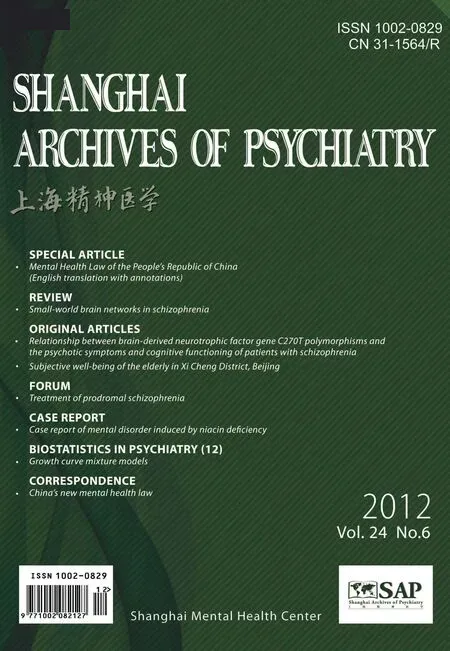
This issue starts with a translated and annotated version of the ‘Mental Health Law of the People’s Republic of China.’[1]This law, the first national mental health law in China, was approved by the Standing Committee of the National People’s Congress on 26 October 2012 and will go into effect on 1 May 2013. Twenty-seven years in the making, the law will fundamentally change the trajectory of mental health services in the country over the coming decades. It covers a very wide range of issues including primary prevention, criteria for involuntary treatment, community-based rehabilitation, definitions of professional roles, the responsibilities of guardians and other stakeholders, social welfare support for patients and their families, and penalties for noncompliance. The major changes envisioned in the Law are to convert the majority of involuntary inpatient admissions (at present the family – not the individual– makes the decision about admission) to voluntary admissions and to change the focus of treatment from specialty psychiatric hospitals, which are primarily situated in urban areas, to community-based health centers. Achieving these aspirational goals will require the subsequent development of detailed regulations, ongoing scientific assessment of alternative strategies, a substantial increase in the workforce available for providing mental health services and, most importantly, political will at both the national and local level. The lessons that China learns as it moves towards these goals will be of value to other low- and middle-income countries as they try to address the common problem of promoting the mental health of their citizens.
Active debate about the law and about the downstream effects of the different components of the law will be essential to ensuring that the law realizes its goal of improving mental health. The correspondence section of this issue includes three letters about the law: Xihe Liu,[2]the first major advocate for a national law in the country, helps put the law in its historical context; Kate Diesfeld and Graham Mellsop[3]provide an international perspective on the law, emphasizing cross-national differences in approaches to involuntary treatment; and Ziqing Zhu[4]discusses the law’s regulations about the prevention and rehabilitation of mental disorders. TheShanghai Archives of Psychiatrywill continue to promote active discussion of the law and comparison with statutes in other countries. We encourage both Chinese and international readers to submit letters or commentaries about the law.
The review paper in this issue by Mingli Li and colleagues[5]presents the current status of our understanding of ‘small-world brain networks’ as they apply to schizophrenia. The integration of advanced neuroimaging techniques with graph theoretical analysis has generated an exciting new platform for understanding the complex anatomical and functional networks of the brain. Emerging research that uses these models suggests that disruptions of information exchange both locally and globally throughout the brain may be one of the causes of the clinical and cognitive deficits seen in schizophrenia. Further research is needed to determine whether these changes are fundamental ‘traits’ which could be used as biological markers for schizophrenia or transient ‘states’ that reflect the current symptomatic severity of the disorder.
The first original research paper[6]compares the prevalence of different polymorphisms of the BDNF C270T gene between 224 drug-free patients with schizophrenia and 220 controls and, within the patient group, compares the clinical and cognitive symptoms in patients who have different polymorphisms of the gene. They confirmed previous findings of a higher prevalence of the T allele and of the C/T genotype in patients than in controls, but they did not find convincing evidence of a relationship between the genotype and the severity of clinical or cognitive symptoms. However, this is a cross-sectional study that had a very low prevalence of the minor T/T genotype (1.7%), so further prospective studies with much larger samples will be needed to definitively prove that the different polymorphisms of the gene in patients with schizophrenia are not related to clinical responsiveness or to prognosis.
The second original research paper[7]reports on a large community-based study about the subjective well-being of elderly residents in the Xi Cheng District of Beijing. Over the last two decades, increasing life expectancy combined with the one-child per family policy and a young government-mandated age of retirement (50-55 for women and 60 for men) has resulted in a very rapid increase in the proportion of the urban population that could be classed as ‘idle elderly.’ Improving the physical and psychological well-being of these individuals has become a major focus of urban social welfare programs. But there has been very little high-quality research about the problem and almost no rigorous assessment of the various initiatives that have been undertaken. This cross-sectional study of 2342 community residents 60-80 years of age used a validated Chinese version of the Memorial University of Newfoundland Scale of Happiness to assess subjective well-being. Despite a relatively low prevalence of significant self-reported depression (8.6%), the study found that poor subjective well-being is most closely related to the severity ofself-reported symptoms of depression. Other factors independently associated with well-being included the level of anxiety symptoms, social support, income level, the quality of family relationships, ability to self-regulate emotions, and regular exercise. Prospective studies that clarify the complex causal pathways between these many factors are needed before it will be possible to design and test evidence-based interventions for improving the well-being of the elderly.
The forum in this issue addresses a topic that has been debated for years but has increased in importance in the build-up to the publication of DSM-5 next May:[8]the value of identifying subthreshold prodromal schizophrenia (given a variety of names over the years but currently called ‘Attenuated Psychosis Syndrome’[APS]) as a distinct diagnosis and, more importantly, of treating these individuals with low-dose antipsychotic medication in the hope of preventing or delaying the onset of full-blown schizophrenia. There is little disagreement about the evidence; a substantial minority of individuals who meet the criteria for APS will progress to schizophrenia or some other chronic psychosis in the subsequent two to three years. But there is considerable disagreement about what should be done with these individuals. Jingping Zhao and colleagues,[9]who are conducting a large prospective study on the condition, believe that low-dose antipsychotic medications for these individuals is justified because it both treats the symptoms they usually present with (i.e., distress about transient psychotic symptoms) and decreases their risk of subsequently progressing to a chronic psychotic disorder. On the other side of the argument, Sophia Frangou[10]believes that labeling and treating persons with transient psychotic symptoms, the majority of whom do not progress to chronic psychotic conditions, does more harm than good.
The issue also includes a case report on niacin deficiency-induced psychosis,[11]a description of the use of growth curve mixture models to make optimal use of all available data in longitudinal follow-up studies,[12]and a summary of the revised Ethics Policy of the journal.[13]
Finally, we are pleased to announce that starting with this issue we will regularly publish the table of contents of theAmerican Journal of Psychiatryin the back of our journal and theAmerican Journal of Psychiatrywill reciprocate by regularly publishing the table of contents of theShanghai Archives of Psychiatryin their journal.
1. Chen HH, Phillips MR, Cheng H, Chen QQ, Chen XD, Fralick D, Zhang YE, Liu M, Huang J, Bueber M. Mental Health Law of the People’s Republic of China (English translation with annotations).Shanghai Archives of Psychiatry2012; 24(6): 305-321.
2. Liu XH. A long overdue pleasure (correspondence).Shanghai Archives of Psychiatry2012; 24(6): 359.
3. Diesfeld K, Mellsop G. Mental health Law of the People’s Republic of China: inviting dialogue (correspondence).Shanghai Archives of Psychiatry2012; 24(6): 360-361.
4. Zhu ZQ. A greater focus on prevention and rehabilitation (correspondence).Shanghai Archives of Psychiatry2012; 24(6): 362-263.
5. Li ML, Chen ZF, Li T. Small-world brain networks in schizophrenia.Shanghai Archives of Psychiatry2012; 24(6): 322-327.
6. Zhai JG, Zhao JP, Chen M, Li J, Su ZH. Relationship between brainderived neurotrophic factor gene C270T polymorphisms and the psychotic symptoms and cognitive functioning of patients with schizophrenia.Shanghai Archives of Psychiatry2012; 24(6): 328-334.
7. Li S, Xie ZH, Shao J, Xiao CL, Tian L, Zhao RF, Gong JK, Han JX, Wang Y, Han C, Dang LP, Chen B, Luo XJ, Guo W. Subjective well-being of the elderly in Xi Cheng District, Beijing.Shanghai Archives of Psychiatry2012; 24(6): 335-346.
8. Carpenter WT, van Os J. Should Attenuated Psychosis Syndrome be a DSM-5 diagnosis?Am J Psychiatry2011; 168: 460-463.
9. Zhao JP, Lv HL, Guo XF. Is pharmacological intervention necessary in prodromal schizophrenia?Shanghai Archives of Psychiatry2012; 24(6): 347-349.
10. Frangou S. To cure sometimes, to relieve often, to comfort always.Shanghai Archives of Psychiatry2012; 24(6): 350-351.
11. Wang W, Liang B. Case report of mental disorder induced by niacin deficiency.Shanghai Archives of Psychiatry2012; 24(6): 352-354.
12. Leiby BE. Growth curve mixture models.Shanghai Archives of Psychiatry2012; 24(6): 355-358.
13. Shanghai Archives of Psychiatry Ethics Policy.Shanghai Archives of Psychiatry2012; 24(6): 364-365.
10.3969/j.issn.1002-0829.2012.06.002