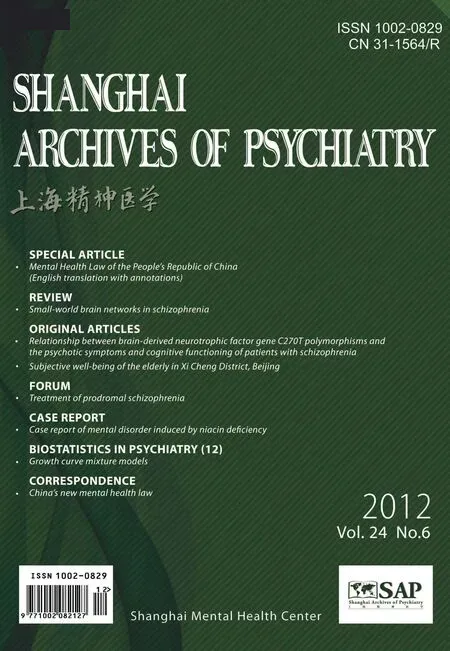
Mental Health Law of the People’s Republic of China: inviting dialogue
2012-07-08 02:15:19KateDIESFELDGrahamMELLSOP
上海精神醫學 2012年6期
Kate DIESFELD* Graham MELLSOP
Mental Health Law of the People’s Republic of China: inviting dialogue
Kate DIESFELD1* Graham MELLSOP2
The Shanghai Archives of Psychiatryis commended for publishing an English translation of China’s first mental health statute. Legislation illuminates how a society functions, the issues it faces and its collective priorities. Access to an extensively annotated English translation of Chinese legislation about mental health will stimulate reflection, comparison and constructive critique from both Chinese and international observers about the mental health laws in different countries, about different governments’ priorities, and about the robustness of mental health services cross-nationally. The translation of theMental Health Law of the People’s Republic of China(the Act) will foster fruitful communication across borders and, thus, benefit the persons with mental disorders whom we all serve.
Many nations do not yet have national mental health laws.[1]By joining the growing number of nations that have national statutes, China has established a legal framework on behalf of people with mental disorders in the country. The Chinese law speaks to many of the universal, competing concerns that societies face. These include how to respond to individuals’ needs for therapeutic care, how to protect their liberty and interests, and how to ensure the safety of other community members.
One distinctive feature of the Act is that it simultaneously provides a broad conceptual framework and describes specific procedures and responsibilities in considerable detail.It includes components that address a wide range of issues related to mental health such as mental health promotion, the protection of the rights of the mentally ill, the management of compulsory care and so forth. It espouses the broad principles of human dignity and personal safety and defines the specific rights of persons with mental disorders to education, employment, medical care and welfare assistance. It specifies the obligations that central and regional governmental bodies assume in the provision and management of mental health services and details the process that health facilities must undergo in the diagnosis, treatment and involuntary detention of persons with mental disorders.
China’s omnibus approach may be compared with the more incremental approach adopted by other nations which have enacted a series of statutes over time to address discrete issues related to mental health and the management of the mentally ill. For example, in New Zealand, involuntary detention and accompanying rights are contained in theMental Health (Compulsory Assessment and Treatment) Act1992,[2]but additional protections are contained in several separate statutes, such as theNew Zealand Bill of Rights Act1990, theHuman Rights Act1993, the Health and Disability Commissioner (Code of Health andDisability Services Consumers’ Rights) Regulations 1996and theProtection of Personal and Property Rights Act 1988. In contrast, the Chinese Act addresses many of the relevant issues in a single statute.
The Act may also be evaluated using the universal human rights principles that international mental health law scholars consider relevant for the assessment of mental health legislation.[3-6]One such principle is that patients have the right to humane, dignified and professional treatment: several provisions of the Chinese Act are based on this principle including the focus on human dignity in Article 4 and the requirement for compliance with standardised treatment regulations in Article 17. Another universal principle is that treatment should be provided in the least restrictive environment possible with or without recourse to compulsion: the Chinese statute does not specifically address the issue of ‘least restrictive environment’ (compulsory outpatient treatments are not considered) but Article 30 incorporates the latter principle by stating that ‘inpatient treatment shall generally be voluntary’.
A third fundamental jurisprudential principle is that people will have a fair, impartial judicial review before detention; periodic reviews during detention; the right to independent representation; and the right to appeal a decision to an independent body. The Chinese Act requires that specific conditions be met before involuntary detention is permitted (Articles 30-33) but it does not require judicial review of involuntary admissions. However, the Chinese statute allows both the patient and the guardians to challenge psychiatrists’determination of the need for inpatient treatment and to demand independent assessments (Articles 32-34). There are no specific intervals set for re-assessing involuntarily admitted patients, but health facilities are required to re-assess the need for involuntary treatment when there are changes in the clinical status of the patient (Article 44) and to release the patients if they no longer meet the criteria for involuntary treatment. Patients and guardians who believe that their legal rights have been compromised can take health facilities and health care providers to court and demand compensation (Article 82).
Some nations enshrine protections in legislation by identifying the factors that are not grounds for involuntary detention. For example, according to the New Zealand legislation[2]a person cannot be subject to compulsory psychiatric assessment and treatment solely on the following grounds: political, religious or cultural beliefs; sexual preferences; criminal or delinquent behaviour; substance abuse; or intellectual disability. As in other nations, the Chinese legislation may evolve to incorporate these types of exclusions in response to gaps identified during the implementation of the law.
Another universal principle is reciprocity. Where a nation imposes an obligation upon the person to comply with treatment, it should establish a parallel obligation upon the health and social welfare authorities to provide appropriate services, including after-care.[6]Thus, diminution of liberty must be accompanied by therapeutic efforts to restore the person’s health and freedom. All nations must face the challenge of providing services that are responsive to the needs of persons with mental disorders. The Chinese law incudes an entire Chapter dedicated to the rehabilitation of persons with mental disorders (Chapter IV) and many articles from other chapters are related to the provision of standardised, high-quality care. The challenge for the Chinese government will be to achieve these aspirational goals.
For all mental health legislation, the qualifying criteria are pivotal. This relies upon a definition of mental disorder that is founded on concepts that are both consistent and medically, legally and ethically defensible. Best practice is based upon classificatory systems and/or diagnostic criteria that incorporate internationally-recognised, evidence-based clinical concepts.The elasticity in the Chinese Act’s definition of mental disorder and severe mental disorder (Article 83) may pose some difficulties during the implementation of the Act. As experience with the Act accrues over time, it should be possible to formulate detailed regulations that will help clarify these criteria.
Access to the Act offers tremendous opportunities for exploration. This translation of theMental Health Law of the People’s Republic of Chinais a monumental achievement by theShanghai Archives of Psychiatryand we welcome further exchange.
1. Perlin ML. International human rights law and comparative mental disability law: The universal factors.Syracuse Journal of International and Comparative Law2007; 34: 333-357.
2. Mental Health (Compulsory Assessment and Treatment) Act, 1992. Available at: http://www.nzlii.org/cgi-bin/download.cgi/ nz/legis/consol_act/mhaata1992522 (Accessed 2 December 2012).
3. Bartlett P. Thinking about the rest of the world: Mental health and rights outside the ‘First World’. In B. McSherry and P. Weller (Eds)Rethinking Rights-Based Mental Health Laws. Oxford:Hart Publishing, 2010: 397-428.
4. Gostin LO. Human rights in mental health: A proposal for five international standards based upon the Japanese experience.Int J Law Psychiat1987; 10: 353-368.
5. Gostin LO, Gable L. The human rights of persons with mental disabilities: A global perspective on the application of human rights principles to mental health.Maryland Law Review2004; 63(20): 20-121.
6. Richardson G. Involuntary treatment: Searching for principles. In K. Diesfeld and I. Freckelton (Eds.)Involuntary Detention and Therapeutic Jurisprudence: International Perspectives on Civil Commitment. Aldershot: Ashgate, 2003: 55-74.

Kate Diesfeld is currently an Associate Professor at Auckland University of Technology in Auckland, New Zealand. In the early 1990s, she represented people with developmental disabilities in Los Angeles at Protection and Advocacy, Inc. From 1992 to 2000, she represented patients before the Mental Health Review Tribunal in England, was Legal Supervisor of the Kent Law Clinic (Mental Health and Learning Disability), and worked as a legal academic at the University of Kent Law School. With Professor Ian Freckelton, she edited Involuntary Detention and Therapeutic Jurisprudence: International Perspectives on Involuntary Detention (Ashgate, 2003). She is the former Associate Dean (Research) at the University of Waikato Faculty of Law in New Zealand. Her current research interests include mental health law and disability law.
10.3969/j.issn.1002-0829.2012.06.011
1Auckland University of Technology, Auckland, New Zealand2Waikato Clinical School, University of Auckland, New Zealand
*correspondence: kdiesfel@aut.ac.nz