
· In this issue ·
2012-04-12 06:53:03
上海精神醫學 2012年5期
· In this issue ·
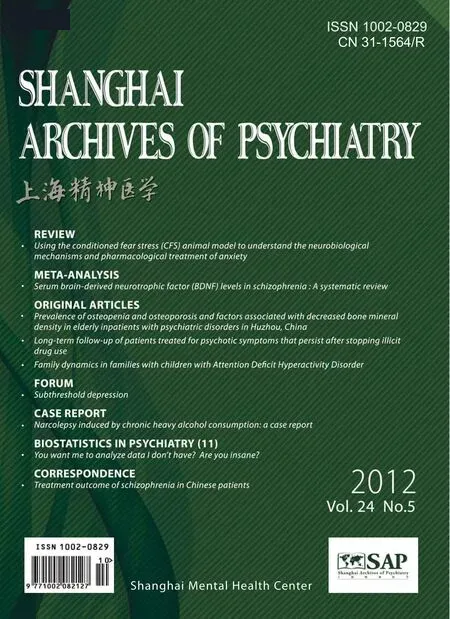
We are pleased to announce that with this issue we are inaugurating a new section of the journal on metaanalyses and systematic reviews. We plan to regularly publish meta-analyses about topics that are of interest to both Chinese and international investigators. By pooling results from studies published in Chinese and in English we hope to include studies that are not identified in systematic reviews in other English-language journals and, thus, expand the current knowledge base about the selected topics. Professor Chunbo Li from the Shanghai Mental Health Center will be the editor responsible for this section of the journal.
This issue starts with a review by Professor Xiaobai Li[1]of the long and productive history of using animal models of conditioned fear stress (CFS) to investigate the etiology and pathophysiology of anxiety. Investigation of the neurobiological mechanisms underlying fear memory is an important step in developing treatments for post-traumatic stress disorder (PTSD), specific phobias and other types of anxiety disorders. The review describes the neural circuitry and neurotransmission processes that are activated during CFS and, based on these findings, explains the molecular basis for pharmacological treatments of anxiety. Recent interest in this field has focused on the cellular and molecular mechanisms that result in the extinction of fearful responses, which depends on both gluatamatergic and GABAergic systems, because these pathways are potentially useful targets for the treatment of anxiety.
Confirming the value of integrating Chinese and international research, the meta-analysis by Cui and colleagues[2]on the relationship of serum BDNF levels to schizophrenia included five studies from mainland China that had not been identified in recent meta-analyses on this topic published in high-level international journals.[3]Pooling the results of 25 studies that met their rigorous inclusion criteria, they report that serum BDNF was lower in patients than in controls but they did not find any before-versus-after changes in BDNF levels with treatment. However, almost all identified studies were cross-sectional reports that do not adequately address several potential biases so the overall quality of the result– despite being statistically robust – was considered‘weak’. There is considerable interest in the potential value of serum BDNF as a biomarker for schizophrenia, but more high-quality, prospective studies will be needed before it will be possible to decide whether or not serum BDNF is a valid biomarker for the disorder.
The first research paper[4]highlights a common problem in elderly patients that is frequently undiagnosed and untreated by psychiatric clinicians –osteoporosis. Using internationally accepted standards to assess bone mineral density (dual energy X-ray absorptiometry, DXA) in 102 psychiatric inpatients 60 years of age or older, the authors report that one-third of the patients had osteopenia (i.e., low bone mass) and another one-third met WHO criteria for osteoporosis. The prevalence of abnormal bone mass (i.e., osteopenia or osteoporosis) was higher in depressed patients than in those with other diagnoses, much more common in women than in men, and associated with increasing age and decreasing body mass index (but not with the use of antipsychotic medication). Improved care of the mentally ill includes identification and management of common physical problems like osteoporosis that can seriously affect the quality of their lives. Psychiatric clinicians have a responsibility to keep up-to-date on the diagnosis and management of these conditions and, perhaps more importantly, must make the evaluation of these conditions a routine part of their clinical care.
The second research paper[5]assessed the long-term outcomes of patients who had a psychiatric admission for the management of psychotic symptoms that were induced by the use of illicit drugs. The prevalence of illicit drug use is much lower in China than in most high-income countries and the evolution of the drug abuse problem has followed a different trajectory.[6]Thus its uncertain whether or not illicit drug use in China has the triggering effect on the onset of chronic psychosis that has been widely reported in other countries.[7]The authors followed up 189 patients with drug-induced psychosis for 13 to 108 months after admission and found that in 60% of the patients the psychotic symptoms resolved less than one month after stopping the drugs, in 30% of patients symptoms resolved 1 to 6 months after stopping, and in 10% of patients psychotic symptoms persisted for more than 6 months after stopping the illicit drugs. This is a lower rate of chronic psychosis among individuals with a history of illicit drug use than reported elsewhere,[7]but, similar to other studies, persistent psychotic symptoms were associated with a family history of mental illness and with an earlier onset and longer duration of illicit drug use.
The third research paper[8]is a preliminary report on the family dynamics of children with Attention Deficit Hyperactivity Disorder (ADHD). The authors compare the self-reports of 46 children 10 to 17 years of age with ADHD to those of 46 children without ADHD using a 19-item instrument that has been specifically developed for use in China – the Questionnaire of Systematic Family Dynamics. After adjustment for potential confounders the ADHD children were more likely to report a less harmonious family atmosphere and decreased autonomy in the home than control children. Understanding the family dynamics of families that have disturbed children is an essential prelude to developing targeted family interventions that can augment psychopharmacologicaltreatments, but further studies are needed to assess the causal pathways that link family environment with the onset and course of ADHD before this information can be employed in clinical settings.
The four articles in the Forum[9-12]provide four very different perspectives on a perennial diagnostic dilemma: the identification, diagnosis, and management of subthreshold depressive states. Yi and Fang[9]discuss the ‘Subsyndromal Symptomatic Depression’(SSD) concept of Judd and colleagues[13]that includes individuals without depressive affect or anhedonia who, nevertheless, experience two or more of the other seven symptoms of a major depressive disorder. They conclude that substantial differences in the neurobiochemical characteristics and gene expression of SSD suggest that it does not belong to the same spectrum of disease as major depressive disorder. Ji[10]discusses the confusing use of the ‘subclinical’ and ‘subthreshold’ labels in psychiatry. In other medical disciplines these terms are reserved for prodromal states before the first full onset of a condition, but in psychiatry the terms refer both to prodromal symptoms and to residual symptoms after partial remission of a full episode; he recommends changing the label of the latter situation to ‘residual symptoms’. Dunner[11]emphasizes that depression as we see it in clinical settings is probably a group of conditions with different etiologies and different prognoses, but until the identification of subtype-specific biological markers clinicians will need to take careful clinical histories to distinguish the different subtypes. Finally, Juruena[12]posits that the many different manifestations of depressive symptoms that have been subdivided into different diagnoses with overlapping criteria in diagnostic manuals are, in fact, different phases in the intensity, activity and severity of a single diagnostic entity.
The issue also includes a case report on narcolepsy induced by chronic heavy alcohol use,[14]the third of three installments in the Biostatistics in Psychiatry section on methods of dealing with missing data,[15]and a letter about a previous paper on community treatment of schizophrenia.[16]
1. Li XB. Using the conditioned fear stress (CFS) animal model to understand the neurobiological mechanisms and pharmacological treatment of anxiety.Shanghai Arch Psychiatry2012; 24(5): 241-249.
2. Cui HR, Jin Y, Wang JJ, Weng XC, Li CB. Serum brain-derived neurotrophic factor (BDNF) levels in schizophrenia: A systematic review.Shanghai Arch Psychiatry2012; 24(5): 250-261.
3. Green MJ, Matheson SL, Shepherd A, Weickert CS, Carr VJ. Brainderived neurotrophic factor levels in schizophrenia: a systematic review with meta-analysis.Mol Psychiatry2011; 16(9): 960-972.
4. Guo P, Wang SK, Zhu YP, Shen XH, Jin XM, Qian MC, Tang HY. Prevalence of osteopenia and osteoporosis and factors associated with decreased bone mineral density in elderly inpatients with psychiatric disorders in Huzhou, China.Shanghai Arch Psychiatry2012; 24(5): 262-270.
5. Deng XH, Huang ZB, Li XW, Li Y, Wang Y, Wu DL, et al. Long-term follow-up of patients treated for psychotic symptoms that persist after stopping illicit drug use.Shanghai Arch Psychiatry2012; 24 (5): 271-278.
6. Hao W, Xiao SY, Liu TQ, Young DS, Chen SM, Zhang DR, et al. The second National Epidemiological Survey on illicit drug use at six high-prevalence areas in China: prevalence rates and use patterns.Addiction1997; 97(10): 1305–1315.
7. Boutros NN, Bowers MB Jr. Chronic substance-induced psychotic disorders: state of the literature.J Neuropsychiatry Clin Neurosci1996; 8(3): 262-269.
8. Chu KK, Wang MC, Chen YX. Family dynamics in families with children with Attention Deficit Hyperactivity Disorder.Shanghai Arch Psychiatry2012; 24(5): 279-285.
9. Yi ZH, Fang YR. Are subsyndromal symptomatic depression and major depressive disorder distinct disorders?Shanghai Arch Psychiatry2012; 24(5): 286-287.
10. Ji JL. Distinguishing subclinical (subthreshold) depression from the residual symptoms of major depression.Shanghai Arch Psychiatry2012; 24(5): 288-289.
11. Dunner DL. Differentiation of various forms of depression.Shanghai Arch Psychiatry2012; 24(5): 290-291.
12. Juruena MF. Understanding subthreshold depression.Shanghai Arch Psychiatry2012; 24(5): 292-293.
13. Judd LL, Rapaport MH, Paulus MP, Brown JL. Subsyndromal symptomatic depression: a new mood disorder?J Clin Psychiatry1994; 55(Suppl): 18-28.
14. Wang XY. Narcolepsy induced by chronic heavy alcohol consumption: a case report.Shanghai Arch Psychiatry2012; 24 (5): 294-296.
15. Meng XL. You want me to analyze data I don’t have? Are you insane?Shanghai Arch Psychiatry2012; 24(5): 297-301.
16. Kua EH. Treatment outcome of schizophrenia in Chinese patients (correspondence).Shanghai Arch Psychiatry2012; 24(5): 302.
- 上海精神醫學的其它文章
- Treatment outcome of schizophrenia in Chinese patients
- You want me to analyze data I don’t have? Are you insane?
- Narcolepsy induced by chronic heavy alcohol consumption: a case report
- Understanding subthreshold depression
- Differentiation of various forms of depression
- Distinguishing subclinical (subthreshold) depression from the residual symptoms of major depression