從杭州到撒馬爾罕,煥發(fā)全新活力
2022-08-26 09:42:16文/趙豐
文化交流 2022年8期
關(guān)鍵詞:博物館
文 / 趙 豐

烏茲別克斯坦希瓦古城墻。Filippo Gordini/ 攝?聯(lián)合國(guó)教科文組織絲綢之路項(xiàng)目The city walls of Khiva, Uzbekistan. Photo by Filippo Gordini. Photo credit: UNESCO Silk Roads Program.
大約在公元658年前后,大唐皇帝唐高宗李治(628—683)冊(cè)封拂呼縵(Varkhuman)為康居都督府都督,其實(shí)也就是康國(guó)的國(guó)王。高宗派出了一個(gè)使團(tuán),千里迢迢送上了珍貴的蠶繭、絲線和絲綢。同樣來(lái)自東方的使者還有吐谷渾人,他們獻(xiàn)上了代表財(cái)富的牦牛尾,鄰近的石國(guó)(Chaganian)也派使者穿著鮮艷服裝前來(lái)祝賀。拂呼縵的身邊,依然有著眾多的突厥武士佩刀守衛(wèi),當(dāng)時(shí)突厥對(duì)粟特地區(qū)的影響非常大。不過(guò),他特別把唐朝的使者放到了最中間。
這一盛會(huì)被康國(guó)的畫(huà)家高手繪在了位于阿弗拉西亞卜(Afrasiab)的一處四方形建筑內(nèi)的西墻上。20世紀(jì),中亞考古學(xué)家在烏茲別克斯坦發(fā)現(xiàn)了這一遺址,并把這組壁畫(huà)的所在地稱為大使廳。
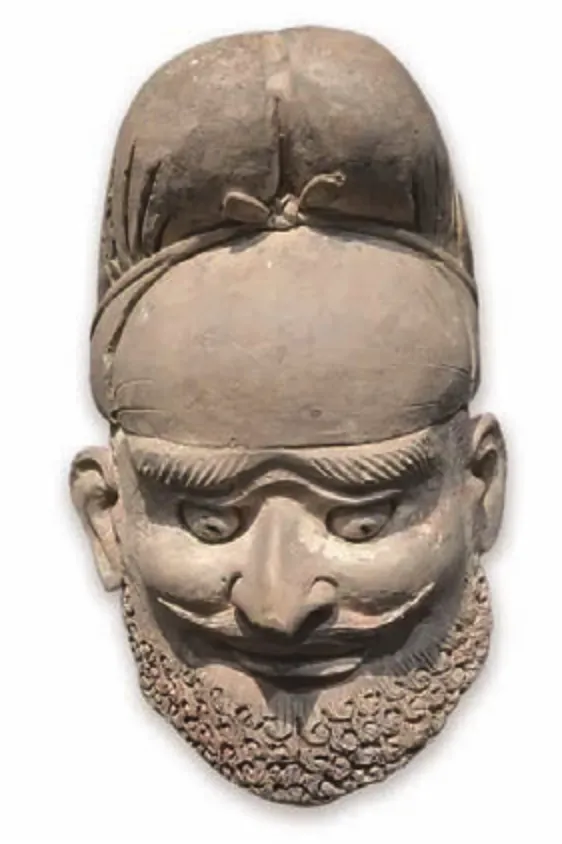
粟特人。Head of a statue of a Sogdian.
讓歷史淵源照亮絲路文化
作為著名的“絲綢之路”古國(guó),烏茲別克斯坦共和國(guó)地處中亞腹地、東西方往來(lái)必經(jīng)之地。因絲綢之路的開(kāi)辟,讓眾多貿(mào)易重鎮(zhèn)迅速崛起,成為中亞歷史的核心和精華。其中的費(fèi)爾干納盆地是中亞地區(qū)歷史文化遺跡中最為龐大和重要的地區(qū)。壁畫(huà)中的康國(guó)正是今天烏茲別克斯坦第二大城市撒馬爾罕,阿弗拉西亞卜曾是粟特人的都城。在唐朝年間,以撒馬爾罕和布哈拉為中心區(qū)的烏茲別克斯坦西南部就已經(jīng)是粟特人的主要居住區(qū)了。
世界各地的粟特學(xué)者對(duì)撒馬爾罕大使廳的壁畫(huà)進(jìn)行了研究,其中被普遍接受的說(shuō)法是,大使廳入口處的正對(duì)面是位于西墻的各國(guó)使者慶賀圖。大使廳的南墻,則被推測(cè)有可能是表示石國(guó)(突厥語(yǔ),位于烏茲別克斯坦首都塔什干市)國(guó)王的新年出行祭祀圖,東墻畫(huà)有唐高宗狩獵和武則天泛舟的場(chǎng)面,有人推測(cè)這是中國(guó)的端午節(jié)。而進(jìn)門(mén)的北墻壁畫(huà)保存最差,推測(cè)是與印度相關(guān)的圖像。粟特人是絲綢之路上的貿(mào)易擔(dān)當(dāng)者,他們從小就跟著父母到處做生意,足跡遍布亞洲大地:比如,中亞的阿姆河和錫爾河,正是絲綢之路上東西南北的通道,是文明和商業(yè)的十字路口;向南是印度,向北是游牧的突厥、柔然、匈奴這些王國(guó),往東到中國(guó),向西就是波斯、羅馬。另一方面,粟特人也善于織錦,加上他們陸續(xù)遷徙移居至中國(guó)西北和內(nèi)陸地區(qū),使他們的織錦與中國(guó)的織錦相互產(chǎn)生影響,提升了雙方的絲綢生產(chǎn)技術(shù)。
這個(gè)大使廳目前已是撒馬爾罕國(guó)立博物館的壁畫(huà)館,它不僅成為古代中國(guó)以及古代亞洲各國(guó)與古代烏茲別克斯坦交往、交流、融合的有力見(jiàn)證,更在今天受到了來(lái)自世界各地尤其是絲綢之路沿線國(guó)家人民的廣泛喜愛(ài),成為他們來(lái)到烏茲別克斯坦撒馬爾罕必打卡的旅游點(diǎn)。
以互展互動(dòng)深化文化合作
2022年7月第三屆絲綢之路周期間,中國(guó)絲綢博物館與撒馬爾罕國(guó)立博物館在大使廳上層的展廳里共同舉辦名為“絲綢與絲路:從杭州到撒馬爾罕”的特別展覽。烏茲別克斯坦共和國(guó)旅游與文化遺產(chǎn)部文化遺產(chǎn)局第一副局長(zhǎng)Tursunali Kuziev,撒馬爾罕文化遺產(chǎn)局博物館發(fā)展處處長(zhǎng)Ziyodullo Nasimov,撒馬爾罕國(guó)立博物館館長(zhǎng)Samariddin Mustafokulov,撒馬爾罕考古研究所所長(zhǎng)Saidkhan Mominov,撒馬爾罕國(guó)立外國(guó)語(yǔ)學(xué)院孔子學(xué)院烏方院長(zhǎng)Shakhriyor Safarov,中方院長(zhǎng)李晨旭等出席了這一展覽開(kāi)幕式。同名云上展覽也同時(shí)上線。
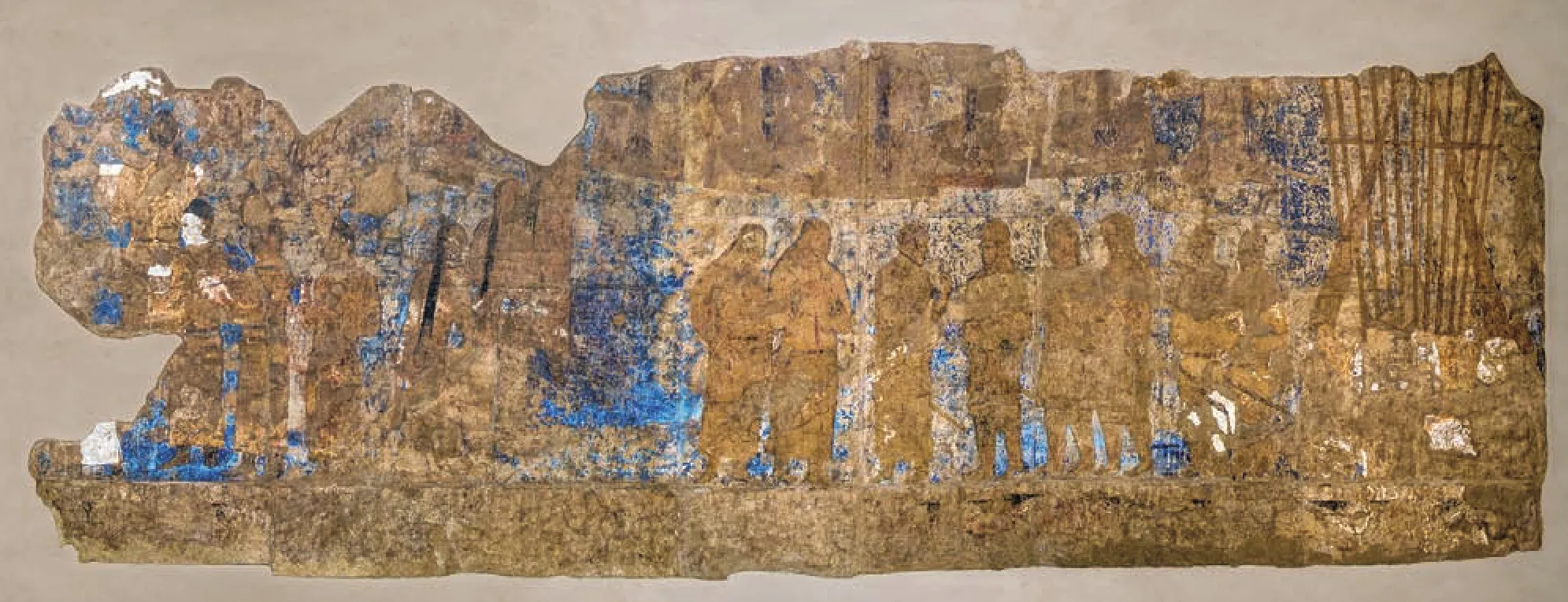
撒馬爾罕古城大使廳西墻壁畫(huà)。(圖片來(lái)源:烏茲別克斯坦撒馬爾罕國(guó)立博物館)The mural on the west wall of the Hall of Ambassadors in Afrasiab, Samarkand. Photo credit: Samarkand State Museum-Reserve of Uzbekistan.
展覽共分為三個(gè)單元。第一單元是從杭州到撒馬爾罕絲綢之路沿途的重要考古遺址和出土的絲綢實(shí)物,其中包括鄭州、西安、敦煌、吐魯番、費(fèi)爾干納等重要節(jié)點(diǎn)。第二單元是整個(gè)展覽的亮點(diǎn),中國(guó)絲綢博物館的策展團(tuán)隊(duì)用今天的電子提花織機(jī),復(fù)制還原了大使廳壁畫(huà)上的九種圖案的中亞織錦,并用這些織錦再制作了石國(guó)使者的錦袍、大唐使者的綾袍,通過(guò)3D和2D圖像的組合,生動(dòng)地還原了壁畫(huà)中6世紀(jì)中葉絲綢之路上一次多元文化相匯的“峰會(huì)”盛況。第三部分介紹了以中國(guó)絲綢博物館牽頭申報(bào)的聯(lián)合國(guó)教科文組織(UNESCO)人類非遺項(xiàng)目“中國(guó)蠶桑絲織技藝”,從蠶桑到絲綢的傳統(tǒng)生產(chǎn)技藝。
同時(shí),展覽還對(duì)這九件粟特織錦的圖案和來(lái)歷分別進(jìn)行了詳細(xì)的解釋,使人們對(duì)6世紀(jì)前后中亞粟特地區(qū)的織錦有了更為深入的了解。
中國(guó)絲綢博物館曾于2010年與烏茲別克斯坦共和國(guó)科學(xué)院考古研究所和東華大學(xué)服裝藝術(shù)學(xué)院共同合作,首次針對(duì)費(fèi)爾干納盆地早期中古時(shí)代紡織服飾品進(jìn)行了全面的綜合性研究,并完成了《大宛遺錦:烏茲別克斯坦費(fèi)爾干納蒙恰特佩出土的紡織品研究》中英俄三語(yǔ)種同時(shí)出版的著作,成為中國(guó)和烏茲別克斯坦考古學(xué)和紡織歷史研究領(lǐng)域?qū)<业氖状魏献鞒晒V袊?guó)絲綢博物館目前正在跟烏茲別克斯坦考古研究所探討蒙恰特佩出土的紡織品的修復(fù)項(xiàng)目。
而此次展覽也是中國(guó)絲綢博物館第一個(gè)赴烏展覽,兩館在2022年5月簽署了為期五年的合作諒解備忘錄。雙方合作的第一條款包括交換展覽:中方將在撒馬爾罕國(guó)立博物館推出以絲綢、紡織品、服飾或與絲綢之路相關(guān)的主題。中方也將引入來(lái)自烏方的民族服飾等相關(guān)展覽。
使合作交流煥發(fā)全新活力
“絲綢之路周”已連續(xù)成功舉辦三年,即使是在新冠疫情的影響下,仍然吸引了全球百余家文化機(jī)構(gòu)的積極參與,并逐步成為一個(gè)全球性的交流、分享平臺(tái),其中的關(guān)鍵在于積極倡導(dǎo)合作,“合作”是“絲綢之路周”的生命力所在。
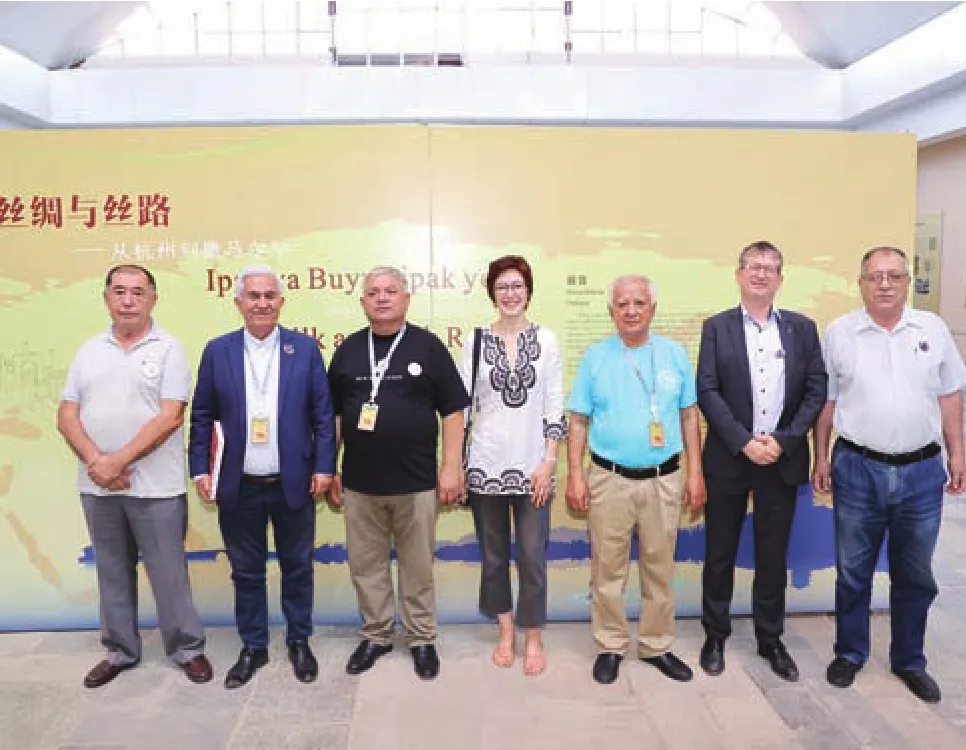
“絲綢與絲路:從杭州到撒馬爾罕”展覽開(kāi)幕式。Guests of honor pose for a group photo at the opening ceremony of the exhibition Silk and the Silk Roads: from Hangzhou to Samarkand.
從“2020絲綢之路周”主題為“互學(xué)互鑒促進(jìn)未來(lái)合作”,到2021年的“多元共存和包容發(fā)展”,再到今年定為“民族融合,共同繁榮”,可以看到許多“絲綢之路周”全球化進(jìn)程中各國(guó)合作共享的案例。中國(guó)絲綢博物館擁有絲綢、紡織品等方面的領(lǐng)先技術(shù),撒馬爾罕有諸多與絲綢之路相關(guān)的珍貴文物,通過(guò)“2022絲綢之路周”邀請(qǐng)烏茲別克斯坦共和國(guó)作為主賓國(guó)共同舉辦系列活動(dòng)這一深入合作,彼此間形成互補(bǔ),能攜起手來(lái)更好地傳播絲綢文化。
在此初衷的基礎(chǔ)上,“絲綢之路周”在今年又有了新的嘗試。主賓省、主賓國(guó)將會(huì)在此后的活動(dòng)中一直承襲下去。接下來(lái)的每年,都會(huì)有主賓省與主賓國(guó),若干年后,我們相信,世界上會(huì)有更多的人了解絲綢之路和絲綢文化。歷史上的絲綢之路就是通過(guò)一代又一代人的交流、交往才延續(xù)至今,我們期待“絲綢之路周”也能架起東西方合作的紐帶和橋梁。
正如主賓國(guó)代表、烏茲別克斯坦駐上海總領(lǐng)事馬蘇托夫·阿吉茲在今年“絲綢之路周”開(kāi)幕式上所說(shuō)的:“絲綢之路表明,文化交流是加強(qiáng)不同國(guó)家、不同民族之間相互信任的有效途徑。”
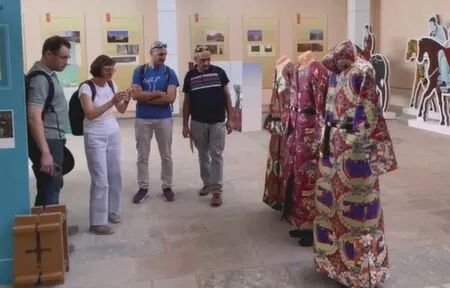
“絲綢與絲路:從杭州到撒馬爾罕”展覽現(xiàn)場(chǎng)。Visitors take a photo at the exhibition Silk and the Silk Roads:from Hangzhou to Samarkand.
From Hangzhou to Samarkand: New Vitality
By Zhao Feng
In about the year 658, Li Zhi (628-683), Emperor Gaozong of the Tang dynasty (618-907) made Varkhuman (ca. 640-670),King of Samarkand, the Governor of Kangju (generally regarded as the Chinese variant of Sogdiana). For this, Emperor Gaozong sent an embassy with valuable silk cocoons, silk threads and silks. At the same time, the Tuyuhun people and the neighboring Chaganian sent their ambassadors as well, with the former presenting yak tails which signified wealth and the latter dressed in colorful clothes for celebration. Standing alongside Varkhuman were the many Turkic guards with swords, which shows the deep Turkic influence on Sogdiana. However, the emissaries from Tang had been specially placed at the very center by Varkhuman.
The details of the above spectacle were painted in a series of murals on the west wall of a rectangular building in Afrasiab, an ancient site of Northern Samarkand, present-day Uzbekistan. In the 20th century, archeologists from Central Asia discovered the site and named the place of the murals “Hall of Ambassadors”.
As an ancient country along the Silk Roads, the Republic of Uzbekistan is located in the hinterland of Central Asia, where the East and the West must pass through. Thanks to the opening of the Silk Roads, many important trade towns rose rapidly and became the core and essence of Central Asian history, of which the Fergana Valley boasts the largest number of and some of the most important historical and cultural sites in Central Asia. The Kingdom of Samarkand painted on the murals is the city of Samarkand, the second largest city in Uzbekistan today, and Afrasiab used to be the capital of Sogdians. During the Tang dynasty, southwestern Uzbekistan, centered around Samarkand and Bukhara, had already become the main area for Sogdian settlement.
Scholars on Sogdian history and culture from all over the world have studied the murals in the Hall of Ambassadors in Samarkand, and the most widely accepted theory is that main wall of the hall is the west wall on which is a painting of the envoys from various countries paying homage to King Varkhuman. The mural on the south wall of the hall is believed to show the New Year’s Day ritual of the King of Chaganian (located in Tashkent,the capital of Uzbekistan), while the east wall painting shows the hunting scene of Emperor Gaozong and Empress Wu Zetian (624-705) on a boat, which some argued represents China’s Dragon Boat Festival.
The north wall painting in the entrance is the worst preserved and is thought to be related to India. The Sogdians were among the best traders on the Silk Roads. They followed their parents to do business everywhere even when they were young and traveled all over Asia. For example, the Amu Darya and Syr Darya rivers in Central Asia were the north-south and east-west passages of the Silk Roads and at the crossroads of civilization and commerce. To the south was India, to the north were the nomadic Turkic and Rouran khaganates as well as the Xiongnu tribes, to the east lied China, and to the west were Persia and Rome. On the other hand,Sogdians were also good at weaving brocade, and their migration to the northwest and inland areas of China made their brocade interact with that of China and improved the silk production technology on both sides.
The Hall of Ambassadors has now become a mural hall of the Samarkand State Museum-Reserve of Uzbekistan. It has not only witnessed the interactions, exchanges and integration between ancient China, ancient Asian countries and ancient Uzbekistan,but also been widely loved by people from across the globe,especially countries along the Silk Roads. It is now a must-visit spot for tourists when they travel to Samarkand.
In July 2022, during the third Silk Road Week, the China National Silk Museum and the Samarkand State Museum-Reserve of Uzbekistan jointly held a special exhibition entitledon the upper level at the Hall of Ambassadors. Tursunali Kuziev, first deputy director of Uzbekistan’s Cultural Heritage Agency, Ziyodullo Nasimov, director of Museum Development at the Samarkand Cultural Heritage Bureau, Samariddin Mustafokulov, director of the Samarkand State Museum-Reserve of Uzbekistan, Saidkhan Mominov, director of the Samarkand Institute of Archaeology,Shakhriyor Safarov, head of the Confucius Institute at the Samarkand State Institute of Foreign Languages and Li Chen,the Chinese head of the Confucius Institute, among other guests,attended the opening ceremony of the exhibition. An online exhibition of the same title was also launched simultaneously.
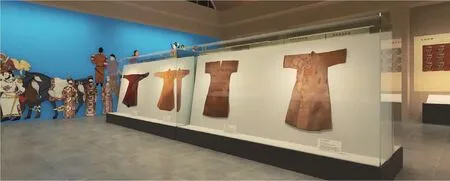
“絲綢與絲路:從杭州到撒馬爾罕”線上展覽。The online section of the exhibition Silk and Silk Roads: From Hangzhou to Samarkand.
The exhibition is divided into three parts. The first part focuses on important archaeological sites and silk items unearthed along the Silk Roads from Hangzhou to Samarkand, including major places such as Zhengzhou, Xi’an, Dunhuang, Turpan,and Fergana. The second part is the highlight of the whole exhibition. The curatorial team of the China National Silk Museum reproduced the nine pieces of the Central Asian brocades on the mural of the Hall of Ambassadors through the electronic jacquard loom, which were then used to make the brocade robe of Chaganian envoys and the satin robe of Tang envoys. Combining 3D and 2D imaging, it vividly reproduced the spectacular“summit” of the many cultures converging on the Silk Roads in the middle of the 6th century. The third part introduced the traditional production techniques from sericulture to silk, which,led by the China National Silk Museum, has been applied for the UNESCO Intangible Cultural Heritage of Humanity.
The Silk Road Week has been successfully held for three consecutive years. Despite the impact of the COVID-19 pandemic, it has attracted the participation of more than 100 cultural institutions around the world, and has gradually become a global platform for communication and sharing. The key is cooperation, which is at the heart of the Silk Road Week.
From the 2020 Silk Road themed “The Silk Roads: Mutual Learning for Future Collaboration” to the 2021 Silk Road Week themed “Cultural Diversity and Sustainable Development” and now to the 2022 Silk Road Week themed “National Integration and Common Prosperity”, we can see many a case of cooperation and sharing among countries in the process of the Silk Road Week going global. In 2020, focusing on world silk heritage, we launched the Silk Road Interactive Map, a 13-country cooperation project.In 2021, the Silk Road Online Museum was jointly established with nearly 40 museums from 16 countries, including the UK,the US and Russia. As the China National Silk Museum possesses state-of-the-art technologies silk and textile, and Samarkand is where many rare and precious cultural relics related to the Silk Roads lie, the initiative to invite the Republic of Uzbekistan through the 2022 Silk Road Week as the Guest Country of Honor and jointly hold a series of in-depth cooperation events has further promoted the silk culture.
The initiative of inviting a Guest Province of Honor and a Guest Country of Honor will continue in the future. After a few years, we believe that more people around the world will know more about the Silk Roads and silk culture. It is through generations of exchanges and interactions that the historical Silk Roads have survived until now. We hope that the Silk Road Week will also build a bond and bridge of cooperation between the East and the West.
Just as Aziz Masutov, the Uzbek Consul General in Shanghai,said at the opening ceremony of the 2022 Silk Road Week,“The Silk Roads show that cultural exchanges are an effective way to strengthen mutual trust between different countries and peoples.”
猜你喜歡
金橋(2022年6期)2022-06-20 01:35:58
好日子(2022年3期)2022-06-01 06:22:06
今日農(nóng)業(yè)(2022年4期)2022-06-01 06:12:38
小獼猴智力畫(huà)刊(2022年3期)2022-03-29 01:09:44
金橋(2022年2期)2022-03-02 05:43:00
金橋(2022年2期)2022-03-02 05:42:52
小太陽(yáng)畫(huà)報(bào)(2020年4期)2020-04-24 09:28:22
走向世界(2018年11期)2018-12-26 01:12:44
中外文摘(2017年20期)2017-09-30 06:40:48
童話王國(guó)·原創(chuàng)版(2016年4期)2016-11-23 16:06:06