
Rejecting Change
2011-11-17 15:22:43ByKERRYBROWN
Beijing Review 2011年20期
By KERRY BROWN
Rejecting Change
By KERRY BROWN
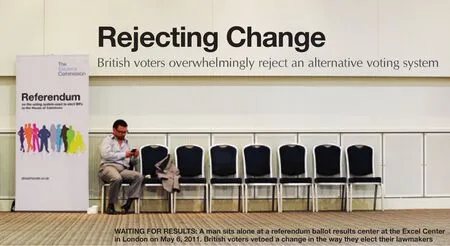
WAITING FOR RESULTS: A man sits alone at a referendum ballot results center at the Excel Center in London on May 6, 2011. British voters vetoed a change in the way they elect their lawmakers
British voters overwhelmingly reject an alternative voting system

The British electorate, in only the second ever national referendum held in their history (the first was on joining the EU, over 35 years ago) rejected alterations to their voting system from the current first-past-the-post system to a form of alternative voting similar to that used in Australia. The scale of the rejection was unexpected—70 percent opposed the proposed change.
The main politician supporting this, Nick Clegg, British Deputy Prime Minister and leader of the Liberal Democrat Party, stated that since the people had spoken so emphatically against making the change, it was best to simply move on. Further changes are unlikely to be proposed for a number of years.
Less optimism
The referendum was one of the key promises the Conservative Party made a year ago, on entering into the coalition government as the largest party in the UK after the election then failed to deliver a mandate to a single party. It was something the Liberal Democrats wanted, because despite getting more than a fifth, and sometimes as much as a quarter, of votes in national elections,the current system means that they seldom get more than 10 percent of members of the parliament. Their preferred option would be a more sophisticated form of proportional representation. The alternative voting option was considered a reasonable compromise.
This failure, at least for the Liberal Democrats, means that some of the earlier optimism of the coalition has worn off. The real surprise, however, is that this positive atmosphere lasted as long as it did. The Liberal Democrats like to present themselves as a progressive party, and many of their views on alleviating poverty, education and tuition fees,the health service, and social welfare generally sit at odds with the Conservative Party, which has, historically, been perceived as disliking big government, wanting to reduce the role of the state, and being keen to bring down public expenditure as much as possible.
Their rationale for joining a government with the Conservatives last May was,however, easy to understand. They had been out of power for over eight decades. This was their fi rst real chance to again enter into meaningful government roles. They felt that it made no sense for them to try to make an arrangement with the Labor Party, which had clearly lost the public support to govern (it received less votes than the Conservatives).Finally, they felt that they could strike a deal where a number of important positions were theirs, and through these they could exercise real in fl uence over decision-making.
This has partially worked out. The Conservatives have been more cautious than perhaps they would have had they been alone in the timescale within which they want to slash public fi nance. Even so, the cuts they have proposed and will now implement are deep, and the public reaction to them is, as yet, unclear.
Clegg’s greatest challenge, however,was in explaining how he could support the increase in student tuition fees from the current 3,000 pounds ($4,909) per year, to as much as three times this. Large demonstrations in London late last year and earlier this year showed the depth of public outrage, and while something like it was expected from the Conservatives, for the Liberal Democrats it was felt that they had made promises to oppose this. The change around in their position infuriated not just students, but also key grassroots supporters of the party, and, more importantly, swing voters who had given them their support during the election.
Public opinion polls now show that support for Clegg and his party has dropped to about 10 percent. He has a lot of ground to make up in the coming four years, if the coalition runs its full course, to get that support back.
Social discontent
While the referendum may have failed tobring about change, that doesn’t mean there isn’t widespread frustration at the current state of the British political system, and at the institutions that constitute government in the UK. Britain maintains a strong sense of history—something the world saw during the wedding between the heir to the throne,Prince William, and Catherine Middleton in late April. But the pomp and ceremony here hide a sense of malaise and discontent.
There remains deep anger at what is perceived as the complacency of politicians before the financial crisis in 2008, and the way in which bankers in particular were able to create so much destruction of wealth while continuing to reward themselves with huge paychecks. Inequality in the UK has grown deeper, with less social mobility now than even 30 years ago. The continuing anomalies in the system of an unelected second chamber (the House of Lords), despite the fact that Nick Clegg is due to make proposals about how to change this, and the remaining vast pockets of vested interest and protected elites that continue to control large parts of economic and public life, all motivate public dissatisfaction.
The coalition will sink or swim, however, not on the outcome of the referendum.What it has to deliver, and deliver soon, is economic growth. So far, that has remained elusive. A shock fall in GDP growth at the end of 2010 by 0.5 percent, blamed on heavy snowfall in December dampening retail growth and spending, was replaced by a rise of 0.5 percent in the first quarter of 2011.This means that for the last six months, the UK’s economy has remained stagnant.
There has not been the rise in unemployment that was expected, and the manufacturing sector has, at least since the turn of the year, been performing strongly.But property prices remain stagnant and public con fi dence relatively low. Perhaps the biggest issue has been the rise in in fl ation to almost 5 percent, way above the government target of 2 percent, and largely fueled by rises in gas and food prices.
The impact of deep government cuts in order to rein in the current de fi cit of 12 percent, one of the highest in the EU, is yet to be seen. With some services taking as much as a 20-percent hit, the social, political and economic consequences of this remain uncertain. But the Conservatives in particular have been adamant that a slower rate of cutbacks would not work and would mean that the confidence of the international markets in the UK would dip, placing the country in the same position as Ireland, Portugal and Greece in need to go to the IMF for support.They cannot allow a major economy like the UK to be in this position, and so the cuts are fi rst and foremost a demonstration that, unlike Greece in particular, they are not willing to let public debt get out of control.
Deeper cuts
The public has been prepared for over a year for what is about to come. The impact will start this year and grow deeper over the next three to four years. Social bene fi ts will be reduced, there will be greater pressure on those out of work to fi nd anything that might make them economically productive again,even if it is not their preferred work, and the enormous budget spent on health in particular will come under pressure from a swathe of controversial new reforms.
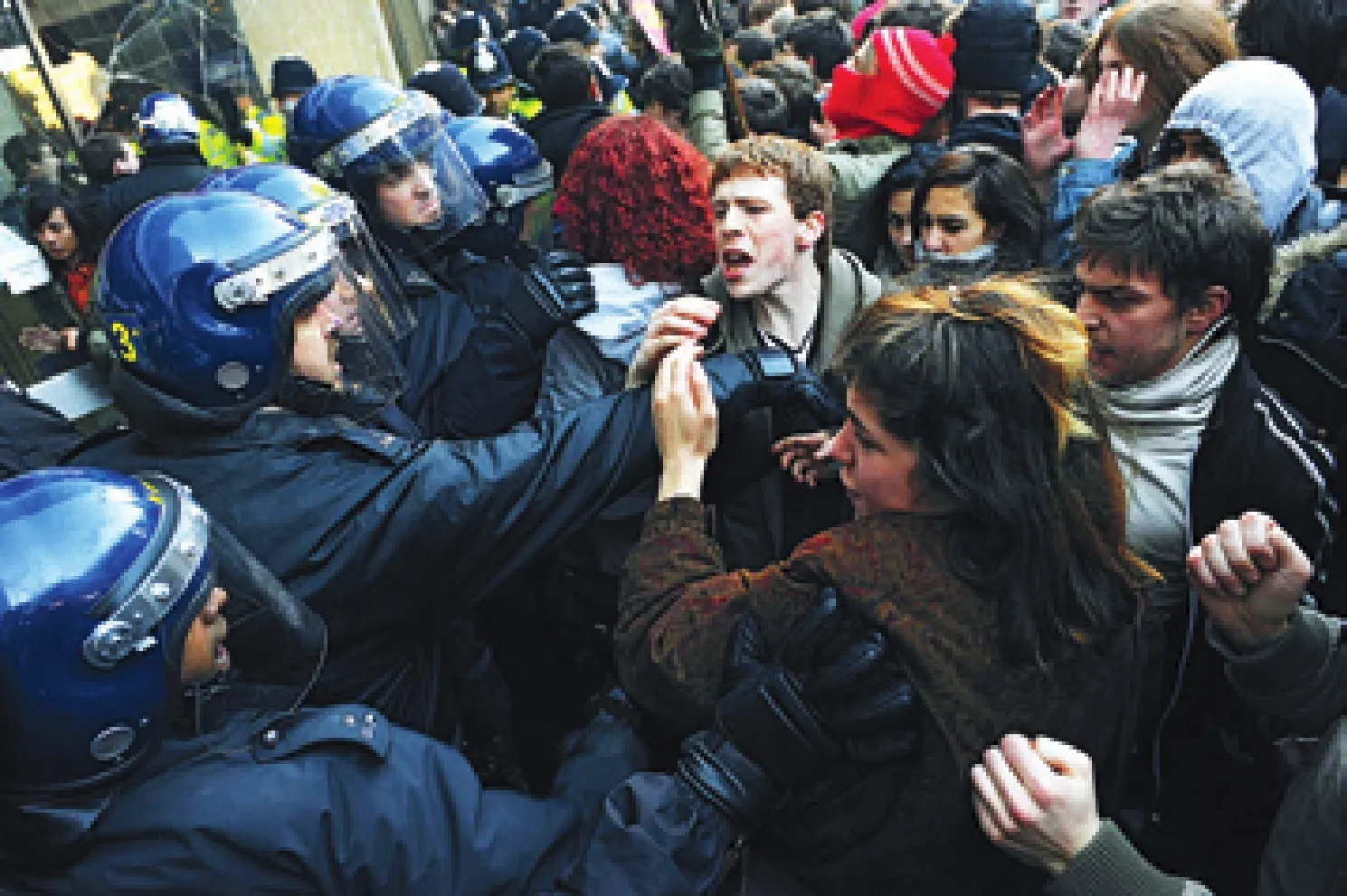
OPPOSING TUITION HIKES:University students clash with police in London on November 10, 2010, during a protest against the British Government’s plan to triple tuition fees
The defense budget will be reduced, and infrastructure commitments all reviewed,with many postponed or cancelled. An ongoing school building program was halted last year as one of the fi rst to be reviewed, with only a proportion of the promised projects given the green light to continue.
The student demonstrations over tuition fees earlier in the year only showed how much public anger there was, and this was on an issue that affects only a minority of people.Changes to the national health service in particular, with the proposed part privatization of it, will create massive opposition.
British Prime Minister David Cameron has been astute and shrewd in the way in which he has entered into a coalition arrangement, despite many misgivings within his own party, and managed to head off the threat of the alternative vote referendum going against his party’s position. So far, the anger has hit the Liberal Democrats, with support for the Conservatives remaining relatively stable. Clegg in particular has become an unpopular and disliked fi gure.
But Cameron’s real test lies ahead. He will be held accountable for one thing, and one thing alone: the economy. If the cuts lead, quickly, to a stronger economic recovery, all will be well and he will probably be returned to power in four years’ time with enough of a mandate to form a Conservative only government. If, however, cuts dent public confidence and lead to a worsening of an already delicate situation, the coalition, and the Conservatives, will lose of fi ce.And while Cameron’s political opponents of course do not want to see him reelected in 2015, nor do they want to see the country’s economy become frailer.
The quandary of the Liberal Democrats is in many ways the quandary of the other political parties in the UK too—how to do something about the weak fi scal situation of the country without making things worse. The results of the coalition’s proposed course of action won’t be known for a number of months.In the meantime, we will just have to wait and see.
(Viewpoints in this article do not necessarily represent those of Beijing Review)
The author is a senior fellow with Chatham House,London
