
Earning Their Keep
2011-12-06 09:12:06ByYUANYUAN
Beijing Review 2011年20期
By YUAN YUAN
Women face gender discrimination in the job market
Yi Rongrong, a postgraduate student at the Communication University of China in Beijing, describes her jobhunting process as a “bumpy road,”though she has a good record in the university with quite a few scholarships and internship experiences at Xinhua News Agency and People’s Daily, two of the leading media organizations in China.
Majoring in journalism, Yi wants to work in a media company. “I sent resumes to major media outlets in Beijing, but for most of them, I didn’t even get a chance for a writing test,” said Yi.
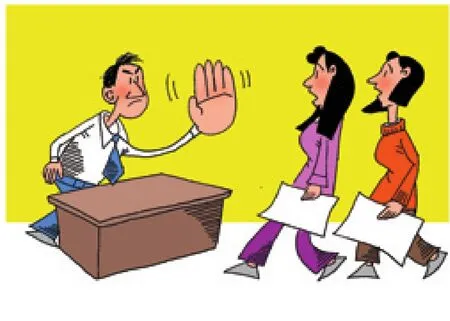
According to Yi, male students in her class, even some with much worse exam records than her, were more popular and get more offers. “Media outlets like male workers, as media work is very hard and tiring and women are considered to have fewer advantages in this regard,” said Yi.
Yi finally got an offer from a newspaper in Beijing, but this won’t get her a Beijing hukou, or registered permanent residence.“I want to stay stable in Beijing, but without hukou, I feel I am a floater here,” said Yi,who hesitated about whether she should accept the offer or not.
“There are more female students than male students in this major. But as for job hunting, males get more chances. It is a conflict. If media companies all want male graduates, where should the women go?”said Yi’s teacher, Zhang Mou.
“This doesn’t only happen with job hunting in the media,” said a 30-year-old woman surnamed Xie, who declined to give her full name. “It happens in every industry.”
Xie has been working in a state-owned company based in Beijing for four years.“The company says in the employment advertisement that they only accept employees with a master’s degree or higher,” said Xie.“But, I finally realized this requirement was only established for female candidates, as I found out some of the men who got in here in the same year as me only had a bachelor’s degrees or lower.”
Less welcome
A survey conducted by the All-China Women’s Federation at the end of 2010 showed 91.9 percent of women felt there was gender discrimination in the job market.While 90.2 percent of employers admitted when a woman and a man of similar qualiif cation compete for the same position, they prefer the male giving the reason that the female candidate is very likely to get married soon and then give birth to children.
“We did hire more women than men in the last several years,” said Sun Yan, a human resources manager of an advertising company based in Shanghai. “But problems showed up gradually as most new female entrants got married soon and had to pay more attention to taking care of the family. Things got much worse after they had children. So this year, we want to employ more men.”
Even Sun, a 40-year-old woman, felt stressed and tired of competing with men in promotion. Having been working in advertising for more than 10 years, Sun said she went through a hard time dealing with both work and housework including taking care of her child.
“The tradition regards women as the group to spend more time at home,” she said.“So women have to work harder to keep up with men at work. Actually we devote more.”
“Even female managers won’t hire other women, it is pathetic,” said Bai Jia, a graduate from East China Normal University in Shanghai with a master’s degree, majoring in English. “Many times I saw at job fairs women sitting at the recruitment booths,rejecting female job-hunters’ resumes and saying they only wanted male workers. I don’t understand it.”
Bai said in the interviews she went through, most employers would raise questions such as “Do you have a boyfriend?” or“Do you have plans to get married in the following one or two years?” or even “At what age do you want to have children?”
“They pay more attention to the answers to this kind of questions than my career plan,” said Bai. “And they also ask what is more important for me, family or work?”
“Many female candidates would say both are very important, and they will strike a balance between them, but we know it is almost impossible,” said Sun.
“If the employers don’t believe such answers, why do they ask?” said Bai.
Gao Yanxia, Bai’s schoolmate, came across the same problems when looking for job.
“I found out female students with a master’s degree are not even welcome compared to those with just a bachelor’s degree,”said Gao, who said her purpose for getting a master’s degree is to get more advantages in the job market. “But women with a master’s degree are normally 25 or 26 years old, more likely to get ready for marriage and childbearing. It has turned out to be a disadvantage.”
But Yu Feifei, a bachelor graduate from University of Science and Technology Beijing, doesn’t think younger age is an advantage. Majoring in computer science, her dream companies all prefer male students. “Male students of my major are much easier to find a job,” said Yu. “Some of the women in my class want to change to other careers such as to be civil servants,but that is an even harsher competition. I might have jumped into the wrong major, I think I should study languages or literature or arts, which may be easier for women to find jobs.”
While, Hou Ju, a student majoring in literature at Beijing Normal University, said it is not true.
“For the employers, I am not goodlooking and I am relatively short,” said 1.55-meter-tall Hou. “I always fail the interview.”
This is the concern of many female graduates. According to an online survey conducted by Peking University’s Law School in 2010, 80 percent of female graduates admitted they lied on resumes about their height and weight and made their resume photos look better with Adobe Photoshop. Thirty percent of them said they would shed the pounds for job-hunting and 17 percent have considered undergoing facial surgeries to look prettier, and less than 5 percent finally did that. It is reported by Eastday.com, a news portal in Shanghai, in 2009, a female student majoring in Japanese from Shanghai International Studies University,spent 20,000 yuan ($3,077) on facial surgeries just for job hunting.
“Compared to male students, female students are expected to work in the service industry, education and health care,diet, secretary, etc. The image of female students is one of the conditions employers consider,” said Cai Rongsheng from the Employment Service Center of Renmin University of China. “But its importance has been exaggerated in a way, and some female students focus more on this than solidifying their own abilities.”
Glass ceiling
On March 2, 2011, a job fair for female college graduates held by the Beijing Graduates Employment Service Center attracted more than 3,000 job hunters.However, disappointingly, more than 600 of the job posts were secretarial, accounting and customer service positions.
The gender discrimination against women does not only exist in the job market for college graduates, but also for migrant workers. Jia Minxia, who is working in a clothing factory in Dongguan, a major manufacturing hub in south China’s Guangdong Province,revealed for female migrant workers, job choices are limited to sewing clothes, housecleaning and serving in restaurants.
“For married women, like me, we go out at the price of leaving children at home with grandparents,” said Jia. “We earn less than men and it is hard to get insurance as well.”
In January 2008, the Employment Promotion Law took effect. The law allows female job seekers to bring employers to court if the latter discriminate against them.Except for jobs in mines, lumberyards, installation and removal of scaffolding and other posts that are considered unsuitable for women, employers should not refuse female workers without legitimate causes.
“But discrimination against female workers has many guises in the job market.Sometimes, employers openly say they don’t want women or prefer male applicants. Or through eliminating female applicants at initial stages of competition, firing pregnant women or transferring them to jobs with severe working conditions, they manage to force female workers to quit,” said Liu Shen, a professor at the China University of Political Science and Law.
Xie Zhengguan, a professor at the Graduate School of the Chinese Academy of Sciences,said more measures to punish gender discrimination in the job market should be included in current laws.“Female students always need to spend more time hunting job than male students but get paid less,” said Xie. “A complete insurance system should be set up to protect women’s rights during pregnancy and childbearing. The government should invest more in this, not leaving the burdens all to employers, and a proportion of female employees to a company’s total staff should be set to encourage employers to hire a certain number of females every year.” ■
