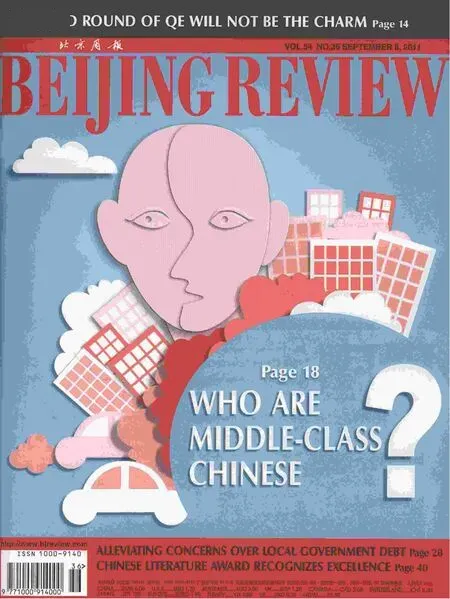
Literary Pens Sparkle
2011-10-14 02:15:56ByYULINTAO
Beijing Review 2011年36期
By YU LINTAO
Literary Pens Sparkle
By YU LINTAO
The eighth Mao Dun Literature Prize rewards accomplished writers
Five novels with realistic themes were crowned as the winners of the eighth Mao Dun Literature Prize on August 20. “The conscience of realist authors is palpable in these works,” said literary critic and member of the judging panel Li Guoping.
The winners wereEndless Wanderingsby Zhang Wei,Heavenly Missionby Liu Xinglong,Frogby Mo Yan,Massageby Bi Feiyu andA Sentence Is Worth Thousandsby Liu Zhenyun.
“The five novels introduce the readers to the progress of civilization in China and reflect common values upheld by modern Chinese, representing the highest achievements of China’s literature in recent years,”Li said.
While ensuring the prize has a convincing list of laureates, a more “fair and transparent” selection process has endowed the 30-year-old literature award with added credibility this year.
The eponymous prize of Chinese novelist Mao Dun (1896-1981), which was initiated in 1981 with his donation of 250,000 yuan($39,062.5) after he died, and sponsored by the Chinese Writers Association (CWA), is considered one of China’s most prestigious literary prizes and awarded every four years.
The prize has selected 31 novels in its previous selections, but not all of them have stood the test of time and been canonized by both readers and literary criticism circles.
“The most important principle of selection hasn’t changed: We value the depth of thinking and the artistic and aesthetic qualities of a novel and the fl awless fusion of the two in a work,” said Gao Hongbo, deputy head of the judging panel for the eighth prize.
The organizers of the prize did introduce changes to the selection process this year in hopes that results were more in line with the prize’s intentions, such as having a greater number of judges in the jury, requiring realname selection and appraisal by judges, and announcing results of each round of voting as they occurred.
Through five rounds of voting by 61 judges made up of literary critics and writers,the fi ve novels emerged from 180 nominated works, which were mostly recommended by provincial associations of writers from a repertoire of 8,000 novels fi rst published on the Chinese mainland between 2007 and 2010.
True to its name
Liu Zhenyun, the only one of the five who won the prize and is not a CWA member, attributed his award to the practice of“democracy” in this year’s selection.
While the number of judges was increased from 21 to 61, responsible for the whole process from preliminary evaluation to fi nal selection, all judges were required to sign their names to vote for the sake of transparency and fairness.
It’s an important improvement to require real-name voting as it allows judges to express their opinions publicly and effectively reduces votes for acquaintances of jury members, said Hu Ping, a member of the judging panel.
The prizes were awarded for the works and not because of the authors who wrote them, said Gao. But the results show most of the nominees were realistic novels by well-known writers who were older than 50 and who established their names in the late 1980s, which became increasingly obvious after four rounds of voting. Bi, born in 1964,is the only exception.
“It’s easy to make the selection open and transparent, but it’s hard to have absolutely fair results that satisfy everyone,” said Mo Yan at a press conference arranged for the readers to meet the laureates on August 26.
“We are encouraged as the prize has diverted a great deal of attention to literature in a world where literary writing and reading are increasingly marginalized,” Mo said.
One signi fi cance of the prize is the fact it provides modern Chinese models for serious reading and proof of a particular phase of the Chinese civilization for future research, Gao said.
For the first time, the prize opened its door to popular novels published online, but all seven nominated online novels failed in the fi rst two rounds of voting.
Hu attributed the failure to the small number of online novel nominees and the fact most online novels targeted the popular market while the Mao Dun Literature Prize is an award targeting “pure” literature.
Still, not all online novels should be labeled as popular reading, and the CWA is considering a prize for pop literature to encourage more people to write in the future, Hu said.

“The real significance of the award for me is that I should write differently hereafter.”—Mo Yan

“Literature should be testified to by time. A bigger market share doesn’t equal a better work.”—Zhang Wei

“The blind group is almost isolated from mainstream society. Their tragedy is not that they are being harmed by mainstream society but that they are being neglected.”—Bi Feiyu
“The elements of literature remain the same despite the changes in instruments.While writing online, authors should also be able to tell good stories and create vivid characters, which is the simple and uncompromising rule of literary writing, “ said Gao.
Realistic themes
The five novels share a realist perspective, which Liu Zhenyun interpreted as “a realistic attitude toward life,” “a state of always being conscious of what occurs” and“the ability to rein the imagination to explore every corner and detail of reality.”
The 39-volume novelEndless Wanderings, which topped the fi ve winners with 58 votes, tells the stories of a group of people born in the 1950s whose families bear witness to the country’s political and social transformation. The novel, loosely divided in 10 units, took Zhang 22 years to fi nish. The 4.5-million-word novel in length equates to six copies of the four-volumeA Dream of Red Mansions, the Chinese classic masterpiece by Cao Xueqin (1715-1763).
“Endless Wanderingswas awarded the prize not only because of its artistic achievements, but also because of the author’s faith in pursuing his literary dreams, and his perseverance in writing,” said literary critic Su Ning, who is the Director of the Literature Institute of Sichuan Academy of Social Sciences.
WhileEndless Wanderingsis considered a landmark work in Chinese contemporary literature, other novels such asHeavenly Mission, which depicts low-income teachers in poverty-stricken rural areas who manage to perform their roles without government subsidy, andFrog, which re fl ects on China’s birth control practices through the eyes of a rural gynecologist, described the pain and emotional struggle the Chinese people have gone through as its growth engine roared on,literary critic Li Guoping said.
Liu Xinglong, the author ofHeavenly Missionsaid it was a sorrowful story, “The story had hovered over my head for a long time before I began writing it down. It is not only the pain of my own heart; it is also the pain of the country.”
Frogdepicts the life of a rural gynecologist, a character based on the author’s aunt,who struggles with an emotional breakdown after a 30-year career of performing forced abortions and sterilizations.
A Sentence Is Worth Thousandsis a simple story, describing a man’s constant search for someone to talk to, mirroring people’s loneliness in a society without religion. Meanwhile, Massage concentrates on the world of a group of blind people, exploring their inner world. “This is an area rarely touched upon by other authors,” said Lei Da,a member of the judging panel.

“The story had hovered over my head for a long time before I began writing it down. It is not only the pain of my own heart; it is also the pain of the country.”—Liu Xinglong
“Heavenly Mission,FrogandMassageshow not only writers’ consciousness of the humanities but also their sense of being different and creative. They have added to old topics new thoughts,” said writer and CWA member Liang Hongying.
To a global audience
China is one of the largest publishers in the world but Chinese writers receive little recognition in literary circles outside of China. Winners of the Mao Dun Literature Prize said more Chinese novels have to be translated into foreign languages to reach an international audience.
“Chinese readers know more about Western writers and their works than Westerners do about Chinese literature. It is very common to see Chinese versions of Western literary classics and best sellers on bookshelves of Chinese households. But this is not the case with Chinese books in homes in the West,” said Liu Xinglong.
“It’s not because of the quality of works of Chinese writers,” Liu Zhenyun said. “One of the most important reasons is the lack of Chinese works translated into other languages.”
It’s easy to identify the influence from eminent Western novelists on Chinese writers’ style. For instance, Mo and Zhang all acknowledged the influences on their writings from U.S. novelist William Faulkner and Colombian writer Gabriel García Márquez,author ofOne Hundred Years of Solitude.

“The fact that little recognition is given to Chinese writers overseas is not because of the quality of works of Chinese writers. One of the most important reasons is the lack of Chinese works translated into other languages.”—Liu Zhenyun
Of this year’s five winners, Mo, born in 1955, is the oldest and most familiar to Western readers. His workRed Sorghum,which was made into a film by famous Chinese director Zhang Yimou, was popular in the West. He has his five-pieceRed Sorghumseries translated and published into 12 languages;Big Breasts & Wide Hipsinto 11 languages; andSandalwood Penaltyin five languages. In addition, many countries have published his short stories and collections of essays.
“Overseas readers are most accustomed to the older novels about the “cultural revolution” (1966-76) and the countryside, from writers like Mo Yan or Su Tong. There’s also a certain familiarity with novels written by young women about sex, drugs and rock and roll in China,” Eric Abrahamsen, a literary translator in Beijing who reads Chinese writers regularly, toldBeijing Review.
But Abrahamsen, who translated a novel of Wang Xiaofang,Notes of a Civil Servant, for Penguin and many short pieces,said readers had largely lost interest in these genres, without really knowing what else they wanted to read.
“A good understanding of the Chinese literary scene on the part of foreign publishers is probably the single most important thing. Once editors have a good grasp of what’s out there, they’ll be able to pick books they’re relatively confident readers will be interested in and, most importantly,they’ll be willing to put resources into promoting those books, so that people actually end up reading them,” he said.
“There is still a long way to go—so much good Chinese literature still hasn’t been translated—but more is coming out,slowly but steadily,” he said.