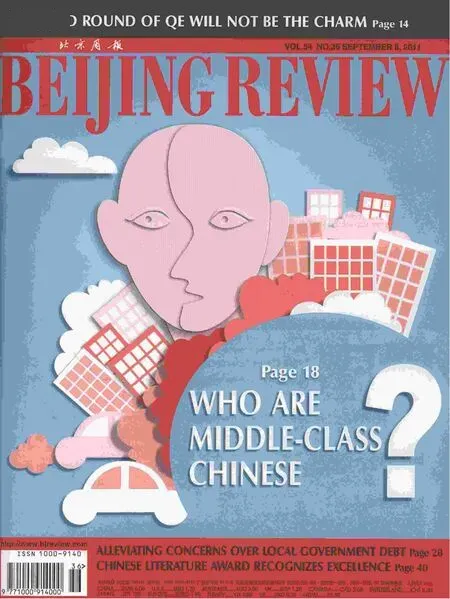
DEFINING THE MIDDLE CLASS
2011-10-14 06:19:32ByWANGHAIRONG
Beijing Review 2011年36期
By WANG HAIRONG
DEFINING THE MIDDLE CLASS
By WANG HAIRONG
Classifying the middle class remains controversial despite its alleged growth
China’s cities housed more than 230 million middle-class residents in 2009 or 37 percent of the urban population,according to the2011 Blue Book of Cities in Chinareleased on August 3.
In China’s main urban centers, Beijing and Shanghai, the middle class accounted for 46 percent and 38 percent, respectively, of the local population.
The report, published by the Chinese Academy of Social Sciences (CASS), def i nes the middle class as people who spend only 30 to 37.3 percent of income on food.More specifically, the report’s lead author,Zhang Lifeng, said they are mostly people in households with a per-capita annual disposable income of between 16,300 yuan ($2,556)and 37,300 yuan ($5,848).
Tan Tan, a young staff in a private company in Beijing with a monthly salary of 5,100 yuan ($800), belongs to the middle class category as de fi ned by the report. But she said she didn’t feel “middle class” at all.
Tan spends about two thirds of her disposable income on daily necessities, such as rent, utilities, food, clothing, transportation and phone bills. She saves about 17,000 yuan ($2,665) a year on average.
She believes “middle class” refers to a lifestyle far removed from her own.Facing rising housing prices and in fl ation,Tan said she found her fi nances constantly stretched and didn’t have the peace of mind with which she associates a middle-class lifestyle.
“I do not own a house. The money I save in a year is not enough to buy 1 square meter of living space,” Tan said.
Like Tan, many statistically qualified middle-class Chinese people are struggling to pay mortgages, cars, medical bills and their children’s education.
Vague definition
Although the term middle class is widely used, there is no universally accepted de fi nition for it.
The middle class in other countries is usually defined by income and occupation,said Zhang, lead author of the CASS report and a researcher with the academy’s Institute for Urban and Environment Studies.
“The American middle class consists of households with an income between$40,000 and $200,000, which accounts for 80 percent of the country’s population, while the German middle class includes households with an income between $30,000 and$800,000, or about 55 percent of the population,” she said.
The fi rst references to a modern Chinese middle class were made in the late 1980s after China implemented the reform and opening-up policy. Only since the turn of the century have mainstream Chinese scholars been studying the middle class, said Cheng Li, a senior fellow at the U.S.-based Brookings Institute.
According to international standards,to be middle class in a developing country requires a daily income of between $4 and$6, said Li Shi, a professor at the School of Economics and Business Management of Beijing Normal University.
By this standard, China has a very large middle class, but the accuracy of this standard is debatable as developing countries vary wildly.“Whether China has a middle class is contingent on how we de fi ne it,” Li said.
Chinese researchers usually use income,profession and education as most essential criteria in determining middle-class status,and some scholars also use consumption level in their studies.
In 2005, the National Bureau of Statistics released a survey, which showed the urban middle class should have an annual income between 60,000 yuan ($9,405) and 500,000 yuan ($78,376). At the time the bureau estimated that the middle class constituted 5 percent of urban Chinese residents.
In her newly published report, Zhang classified households with an Engel’s Coefficient of between 0.3 and 0.373 as middle class. The Engel’s Coef fi cient refers to the share of food in total household expenditure.
Zhang chose to use consumption level rather than income as a measure of middleclass status, because, she said, Chinese citizens are often hesitant to disclose their full incomes, and there are huge disparities in living costs between China’s regions.
According to the UN Food and Agriculture Organization, the Engel’s Coefficient for the richest segment of society is typically below 0.3 and for the wealthy stands at between 0.3 and 0.4. Zhang said she chose the 0.3 to 0.373 range for China’s middle class after taking into account Chinese citizens’ consumption and living patterns and China’s socio-economic system.
But Zhang’s conclusion that China had 230 million middle-class urban residents in 2009 has been widely criticized. A netizen known as Wuyue Sanren said the Ministry of Finance’s (MOF) statistics show only 24 million people in China make more than 3,500 yuan ($549) per month, the personal income tax exemption threshold effective on September 1. “How can a person with income below the income tax exemption threshold level qualify as a middle class?”Wuyue Sanren said.

MIDDLE-CLASS LIFE: A family from Beijing enjoys a vacation at a resort near the Wenyu River in Tongzhou District on May 22
Zhang said the MOF’s data were based on individuals’ reported incomes, while hers were based on household spending. Since many Chinese people have off-book income,Zhang said she believed household spending provides a more accurate picture of people’s lifestyles.
Wang Jian, Secretary General of the Chinese Society of Macroeconomics of the National Development and Reform Commission, said he thought Zhang’s estimate was more or less accurate.
Wang admitted China’s present high inflation had placed an enormous strain on all citizens, but he said even struggling mortgage payers remained middle class in comparison to people who cannot even afford a down payment.
Painstaking growth
“Currently, the shape of China’s income structure is not an olive with a bulging middle and tapering ends, but a pyramid with a large group of low-income people at the bottom,” said Li at Beijing Normal University.
But Zhou Tianyong, a professor at the Party School of the Central Committee of the Communist Party of China, tends to believe China’s income structure takes an inverted T shape, with the middle to high-income population constituting the vertical bar and the bulk of the people being the horizontal bar at the bottom.

Zhou said the best way to produce an olive-shaped income structure in China is to boost the growth of small and medium-sized enterprises.
“In China, the number of owners and managers of small and medium-sized enterprises is relatively small, as the growth of small and medium-sized enterprises is inhibited by heavy taxes and difficulties in fundraising,” Zhou said.
Using data released by the State Administration for Industry and Commerce,Zhou calculated China had 12 enterprises per thousand people, whereas China’s Taiwan and South Korea each had 50 enterprises per thousand people.
“If China has 50 enterprises per thousand people and each company is run by at least two people, then one 10th of the country’s population will be middle class,”he said.
China’s growing income disparity between a high-income elite and the struggling remainder of the population remains an impediment to changing the structure of the country’s income pyramid.
“With the growing income gap, it is difficult to have a fast-growing middle class,said Chi Fulin, a researcher with the China Institute for Development and Research, a think-tank based in south China’s Hainan Province.
Chi believes a rapid expansion of the middle class will only happen if China increases wages in its service and hi-tech sectors. “It is dif fi cult for an economy dominated by investment and industry rather than services to breed a mass middle class,” he said.
According to Bai Chongen, a professor at the Tsinghua University’s School of Economics and Management, the share of household income in total national income dropped from 63 percent in 1993 to 52 percent in 2007, whereas in the same period, the share of government revenues increased 9 percentage points, and that of enterprises’ income went up 2 percentage points.
He called on the government to increase expenditure on public programs and distribute dividends of state-owned enterprises to citizens, saying these efforts will greatly reduce the burden on citizens.
The urban-rural income gap and income disparity across regions and industries also remain a source for concern. In order to encourage emergence of a genuine middle class in China, Bai also suggested the government reform the transfer payment system for underdeveloped regions,push forward urbanization and tackle monopolies.