Visible Nano Applications
2011-10-14 02:15:08ByTANGYUANKAI
Beijing Review 2011年39期
By TANG YUANKAI
Visible Nano Applications
By TANG YUANKAI
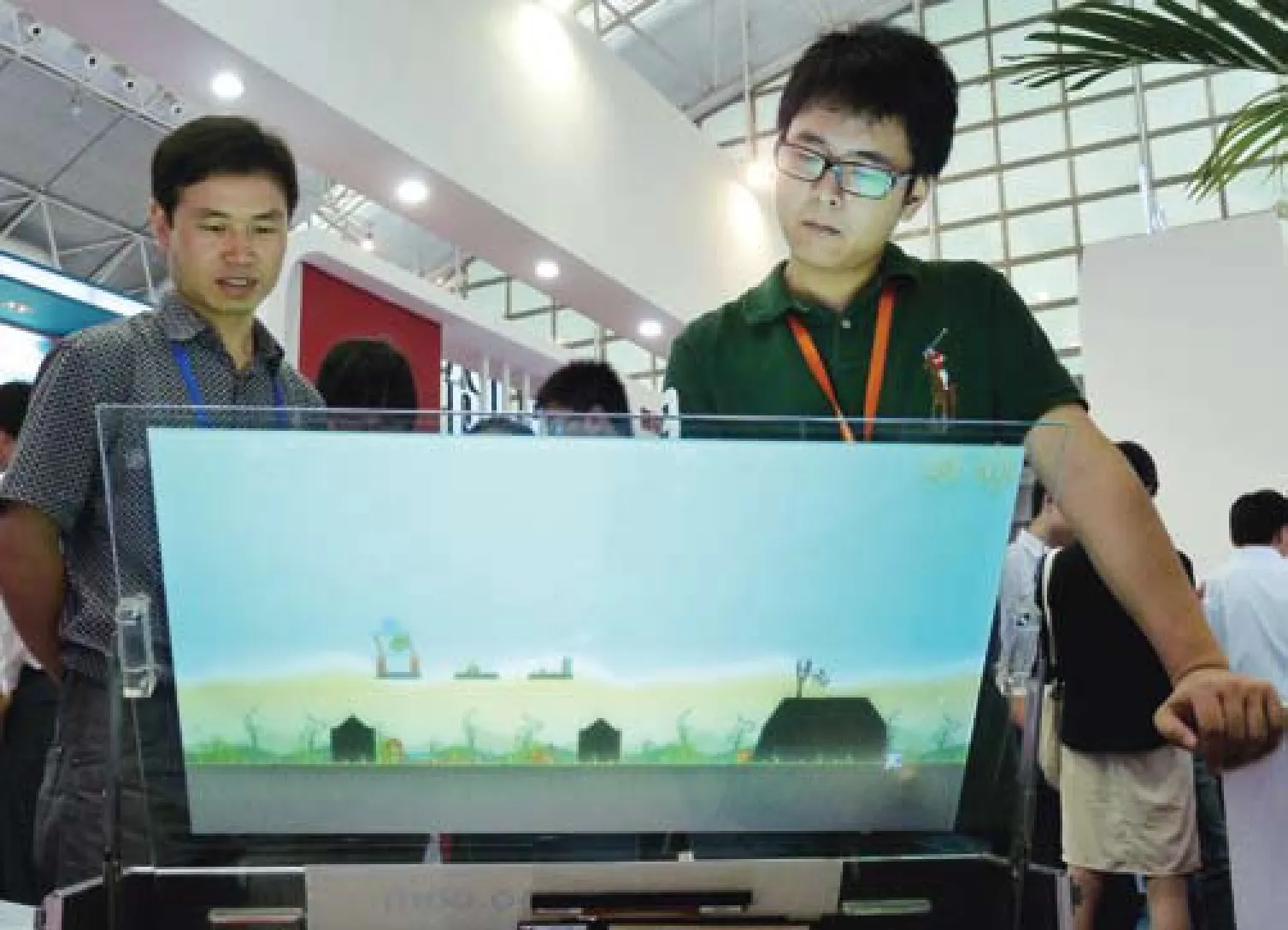
NANO FILM: An enterprise in Nanjing, capital of east China’s Jiangsu Province,has invented a nano material film that can turn any common glass into a touch screen. It’s seen as a great revolution in human-computer interaction
China leads the world in nanotechnology research and application
Nanotechnology is the buzzword among international scientific researchers.However, despite the fancy label,nanoscience isn’t something for the future;it’s already been used in dozens of products.Products using this technology are now available on ordinary supermarket shelves across China.“Nanoscience and technology has stepped out of the lab and into the society to bring more convenience to people’s everyday life,” said Bai Chunlin, President of the Chinese Academy of Sciences (CAS)and chief scientist of the National Center for Nanoscience and Technology.Most people, however, still struggle to identify nano materials.“First, you have to examine whether the material is within one nanometer to 100 nanometers; second, you have to check whether it has characteristics that traditional materials don’t possess,” said Bai, citing the example of the oil-proof nano-material tie he wears. A shake of the tie will cause any liquid drops such as milk, ink and oil on it to fall like dew does from lotus leaves, without staining the tie.
“The seemingly self-cleaning effect of lotus leaves vividly demonstrates how ‘the nano structure’ works,” said Hou Jianguo,President of the University of Science and Technology of China, who is also an expert in nanoscience and technology. “Scientists discovered that lotus leaves and fl ower petals have a nano structure, which prevents the penetration of dust and water. This is the famous ‘Lotus Effect.’”
China has successfully integrated its expertise in four dominant technologies of this century: nanotechnology, biology, information and cognition. Technologies developed from that integration are believed to have enormous in fl uence on the human society in the near future.
“China is now in a leading position in terms of the number of published papers on nanotechnology, the frequency of papers’being cited, the number of nanotechnology patents, and the frequency of authorizing others to use patents,” said Bai at the International Conference on Nanoscience and Technology, China 2011 (ChinaNANO 2011), which opened on September 7.
Over the past fi ve years, Chinese scientists published 34 percent of Science Citation Index theses on nanoscience and technology.
“These papers have been cited more than 80,000 times, second only to papers from the United States,” said Mihail Roco, Chair of the US National Science and Technology Council subcommittee on Nanoscale Science, Engineering and Technology. Roco and Sumio Iijima, Japanese physicist and the discoverer of carbon nanotubes, received the China NANO Award at ChinaNANO 2011.
“China now leads the world in terms of the numbers of research institutions dedicated to nanotechnology research, research results and relevant applications,” said Roco.“By 2020, nanoscience application will be in everyone’s lives and not just a marginal research field, which can be accelerated in China.”
“China has worked to combine fundamental research with practical applications,”said Bai. “The Central Government has established a series of national and international standards, paving the path for the nanotechnology industrialization.”
China’s nano research
As a unit of length in the metric system,one nanometer is equal to one billionth of a meter; one nanometer to a pingpong ball is like one pingpong ball to the earth.
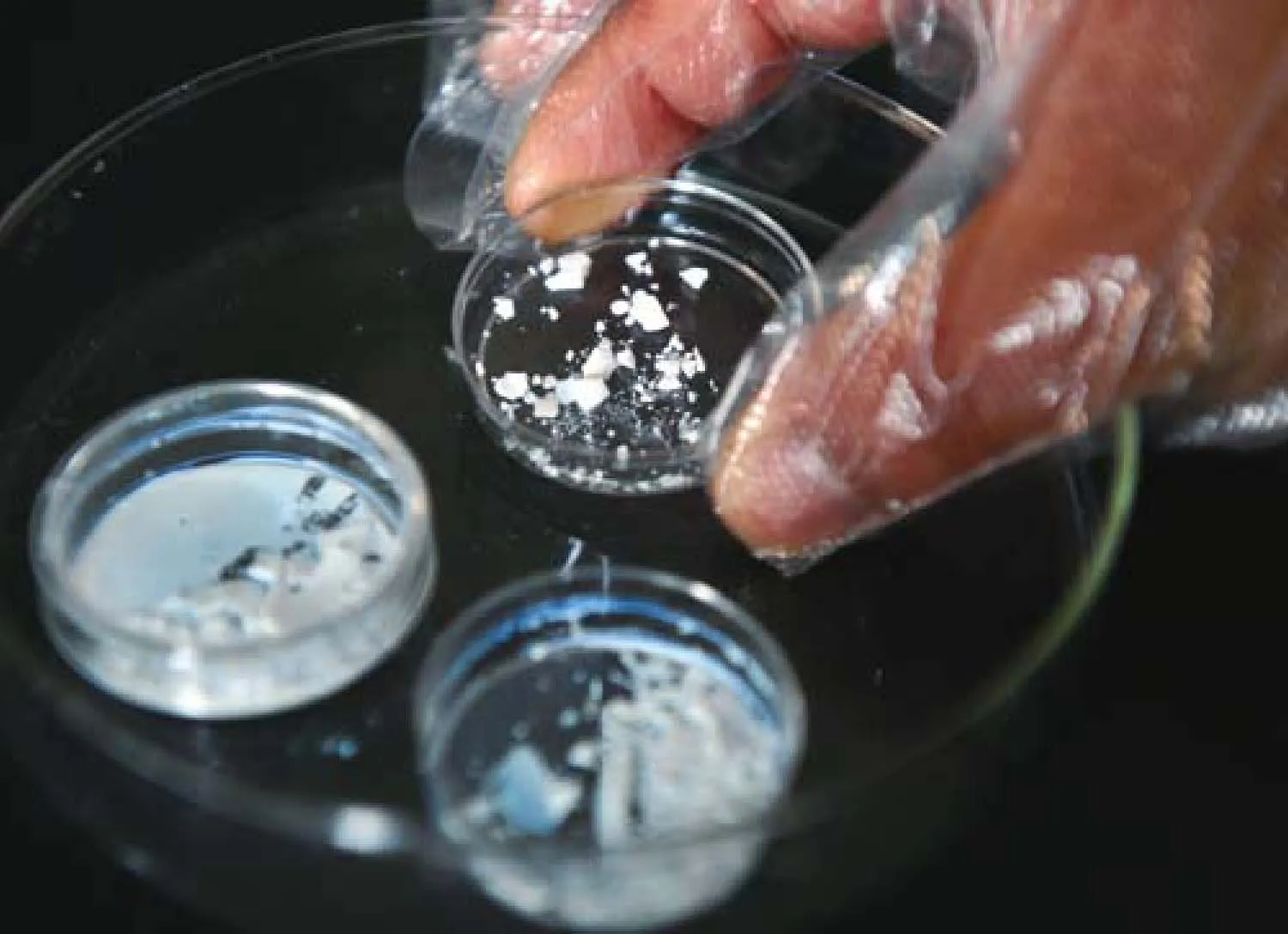
NANO BONE: The chemistry department of Zhejiang University has developed a nano material simulative bone, which is closer to natural bones in strength and viscosity. If put into use, it will help cure bone injuries
Twenty years ago, scientists discovered that things from one nanometer to 100 nanometers have very unique physical characteristics. They don’t follow the quantum principles of the micro world nor do they conform to the principle of relativity and the Newtonian mechanics of the macro world.Finding a new theory for explaining their activities has become the key subject for nanoscience and technology, which began in the late 1980s.
“Nanoscience and technology is a multidisciplinary and interdisciplinary field for studying characteristics of substances from one nanometer to 100 nanometers and their interactions,” said Bai. “Moreover, nanotechnology, information technology and biology have become the three pillars of today’s technologies and are also the fastest developing fi elds.”
China is one of the first few countries to have started research on nanoscience and technology and Bai has been an important witness and participant in the whole undertaking. After getting his doctoral degree from the CAS, Bai became a post-doctoral researcher at the California Institute of Technology in 1985, where he became the first Chinese researcher in the Scanning Tunneling Microscope (STM) fi eld.
STM is vital for the development of nanoscience and technology, and serves as the “eyes” and “hands” for materials science. German physicist Gerd Binnig and Swiss physicist Heinrich Rohrer won the Nobel Prize for their development of the STM in 1986, one year earlier before Bai returned to his motherland and started nano research in China.
Bai and his colleagues invented China’s fi rst computer-controlled STM on April 12,1988. From then on they were not satis fi ed simply to observe atoms but became determined to reconstruct them. Bai’s STM team eventually developed into an international lab.
The Central Government has offered considerable support to nanotechnology research. In order to allow relevant scientists to communicate with each other, the government established a national network connecting all large research centers for nanoscience and technology.
China possesses almost all the rare mineral substances and biological resources needed for high-level nanotechnology research. The country’s consumer market also offers a huge incentive for the development of products that use nanotechnology.
In China, nano-related technologies are already being put to daily use; green nano printing technology, quick and low-cost AIDS tests and the Lithium-ion battery are applications that demonstrate the fi eld’s potential.
Green printing
The Institute of Chemistry under the CAS has created a new nano material for printing. Printing with this material costs less, pollutes less and printing plates can be recycled.
“The green nano plate making and printing technology is likely to catalyze a revolution in the printing industry,”said Bai.
Traditional printing uses a number of chemicals and consumes a lot of energy, but the new
nanotech printing method eliminates chemical treatment steps by allowing publishers to directly print images onto the plate.
The team led by Song Yanlin, a researcher at CAS’s Institute of Chemistry,has achieved huge breakthroughs in applying nanotechnology to improve printing accuracy and increase the life of plates.

Bai Chunli
Song secured 24 million yuan ($3.75 million) as the initial capital for his plant established in 2009. A production base will soon be put into operation. The plant will annually produce printing plates of 6 million square meters and other printing materials using nanotechnology, with technical support from CAS and Lenovo.
Diagnosing diseases
Scientists are also using nanotechnology to diagnose and cure diseases.
A magnetic nano microsphere with improved capacity, or nano prober, has been invented and made by the Research Institute of Micro/Nano Science and Technology of the Shanghai Jiao Tong University. The device can be used in biomedicine to test for myocardial infarction, hepatitis and AIDS.It can also be used for food safety tests—to determine the amount of pesticide in fruits and vegetables and illegal additives in food.
The team with the university made a breakthrough in terms of magnetic nanoparticles the microsphere contains. The amount of magnetic nanoparticles was increased from below 35 percent in the past 30 years to more than 70 percent at present, which has signi fi cantly shortened the test time.
In detecting AIDs or other major communicable diseases, the magnetic nano microsphere is a powerful diagnostic tool 10 to 100 times more sensitive than existing tests using optical signals.
The improved sensitivity allows the device to save lives. For instance, the death rate for acute myocardial infarction is very high and the key to rescue lives lies with diagnosing it as early as possible.While an ordinary examination takes about 40 minutes, magnetic nano microspheres can reduces detection time to about 20 minutes.They can also sensitively detect latent viruses that traditional examination technologies may not identify.
While saving test time and lives, the magnetic nano microsphere,smaller, more sensitive and adjustable for various situations, also remarkably reduces the medical cost for patients.
In addition, researchers from Yunnan University and Jilin University have developed the nanocrystalline test paper for AIDS and hepatitis B detection.