GETTING STRICT WITH RULE BREAKERS
2011-10-14 02:15:04LANXINZHEN
Beijing Review 2011年39期
GETTING STRICT WITH RULE BREAKERS
More supervision is needed over multinationals operating in China as controversy begins to surround these foreign companies
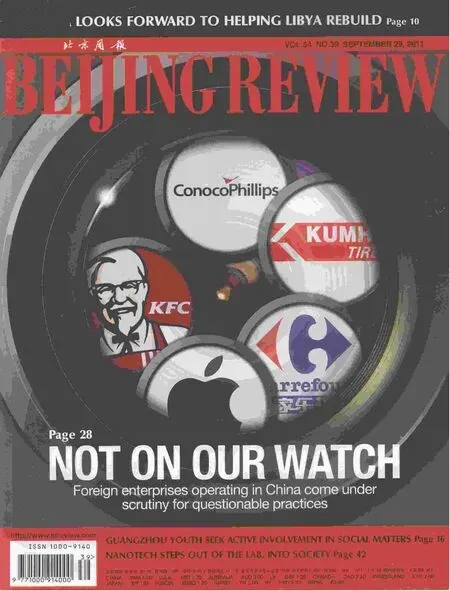
Governments at municipal and provincial levels seem to be letting just about any multinational company into China these days, creating a backlash after inadequate supervision over production and operations led to a number of scandals and accidents.
ConocoPhillips China’s delayed response to an oil leak in the Penglai 19-3 Oilfield resulted in thousands of tons of crude spreading across an area of at least 840 square km of the Bohai Sea, causing an ecological disaster and outrage among the Chinese public.
And not long after KFC disclosed that its soybean milk was made from a questionable powder, another public outcry erupted after reports that the U.S. fast food giant was changing its cooking oil every four days, far longer than most Chinese restaurants.
These are not the only problematic foreign companies.
On January 9, 2008, the Ministry of Environmental Protection (MEP) released a list of 130 multinationals operating in China that have illegally polluted the environment.The ministry’s blacklist was based on special inspections conducted between 2004 and 2007 on suspected foreign companies.
From government investigations and reviews, it’s clear that some multinationals have not and are not fulfilling their responsibilities to maintaining operations in China.
“When we open our door and are ready to enjoy products and services provided by world famous brands, are we ready to protect our consumers, our resources and environment?” Xinhua News Agency asked in a commentary published on September 9.
As China continues to reform and opening up, more multinationals are investing in China, establishing factories, research and development institutions and trading companies. Among the world’s top 500 companies, more than 450 have set up shops here, promoting China’s economic development, social progress, technology upgrading and introduction of strategic resources. However, this is not the reason to relax government supervision.
Gu Xiaoming, professor of sociology at the Shanghai-based Fudan University, saidthe government should play the leading role in urging enterprises to fulfill their social responsibilities and establish a mechanism to make enterprises regularly publicize their social responsibilities.
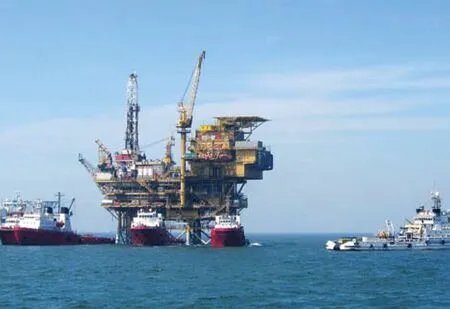
(From left to right)STOPPING LEAKS:A ConocoPhillips ship collects oil around the Penglai 19-3 Oilfield
Inadequate supervision
In the past decade, ConocoPhillips has been involved in at least fi ve environmental lawsuits or disputes in the United States,paying out nearly $700 million in damages and restitution. But in China, under the high pressure of the media, ConocoPhillips has reversed the passive situation of avoiding environmental impact assessment and ecological damage and announced it will establish the Bohai Bay Fund. The fund will address ConocoPhillips’ responsibilities in accordance with relevant laws of China and to benefit the general environment in the Bohai Bay.
Since related Chinese laws and regulations are still in their infancy, it is hard for the Chinese Government to get reasonable compensation from ConocoPhillips similar to what it had paid out in the United States.According to China’s Marine Environment Protection Law, the maximum administrative fi ne for pollution caused by offshore oil exploration is only 200,000 yuan ($31,348).
Three months after the Bohai oil leak was discovered, ConocoPhillips has yet to receive any severe punishment. The Xinhua commentary went on to point out that even though ConocoPhillips has paid some compensation, due to the lack of a supervision mechanism and inefficient punishment multinationals will have no “heart of fear”when they come to China seeking wealth.
China implemented a revision to the Marine Environment Protection Law in 2000—which was first promulgated in 1982—but the State Oceanic Administration, the major enforcer of the law, has yet to promulgate any regulations for the government to demand compensation for ecological damages.
W a n g X i, D i r e c t o r o f t h e Environmental and Resources Law Institute af fi liated to Shanghai Jiao Tong University,said if the regulations for the government to demand compensation for marine ecological damage, or even department provisions on oil leakage accidents of drilling platforms, were formulated and issued,China would not have been so passive and powerless in supervising and punishing ConocoPhillips.
In fact there are many cases of multinationals’ different compensation methods for the same product fl aws or service problems in different countries. For example,for the recall of defective cars in 2010,Toyota paid a fi ne of $50 million to the U.S.Government, but in China, only a small number of consumers got a 300-yuan ($47)coupon as compensation.
McDonald’s serves as another example.According to a Xinhua report, since the temperature of its coffee is 10 degrees centigrade to 16 degrees centigrade higher than the acceptable average, a consumer in the United States received compensation in the amount of $600,000 after being burned by the hot coffee. In China, the fast food behemoth paid out only 2,000 yuan ($313) out of court after a consumer found maggots in a chicken wing.
Why are Chinese supervisors so powerless in supervising multinationals? Dong Zhengwei, a lawyer of Beijing Lianggao Law Firm who has participated in lawsuits against foreign brands, told Xinhua that multinationals adopting dual standards in China and foreign markets shows not only the problem of “sense of morality” for the companies, but also loopholes in China’s legal system.
Dong said monitoring technologies of government departments are outdated and the working efficiency is poor. Many government officials know little about corporate social responsibilities and government supervisors have no monitoring or prevention authority over these companies.
The networks of government public relations in fl uenced by multinationals also lead to a failure of government supervision,Dong said. This obviously points to bribes.
The problem most Chinese people are concerned about is that to many local government officials multinationals equate to tax revenues, job opportunities and “internationalization” of the local market. Even though the country has eliminated special treatment of foreign companies, such treatment still exists in the minds of some of fi cials.
Lacking social responsibility
It is unlikely that Apple Inc. is completely ignorant of the human rights violations and pollution problems of its suppliers in China. However, the company did nothing after its Chinese suppliers were found to have failed to honor their social responsibilities. Although Apple admits there are some problems in its supplying chain, it still continues to use the suppliers, reaping huge pro fi ts at the price of China’s environment and public health.
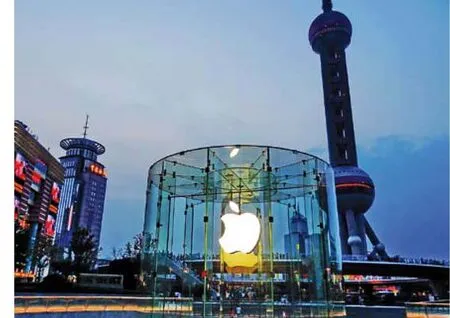
POISONOUS APPLE:The electronic device giant Apple disclosed that environmental problems exist in its suppliers in China
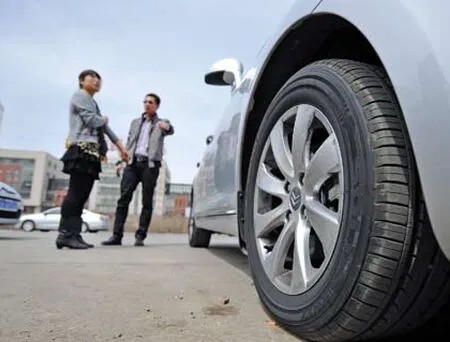
REPAIR MY TIRES:A car owner in Yinchuan, Ningxia Hui Autonomous Region,talks with a representative from Kumho about results from tire checks on his car
Wang Tieshan, professor at Xi’an Jiaotong University, researched a topic on(From left to right)STOPPING LEAKS:A ConocoPhillips ship collects oil around the Penglai 19-3 Oilfield social responsibility and public relation behaviors of multinationals in China. The result shows that many multinationals in China lack a sense of social responsibility.
According to Wang, serious problems in environmental protection top the list of disregards. Since Chinese environmental protection standards are low, the efforts of environmental protection are inadequate and punishment against pollution is typically lenient, enterprises do not need to assume all the social treatment costs after they damage the environment. Moreover, to pursue high economic growth, some local governments accommodate and even protect those enterprises from being punished.This has allowed some multinationals to transfer their heavy-polluting factories into China, deteriorating local environment and ecosystem.
Multinationals often avoid taxes illegally in China. Because there are differences in product prices, interest rates, labor and other costs and tax rates among different countries, multinationals often avoid taxes by controlling pricing among affiliated companies.
According to an anonymous of fi cial of the State Administration of Taxation, more than two thirds of losses in China reported by foreign-invested companies are artificial with the aim of tax evasion. Each year China loses tax revenue of about 30 billion yuan ($4.7 billion) because of tax evasion by foreign-invested companies.
Another social responsibility problem is infringement on labor rights. Wang said the problem of infringing on labor rights by some multinationals has become more and more serious, mainly in processing trade companies and exporting companies in the industries of electronics, textiles, garments, shoes, toys and handicrafts. Some enterprises in these industries ignore work safety and sanitation, environmental protection and labor protection, take excessive holidays, depress salaries and bene fi ts, and provide inadequate remedies for industrial injury and medical treatment.
Compared with these problems, the public condemns product quality and in some instance safety. Wang said to provide safe and reliable products is the basic requirement for a company and the basic responsibility a company should fulfill.However, some multinationals that produce high-quality, safe and reliable products in their mother countries lower their safety standards after they enter the Chinese market. Some of their products do not stand up to safety standards.
Some people may say multinationals in China often make charity donations.But Su Yong, Director of the Department of Corporate Management of Fudan University, said donations do not equal corporate social responsibility. The most essential social responsibility lies in human-oriented management of the employees, strict control of product quality and the protection of the environment,and strict abidance to state laws and regulations.
Chen Mingsheng, Deputy Director of the Center for Law and Economics affiliated to the Central University of Political Science and Law, said entrepreneurs should lead their companies to carry out social responsibilities with their faith, practice ideas of sustainable development, pursue harmonious development among employees, the society and the nature, repay the society,care for the nature and protect the environment. This is what companies should do to ful fi ll social responsibilities.
Powerless supervision
Multinationals are ignoring their social responsibility in China for three reasons,Wang said.
First, related Chinese laws and regulations are not sound and law enforcement is powerless. Major Chinese laws related to social responsibilities lag behind economic development. The Law on Protection of Consumer Rights and Interests, Contract Law, Civil Procedural Law and Product Quality Law only offer general provisions,so it is hard for consumers to win lawsuits to protect their rights, and the costs for companies that break the law is quite low.
During the 2010 recall by Toyota,Akio Toyoda, President of Toyota Motor,visited China and apologized to Chinese consumers. He said the company would fulfill its obligations and responsibilities in accordance with local laws. His words indicate the attitude of Toyota: For the part which Chinese laws do not stipulate, Toyota may not fulfill the same obligations and responsibilities as it did in the United States,and Toyota is making this adjustment in accordance with the characteristics of the Chinese market.
In the product quality incident of Pajero cars in 2010, Mitsubishi Motors refused to recall the defective cars sold in China using the reasoning that China has no legal system to issue such a recall. It actually means that Mitsubishi Motors adopts “discriminative treatment” to Chinese consumers not because the company is immoral, but because Chinese laws are inadequate in protecting the consumers.
“It is thus clear that loopholes in the legal system will be exploited by some multinationals, while related government supervisors have no law to go by and legitimate rights and interests cannot be appropriately protected,” Wang said.
Second, policies of some local governments boost the egos of multinationals. To attract investment, local governments at various levels offer preferential policies to foreign-invested enterprises.

(Left)NO PRICE FRAUD:A Carrefour supermarket in Guangzhou, capital of Guangdong Province,establishes a “price center” to resolve problems involving incorrect price labels
Third, industrial associations have not played their due role. Throughout the world most standards on corporate social responsibilities are formulated and implemented by non-governmental organizations. But in China, there is no similar social organization specially promoting the construction of corporate social responsibilities. Industrial associations and united organizations voluntarily established by enterprises should have played an important role in social responsibility construction, but they did not ful fi ll their due functions of self supervision.
“Unsound development of industrial associations also boosts some companies,including multinationals, in unfair competition and infringement on consumers’ rights and interests,” Wang said.
How to supervise?
Gu from Fudan University said the government should at least adopt some measures, like improving related legal systems, establishing effective supervision mechanisms, setting up indicators and assessment mechanisms on the social responsibilities of these companies, fully playing the role of non-governmental organizations and strengthening supervision through the media and the public.
The top priority task is to improve related laws and regulations as soon as possible to stop loopholes. The government should incorporate corporate social responsibility into the legal system. The supervising authority should set up a claiming mechanism and update monitoring facilities to make sure all claims reach authorities’ attention. The government should also regularly publicize the blacklist of multinational companies breaking social responsibilities and strengthen law enforcement, strictly punishing all enterprises breaking the law.
According to Gu, China can also learn from the experience of developed countries, utilizing international organizations and non-governmental organizations to curb behaviors of breaking corporate ethics by multinational companies. In China there are few similar organizations, but the government can utilize existing trade unions, consumers’ associations, investors’associations, industrial associations, quality supervision associations and other social organizations to jointly supervise multinational companies to assume their social responsibilities.
However, an anonymous official of the State Administration for Industry and Commerce expressed his concerns. He said supervision over multinationals is not as easy as that over domestic companies. It is likely to cause international condemnation and be smeared as striking foreign investment. This is why they are overcautious when it comes to supervision.
He said multinationals’ behaviors in fl uence social and economic bene fi ts of more than one country. Since every country where any branch of a multinational company is located has the jurisdiction of the branch, jurisdiction conflicts of different countries over the same multinational company will be unavoidable.
“Hence pressure from the consumers and mass media will be more powerful than government supervision against bad behavior by multinational companies,” said this of fi cial.