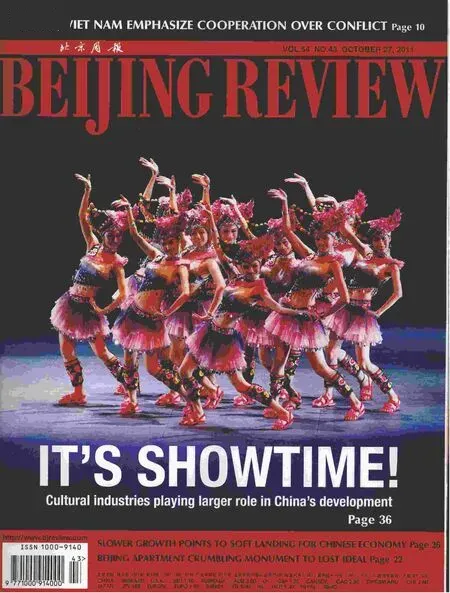
UNLEASHING GROWTH
2011-10-14 05:20:58ByDINGWENLEI
Beijing Review 2011年43期
By DING WENLEI
UNLEASHING GROWTH
By DING WENLEI
China pledges further reform of its cultural sector for real prosperity
The 100th movie of kungfu star Jackie Chan,1911, a historical drama based on the 1911 Revolution when the nationalist forces led by Dr. Sun Yatsen overthrew the Qing Dynasty (1644-1911), won big at the box office during the National Day holiday (October 1-7). This has ensured a bright future for the 65-year-old Changchun Film Group, said Chairwoman Liu Lijuan.
Changchun Film Group, as one producer of the movie, was the first movie studio in China to complete its transformation from a public-funded cultural institution to a forprofit enterprise in 2003. The overhaul has invigorated the studio, which had an accumulated loss of 30 million yuan ($4.7 million) in 1997, but reaped a net profit of 50.8 million yuan ($7.94 million) last year.
“We are braver and more confident in facing challenges after the transformation,”said Liu.
These huge changes came from profound internal structural reforms covering all sectors of the cultural industry, which kicked off in 2003. By the end of 2010, more than 4,300 cultural institutions in publishing, distribution, movie production and other sectors had completed their transformations.
Thanks to the reform, the cultural sector’s value added increased 24.2 percent annually from 2008 to 2010, much faster than GDP growth, said the 2011 blue paper on China’s cultural industry compiled by the Chinese Academy of Social Sciences (CASS).
And the year 2010 marked a milestone in the development of China’s cultural sector, with its value added reaching 1.1 trillion yuan ($172 billion), accounting for 2.75 percent of the GDP, and this is expected to be 5 percent by 2015, said the annual blue paper.


XIN HUA
As the cultural sector moves toward diversity and prosperity, the Sixth Plenum of 17th CPC Central Committee opened on October 15 to address problems that prevent cultural enterprises from fully unleashing their growth momentum.
The meeting addressed the fact that the cultural sector, while developing, doesn’t match China’s comprehensive national power, lags behind the country’s economic growth, and has yet to satisfy the people’s growing demand for high-quality cultural products.
“A new page is turned for the cultural sector reform, as the meeting proposed a number of decisions, plans and measures for the ongoing reform,” said Liu Yunshan, Minister of the Publicity Department of the CPC Central Committee.
The cultural sector reform aims to boost effciency and increase proftability through payroll cuts and adoption of corporate governance in these institutions, in addition to drawing a line between for-profit cultural businesses and non-proft cultural services.
Similar to China’s economic reform, the cultural reform aims to “forge competent players in the market economy by turning public-funded and government-affliated cultural institutions into independent business entities relying on their own profitability for survival and prosperity,” said Zhang Xiaoming, Deputy Director of the CASS Cultural Research Center and an author of the blue paper on China’s cultural industry.
This reform was initially interpreted as dropping the financial burden of cultural institutions from the central budget, and it was not until recently that many began to perceive the goal and benefts of the reform.
The Central Government recently decided that Kunqu opera theaters can still receive public funds as non-profit cultural institutions. But Ke Jun, President of Jiangsu Provincial Kunqu Opera Theater, has already seen the benefts of the reform and said no to that option.
Like many other theaters before the reform, winning prizes was the ultimate goal of creation in the Kunqu opera theater. It was not only because Kunqu’s audience, who is largely the cultural elite, is shrinking, but also because the theater failed to keep up with changes in the market. But operators of the theater had to tailor works to the market in order to attract larger audiences after it was required to reform in January 2005. They introduced a number of mainstream and fashionable works from the classical repertoire, and produced seven versions ofPeach Blossom Fan 1699for audiences of varied ages.
“The theater staged 644 shows in 2010, fve times more than that before the overhaul, which yielded 6.07 million yuan ($948,440), 10 times that before the reform, and brought a 10-fold increase in performers’ annual salaries,” said Ke.
“We could have been stuck in a dead end if we hadn’t carried out the reform,” said Zhu Changyao, General Manager of Jiangsu Performing Arts Group, parent company of the Kunqu theater. “The group reaped a revenue of 125 million yuan ($19.5 million) last year, which has dispersed misgivings over the group’s future.”
“We are going to restructure the group into a shareholding company and invite new strategic investors, just as a true market player does,” Zhu said.
By the end of June this year, 590 theaters and troupes nationwide had completed the transformation, 27.8 percent of the total. The percentage with publishing houses and movie studios respectively reached 95.9 percent and 90.3 percent.
While China became the world’s third largest movie producer with 526 feature films and box office revenue of more than 10 billion yuan ($1.56 billion) last year, publishing houses nationwide yielded 1.3 trillion yuan ($203 billion), topped the world in terms of overall variety, the number of books published, as well as circulation of daily newspapers.
Next priority
China’s per-capita GDP exceeded $4,000 (25,511 yuan) last year, indicating the country is well poised to turn the cultural sector into a new growth engine through further reform efforts, said Zhang.
“Priorities of the reform in the next fve years will be encouraging private investments in the sector, in addition to promoting mergers and acquisitions between existing cultural enterprises for operational efficiency,” said Zhang. “It’s because the goal of the reform is not only making cultural enterprises larger, but also encouraging them to build expertise and produce signature products through innovation.”
Private companies contributed more than half of the cultural sector’s value added, and two thirds of the jobs in the sector last year. And 90.8 percent of the 357,000 publishing businesses were private. The movie studio, Huayi Brothers, was listed at the ChiNext Board on the Shenzhen Stock Exchange in 2009, marking a milestone in the development of China’s cultural sector.
Following Huayi Brothers, a number of restructured cultural enterprises completed initial public offerings in domestic and overseas capital markets. By February this year, 26 cultural enterprises had been listed on the A-share and H-share markets.
In addition, the central and local governments allocated special funds of 5.2 billion yuan ($812.5 million) to support the development of the cultural industry last year. By February, investment funds and companies providing the cultural industry with a total capital of 10 billion yuan ($1.56 billion) were established in seven provinces and municipalities.
Gu Xin, Chairman of the China Oriental Performing Arts Group, said the number of potential investors he met in the past year was equal to the total in the previous eight years.
“Through communication with these strategic investors, I came to know the capital market and became aware of the brand value of China Oriental,” said Gu.“I’m not only a businessman, but while other employees of China Oriental are proud of the brand, I see a gold mine awaiting exploration.”
But there are still a number of restrictions in movie production and distribution, broadcasting, publishing and printing. Generally, companies in these sectors should be statecontrolled and allow a stake of less than 50 percent to private investors, according to a decision on the entry of non-public capital into the cultural industry, which was released by the State Council in April 2005.
In a 2009 plan to invigorate the cultural industry, it was made explicit private and overseas capital should be encouraged to invest in these sectors, especially in shareholding restructuring of state-owned enterprises.
“I don’t think there are only two kinds of entities in the sector: for-proft enterprises and non-profit institutions funded by the government to provide public services,” said Zhang. “Is it possible for non-government funds to establish and operate non-profit cultural facilities such as libraries and museums?”
By 2010, a total of 1,444 public museums and memorial halls had been opened to the public for free and nearly 45,000 public libraries of varied sizes had been established in cities, communities and rural areas.
Challenges
What these institutions lack most is not capital, but creativity and the right mindset for being true market players, said Gu.
Xinhua Bookstore, a national brand and China’s only countrywide distribution channel for books, magazines, CDs and DVDs, started its innovation in Zhejiang Province. While increasing the number of stores in the countryside, the bookstore connected all these small outlets with computers, allowing information sharing and efficient inventory adjustment while offering farmers quick access to a diverse variety of books.
“But before having any impulse to innovate, we should have a full understanding of the roots and seeds of the culture so that we can pass it on to future generations,” said Hu Huilin, another author of the CASS blue paper and professor with Shanghai Jiao Tong University.
In addition to innovation, striking a balance between profit seeking and social responsibilities is another challenge.
“The key word in the ‘cultural industry’ is cultural, not industry. That’s why cultural enterprises should give priority to their social responsibilities instead of profits,” said Hu. “Cultural enterprises have to be farsighted, not pursuing quick money at the expense of the mental health of one generation.”
Over-commercialization and vulgar content should be avoided during product development and innovation, because only cultural businesses that value the social benefts of products will have growth momentum for long-term economic returns, said Chen Shaofeng, Vice Dean of the Institute for Cultural Industries at Peking University.