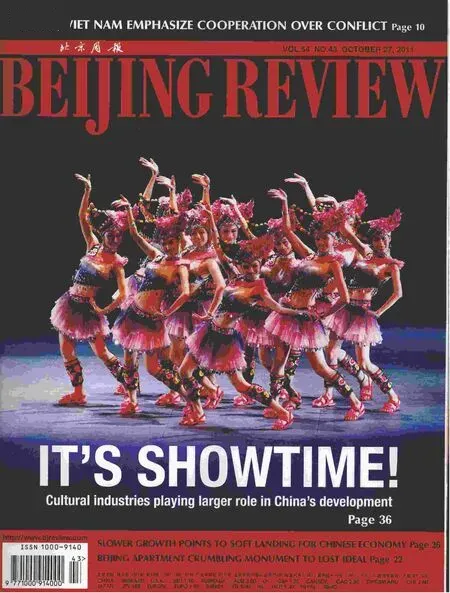
Blooming Again
2011-10-14 08:30:32ByYUANYUAN
Beijing Review 2011年43期
By YUAN YUAN
Blooming Again
By YUAN YUAN
The China Oriental Performing Arts Group is a model for the reform of China’s cultural system
While Chinese cultural performances are world renowned for their high standards, the difficulties local troupes face in generating adequate revenues from these performances has long stifled the development of China’s best performance artists.
“We do have many talented artists, but almost all of them are working for stateowned troupes, where there hasn’t been cutthroat competition,” said Gu Xin, Chairman of the China Oriental Performing Arts Group (China Oriental), who is credited with successfully transforming his group from a stagnant performing troupe to a profitable one.
“I have given a lot of thoughts to why Chinese cultural performances aren’t meeting the demands of the market,” said Gu. “I don’t think it is because we don’t have the ability to create good performances. I think the problem really lies with the cultural administrative system.”
The first to eat crab
Born in 1956, Gu used to be a tenor in the Jiangsu Provincial Song and Dance Ensemble and won several competitions both in China and abroad. In 1991, when he was at the peak of his career, the Jiangsu Culture Bureau was seeking a talented artist to become the director of the Jiangsu Ballet and Opera House.
Gu was given the position and displayed his versatile management ability as the Opera House’s director. In 1995, he was selected to be Deputy Director of Jiangsu Provincial Department of Culture.
“I saw many problems with the stateowned ensembles, which were fettered with outdated systems,” said Gu. “The rigidity of the system sapped performers of motivation and passion.”
In 2001, Gu restructured the province’s state-owned performing arts troupes to create the Jiangsu Performing Arts Group—the country’s first major reform of a cultural institution.
The success of the reconstruction triggered the national reform of the cultural system. In 2003 major reforms were implemented in cultural institutions across the country. The State Administration of Radio, Film and Television, the Ministry of Culture and the General Administration of Press and Publication decided to transform cultural institutions into enterprises and encourage privatization.
“No reforms can be entirely smooth, especially when you touch upon a myriad of divergent interests,” said Gu, who has attracted both praise and criticism for his role in the reforms.
“As the saying goes, it took a lot of courage to become the frst crab eater,” said Gu. “I feel I am more than that, I am like the frst to eat a hedgehog.”
Time would prove Gu right, and the reforms’ success prompted the Central Government to extend it nationwide. Following the success of his initiative Gu also became the ideal candidate for overhauling the country’s leading performing arts troupe—the Oriental Song and Dance Ensemble.
A new look
Founded in 1962 by then Premier Zhou Enlai, the Oriental Song and Dance Ensemble brought together leading artists who specialized in Asian, African and Latin American folk songs and dances. In those days, few foreign troupes toured China. The ensemble made up for the lack of foreign performances and also won international acclaim with its overseas tours.
Some of the ensemble’s members, such as Zhu Mingying, Li Guyi and Cheng Fangyuan, became idols like today’s pop stars.
Things changed with the reform and opening up when many similar troupes were set up, creating competition and ousting the ensemble from its top spot in the early 1990s. Some singers such as Cheng Fangyuan left the ensemble.
“The ensemble’s name is golden but that didn’t mean it was proftable,” said Gu, who was appointed General Manager of China Oriental in January 2010.
After assuming the post, he called more than 50 meetings to discuss solutions and spoke to more than 200 of the group’s members about their concerns.
“Many were worried that the reform would affect their income,” said Gu. “Fordecades, the ensemble was mainly supported by government subsidies. Their concerns weren’t surprising. They felt safe in the iron-bowl system and were not inclined to change. But change can’t be stopped.”

(From left)THE REFORM FIGURE: Gu Xin, Chairman of China Oriental sings as the group performs in a village in Fujian Province on October 14

To alleviate this anxiety, the group offered double pensions, medical and unemployment insurance, and a housing allowance to all its members.
And to assuage concerns that members would simply be discarded after they passed the peak of their performing lives, the group guaranteed that senior members would be able to find positions at company’s new training center, or in areas such as management, marketing and human resources.
After six months of effort, in May 2010, all 484 performers had signed contracts with the group.
Production department director Song Bingfu said that before the reform, the shortage of regular shows meant less than 20 of the vocal team’s singers were able to perform, and less than 20 of the 73 instrumentalists received regular spots.
“It was a waste of both money and talent,” said Gu, who also worked to create more opportunities for young artists.
Before the reform, dancers joined the company after graduation, usually at around the age of 20.
They first did a year-long internship and then entered the troupe as Level 4 dancers, progressing to Level 3 after four years and level 2 in another four. If you wanted to be a principal dancer, you had to wait another few years. Young members desperately waited for veterans to retire. Upon fnally becoming principal dancers in their late 30s, they found they had passed their prime. Many decided not to waste their peak performing years and left.
Gu’s reforms made the system much more flexible. 28-year-old Teng Yu was a level 3 dancer in 2009 but she was chosen to be the principal dancer at the group’s Expo performance in 2010.
“It was impossible before the reform,”said Teng, who said she could not have been a principal dancer until the age of 33 according to the old system. “I never thought I could play the leading role at this young age.”
New talents discovered during the national singing and dancing competition have also been absorbed to the group. “We need a lot of new blood while reviving veterans’passion,” said Gu.
Just a year after the reform, China Oriental now stages twice the performances it used to do and all its qualified members regularly appear on stage. The income of the performers has increased sharply.
Performers’ average salaries have increased from less than 4,000 yuan ($625) to 7,000 yuan ($1,094) a month, plus extra for every show in which they appear.
Group dancers can earn 111,000 yuan ($17,344), and principal dancers, such as Teng, expect 300,000 yuan ($46,875) a year.
The future
“This is just the start of the reform and we still have a long way to go,” said Gu.
“The group can perform many highquality operas but most are in foreign languages and are far from ordinary people’s lives,” said Xu Peidong, Vice Chairman of Chinese Musicians Association, who suggested the group produce more performances with Chinese features.
“To be honest, I feel that stage arts have lost their originality in China,” said Gu.“China has a long and splendid history. We are making efforts to deliver high-quality examples of traditional Chinese culture to our audiences through music and dance, and strengthen our cultural influence. That’s a must for us.”
On September 8-9, China Oriental staged a performance featuring Chinese ink painting at the Beijing Expo Theater. “We depict the images of fowers, mountains and brooks in our performance and create a picture of Chinese ink painting with singing and dancing,” said Gu.
In 2010, the group’s box office revenue exceeded 100 million yuan ($ 15.63 million), an extraordinary achievement for a performing arts group. But Gu insisted box offce revenue should not be the group’s main income.
“A company can’t rely on box office revenue alone. We must create as much added value as possible to translate our golden name into golden returns,” Gu said. “Our goal in the following two years is to conduct shareholding reform and get listed.”
a salary from the ensemble every month but had only been moonlighting,” Song said.

CFP

HUANG JINGWEN