
Study of the China PTN Industry Standard and Its Key Issues
2010-09-08 10:31:46
ZTE Communications 2010年3期
(Institute of Communication Standards Research,China Academy of Telecommunication Research of MIIT,Beijing 100191,P.R.China)
1 Implementation of Packet Transport Networks
Packet Transport Networking(PTN)is Connection-Oriented Packet-Switched(CO-PS)multi-service unified transport technology.PTN is sufficient for bearing carrier-class Ethernet services,and features standardized services,high reliability,flexible scalability,strict Quality of Service(QoS),and improved Operation,Administration and Maintenance(OAM).Moreover,it supports legacy Time Division Multiplexing(TDM)and Asynchronous Transfer Mode(ATM)services,and inherits management functions such as graphical interface and end-to-end configuration of Synchronous Digital Hierarchy(SDH)network management.PTN is currently applied in Metropolitan Area Networks(MANs)that bear services with QoS requirements—such as mobile backhaul and enterprise private lines/networks.The MANs of Chinese operators are being transitioned away from TDM to PTN packet switching.
PTN has two implementation technologies:MPLS Transport Profile(MPLS-TP)and Backbone Bridge Traffic Engineering(PBB-TE).Based on Internet Protocol/Multiprotocol Label Switching(IP/MPLS),MPLS-TP discards hop-by-hop forwarding according to IP addresses and establishes transport paths that are independent of the control plane.The connection-oriented end-to-end label forwarding capability of MPLS is retained,and non connection-oriented and non end-to-end features-including Penultimate Hop Popping(PHP),Label Switched Path(LSP)Merge,and Equal-Cost Multi-Path Routing(ECMP)—are eliminated.MPLS-TP therefore supports definite end-to-end transport paths,PTN-style network protection,and OAM capability.
The other implementation technology is Backbone Bridge Traffic Engineering(PBB-TE)specified by IEEE 802.1Qay—a connection-oriented Ethernet transport technology.Also called Media Access Control(MAC)in MAC,Provider Backbone Bridge(PBB)represents an improvement on IEEE 802.1ah,eliminating connectionless Ethernet characteristics such as MAC address learning,spanning tree protocol,and flooding.Traffic Engineering(TE)is also incorporated to enhance QoS.PBB-TE currently supports Point-to-Point(P2P)and Point-to-Multipoint(P2MP)connection service transport and linear protection.However,it does not yet support multipoint-to-multipoint connection-oriented service transport and ring protection.
MPLS-TP and PBB-TE differ in terms of data forwarding,multi-service bearing,network protection,and OAM mechanism[1-2].As far as standardization,vendor products,operator applications,and the broader industrial chain are concerned,MPLS-TP seems to have a more promising future than PBB-TE.Therefore,MPLS-TP is currently treated as the leading PTN(4)PTN implementation technology.
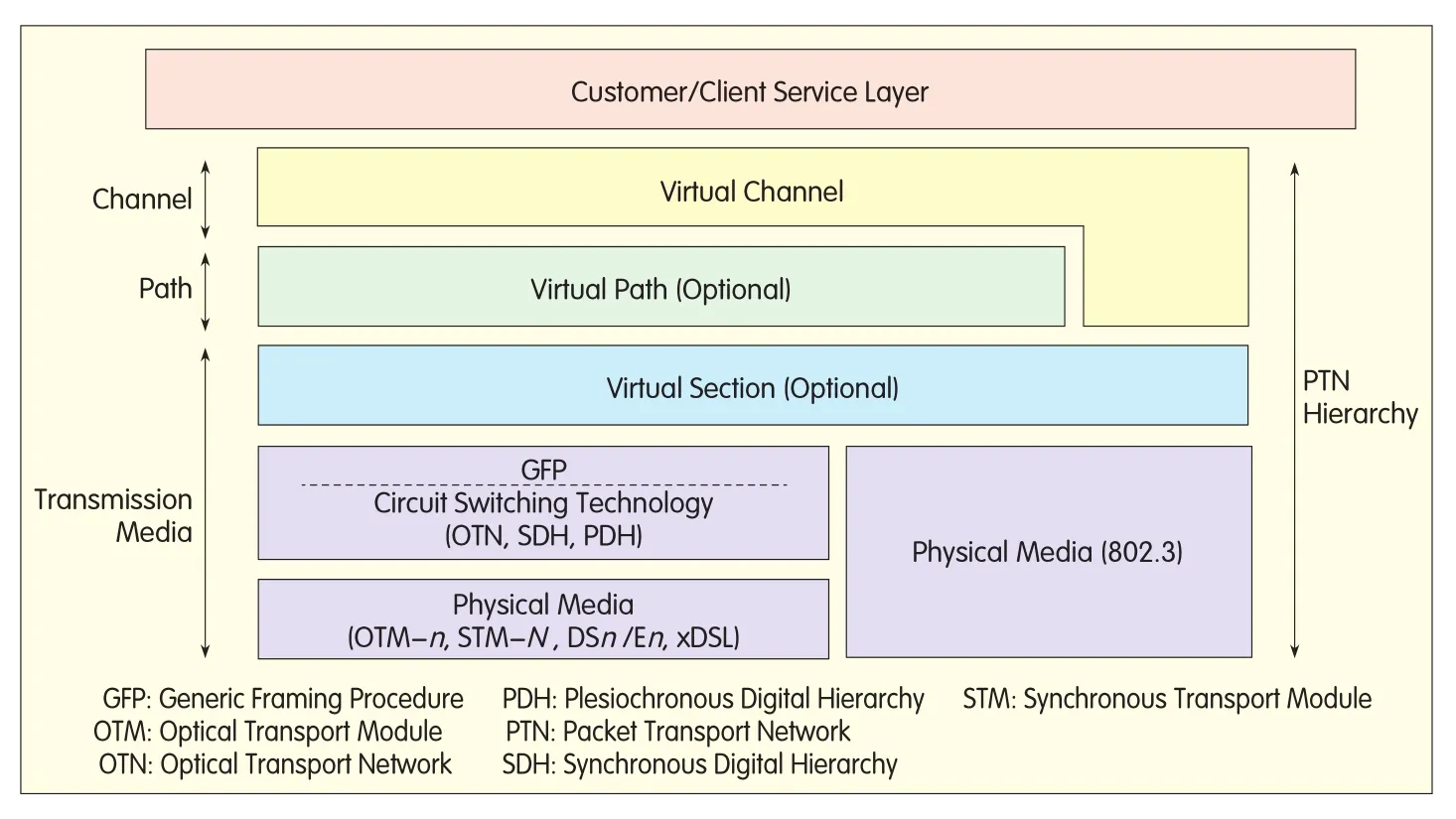
Figure 1.PTN layers.
2 Main Content of the China PTN Industry Standard
General Technical Requirements for Chinese Packet Transport Networksspecifies PTN architecture,multi-service bearing and data forwarding functions,network protection function and performance,OAM capability,QoS,packet synchronization,network interface,network performance,network management,and functions of the control plane.The following introduces main features of PTN.
2.1 PTN Architecture
PTN has the following technical characteristics:
·CO-PS,packet switched kernel,and multi-service bearing;
·It is strictly connection-oriented,and has long-lasting connection that supports manual configuration;
·A Reliable network protection mechanism,capable in various PTN network layers and topologies;
·Different QoS guarantees for different services;
·Sound OAM fault management and performance management;
·Label-based packet forwarding.Encapsulation,transport,and processing of OAM messages are independent of IP encapsulation and processing.The protection mechanism does not rely on IP packets;
·Support for bidirectional and unidirectional point-to-point transport paths,as well as TE control of P2P and P2MP transport paths.
As shown in Figure 1[3],PTN has three layers:Virtual Channel(VC)layer,Virtual Path(VP)layer,and Virtual Section(VS)layer.At the bottom of PTN is the physical media layer,implemented by IEEE802.3 Ethernet/SDH and Optical Transport Network(OTN)Connetion-Oriented Circuit-Switched(CO-CS)technologies.In a MPLS-TP system,a Pseudo Wire(PW)layer is equivalent to PTN VC,and the LSP layer is equivalent to PTN VP.
2.2 PTN Multi-Service Bearing and Data Forwarding Functions
The client layer in MPLS-TP architecture[4]includes PW-based emulation services,services with MPLS labels,and IP services.The standards for this bearing architecture specify PW-based emulation services including TDM services,Ethernet L2 services,and ATM services.However,the functional requirements of a peer-to-peer IP and MPLS service bearing model are still being studied.All service bearing in PTN is connection oriented;a non connection-based mechanism is not included in the standard.
MPLS-TP PTN should meet the following functional requirements for bearing PW-based emulation services:(1)Pseudo Wire Emulation Edge-to-Edge(PWE3)encapsulation should be used uniformly to bear emulation services.The PWE3 control word should follow RFC4385.
(2)TDM service emulation and transport should be supported.Specific requirements are as follows:
·TDM service bearing in the Structure-Agnostic TDM over Packet(SAToP)mode should be supported,with the PWE3 encapsulation and control word following RFC4553.The SAToP mode can be applied to any signal structure of TDM circuit emulation.
·Support for TDM service bearing in Circuit Emulation Services over Packet Switch Network(CESoPSN)mode is optional,with the PWE3 encapsulation and control word following RFC5086.CESoPSN is mainly used for Nx64kb/s signal structures of TDM circuit emulation,and is capable of saving bandwidth.
·Support for TDM service bearing in the SDH Circuit Emulation over Packet(CEP)mode is also optional,with PWE3 encapsulation and control word following RFC4842.CEP is mainly used for VC12/VC-4 signal structures of TDM circuit emulation.
(3)Ethernet L2 service emulation and transport should be supported.The specific requirements are as follows:
·Ethernet Line(E-Line),Ethernet Local Area Network(E-LAN),and Ethernet Tree(E-Tree)services are supported,and should follow the related specifications of International Telecommunication Union’s Telecommunication Standardization Sector(ITU-T)and Metro Ethernet Forum(MEF).
·Service and VC/CP binding implemented through ports or port+Virtual Local Area Network(VLAN)should be supported.
·Network management-based static configuration of Ethernet services should be supported.Signalling based dynamic configuration of Ethernet services is optional.
·The PWE3 encapsulation and control word should follow RFC4448.
(4)PTN support for ATM service emulation and transport is optional,and the PWE3 encapsulation and control word should follow RFC4717.PTN supports both 1:1 andN:1 Virtual Channel Connection/Virtual Path Connection(VCC/VPC)encapsulation,as well as the establishment of unidirectional and bidirectional point-to-multipoint VCC/VPC.Inverse Multiplexing over ATM(IMA)group processing is optional.
MPLS-TP based PTN should meet the following data forwarding requirements:
(1)The MPLS-TP data forwarding mechanism is a subset of the MPLS data forwarding system(RFC3031),and should meet the transport requirements specified in RFC5654.MPLS-TP does not use hop-by-hop forwarding based on IP addresses,and does not support the merged function of ECMP,PHP,and LSP.
(2)MPLS-TP label stacking should follow RFC3032 and RFC5462.The MPLS Time-to-Live(TTL)processing mechanism should follow RFC3443.(Both VC and VP Transmission Convergence(TC)and TTL should adopt pipe models.)
(3)The range of PWs and LSP labels should be 1-1,048,575(eg.220-1),from which 0-15 are reserved labels(used or reserved for PTN OAM.RFC3032 defines 4 reserved label values).
(4)MPLS-TP should support the following label switching functions:
Correct pushing of PWs and LSP labels by the source node,enabling multiple PWs to be multiplexed into one LSP;
Correct popping of PWs and LSP labels by the sink node;
Supporting Single-Segment Pseudo Wires(SS-PW)and Multi-Segment Pseudo Wires(MS-PW)switching.SS-PW architecture should follow RFC3985.MS-PW switches PWs of different LSPs into the same LSP.
2.3 PTN Network Protection Functional Requirements
PTN supports three protection types:
(1)Protection within PTN
·Linear protection within PTN including unidirectional/bidirectional 1+1 path protection,bidirectional 1:1 or 1:N(N>1)path protection,unidirectional/bidirectional 1+1 SNC/S protection,and bidirectional 1:1 SNC/S protection.At minimum,a bidirectional 1:1 protection mechanism should be supported.
·Ring protection within PTN including Wrapping and Steering.At minimum,one of these two protection mechanisms should be supported.
(2)Access Link Protection of PTN and Other Networks
·1+1 or 1:Nprotection of TDM/ATM access links;
·Protection of GE/10GE access links,eg.Link Aggregation(LAG).
(3)Dual-Homed Protection
Protection within PTN and access link protection are combined for end-to-end service protection when the access link or PTN access node fails.This mechanism is still being studied.
Protection within PTN should meet the following generic functional requirements:
(1)PTN protection switching should support triggering of link/node fault conditions and external commands from the network management system,as well as priority handling of various switching requests.The types of faults triggered include Signal Failures(SF),intermediate node failures of both physical links and VP/VC,and Signal Degrade(SD).External commands that are triggered result in network management orders such as"locked protection","forced switching","manual switching",and“clear command”.
(2)Protection switching mode:This supports both single-end and dual-end switching types.It should support configuration of"non-revertive operation"or"revertive operation"mode,as well as initiation of Wait to Restore(WTR)function and WTR time setting.
(3)Protection switching time:The service disruption time caused by protection switching—except SD-triggered protection switching—should not exceed 50ms when the delay time is set at 0.
(4)Hold off time setting:When the PTN bottom network(WDM and OTN)is configured with protection,PTN network protection should support a hold off time,which can be set at 50 ms or 100 ms.
2.4 PTN OAM Architecture and Functional Requirements
PTN OAM includes the OAM mechanism within PTN,service layer OAM,and access link layer OAM.
The OAM mechanism within PTN is divided into alarm-related OAM,performance-related OAM,and other OAM.The OAM requirements of the VC,VP,and VS layers are shown in Table 1.Proactive OAM periodically or continuously reports fault and error code performance,whereas on-demand OAM is manaually initiated for the purposes of fault diagnosis and positioning.
3 Key Issues Associated with the China PTN Industry Standard
In the drafting ofGeneral Technical Requirements for Chinese Packet Transport Networks,selection of technologies for the standard,PTN applications,and sustainable development of PTN were disputed.After extensive discussions,some issues have been solved,but others require follow-up study.
(1)MPLS-TP OAM Implementation Mechanism and Encapsulation Format
There are three available options:T-MPLS G.8114,G-ACh[5]+Y.1731 OAM PDU[6],and IETF BFD expansion[7]+new OAM tools.All Chinese members of the standardization group have agreed to adopt G-ACh+Y.1731 OAM PDU to preserve existing benefits of Chinese operators and vendors,and to facilitate software upgrade in the future.All members wish to promote their preference as the international MPLS-TP standard.However,selecting G-ACh+Y.1731 OAM PDU as the MPLS-TP standard is difficult because the group is led by non-Chinese giants Cisco and Juniper.
(2)Implementation Mechanism of PTN Ring Protection
IETF has approved ring protectionrequirements,with implementation mechanisms including MPLS-TE Fast Re-route(FRR)applied in ring topology[8],IEEE multi-segment protection[9],and ITU-T Wrapping/Steering ring protection[10].In consideration of Chinese vendor products and operator applications,the standard adopts ITU-T Wrapping/Steering ring protection.Prior to selection,three technologies were deeply analyzed in terms of service configuration,bandwidth sharing,OAM,and cross-ring protection.The impacts on network operation and maintenance were also taken into consideration.Follow-up standardization work will involve specific mechanisms for point-to-multipoint service protection and cross-ring protection.
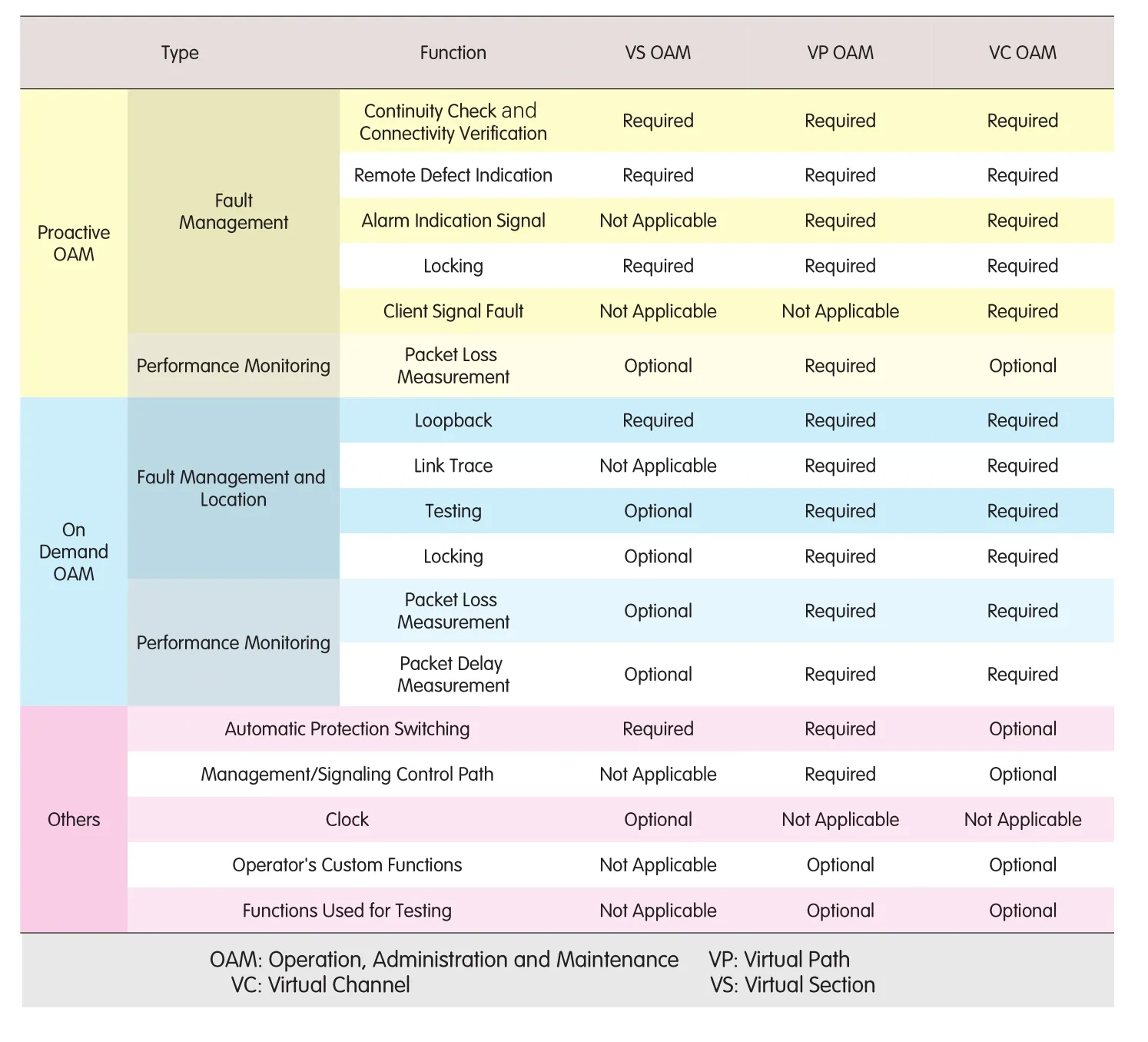
Table 1.OAM requirements in PTN
(3)PTN and Multiservice Transport Platform(MSTP)Mixed Networking and Interworking Requirements
The mission of PTN is to gradually replace SDH-based MSTP.Therefore,in network deployment,operators must deal with PTN and MSTP mixed networking,and interworking of two networks.Such a scenario might include PTN convergence ring interworked with the MSTP access ring.However,specifications of the related standard are still open and being debated.
(4)Requirements of PTN Supporting IP/MPLS L3 Functions
With the trend towards all-service operation and Long Term Evolution(LTE)mobile backhaul bearing,should PTN support certain IP/MPLS L3 functions?If so,how should it cooperate with the existing router network?These questions will be studied after operators’specific requirements are made clear.This is an open issue in PTN standardization.
PTN is developing,competing,and converging with IP/MPLS technology.It has so far been applied in IP-based 3G mobile backhaul networks.The next two years will be key in the standardization and industrial application of PTN technology.The PTN industrial chain is expected to continue developing.
[1]荊瑞泉.MPLS-TP技術標準進展[R].專家技術報告.2009.
JING Ruiquan.MPLS-TP technology standard progress[R].TC6-2009-026Q Experts’Technical Reports.2009.
[2]李芳.《分組傳送網(PTN)總體技術要求》征求意見稿
LI Fang.Draft of general technical requirements for Chinese packet transport networks for comments[S].2009.
[3]ITU-T SG15 G.ptneq.Types and characteristics of Packet Transport Network(PTN)equipment[S].2009.
[4]BOCCI M,BRYANT S,FROST D,et al.A framework for MPLS in transport networks[R].draft-ietf-mpls-tp-framework-10.2010.
[5]IETF RFC 5586.MPLS generic associated channel[S].2009.
[6]BUSI I,van HELVOORT H,HE J.MPLS-TP OAM based on Y.1731[R]draft-bhh-mpls-tp-oam-y1731-04.2010.
[7]FULIGNOLI A,BOUTROS S,VIGOUREUX M.Proactive connection verification,continuity check and remote defect indication for MPLS transport profile[R].draft-asm-mpls-tp-bfd-cc-cv-01.2009.
[8]IETF RFC 5317.Joint Working Team(JWT)report on MPLS architectural considerations for a transport profile[S].2009.
[9]IEEE 802.1Qbf.PBB-TE infrastructure segment protection[S].2009.
[10]ITU-T SG15 G.8132(draft).T-MPLS shared protection ring(TM-SPRing)[S].2007.
猜你喜歡
現代儀器與醫療(2021年4期)2021-11-05 08:25:32
皮膚病與性病(2021年3期)2021-07-30 08:07:32
科技傳播(2019年22期)2020-01-14 03:06:40
南方人物周刊(2017年32期)2017-10-28 22:48:36
南風窗(2016年26期)2016-12-24 21:48:09
南風窗(2015年22期)2015-09-10 07:22:44
南風窗(2015年14期)2015-09-10 07:22:44
南風窗(2015年7期)2015-04-03 01:21:48
南風窗(2014年5期)2014-09-10 07:22:44
疑難病雜志(2014年12期)2014-04-16 05:19:34

- ZTE Communications的其它文章
- ZTE Positioned in the Leaders Quadrant in Leading Industry Analyst Firm Report
- ZTE Topsthe Global CDMA Market with a 30%Market Share
- ZTE France Awarded Best Investor Prize 2010
- Cloud Computing(3)
- Research on Convergence Network of EPON and WiMAXBased on ROF
- Applying Analytical Hierarchy Process to a WiMAX Performance Evaluation Model