
Applying Analytical Hierarchy Process to a WiMAX Performance Evaluation Model
2010-06-05 03:32:22RonaldShiuKeungKwanKimFungTsang
ZTE Communications 2010年3期
Ronald Shiu Keung Kwan Kim Fung Tsang
(1.Department of MEEM,City University of Hong Kong,Hong Kong SAR,P.R.China;
2.Department of Electronic Engineering,City University of Hong Kong,Hong Kong SAR,P.R.China)
Abstract:Evaluating performance of individual features of WiMAXtechnology is a topic of widespread discussion.Currently,there is no quantitative way of measuring WiMAX technology so that wireless operators can meet their design objectives.This paper outlines a set of design criteria for WiMAXand provides a decision-making aid that ranks the importance of criteria using Analytic Hierarchy Process(AHP).This ranking should sufficiently reflect market expectations of the relative importance of various design criteria.A model integrating AHPpriorities with enhanced Data Envelopment Analysis(DEA)is the basis for formulating a technological value in simple,comparable format.A case study is provided to show how this technological value is used to evaluate a three year network deployment plan.In the future,this model could be extended to WiMAXequipment suppliers for the purpose of validating performance targets of individual criteria,and enhancing supplier roadmaps for future network development.
1 Introduction
T o satisfy the need for multi-media data access any time and anywhere,demand has grown for high speed wireless data transmission.Expansion of the smart phone and embedded device market requires high speed data networks to cope with different application suites.
Worldwide Interoperability for Microwave Access(WiMAX)is based on the IEEE 802.16 standard.It was initially designed for fixed and nomadic connection;and since 2001,has been continually updated and enhanced.With the introduction of 802.16e in 2005,it started to evolve towards support for fixed and mobile connection.Important technologies such as Multiple-Input Multiple-Output(MIMO),Orthogonal Frequency Division Multiplexing(OFDMA),and Media Access Control(MAC)have been introduced to enable high data rate,enhanced spectralefficiency,and to improve efficiency and coverage in Non-Line of Sight(NLOS)situations.
Anumber of studies[1]have been carried out to evaluate different WiMAX techniques,and to individually assess uplink/downlink data rate,spectral efficiency,and Quality of Service(QoS).However,such studies have failed to reference overall design objectives.These assessments do not address the fact that WiMAXtechnology should support multiple types of applications.Thus,evaluation of any individual feature does not help engineers improve design effectiveness in a quantitative manner.
As a result,there is no consensus about how good WiMAXtechnology and network performance can actually be.There is a lack of systematic and analytical method to improve overall network performance so that long term high-speed data network development plans can be met.
Analytical Hierarchy Process(AHP)and Data Envelopment Analysis(DEA)can be used to develop a new WiMAX performance model.The purpose of such a model is to establish an agreed-upon performance index(defined as a technological value)that can be measured and compared with design objectives.It is built on the features of broadband wireless access networks,but is not only applicable to WiMAXtechnology.Indeed,the model can easily be modified for Evolved High Speed Packet Access(HSPA+)and Long Term Evolution(LTE)technologies.
2 Methodology of AHP-Based WiMAX Performance Evaluation Model
2.1 AHPModeling
In the field of technology management,many studies[2]have been carried out in which AHPhas been adopted to evaluate or assess technology by prioritizing different criteria.AHPis a comprehensive framework designed to cope with intuitive,rational,and irrational factors when multi-objective,multi-criterion decisions must be made,and a number of alternatives are possible.
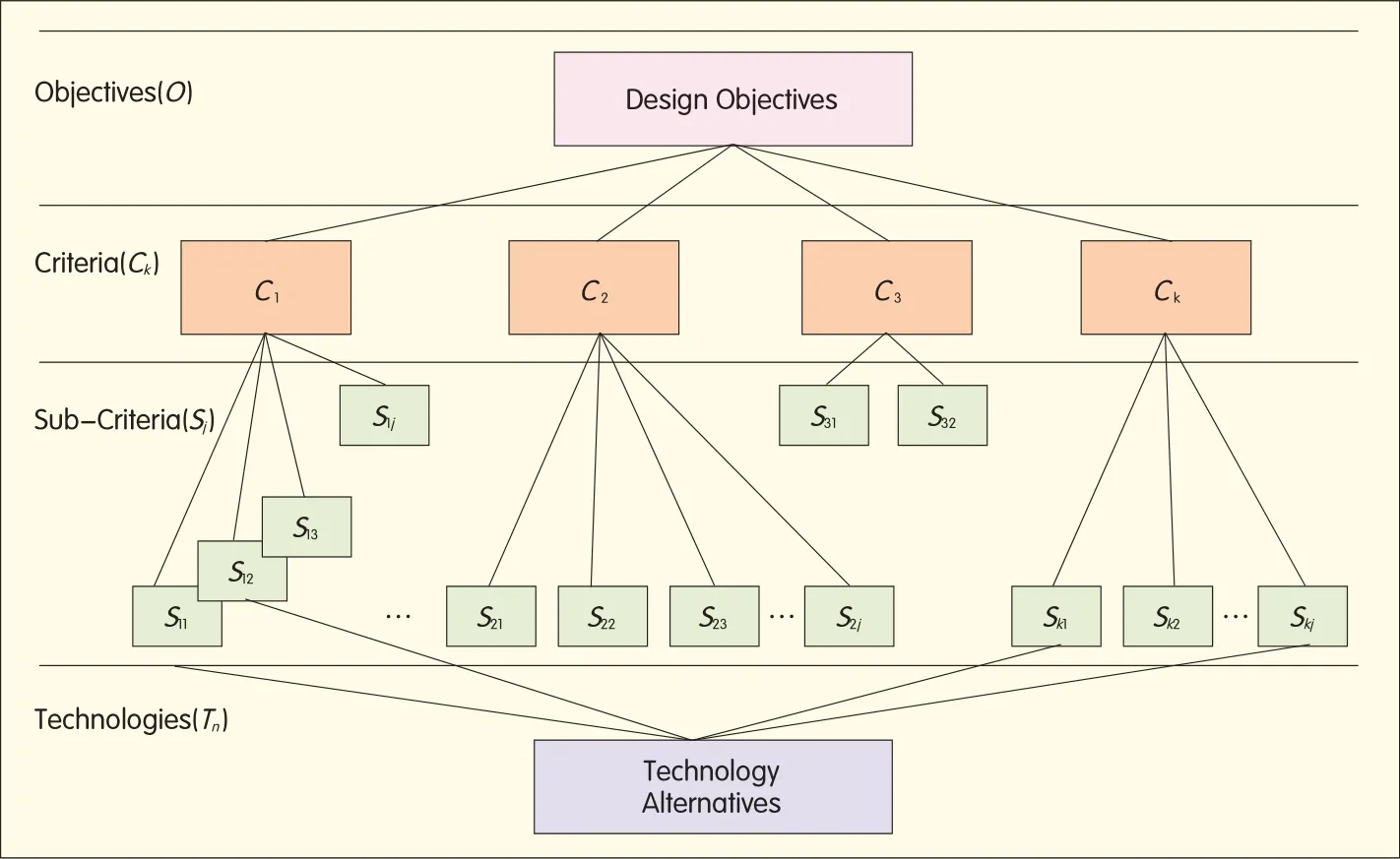
▲Figure 1.An AHPhierarchicalmodelusing relative values.
The AHPapproach was designed to help decision makers integrate qualitative and quantitative aspects of complex problems.Complex problems are solved by decomposing the structure of the problem into hierarchies,and pair-comparisons are made to determine the priorities in each hierarchy.
Typically,an hierarchical model comprises three or four levels—Objectives,Criteria,Sub-Criteria,and Alternatives.Objectives are on the top level while alternatives are on the lowest level,as shown in Figure 1.Pair-comparisons determine the importance of design criteria to the design objective.The results are represented as a relative value which indicates the technical value of a criteria compared to others.For example,technology 1 may be twice as important as technology 2 in meeting design objectives.These results are useful but insufficient because they do not provide a holistic measurement of the overall performance of WiMAXtechnology.
They do not show how the technology should progress in meeting objectives.
As a result,the conventional approach of constructing an AHP hierarchical model with technological alternatives at the lowest levelis insufficient for measuring overall WiMAXperformance.A new hierarchicalapproach called DEA[3]is proposed in which the lowest levelis replaced with technological efficiency,as shown in Figure 2.Technological efficiency is a semi-absolute value with a maximum of 100%.This enables technologies to be measured in a simple and comparable format.
2.2 Integrating DEA into AHP Model
DEAis one of the key methods for measuring technological efficiency of WiMAXor Broadband Wireless Access(BWA).It is a multi-factor efficiency analysis modelfor determining the relative efficiencies of a set of decision making units or criteria.
Technologicalefficiency is represented as a ratio of the maximum sum of output to the relevant input bundle.With this approach,technological criteria are evaluated according to a semi-absolute value;ideal technological efficiency in terms of network performance is 100.
Telecom systems—including wireless networks—can be compared in this way.However,never before has DEA been applied to WiMAXor BWA technology where multiple design criteria are used to assess efficiency.
Unlike traditional wireless communications in which capacity or spectral efficiency is the benchmark for assessing technology,multiple design criteria must be considered when measuring the performance of WiMAX technology that supports not only voice,but also converged data,multi-media,and other IPapplications.

▲Figure 2.Aproposed hierarchicalmodel using technological efficiency measurement.
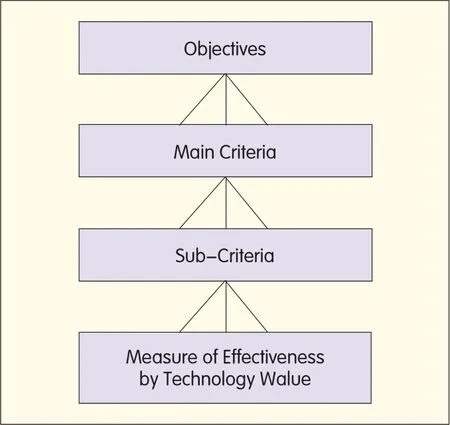
▲Figure 3.An AHPhierarchicalmodelusing technologicalvalue for measurement.
By combining AHPand DEA methodology,design criteria can be weighed and prioritized before being integrated into the DEA framework for deriving technologicalefficiency.The technological efficiencies for each design criteria are then aggregated and transformed into the technology value,which is a quantifiable yardstick for measuring overall WiMAX performance.
The methodology is as follows:
(1)Performance measuring criteria for WiMAXtechnology must be identified and categorized into main performance groups.Main design criteria and sub-criteria are used to build the AHPhierarchical model as shown in Figure 3.
(2)Using AHP,the basic elements of each level—such as the measuring criteria and sub criteria—are then compared in pairs with respect to the design objectives.The comparison is based on a 9 point scale that indicates the relative importance of each criteria/sub-criteria.
(3)DEA framework is used to determine the technological efficiency for each design criteria.These technological efficiencies can then be used to evaluate the technology based on the degree to which its design criteria satisfy the desirability on the measure of effectiveness of each design factor.
(4)By integrating AHPpriority with technological efficiency within the DEA framework,the technological value of WiMAXcan be derived.This is a measure of WiMAXperformance in relation to technological expectations,and can be represented by the mathematical model:

In Equation(1),
3 Characteristics of WiMAX Technology
WiMAXis a BWAtechnology,and BWA is defined as wireless access with broadband connection capabilities.Broadband should have instantaneous bandwidths greater than 1 MHz and support data rates greater than 1.5 Mbit/s(IEEEstandard for Local and Metropolitan area networks Part 16 2009).This is the bare minimum for widespread success.Broadband wireless systems must deliver multi-megabit per second throughput to end users,and have robust QoSto support voice,data,and multimedia services.Indeed,it should be able to support IP-based applications and services in a highly efficient manner.
To meet stringent service requirements and to overcome constraints imposed by wireless,there are several technological challenges that BWA must overcome[4].(1)Data Rate Reliable transmission and reception schemes need to be developed to push broadband data through hostile wireless channels.Typically,services require high data rates and high-speed mobility.Wireless communication relies on complex radio wave propagation mechanisms so that signals can traverse through the intervening environment.
Severalfactors affect or impair transmission:
?Decay of signal power in an NLOS environment;
?Inter-symbol interference in a multipath environment when time delay between various signal paths becomes significant;
?Multipath fading caused by large variations in the amplitude of the received radio signals;
?Doppler effect due to relative motion between transmitter and receiver.
(2)Spectral Efficiency
High spectral efficiency and broad coverage must be achieved because only a limited amount of spectrum is available to deliver broadband services to a large number of users.The capacity of a wireless system is closely related to its frequency usage.For higher capacity and spectral efficiency,frequency reuse must be maximized.But this can significantly increase the potential for interference.The challenge,therefore,is to design a transmission scheme that can operate with a low Signal to Interference plus Noise Ratio(SINR).
The signal leveldepends on cell radius and the number of base stations within the coverage area.In order to maintain a certain spectral efficiency within the coverage area,the following should be considered:
?The cell radius of the base station;
?The number of base stations and cost required for the coverage area;
?An effective method of ensuring reliability under low signal to SINR.
(3)Policy Based QoS
Broadband Wireless networks must support a variety of voice,data,and multimedia applications.Each application has a different traffic pattern and QoSrequirement[5].Therefore,policy-based QoSshould be enforced so that service provision levels are appropriate to different subscriber plans.

QoSmust be delivered end to end across both the wireless link and underlying IPnetwork.The challenge lies in accommodating variable QoS requirements across application,services,and user profile,while maintaining the quality levels as defined for all users.Design factors affecting QoSinclude:
?Throughput that handles multiple traffic flow;
?Packet loss of different applications;
?RAN latency in handover between cells;
?Jitter in the time between idle to transition.
(4)Mobility Management
Mobility is a key element for wireless services.However,support for a subscriber station moving over a large coverage zone leads to two important design considerations[6],
?Roaming:Ameans of reaching inactive users for session initiation and packet delivery must be provided regardless of their location within the network;
?Handoff:A continuous,uninterrupted session must be maintained with the base station while on the move—even at vehicular speeds.
(5)Portability and Device Management Portability requires the subscriber device to be lightweight,battery powered,and energy efficient so that re-charging is not necessary for an extended period of time[7].
To reduce power consumption,WiMAX technology should support a power-efficient transmission scheme,power saving protocol for fast switching technology,signal processing algorithm,and it must be interoperable with other radio channels(e.g.EVDO,Wi-Fi)within the subscriber station.(6)Security
Security is always a major consideration in wireless communication systems.End users are often concerned about privacy and data integrity while network providers are primarily concerned about preventing unauthorized use of network services.WiMAXnetworks should support:
?Data encryption to avoid eavesdropping over the communication link;
?Authentication of legitimate end users who access the network;
?Access control over subscription applications or services.
(7)Converged IP-Based Architecture
IP-based architecture can facilitate rapid development of new services and applications because there is a large development community for leveraging.An IP-based system also tends to be cheaper because there are more supplies in markets that have already been adopted by wired communication systems.
Although IP-based protocol is simple and flexible,it is not necessarily efficient and robust enough to operate with limited bandwidth in wireless environments.Thus,making IPprotocol more bandwidth efficient and guaranteeing QoSis of major concern in WiMAXsystems.
(8)Integration with Legacy Infrastructure
For service operators with existing wireless infrastructure,it is important to leverage the existing platform and roll out wireless broadband services in a timely and cost effective manner.
Although WiMAXemploys a different RFaccess technology,integration of existing base stations,Access Services Network(ASN),and Connectivity Service Network(CSN)can bring about seamless upgrade and easy migration of the existing customer base[8].
4 AHP Hierarchical Model for WiMAX Performance Evaluation
AHPprioritizes and assesses network performance criteria/sub-criteria in relation to design objectives.It is particularly usefulwhere certain design criteria such as converged IP architecture and security are not quantifiable.Paired comparisons between criteria support logical and rational decision making.
AHPformulates a modelby structuring network performance criteria in hierarchies consisting of three levels:services operator’s design objectives at the highest level,followed by categorized performance criteria,and then performance sub-criteria at the lowest level.
5 Case Study—An AHP Model for Evaluating Performace of an Operator’s WiMAX Network
The AHPmodel was adopted by a leading WiMAXservice provider to measure their network performance against their desired target.The data—which was collected in 2009—included three years(2009-2011)desired performance data for each design criteria/sub-criteria.The model converted performance data into technological efficiency,which became an integral part of the technological value of the company’s WiMAXnetwork.The technological value was an index for measuring the extent to which the WiMAXnetwork was meeting the provider’s desired performance level.
5.1 Prioritization of the AHPModel
Technologicalcharacterization was defined by a group of WiMAXservice providers,who also provided judgement on the relative priority of design criteria/sub-criteria.An online evaluation tool was used during face to face interviews.Operators prioritized the importance of each criteria by paired comparisons with other criteria on the same level.The comparison warranted the relative importance of each criteria and sub-criteria,and the results are summarized in Table 1.
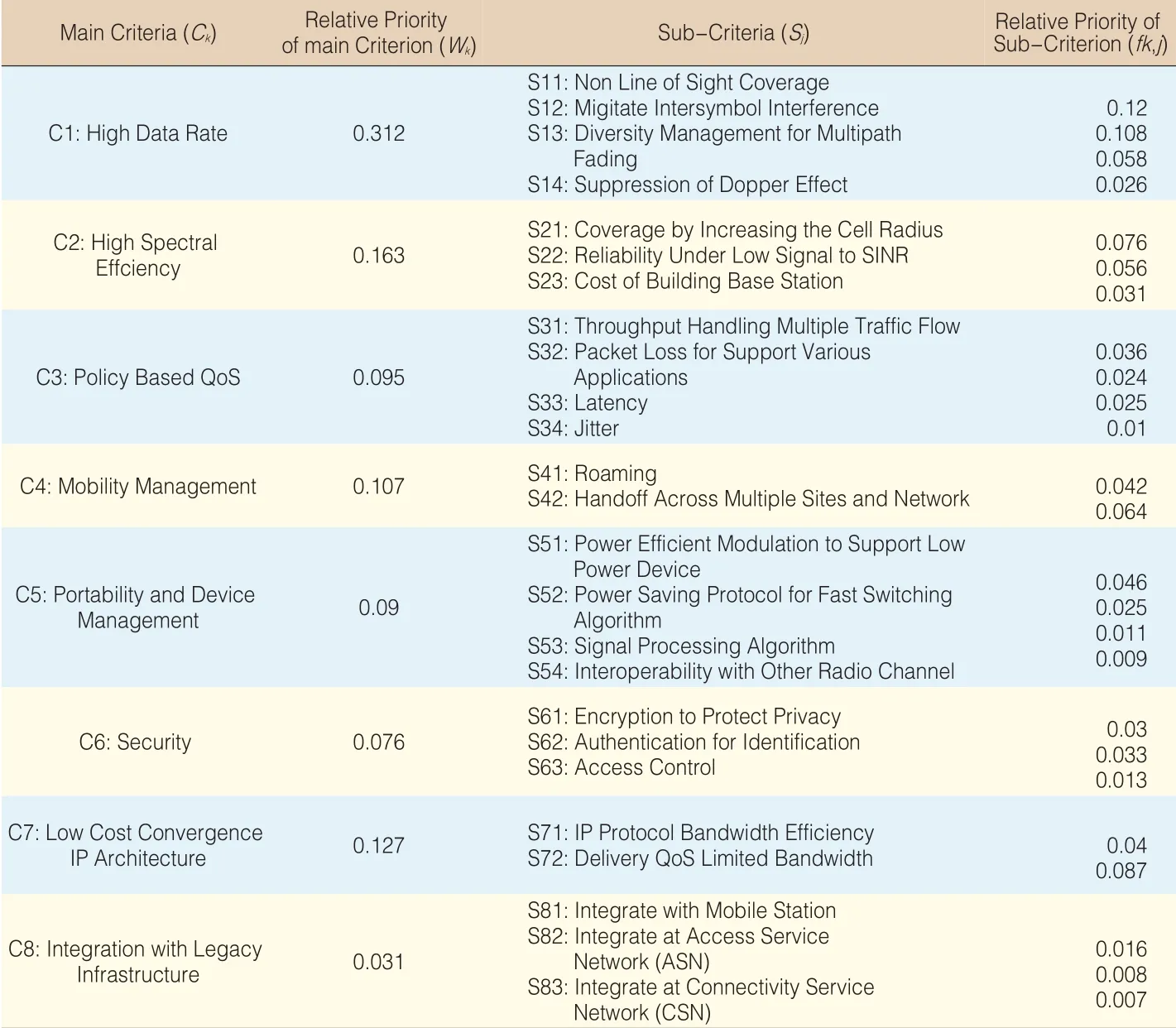
▼Table 1.An AHPmodelwith relative priority from a group of industrialexperts
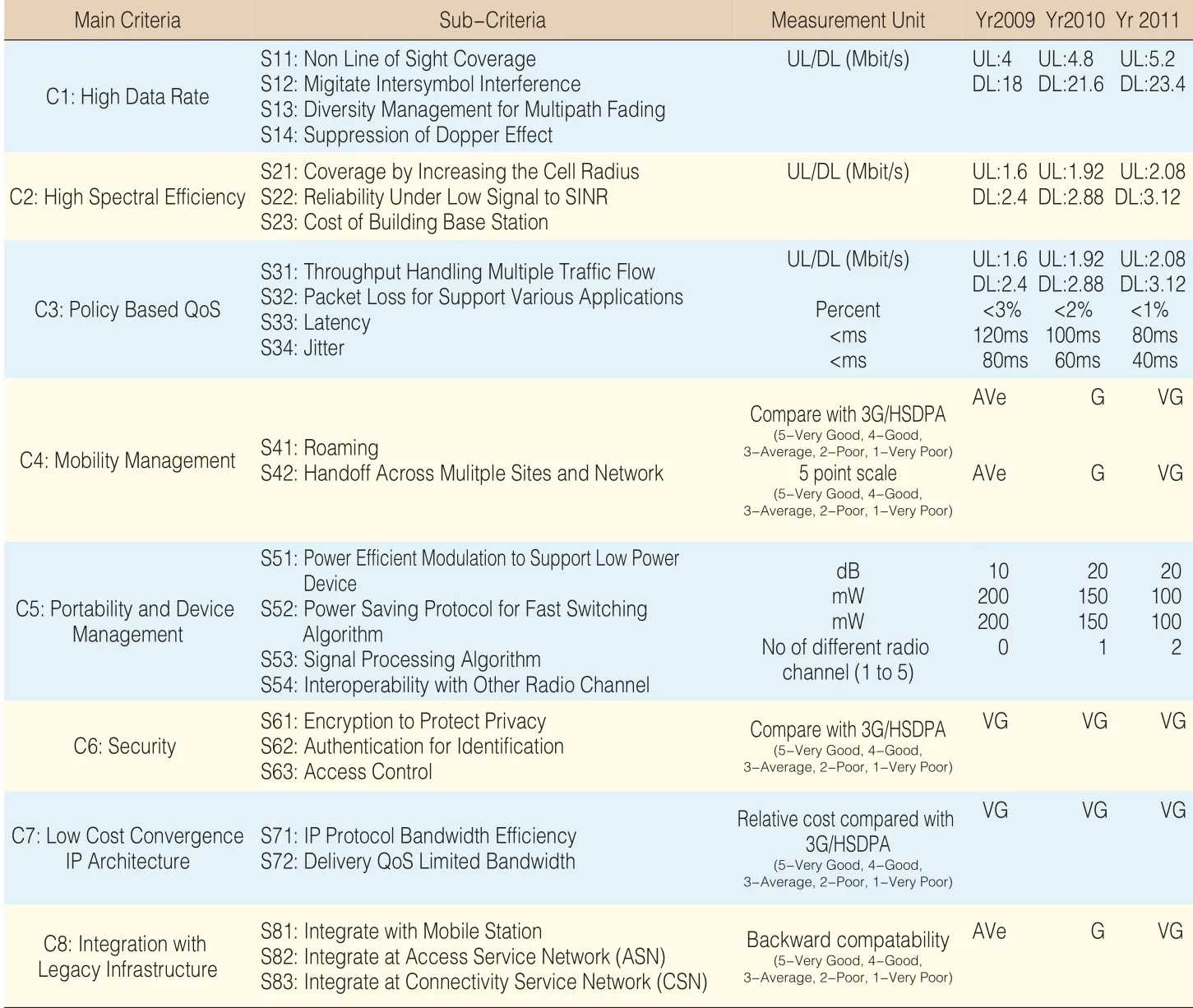
▼Table 2.Technologicalmetrics of the service provider’s WiMAXperformance
The relative priority for the main criteria(Wk)and the sub-criteria(fk,j)is an integral part of the AHPmodel.
5.2 Technological Assessment with Desired Performance Targets
The WiMAXoperators estimated their desired network performance levels from 2009 to 2011,and this became the desirable output under the DEA framework.The data was then integrated into the AHPmodel to become the technological metrics for each of the measuring criteria,as shown in Table 2.
Desirability graphs representing operators’preferences for the technological metrics of each design criteria were drawn.Figure 4 shows examples of desirability graphs for data rate and spectral efficiency.
The technological value represents the overall performance of the AHP model after integrating all the technological efficiencies of the design criteria.For the WiMAXstudy in 2009,this was 50%.As WiMAXtechnology continues to improve,the technological value is expected to improve to 70%by 2010,and then to 100%by 2011.
5.3 Formation of the Performance Evaluation Model
The growth rate of technological value shows WiMAXservice providers how design criteria should be improved in order to meet desired performance targets.
High data rate(0.312)is still the dominant factor affecting overall performance.Any improvement in NLOScoverage and/or interference cancellation would also greatly improve technological value.For example,technological value increases from 8%to 16%between 2009 and 2010,and reaches 31%by the end of 2011.
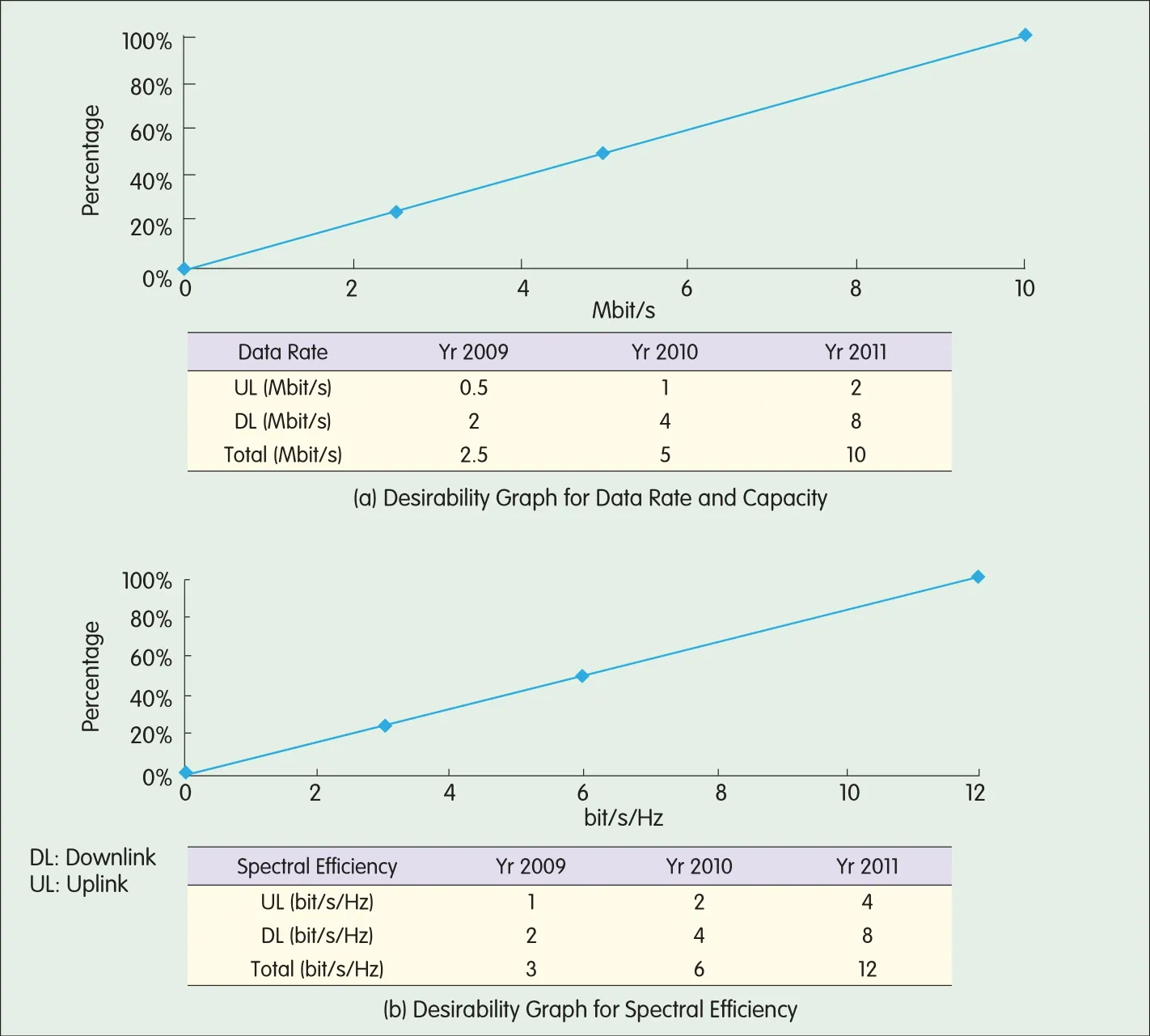
▲Figure 4.Desirability graphs for data rate and spectral efficiency.
High Spectral efficiency(0.163)is the second most important factor.Given that frequency spectrum is the most limited resource in a wireless network ecosystem,operators are concerned about enhancing efficiency and maximizing the coverage and number of end users.Technological value for the operator increased from 4%to 8%between 2009 and 2010,and will reach 16%by 2011.
The contribution of the above two criteria alone affects the overall WiMAX network performance target by 47%.The other six design factors affect the overall performance target by 53%.This modelprovides a clear indication of what resource investments need to be made into the network,and monitors performance improvement in a quantitative way.
6 Conclusions
The performance evaluation model provides a quantitative approach to measuring an operator’s WiMAX network performance against their desired targets.It is not designed for comparing one mobile operator’s network performance with another’s,as performance targets differ according to market strategy and investment model.
However,achieving targets very
much depends on equipment suppliers delivering products that align with the operator’s timetable.This modelcan also be extended to equipment suppliers for the purpose of validating performance targets of individual criteria over some years of study,as wellas to enhance supplier roadmaps for future network development.The enhanced model could strengthen partnerships between mobile operators and equipment suppliers.

- ZTE Communications的其它文章
- ZTE Positioned in the Leaders Quadrant in Leading Industry Analyst Firm Report
- ZTE Topsthe Global CDMA Market with a 30%Market Share
- ZTE France Awarded Best Investor Prize 2010
- Study of the China PTN Industry Standard and Its Key Issues
- Cloud Computing(3)
- Research on Convergence Network of EPON and WiMAXBased on ROF