
Beam Pattern Synthesis Based on Hybrid Optimization Algorithm
2010-03-09 11:57:22YUYanli郁彥利WANGYingmin王英民LILei李磊
Defence Technology 2010年3期
YU Yan-li(郁彥利),WANG Ying-min(王英民),LI Lei(李磊)
(1.School of Marine,Northwestern Polytechnical University,Xi'an 710072 Shaanxi,China;2.School of Mechanics Civil.& Architecture,Northwestern Polytechnical University,Xi'an 710072 Shaanxi,China)
Introduction
Array antennas are widely used in sonar,radar,wireless communication and other fields.In order to suppress unwanted interferences and detect interesting target signals,it is extremely important to design a specified pattern.The optimal pattern synthesis has been an active research topic in the underwater acoustic sensor arrays.In the pattern synthesis,an appropriate weighting vector should be searched to achieve the desired pattern.Various analytical and numerical techniques have been developed for this purpose.
Recently,the numerical approaches have become more popular as they can be used for not only the regular arrays,such as linear array,but also the arrays with complicated geometry layout and radiation pattern requirements.They include the linear or nonlinear optimization methods[1-2]and adaptive methods[3-4].However,most of methods existing in the literature concentrate on the control of the beam's sidelobes,and do not consider the performance of mainlobe.Moreover,the traditional methods may get trapped in local minima,and result in a suboptimum beam.
Because the genetic algorithm[5]can escape from the local minima or maxima and optimize globally in whole complex space,it can be used for solving the beam pattern optimization problem.A numerical hybrid optimization method which combines the notch noisefield method[6]with genetic algorithm is proposed in this paper.Simulation results demonstrate that the proposed method has better performance than the conventional methods.It can find an optimal weighting vector that will form the main beam in a given direction and reduce the lower sidelobes.As a numerical method,it easily handles the arrays in which the elements are located arbitrarily and the element patterns are unequal.
1 Basic Relations
1.1 Beam Pattern
Consider an N-element array with an arbitrary geometry,receiving signals from sound sources in the far field from the array.For narrowband beam-forming,the output of a beam-former can be expressed as

where w= [w1,w2,…,wN]is the weighting vector,x(t)=a(θ)s(t)the signal vector,s(t)the source signal and a(θ)the so-called steering vector.For the arbitrary array geometry and element directivity,the steering vector is

where fn(θ)(n=1,…,N)is the response of nth element in direction θ,and Ψ the set of all directions in the observation field.For all θ∈Ψ,the set of a(θ)composes the array manifold A(θ).The operator(·)Tdenotes the transposition operation and φn(θ)is the phase delay due to propagation.The array response can be expressed as

where w is N ×1 complex weighting vector and(·)Hdenotes the Hermite transposition.
1.2 Mathematical Model of Objective Function
To design the beam pattern by using optimization algorithm,the objective function needs to be created.Firstly,an ideal beam function I(θ)is established according to the sidelobe level SLθs(SLθs<0),the mainlobe pointing angle θsand the mainlobe region [θL,θR],where θLand θRare found out based on θs,SLθsand beamwidth Θ-3dB.In function I(θ),D(θs,θ)stands for the desired mainlobe shape.
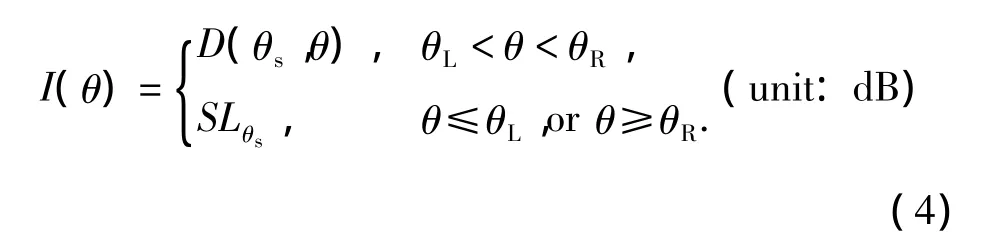
To design the beam pattern function P(w,θ),the error energy function can be defined as

It is based on the minimum mean square error between the beam function P(w,θ)and the ideal beam function I(θ),and reasonable for the mainlobe region,but not for the sidelobe region.In the sidelobe region,we only need to control the maximal sidelobe to approach to the given sidelobe level.Thus,the equation(5)imports a redundant restriction to the sidelobe region.To eliminate the redundant restriction,Q(w,θs)can be further simplified as
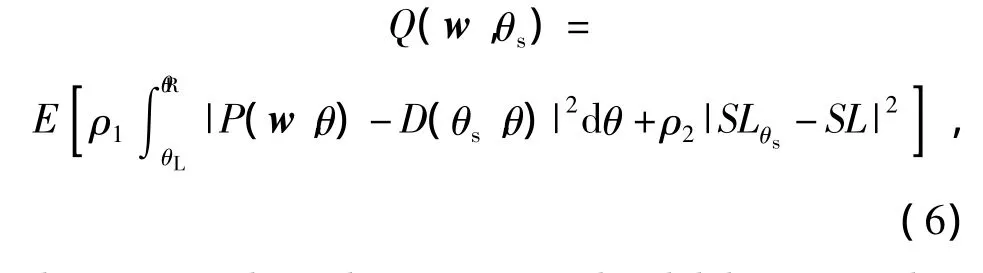
where SL is the value of maximal sidelobe,ρ1and ρ2are the mainlobe and sidelobe cost factors,respectively.The smaller the Q(w,θs)is,the more closely the P(w,θ)approach to I(θ).In order to calculate conveniently,θ can be discretized and Q(w,θs)can be expressed as

So far,the problem of array pattern design and optimization is equivalent to searching a set of weight coefficients which meet

Define Eq.(8)as the objective function.For the problem of multi-beam design,we can design each beam pointing to different direction θsrespectively by using the above method and optimize them using the genetic algorithm.
2 Proposed Method
2.1 Principle of Notch Noise-field Method[7-8]
The notch noise-field method is based on the adaptive array theory.An adaptive array can form the zero point,namely notch,automatically in the direc-tion existing the interference signals,point the main beam to the desired signal direction,and adjust the weights based on the minimizing the interference power.The adaptive patterns can automatically form deep notches in the interference directions.The stronger the interference power is,the deeper the notch is.This is the power inversion concept in the adaptive arrays.The shape of adaptive pattern depends on the external interference distribution.
Based on the phenomenon of power inversion,if the actual sidelobe level is higher than the desired,the power of the interference signal can be increased,otherwise decreased.The adjustment amount is proportional to the difference between the actual and desired sidelobe levels.Thus,in the next iteration,the higher sidelobe will be reduced.After multiple iterations,the sidelobe level of the beam will be controlled effectively.
Because the adaptive array imposes no limitation on the array structure,the principle can be disseminated and used to the pattern synthesis for arbitrary array by artificially constructing a hypothetical interference spectrum.In general,the notch noise-field method can easily realize the beam design and sidelobe reduction through bring in many interference signals in the sidelobe region.Based on this principle,Olen and Compton proposed a numerical algorithm for array pattern synthesis.
2.2 Genetic Algorithm[9-10]
The genetic algorithm(GA)based on the Darwinian principle of natural selection and evolution has been intensively studied during past decades.Amounts of applications have benefited from its utilization.
To optimize the beam pattern,the weights have to be described as chromosomes.Each complex weight is represented by a string of bits,where half of the bits correspond to its real part and the other to its imaginary part.Hence,each weight has two genes,namely the real and imaginary genes,and they jointly constitute a chromosome.The set of N chromosomes represents an individual,which corresponds to the N-dimensional complex weighting vector of the N-element array.The all individuals stored in a given generation are referred to the population.
The optimization procedure requires the definition of fitness function to evaluate each individual and search the optimal individual in the natural selection.The fitness function can be selected as

where Td(wa,θs)is the fitness value.The choice of this fitness function ensures a reciprocal relationship between the pattern optimization and the fitness function,also avoids its infinite value.
2.3 Steps of Proposed Method
To obtain the optimal beam pattern,firstly,create the array model and calculate the array manifold A(θ).Then,design the beam pattern by using the notch noise-field method.A lot of interference signals can be introduced in the sidelobe region,and the weighting vector and the pattern can be calculated.Based on the pattern,adjust the strength of interference signals accordingly and calculate the weighting vector again.Repeat this procedure until obtain the primary optimized pattern.Then,its parameters,such as sidelobe level SLθs,mainlobe direction θsand beamwidth Θ-3dBcan be calculated.To improve the performance of desired pattern,modify the parameters properly before creating a new desired beam pattern with them.
Create the objective function mentioned in section 1.2 according to the new desired beam pattern,obtain fitness function and then optimize the pattern by using GA.The optimization method mainly includes several steps as follows.
1)According to the array parameters,create its model and calculate its manifold A(θ).Design the pattern by using the notch noise-field method and obtain an initial beam.
2)Calculate parameters of the initial beam,modify them properly and then create a new desired beam.
3)Produce an initial weighting vector randomly and encode it based on the gene's definition.The weight values are represented as binary-coded decimal(BCD).
4)Combine two genes to form a chromosome and construct an initial population.Assign the fitness value and evaluate the individuals in population.
5)Perform reproduction operation according to the individuals'fitness values,in order to create the next generation of individuals with higher average fitness.
6)Perform mutation operation for the individuals in new generation,by randomly changing a certain gene of the individual,in order to promote a higher diversity of solutions and avoid getting trapped in local optimization.
7)Decode the individual with the highest fitness,calculate its beam pattern and estimate its performance.If the pattern can not satisfy the given criteria,return to step 5)and continue to search the optimal weights,else go to step 8).
8)Compare the current iteration times with the preset maximal value,if they are equal,return to step 3)and execute the optimization program again,else end.
The optimization criterion we select is to minimize the energy function of the error between the designed and desired patterns.To avoid getting trapped in a local optimization,we combine the inner and outer circulations in optimization procedure.If the current iteration times of the inner circulation reach to the preset maximum,perhaps,the algorithm may not converge completely,so we restart the optimization procedure,from step 3 to step 7,to ensure the algorithm converges to the optimal weighting vector eventually.
3 Application and Examples
To illustrate the effectiveness of proposed approach,an example is presented.
3.1 Structure of Array
The array as shown in Fig.1 is a double-circular array with 24 sensors.The diameter of outer circle equals to 500 mm and the inner 375 mm.Each of twelve sensors in the outer and inner circles is spaced equally.The center frequency of source is 6.0 kHz and the sampling frequency is 15 kHz.We want to design twelve beams that are distributed uniformly on the horizontal plane where the array exists.Define beam#1 points to the direction that the sensor#1 exists,the rest beams can be deduced by analogy and all of the 24 sensors participate in each pattern synthesis.
3.2 Results of Pattern Design
Because of the symmetry for array and beam,only one beam needs to be designed and the other can be obtained by adjusting the weight order.Take beam#3 pointing to 60°as an example.It is assumed that the array elements are isotropic,the desired sidelobe level is less than -20 dB,and the mainlobe shape is optimal.
The beam pattern with uniform weighting and phase compensation is shown in Fig.2(a).Obviously,the sidelobe level is about-9 dB and can not meet the requirement.Fig.2(b)shows the pattern obtained with Olen-Compton method[4].It can be seen that the sidelobe level is acceptable,but the beam points to 64°.There exists 4°deviation for the beam direction.It can be taken as the initial beam and optimized further by using the genetic algorithm.
In the optimization procedure and the same algorithm complexity,different GA parameters may result in dramatically different performances.We can make the algorithm performance better by setting its parameters properly.The parameters selected in this paper are shown in Table 1.

Table 1 Parameters of GA
Figure 3 shows the optimized pattern in solid line,the desired pattern in dot-dash line and the initial pattern in dotted line.The desired pattern is obtained according to the modified parameters of the initial pattern and the optimized pattern is obtained by using proposed method.Table 2 gives the parameters of three patterns.Comparing to the initial pattern,the sidelobe level for the optimized pattern is reduced from-21.1 dB to -25.3 dB,the beamwidth is compressed effectively and the mainlobe points to 60°more strictly.It can be seen from Table 2 that the array gain increases by 0.41 dB.In general,the optimized pattern shows better performance than the initial beam.

Fig.3 Radiation pattern of double-circular array with main beam pointing to 60°by using proposed method
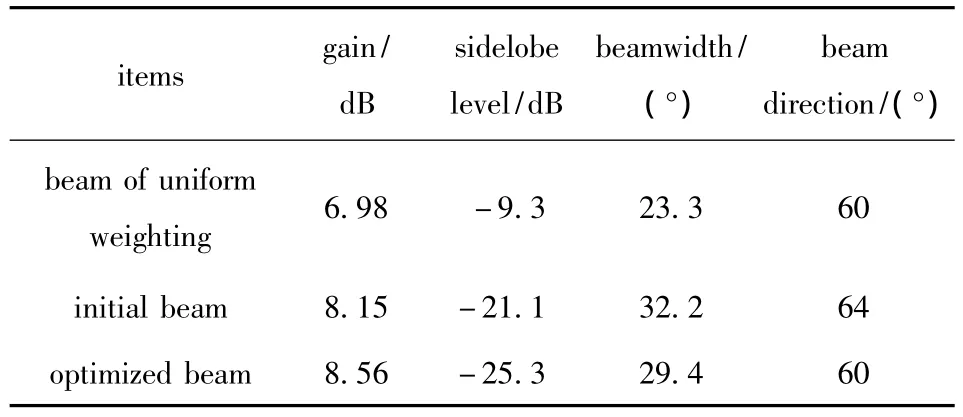
Table 2 Parameters of three patterns
The analysis indicates that,when constructing the objective function in optimization procedure,the constraints are imposed on the magnitude response within mainlobe region also.And for the sidelobe region and mainlobe region,different constraints are imposed.This way to impose the constraints is propitious to search the optimal weighting vector.The high suitability of GA in exploring complex search spaces and the reasonable selection of objective function make the proposed method yield better results.
For the conventional optimization algorithm,it is much faster to achieve the desired result by having several shorter trials than a single longer trial.The reason is that,when the procedure sticks in somewhere,for example,a local maximum,it may take a long time to jump out.The results from different runs are not identical due to different random search routes.The method proposed in this paper combines the inner and the outer circulations in the beam optimization algorithm,and ensures the convergence of the algorithm.
4 Conclusions
In this paper,we present a numerical method based on the notch noise-field method and genetic algorithm for the solution of optimal beam pattern synthesis problem.It can obtain the optimal beam for a given geometry array by imposing constraints on the magnitude response in the mainlobe region and controlling the sidelobes.Compared to the existing approaches,it can effectively realize the sidelobe reduction and achieve less synthesized magnitude error in mainlobe region.A double-circular array is taken as an example to illustrate the method.The principle of this method is simple and obtained results demonstrate its effectiveness.After extensive applications,this method can be used to solve the pattern synthesis problems for arbitrary and broadband arrays.
[1]Er M H,Sim S L,Koh S N.Application of constrained optimization techniques to array pattern synthesis[J].Signal Processing,1993,34(3):323 -334.
[2]SHI Z,FENG Z.A new array pattern synthesis algorithm using the two-step least-squares method[J].IEEE Signal Processing Lett,2005,12(3):250 -253.
[3]Dufort E C.Pattern synthesis based on adaptive array theory[J].IEEE Trans Antennas Propagat,1989,37(8):1011-1018.
[4]Olen C A,Jr Compton R T.A numerical pattern synthesis algorithm for arrays[J].IEEE Trans Antennas Propagat,1990,38(10):1666 -1676.
[5]YU Yan-li,WANG Ying-min.Design method for beamforming using genetic algorithm[J].Audio Engineering,2007,31(4):59 -62.(in Chinese)
[6]MA Yuan-liang.Pattern optimization for sensor arrays of arbitrary configuration[J].Ship Building of China,1984,87(4):78 -85 .(in Chinese)
[7]YAN She-feng.Hydrophone array optimization with extension to generalized spatial filtering[D].Xi'an:Northwestern Polytechnical University,2005:4-9.(in Chinese)
[8]Wu R,Ma Y L,James R D.Array pattern synthesis and robust beamforming for a complex sonar system[J].IEEE Proc Radar,Sonar Navigation,1997,144(6):370 -376.
[9]WANG Ying-min.Optimization techniques with application to underwater acoustic signal processing[D].Xi'an:Northwestern Polytechnical University,2002:92 -98.(in Chinese)
[10]Yan Keen-Keong,LU Yi-long.Sidelobe reduction in array-pattern synthesis using genetic algorithm[J].IEEE Trans Antennas Propagat,1997,45(7):1117 -1122.

- Defence Technology的其它文章
- Analysis on Velocity Characteristics of Cavitation Flow Around Hydrofoil
- Influence of Accelerated Aging on Detonation Performance of Explosives
- Research on Additional Loss of Guidance Optical Fiber
- An HLA/RTI Architecture Based on Multi-thread Processing
- A Fuzzy Adaptive Algorithm Based on“Current”Statistical Model for Maneuvering Target Tracking
- Quantitative Analysis of Components in OC-CS Sprays by High Performance Liquid Chromatography with Double Wavelength UV Detection