文章英文摘要
2006-10-26 06:35:36張錫海
人民音樂 2006年10期
關鍵詞:英文
張錫海
″Success Comes From Hard Work″: Notes on Prof. Li Xinchang
Li Xinchang, well-known baritone and vocal music professor of the Central Conservatory of Music, was born in Tianjing in February 1936. In 1955, He entered the Central Conservatory of Music, located then in Tianjin, and started his long artistic career. During the whole period of his college years, he had been studying all the time with Prof. Yu Yixuan, well-known soprano and vocal music pedagogue. After five years of hard working with Prof. Yu and various singing practices both on and out of campus, he laid a solid foundation for his singing career. In 1960, he graduated from the conservatory with excellent grades, and remained there to be a teacher. In July the same year, he was sent by the Ministry of Culture to participate in the Second Schumann Singing Competition in Berlin and won the fourth place. In 1977, he was invited as special artist to visit DPR Korea together with the Central Symphony Orchestra of China, and had a chance to meet with Chairman Kim Il Sung. In 1978, he was invited to give a recital at the ″Summer of Qingdao″ Festival, and then gave several recitals in the cities of Beijing and Tianjin. In 1979, he performed as soloist in Beethoven's Symphony No. 9 conducted by Seiji Ozawa. In 1980, he was sent abroad by the Ministry of Culture to become one of the first Chinese students studying abroad after the end of the ″Cultural Revolution″. As a visiting scholar, he went to Milan, Italy to further his education at the Verdi Conservatory. Besides studying with professors of the conservatory, he also studied with well-known tenor Mario del Monaco, and even attended classes of teachers for other voice types.
In December 1983, he returned to China and then devoted himself to teaching at the Central Conservatory of Music. Since 1986, he had been the dean of the Vocal and Opera Department for 15 years, and became professor in 1988. For many years, he educated a large number of excellent students, among whom 15 won the gold prize, first place or other prizes in various international singing competitions, 9 won the gold prize or the first place in national singing competitions while 5 won second or third prizes. Li Xinchang is regarded as the first-generation artist of vocal music brought up in the new age since the founding of the People's Republic of China. For dozens of years in his singing and teaching career, he learned from the past and grew up step by step in the cause of vocal music, where he made such great success and achievements and such good reputation and influence, and in particular, educated so many talented singers, that he made important contributions to the construction and development of contemporary Chinese singing art.
The Issue of the Constant Replacement of New Composing Techniques for the ″New Music″: An Analysis of the Limitation of the 20th-Century ″New Music″ Compositions in the West (Part II)
The period from the 1910's or 1920's to 1950's or 1960's has seen rapid development of various new composing techniques for the ″new music″ in the West. The ″new music″ composers, full of passion and impulse, with an aim to seek originality and uniqueness, forced themselves to realize too many missions and duties, regardless of their own expanding self-consciousness. However, their music activities, which represented their ideals and pursuits, reflect somehow the road of the development of Western schools and styles of arts. In the positive sense, musical compositions were freed from the ″barriers″ of traditional composing technique theories and established systems of values. On the other hand, as the replacing process for new techniques was too rapid, it brought about a severe break of history in the ″new music″ structure by creating a certain kind of ″rationality″ risk. Therefore, with the deepening of ″new music″ researches, the limitation caused by the rapid transformation of new composing techniques graduated emerged. Nevertheless, a study on this limitation does not mean an overall denial of all the various composing techniques for the ″new music″, but rather a dialectical critique of them.
This article intends to discuss, from the historical perspective, the issue of the limitation arising from the rapid transformation of new composing techniques for the 20th-century ″new music″. The author believes that works of the ″new music″ lack a value system of ultimate significance which is shared by the contemporary composers, and thus turn the ″new music″ into a series of modern musical forms with varied techniques, but more loose and unstrained, making the ″new music″ face the risk of losing itself and most of the works ″survive for short time″. One may easily find that the new composing techniques for the new music tend to focus more on ″conflicting developments″ among the composers (namely, dodecaphony, cluster, microtone music and tone colour music that are used in the new techniques develop in a way of mutual rejection and incompatibility). This mere focus on ″conflicting developments″ rather than ″gradual development″ (namely, the overall development of music techniques should be compatible and gradual) is not in conformity with the universal principle of human social development in two compatible ways, and is therefore harmful to the maturity of the new composing techniques.
The 20th century saw the social changes in such varied forms that were beyond the control of the natural sciences. Whether it is philosophy, aesthetics, literature or fine art, perception of each science is becoming more and more ambiguous, with no recognized standing-points, so as to cause breaks in their innate continuation. It is thus unavoidable that in this process of co-existence and replacement of various new composing techniques exists the weakness of the so-called ″seeing no forest but trees″. Just as critic Sun Shaozhen remarks, ″each of the schools comes out of fixed accumulation of one's aesthetic experiences and each attempts to exceed the others. But whether they can accomplish their mission or not mainly depends on to what extent their aesthetic experiences have reached, both in terms of what they have inherited and what they have developed. Schools opposing to each other may develop healthily by infiltrating into each other. Both the opposing and the infiltrating are inseparable from each other. Unhealthy growth in either aspect may become obstacle in the emergence of music giants that would exceed their predecessors....Sometimes it is unfavourable to the accumulation of aesthetic experience when only a few comrades stand under the same banner.″ This statement well explains the feature of short life in all those ″new music″ phenomena. These fast going music forms break too soon the process of aesthetic experience accumulation in the music art, and therefore it is only natural to have this feeling that history will be constantly repeated somehow.
However, in the history of Western music, it always happens that whenever a new composing technique appeared, there was always somebody who would oppose to it, but eventually this new technique was accepted by all. The author points out that no matter how the new techniques developed in the history of Western music, they all followed the same principle, i.e. ″gradual development″ and ″conflicting development″ always infiltrate into each other, and stimulate, promote and restrict each other.
Every mature composing technique is unexceptionally developed following contradictions and conflicts. Each conflicting party, such as homophony versus polyphony, major versus minor, harmonious versus inharmonious, ultimately results in fusion rather than extreme opposition. ″Fusion is a process of accepting and eradicating two opposing styles, and finally expel them. When two opposing parties approach each other, a new structure composed of two extremes, or the third style, emerges quietly.″ Most of the ″new music″ composing techniques focus on ″conflicting developments″ among the composers. This mere focus on ″conflicting developments″ rather than ″gradual development″ is not in conformity with the universal principle of human social development in two compatible ways, and is therefore harmful to the maturity of composing techniques. Moreover, when the process of new composition technique transformation is too rapid, the feature of slow changes in the masses' aesthetic experience is often neglected and the living perception of human life is deprived, so that music becomes more and more ambiguous and obscure, far away from the expectation of composers and audience. Culturally speaking, ″there will be no school without exclusivity″, but when the new composing techniques for the ″new music″ despise or terminate the ″others″ too much, it inevitably leads to limitation.
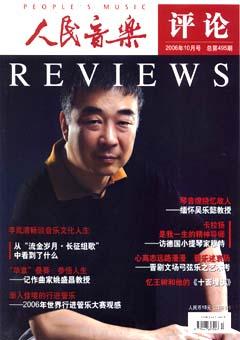
MAIN CONTENTS
Li Lanqing's Talks on Music Culture and Life Zhu Xuejun (5)
″Success Comes From Hard Work″: Notes on Prof.
Li Xinchang Wang Chang (7)
The Issue of the Constant Replacement of New
Composition Techniques for the ″New Music″: An
Analysis of the Limitation of the 20th-Century
″New Music″ Compositions in the West (Part II)
Ye Songrong (16)
Symphonic Music Composition Should Be Closer to
the Masses, to the Reality Wang Yuhe (20)
The Integration of Composition and Theory:
My View on the Concert of Works by Dr.
Zhang Xudong Liu Zaisheng (22)
The Diversified Styles and Harmonious Co-existence:
Impressions on the ″Shanghai Spring″ International
Accordion WeekWang Chaogang (24)
The Historical Research on the Music Magazine of the
Peking University's Music Research Society Hu Xiao (27)
The Ever-lasting Sound of Music: In Memory of Prof.
Wu LeyiChao Zhijue (36)
In Memory of Wang Shu and His Work ″Ambushes
from All Sides″ He Pirong (39)
A Proposal Concerning Ear-Training Teaching Reforms:
On the Importance of the Proper Piano Accompaniment
in the Integrated Practice for Ear-TrainingMa Yufeng (42)
The Characteristics of the Administration of a New
Discipline: An Interview with Prof. Xie Dajing, Dean
of the Art Management Faculty of the China
Conservatory of MusicXiahou Xiaoyu (45)
Marching Show Bands Growing to Be Mature:
Impressions on the 2006 World Championship for
Marching Show BandsYu Hai (64)
″Karajan as My Lifelong Spiritual Guide″: An Interview
with German Violinist Anni-Sophie Mutter
CCTV ″Artist's Life″ (67)
The Four Most Impressive Aspects of My Impressions:
Notes on Anni-Sophie Mutter's 2006 Beijing
Recital Chen Junfeng (69)
A Probe Into the Model Curricula in the Foreign
Major Systems of Music Education in the 20th Century
Yin Aiqing & Liu Xin (73)
The New-Generation Russian Composer Georgi Sviridov
Shao Xiaoyong (76)
(Translated by Zhang Xihai)
猜你喜歡
國際展望(2017年2期)2017-03-21 18:34:18
鄱陽湖學刊(2016年6期)2017-01-16 13:05:41
中國遠程教育(2016年6期)2016-12-07 10:07:02
財經(2016年19期)2016-08-11 08:17:03
中國遠程教育(2016年5期)2016-06-29 10:13:42
中國遠程教育(2016年2期)2016-03-21 10:31:21
中國遠程教育(2016年1期)2016-02-26 10:37:15
國際展望(2015年5期)2015-09-15 05:41:45
國際展望(2015年4期)2015-07-13 05:30:56
能源(2014年9期)2014-09-15 13:18:12