Chaozhou’s Cultural Legacy: What Do Academies Bear?
2025-03-08 00:00:00
中國新書(英文版) 2025年1期


This book is a comprehensive and systematic understanding of Chaozhou culture, born from the “Chaozhou Code” column of Nanfang Daily Chaozhou Observation, a collection of 31 articles, mainly focusing on the public’s most concerned and curious questions about Chaozhou culture, and making Chaozhou culture-related research present to readers in a more friendly way through media penmanship.
By the riverside stands the Han Wengong Ancestral Hall, but the oak tree once planted by Han Yu is long gone. In its place, a new oak tree has grown tall and straight, flourishing in front of the hall with lush greenery. In ancient Chaozhou, the blooming of oak trees symbolized the auspicious success of scholars in the imperial examinations. Han Yu himself became a crucial bridge connecting Chaozhou with the cultural traditions of the Central Plains. After his departure, Chaozhou, slightly lagging behind the cultural pulse of the Central Plains, began sowing the seeds of Confucian culture. These seeds grew and took root in academies and private study halls, nurturing the scholarly spirit and literary integrity that form an integral part of Chinese cultural heritage.
Origins: Chaozhou’s Two Academies, Unmatched Elsewhere
Han Yu, banished to Chaozhou for his candid criticisms born of concern for the state, served there briefly for eight months before being recalled to court, reinstated as Court Gentleman for Ceremonials and director of the National Academy, and honored with golden robes. Yet, dynastic transitions are inevitable, and the past is irrevocable. In the late Tang Dynasty, amid political chaos and warfare, state-run schools fell into decline. In the fourth year of Shengyuan during the Southern Tang Dynasty, White Deer Grotto Academy was transformed into a state academy, serving as a prototype for government-run academies. Concurrently, amidst turbulence, scholars began establishing private academies. Historian Qian Mu described these institutions of the Five Dynasties period as “a ray of light in the darkness,” preserving the potential for scholarly revival in tumultuous times and laying the groundwork for future intellectual flourishing.
After Han Yu left Chaozhou, power shifted among Central Plains rulers, yet Chaozhou’s landscapes remained associated with Han’s legacy. In the fifth year of Yuanyou during the Northern Song Dynasty, Prefect Wang Di built the Changli Temple south of the city to honor Han Yu. Successive officials continued to restore and expand the temple, solidifying his commemoration. While academies originated during the Tang Dynasty and flourished in the Song, their institutionalization began nationwide during the reign of Emperor Lizong of the Southern Song. In the third year of Chunyou, Prefect Zheng Liangchen established an academy at the site of Han Yu’s temple. According to Chaozhou cultural historian Zeng Chunan in Collected Essays on Chaozhou Studies, Hanshan Academy remained located at Han Yu’s former temple site until the twenty-first year of Zhiyuan during the Yuan Dynasty.
Huang Wanyi, a master’s graduate in Chinese philosophy from South China University of Technology, noted in her essay “The Influence of Ancient Chinese Academy Education Thought on Modern Higher Education” an intriguing phenomenon in the development of ancient academies: the integration of academies with the scholarly factions their leaders represented. For instance, Neo-Confucianism was closely tied to Song academies, while Ming academies aligned with the School of the Mind.
Zhou Dunyi, the founder of Neo-Confucianism, visited Chaozhou in the fourth year of Xining during the Northern Song Dynasty as Guangdong’s transport commissioner and composed the poem “Inscription at Dadian Hall.” Later, in the ninth year of Chunyou in the Southern Song Dynasty, his descendant Zhou Meisou, serving as prefect of Chaozhou, established Yuan Gong Academy near the city’s ancient upper water gate, following the trend of promoting Neo-Confucian ideals. Yuan Gong Academy shared equal stature with Hanshan Academy and even appropriated half of the teaching facilities of the state academy nearby.
Hanshan Academy and Yuan Gong Academy, the first academies in Chaozhou, were initiated by local officials to complement the existing state schools. Professor Wu Rongqing from Hanshan Normal University’s College of Chinese Literature and Journalism observes that after the reign of Emperor Lizong, government-sponsored academies became a form of local public schooling, operating in parallel with state schools. For example, Hanshan and Yuan Gong Academies were both overseen by professors from the state academy, who implemented similar teaching and management systems. In addition to these two academies, Chaozhou also saw the founding of Jingshan Academy, a private institution established by local scholar Hu Shenfu, and Dequan Academy, a later Yuan Dynasty government-run academy. Although records from this early stage of Chaozhou’s academies are sparse, they confirm the emergence of institutions that prioritized individual-centered education, distinct from the exam-focused state schools of the time.
Prosperity: Asking the Scholars Among the Ridges, Is the Understanding the Same Before and After Listening?
The development of academies, positioned between official and private education systems, was closely linked to the policies of literature and education, political struggles, and the rise and fall of state-run schools. During the early Ming Dynasty, academies were relatively quiet, but as state schools gradually became corrupt, there was a disconnection between official schools and academies. By the reigns of Emperor Jiajing and Emperor Wanli, a trend of scholars giving lectures emerged.
According to a study by master’s student Kong Xianglong from Yunnan University, titled A Study of Ming Dynasty Academies in Guangdong, there were 30 academies within Chaozhou Prefecture during the Ming Dynasty, ranking third in Guangdong Province. Wu Rongqing believes that the large number of academies in Chaozhou during this period was a result of the spread of Wang Yangming’s School of the Mind in the region. The academies played a crucial role in the formation of Chaozhou culture, particularly in Confucian education, and the proliferation of academies reflected the local culture’s emphasis on literature and education.
Wang Yangming, inheriting the “Mind is Principle” philosophy of Lu Jiuyuan, opposed the “investigation of things and extension of knowledge” advocated by Cheng Yi and Zhu Xi, which sought “the ultimate principle” through external objects. Instead, Wang emphasized “investigating good conscience” and finding the “principle” from within one’s own heart, while also stressing the integration of knowledge and action. Wang Yangming recruited many disciples and spread his philosophy, with many scholars from Fujian and Guangdong joining his school. As a result, Wang’s teachings began to spread across Lingnan (south of the Five Ridges provinces). Among his students, Xue Kan, a Chaozhou native, played a significant role in promoting Wang Yangming’s philosophy in eastern Guangdong, using academies as a platform for this intellectual movement.
Xue Kan confidently asked in his Inscription at Lishan Academy: “To all the scholars who have come here, do you feel that your understanding and insights have changed after listening, compared to before?”
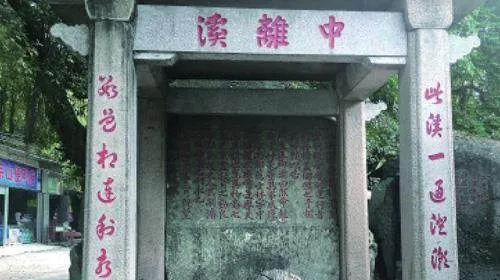
In Fenglong Village, Anbu Town, in the foothills of Huwei Mountain in Chaoan District, one can still find a cave measuring 1.7 meters high, 3.3 meters wide, and 7 meters deep. The entrance bears the inscription “Zhongli Cave,” with the signature “Built by Xue Kan, Jinshi of the Fifth Year of the Jiajing Reign.” In the third year of the Jiajing reign (1524), following his mother’s death, Xue Kan returned to his hometown in Chaozhou to observe mourning, and with his brother and nephew, they built a place for lectures in a natural cave on the mountain slope. The location was named “Zhongli Mountain” due to its shape: “Three peaks rising together, with a passage that connects them, and it seems to have a ‘departure’ (離, li) in its alignment.”
“At that time, scholars from all directions and local people could come to listen, spreading culture not only among scholars but also to the common folk,” explained Kong Lingbin, a professor in the Department of Chinese at Hanshan Normal University. Surrounded by beautiful mountain scenery, scholars, including local officials from other provinces and scholars from nearby areas, followed this high-ranking disciple of Wang Yangming’s school to learn.
Xue Kan lectured three times in his hometown, with the third time occurring in the tenth year of the Jiajing reign. After being slandered, Xue Kan was demoted and returned to his hometown. He then advocated for the construction of the Huaihui Temple, which became Zongshan Academy, where he worshipped Wang Yangming and gathered disciples for lectures. Local officials allocated funds to purchase property for the academy.
In the twenty-third year of the Jiajing reign, ten individuals from Guangdong passed the imperial examination, with seven from Chaozhou, drawing attention from both the court and the people. Among them, four had studied under Xue Kan at Zhongli Mountain. These scholars not only studied in the mountains and countryside but also sought official titles at the imperial court. Through the academy, Confucianism itself was continuously explored and advanced. Kong Lingbin believes that from Zhu Xi to Wang Yangming, Confucianism relied, either directly or indirectly, on the vibrant power of academies for supplementation and transmission.
In Chaozhou, the promotion of Wang Yangming’s philosophy also had a regional background. During the Ming Dynasty, the economy of the Han River valley prospered due to maritime trade, with Chaozhou becoming an economic center of the region. The merchant class became an important force in Chaozhou society. In traditional Confucian values, merchants were regarded as low-ranking, but within Wang Yangming’s philosophy, they found self-recognition and social belonging. Wang Yangming stated, “Even though one engages in trade everyday, it does not prevent them from becoming a sage or a worthy person,” emphasizing that “in ancient times, the four classes had different occupations but shared the same moral path, all striving with one heart.” This affirmed the social value of merchants. In his book Will the Spring of Chaoshan Return?, Xie Haisheng argued that Xue Kan introduced Wang Yangming’s philosophy into Chaozhou, offering the public an extraordinary path to sainthood beyond traditional imperial examinations and education, which helped shape the pragmatic spirit and merchant tradition of Chaoshan.
In addition to Zhongli Academy and Zongshan Academy, other academies such as Yuhua Academy and Nanxi Jing She provided fixed places for Chaozhou’s rich academic atmosphere and stable networks of academic friends and teachers. These academies served as venues for the study of theories, exchange of knowledge, dissemination of ideas, discussions on local matters, and the pursuit of deep theoretical insights.
Su Shiri
Su Shiri is the director of the Chaozhou Reporter Station of the Southern Press Media Group.
Da Haijun
Da Haijun is the director of the Qingyuan Reporter Station of the Southern Press Media Group.