Policy-Driven Sericulture Industry
2025-03-08 00:00:00
中國新書(英文版) 2025年1期
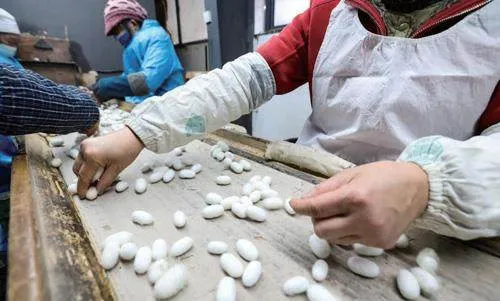
For a long time, apart from tobacco cultivation, Huoshiya Village had no agricultural product that could be considered an “industry.” However, the development of rural areas requires the support of rural industries, as they form the foundation and driving force of progress. To achieve sustainable growth, rural industries must be rooted in local conditions, with encouragement, support, and guidance focused on developing industries that align with local realities. Thus, for Huoshiya Village to modernize, efforts must be directed toward fostering an “industry.” Among the viable options, sericulture stands out as a promising choice. By developing sericulture, local villagers can find new livelihoods, especially for those who remain in the village. Beyond increasing individual farmers’ incomes, the sericulture industry also provides opportunities for local women through temporary work, offering a new avenue for realizing their labor value. This, in turn, promotes regional employment and advances the village’s industrial economy.
Sericulture, with its rich history, has long been a vital pillar of traditional Chinese agriculture. The cultural heritage of silk and mulberry is celebrated as a “cornerstone of Chinese civilization.” Situated deep within the Wuling Mountain region and included in the Chongqing Southeastern Eco-Development Zone, Qianjiang District boasts an excellent ecological environment, making it a fertile ground for sericulture development.
There is a saying, “Plant mulberry, grow paulownia, and prosperity will follow for generations.” In the 1990s, many areas across China pursued sericulture, but large-scale destruction of mulberry plantations occurred due to market fluctuations. Qianjiang, however, stood out as an exception. While sericulture was not traditionally a key industry for Qianjiang and its output ranked among the lowest in Chongqing two decades ago, the situation began to change in 2001 with the implementation of the national Grain for Green program. Adapting to local conditions, Qianjiang developed sericulture, discovering a new path that integrated ecological restoration with rural economic prosperity. Today, Qianjiang stands as Chongqing’s largest sericulture production base, maintaining the top position in the city for mulberry field area and silkworm cocoon production for ten consecutive years. In 2020, Qianjiang was designated as a national-level sericulture bio-industry base.
The district government has implemented policies to incentivize villagers to plant mulberry trees, offering subsidies. Farmers receive 100 yuan per mu (approximately 0.067 hectares) of mulberry trees planted, along with 20 kilograms of fertilizer the following year. Sericulture farmers remarked that the subsidies in 2020 were particularly beneficial; by signing a ten-year contract with the government, they could receive up to 1,200 yuan per mu.
In addition to modest cash subsidies, the government provides silkworm seeds and technical training. Initially, the seeds were distributed by the Qianjiang Forestry Bureau and collected by farmers at township centers. As the number of sericulture households grew, the government began delivering seeds directly to village entrances, making it more convenient and boosting farmers’ enthusiasm.
Taking the example of Huoshiya Village’s Group Two, in 2014, only two households were engaged in sericulture. By 2017, three more households joined. These families shared common circumstances: They had elderly members and children at home, making it impossible to seek work outside the village. Although sericulture was a new venture for them, they embraced it with determination. For them, relying solely on subsistence farming was insufficient to cover household expenses. With the government’s support for sericulture, they committed themselves wholeheartedly to this endeavor.
Meticulous Care for Healthy Silkworm Growth
Silkworm farming requires a high level of skill, precision, and patience. As silkworm farmers often say, “Silkworms are living beings too; they are delicate and need careful nurturing to thrive.” For experienced sericulturists, strict adherence to textbook techniques is no longer necessary — they have developed their own methods through years of practice. As one seasoned silkworm farmer, recounted:
When we first started learning how to raise silkworms, we had to attend training sessions. The instructor would explain all these technical steps, and we thought to ourselves, “This is way too complicated. How are we supposed to learn this?” By the end of the meeting, my head would be spinning. There were so many dos and don’ts, and all these specific ratios — how could we, with no formal education, possibly manage it? Later, we just had to figure things out on our own, step by step. Over time, we got the hang of it. The technical process is really just a general guideline, and as long as you’re strict about cleanliness and disinfection, it’s not that hard. Now that we’re used to it, we know exactly what to pay attention to at each stage and how to handle any problems that come up.
Silkworms can be raised in four seasons each year: spring, summer, early autumn, and late autumn. The first season begins in May. Silkworm eggs are initially placed in communal incubation rooms for nine days, during which they go through two molting phases, known as the first instar and second instar. Once the silkworms reach the second instar stage, they are taken home to individual silkworm sheds, where they undergo the third instar and fourth instar phases. Each molting phase lasts approximately three to four days, during which the silkworms remain in a sleep-like state. After each sleep cycle, they wake up to feed on mulberry leaves before returning to sleep for another three to four days.
During the third and fourth instars, lime powder is used to separate the sleeping silkworms from the mulberry leaves to prevent the silkworms from accidentally eating during their molting periods. This ensures uniform growth and prevents size discrepancies. After completing the fourth instar, the silkworms enter the large silkworm stage. At this stage, they remain fully awake and consume mulberry leaves continuously for six to seven days. Once this feeding period ends, they spin silk and form cocoons. The entire cycle for raising silkworms spans approximately 25 to 26 days per season. Once the cocoons are harvested, they can be sold, marking the completion of a season’s work.
Communal Rearing of Young Silkworms in the Nursery
Silkworms are fragile creatures, especially during their early stages as eggs and young larvae. They require a carefully controlled environment to ensure a high survival rate. To this end, newly distributed silkworm eggs are first raised in a communal nursery during the first and second instars — a process known as communal rearing of young silkworms. The nursery is an enclosed space where all silkworm farmers in the village rear their silkworm eggs collectively.
The communal nursery is a relatively modern silkworm-raising technique. Villagers who construct these facilities receive government subsidies. For instance, one family’s nursery received a cash subsidy of 10,000 yuan, plus an additional 4,000 yuan to cover air conditioning and related facilities, bringing the total subsidy to approximately 14,000 yuan. The actual cost of constructing a nursery is around 10,000 yuan, meaning the subsidy effectively offsets the construction expenses. Although the subsidy for constructing nurseries is not particularly high, nurseries generate profit by selling reared silkworms. The price for farmers purchasing silkworms from the nursery is double the price nurseries pay to the silk cocoon station. For example, nurseries buy silkworm eggs from the cocoon station at approximately 50 yuan per sheet, while individual farmers pay 100 yuan per sheet for the reared silkworms. This yields a profit of 50 yuan per sheet. Additionally, the government provides a subsidy of 30 yuan per sheet, allowing nurseries to earn around 80 yuan per sheet. If the total weight of the reared silkworms exceeds 40 kilograms, the government offers an extra 7-yuan subsidy per sheet. Consequently, the more silkworms a nursery sells to farmers, the higher the profit it earns.
Furthermore, raising silkworms requires no upfront financial investment. Farmers interested in rearing silkworms simply need to register with the government and provide their bank account information. After the silkworms are sold, the government calculates each household’s profit by deducting the cost of obtaining the silkworm eggs and transfers the earnings directly to their bank accounts.
Nurseries are constructed voluntarily by villagers. One family’s nursery in Group Two, for instance, features two windows and eight ventilation openings and is divided into two sections. The outer section, near the entrance, has better lighting and is used for storing mulberry leaves, along with equipment like mulberry leaf cutters and several containers. The inner section, designated for silkworm growth, is kept darker and equipped with over 100 rearing trays, an air conditioning system, a thermometer, and other necessary tools. During the rearing period, the nursery must be kept clean, so its walls are painted with lime for easy maintenance. The lighting is dim red, as exposure to white light can cause uneven silkworm growth by triggering premature hatching. Red light prevents such issues.
Before introducing silkworm eggs into the nursery, farmers cover the walls and windows with black cloth to block out sunlight and prepare the rearing trays with thin membranes. After each rearing cycle, these membranes are cleaned, disinfected, and air-dried for reuse in the next season.
When silkworm eggs are introduced into the communal nursery, they are placed in bowl-like or circular containers, with each tray holding the equivalent weight of half a sheet of eggs. The resourceful villagers of Huoshiyan discovered that using precise measuring instruments slowed down the process, so they repurposed bottle caps from beverages as makeshift measuring cups. A filled bottle cap holds approximately the correct weight. The eggs are then evenly sprinkled over the thin membranes, and soft feather-made separators are used to form square frames around the eggs. Feathers are chosen because they are light and gentle, ensuring that the eggs are not damaged. Arranging the eggs in square formations promotes uniform and concentrated growth. Finally, lime is sprinkled around the edges of the square frame for two purposes: to absorb moisture and dehumidify the space and to provide a cooling and stabilizing effect for the environment.
The town of Shijia, which includes six villages involved in silkworm farming, has over ten communal nurseries. The silkworm farmers have formed WeChat groups such as the “Shijia Sericulture Industry Development Group” and the “Young Silkworm Rearing Group” to share sericulture techniques and exchange knowledge on pest and disease control. During the author’s field research, they witnessed the distribution of late-autumn silkworm eggs to villagers on July 27, 2021. Farmers with communal nurseries reported their required quantities of silkworm eggs to the town’s cocoon station by July 25. Early in the morning of July 27, around 6:00 a.m., 12 farmers (11 men and one woman) from the six villages arrived near the cocoon station to collect the eggs. By approximately 6:50 a.m., the silkworm eggs arrived. The station manager addressed the farmers, providing updates and guidance: The manager summarized the rearing outcomes and quantities from the previous two seasons; reasons for low yield or subpar cocoon quality were discussed; the manager explained government subsidies and how to apply them; specific growth characteristics of the new batch of silkworm eggs and necessary precautions were highlighted. After the briefing, representatives from each nursery collected their allocated eggs based on the quantities reported earlier. Huoshiyan Village has three nurseries located in Groups Two, Three, and Seven, collectively raising 148 sheets of silkworm eggs for the new season. Each nursery representative signed off on the received eggs and carefully wrapped them in pre-prepared black cloth to shield them from light before transporting them back to the village.
Tian Qian
Tian Qian has a Ph.D. in anthropology and is currently the executive dean of the South Asia and Southeast Asia Radiation Center Research Institute, a professor in the School of Sociology, and a doctoral supervisor at Yunnan Minzu University.
Lei Xin
Lei Xin holds a master’s degree in sociology and graduated from the College of State Governance from Southwest University. He has followed the mentor team to Qianjiang Huoshiya Village, Lijiang Qingshui Village, and Baoshan Paxu Village to carry out field investigations, mainly focusing on the excavation and collation of local culture and local knowledge in the process of rural revitalization.