Moving Towards Cooperation: Starting with Guidance, and Persisting Through Challenges
2025-03-08 00:00:00
中國新書(英文版) 2025年1期
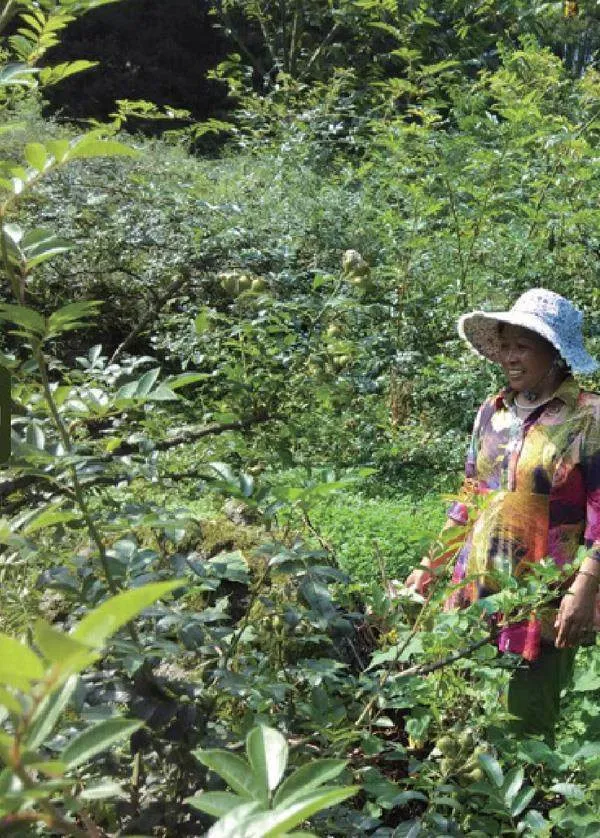

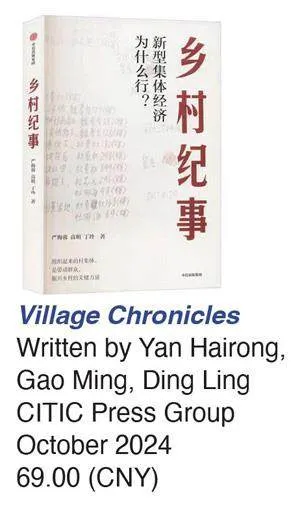
The author of this book has spent several years going deep into the countryside, visiting and researching across the country, and forming a basic understanding of the current new collective economic practice in China’s rural areas. By telling seven true rural stories, the author believes that the internal force of the revitalization and development of socialist rural areas in the new era is the reactivated village collectives.
Individual farmers are like small boats adrift in the vast ocean of the market — unable to safeguard themselves, let alone pool their resources to accomplish significant tasks. Today, the rationale and necessity for farmer cooperation are evident. However, decades of fragmentation among farmers, social stratification, and the influx of capital into rural areas have posed numerous challenges to such collaboration. Fortunately, Daba Village does not suffer from severe wealth disparity, nor does it face entrenched factional strife or conflict between different groups within the village. Moreover, the village has not been “invaded” by outside capital. In Daba Village, these common obstacles to farmer cooperation are absent. The primary challenge lies in overcoming the habits of individualism and disorganization developed over decades.
Despite undergoing decades of land distribution to individual households, the collective mindset among villagers and community groups has not entirely disappeared. Presently, there is no privately owned forestland in Daba Village. In the 1980s, over 1,000 acres of natural forest from the village’s collective mountain land were allocated to households. However, in their quest for firewood, villagers soon depleted the trees on this land. Recognizing the problem of ecological destruction, the Macao group within the village spontaneously held a meeting in 1988. They collectively decided to reclaim their forestland. Observing the regrowth of trees in Macao’s reclaimed forests, other village groups voluntarily ceased cutting firewood in their own areas. In the 1990s, the village committee stepped in and unified the protection efforts by reclaiming all forestlands from the various village groups. Village head Lu Zhengxue explained: “According to our local customs, we celebrate a Torch Festival on the sixth day of the sixth lunar month, which involves the entire village. During the festival, the village committee announced a ban on cutting firewood. A simple verbal announcement was enough for everyone to comply. Those who violated it faced fines.”
How did Daba Village become inspired to embark on a path of cooperation? In July 2012, the village Party Secretary, Chen Daxing, visited Huaxi Village, a model of prosperity and development in China. This visit left him deeply impressed. He recalled: “The greatest fortune was having a half-hour conversation with Wu Renbao, the former Party Secretary of Huaxi Village.” Upon his return, Secretary Chen convened the village’s “two committees” for over a week to share his experiences and discuss the village’s future development. He candidly admitted: “At first, no one believed there could be such a wealthy village in our country. They thought I was making it up. In 2012, Huaxi Village’s per capita dividend was 80,000 yuan, while ours was only about 1,980 yuan. I showed them the DVDs I bought there, and only then did they believe me. When I proposed cooperative development, everyone agreed in principle but remained cautious because we had no money. At that time, we were a second-class provincial poverty-stricken village and quite poor. It took over a week of meetings to finalize the decision to establish a cooperative.”
How could the path of cooperation" be successfully navigated? Secretary Chen Daxing identified three key lessons from Huaxi Village’s success: fostering team spirit, selecting the right industry, and committing fully to a chosen course of action. After repeated failures in the 1990s, Daba Village finally identified gold thorn pear cultivation as its focus. Gold thorn pears were originally wild plants, discovered accidentally by a forestry station chief in the mountains. The discovery was reported to the Guizhou Academy of Agricultural Sciences, which cultivated over 300 saplings. Secretary Chen Daxing was among the first to recognize the value of domesticated gold thorn pears. These pears are rich in ginsenosides, have minimal pest issues, high sugar content, and abundant yields.
In 2008, Secretary Chen initiated a trial plantation by transplanting over 300 saplings from the forestry station to the village, dedicating 20 acres of land behind the office to this purpose. Soon after, other village officials followed suit. They leased and rehabilitated land abandoned after a forest fire, enlisting more than a dozen Party members to lead in planting gold thorn pears. By 2011, the trees began bearing fruit, with market prices ranging from 25 to 30 yuan per jin (500 grams). Given an average yield of approximately 245 pounds per acre, the profitability was considerable. However, Secretary Chen did not rush to sell the fruits at high prices. Instead, he organized promotional events to alleviate villagers’ concerns about planting gold thorn pears. During these events, he invited senior officials and stakeholders to sample the fruit for free.
Following the promotional efforts, many traders came to Daba Village to purchase gold thorn pears, generating daily revenues of 30,000 to 40,000 yuan. This shift in market interest transformed villagers’ attitudes. They began actively requesting seedlings from the village committee. Recognizing the opportunity, the village leaders convened a meeting to prepare for the establishment of a cooperative.
When asked whether mobilizing villagers was challenging, Secretary Chen candidly admitted, “Yes, it was difficult.” Decades of market reforms had fragmented the villagers’ sense of community. Many believed that what was contracted to them was theirs permanently, adhering to the adage, “Not for gold, not for silver would I trade it.” In 2012, efforts to persuade villagers to join the cooperative began in earnest through two main strategies: First, regularly convening meetings, sharing news, and presenting successful examples from elsewhere. Second, village officials worked tirelessly, visiting villagers’ homes at night to explain the rationale and benefits of cooperation, often working until two or three in the morning. During these meetings, Secretary Chen emphasized a key point: Food security is no longer the issue. The issue now is development. Development requires unity — only by working together can we achieve scale and strength. If you rely solely on yourself, no matter how capable you are, you can’t accomplish much. It’s fine to make a living off the land, but to truly prosper, the land must be pooled together. Those suited for farming should focus on farming, while others can engage in different pursuits. With just a few acres, it’s impossible to grow wealthy; but with 100 acres under a unified effort, it becomes feasible.
In 2012, when the cooperative was formally registered, Daba Village consisted of three villager groups comprising 150 households, of which 120 joined the cooperative. Each household paid a membership fee of 10 yuan, primarily contributing land as equity. The land contributed to the cooperative wasn’t limited to the villagers’ originally contracted plots; it could include reclaimed wasteland or leased forestry land. Members of the cooperative were entitled to dividends but did not receive land transfer fees. The transparent and open process of establishing the cooperative laid a solid foundation for the collective economy. To finalize the land-sharing scheme, the village held week-long discussions. To ensure fairness in land measurement, the village committee selected a respected elder from each of the three villager groups to oversee the process. By the end of 2012, all cooperative land contributions had been measured.
Gold thorn pear trees do not bear fruit during the first three years, yet the cooperative needed funds for saplings, fertilizers, and labor. The village committee took on the responsibility of addressing these initial financial challenges. In the first year, the committee secured over one million yuan in project funding from the forestry bureau. Over the following two years, the committee obtained 800,000 yuan in loans from a credit cooperative. In the third year, when the trees began bearing fruit, the market took a downturn. By 2015, as neighboring areas also began cultivating gold thorn pears, the price plummeted to just 2–3 yuan per jin. During a meeting with cooperative members, some suggested dissolving the cooperative and redistributing the land so each household could fend for itself. Others proposed cutting down the gold thorn pear trees and switching to other crops. Reflecting on the situation, Secretary Chen Daxing recalled saying: “First, we’ve worked so hard to unite as a group; if we dissolve now, it will render the past few years’ efforts meaningless. Second, we can explore deep processing to significantly increase the value of our products compared to raw agricultural goods.” The volatile market conditions pushed Daba Village to adopt an integrated three-industry model. Under the leadership of the village committee, the cooperative established a fruit wine processing plant in 2015. That year, the plant produced over 400 tons of gold thorn pear wine, and villagers received dividends. By 2017, with support from higher-level government agencies, the village secured funding to construct a large-scale winery in Daba Village. The project was expected to involve an investment of 160 million yuan, with over 60 million yuan already invested by the end of 2017.
Yan Hairong
Yan Hairong is a professor at the Institute for Advanced Study in Humanities and Social Sciences and an adjunct professor in the Department of Sociology at Tsinghua University. His research interests include rural development, collective economy/cooperatives, and agricultural transformation, as well as China-Africa linkages and the Belt and Road Initiative.
Gao Ming
Gao Ming holds a Ph.D. in Political Science and is currently a lecturer in the Department of Cultural Studies, School of Liberal Arts, Shanghai University. His main research interest is the analysis of new industrial and peasant culture.
Ding Ling
Ding Ling holds a Ph.D. in anthropology and is currently a lecturer at the School of Economics and Management at Anhui Normal University. His main research interests are collective economy and agricultural policy change.