Wool and Wounds
2024-12-28 00:00:00YeYuan
漢語世界(The World of Chinese) 2024年4期
關鍵詞:生活
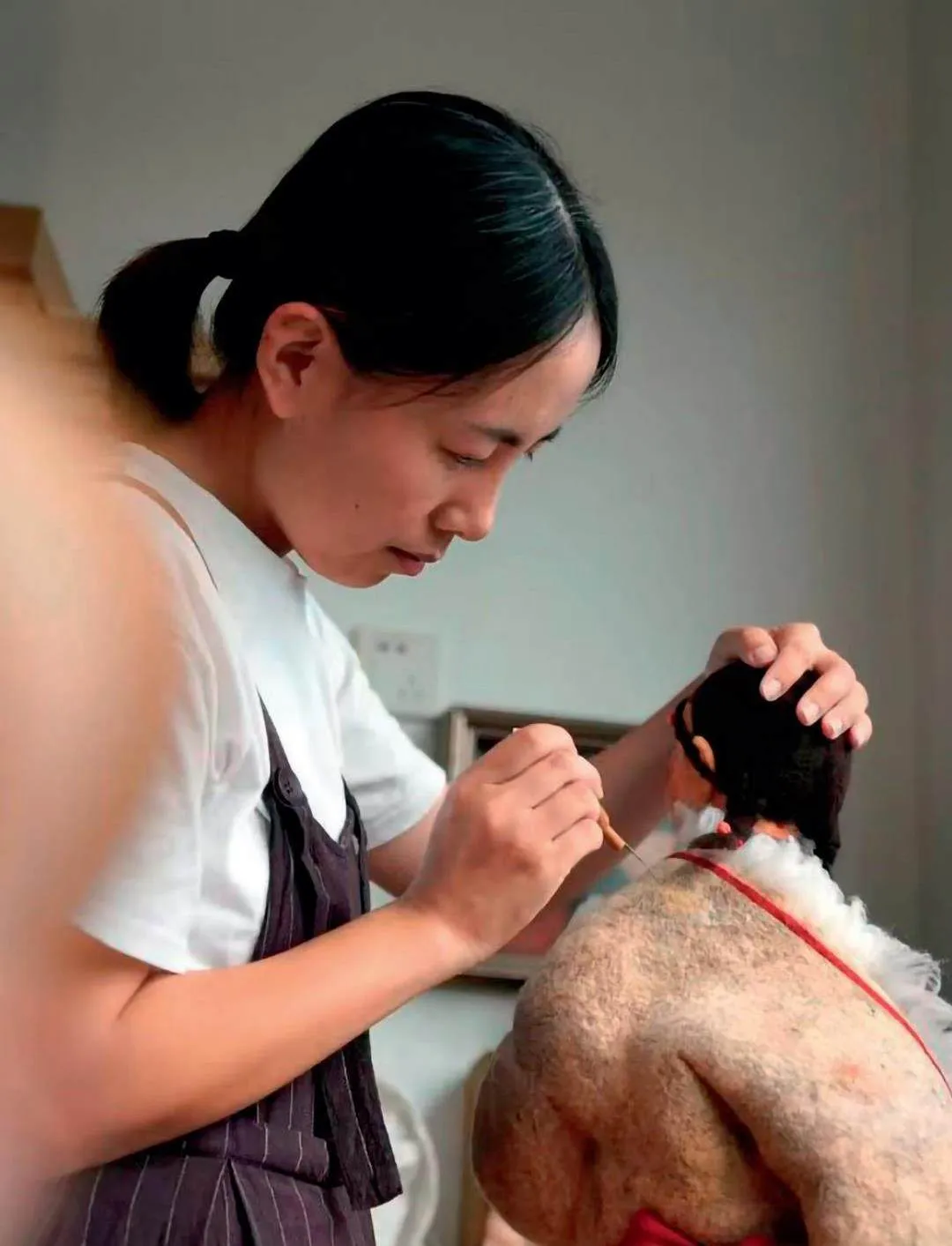

Through wool and raw honesty, needle felt artist Zhang Xian captures the unseen struggles of new mothers while reclaiming her own identity
羊毛氈藝術家張顯戳針下的孕產生活和成為母親的復雜體驗
Images courtesy of Zhang Xian
In 2018, as Zhang Xian lay in a delivery room alongside seven other women in labor, she noticed a mother-to-be trembling in pain, mirroring her own agony. The woman’s screams filled the room, her body shaking from the contractions. Then, in a sudden, haunting moment, the blanket covering the woman slipped, revealing that she was missing a leg.
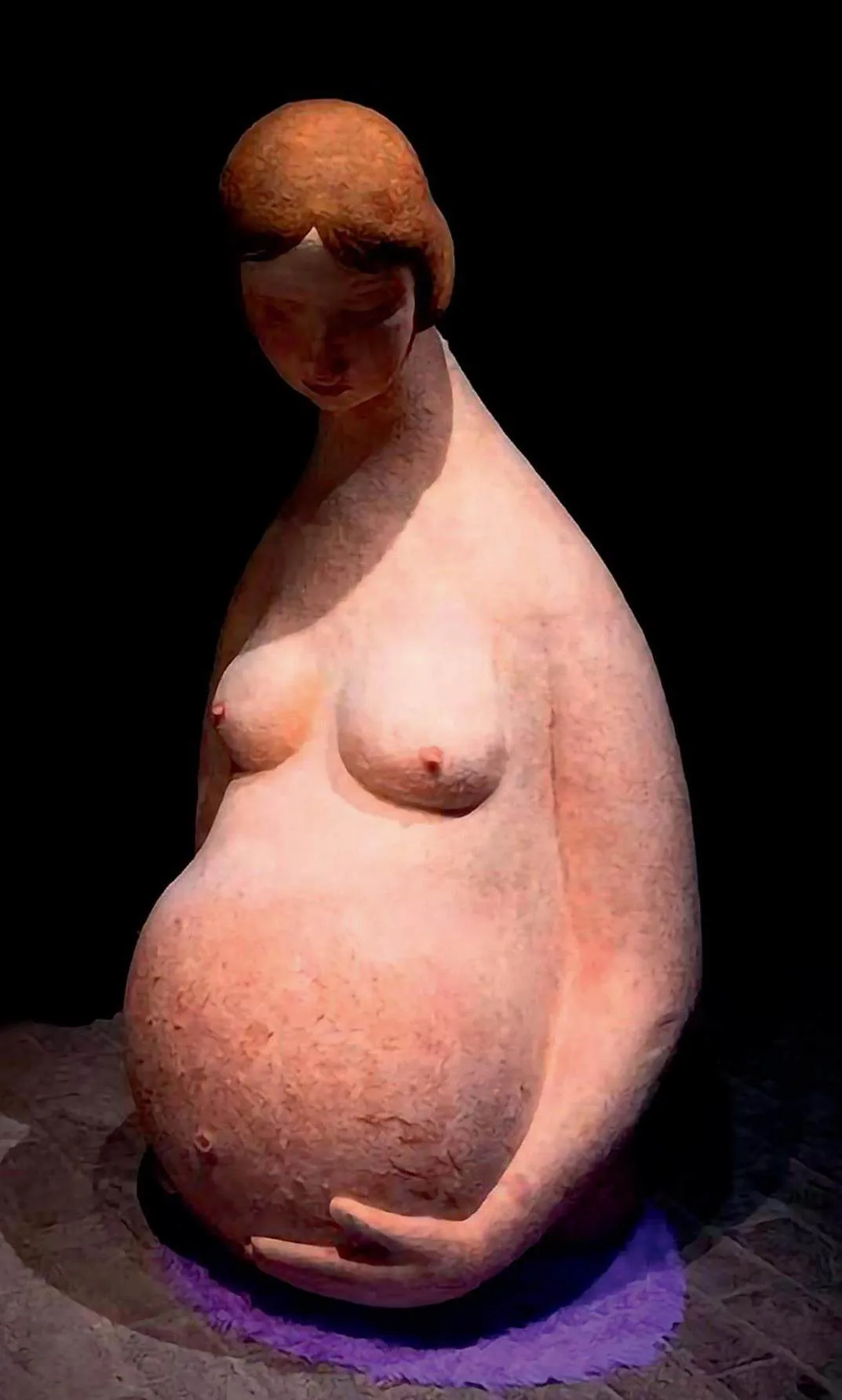
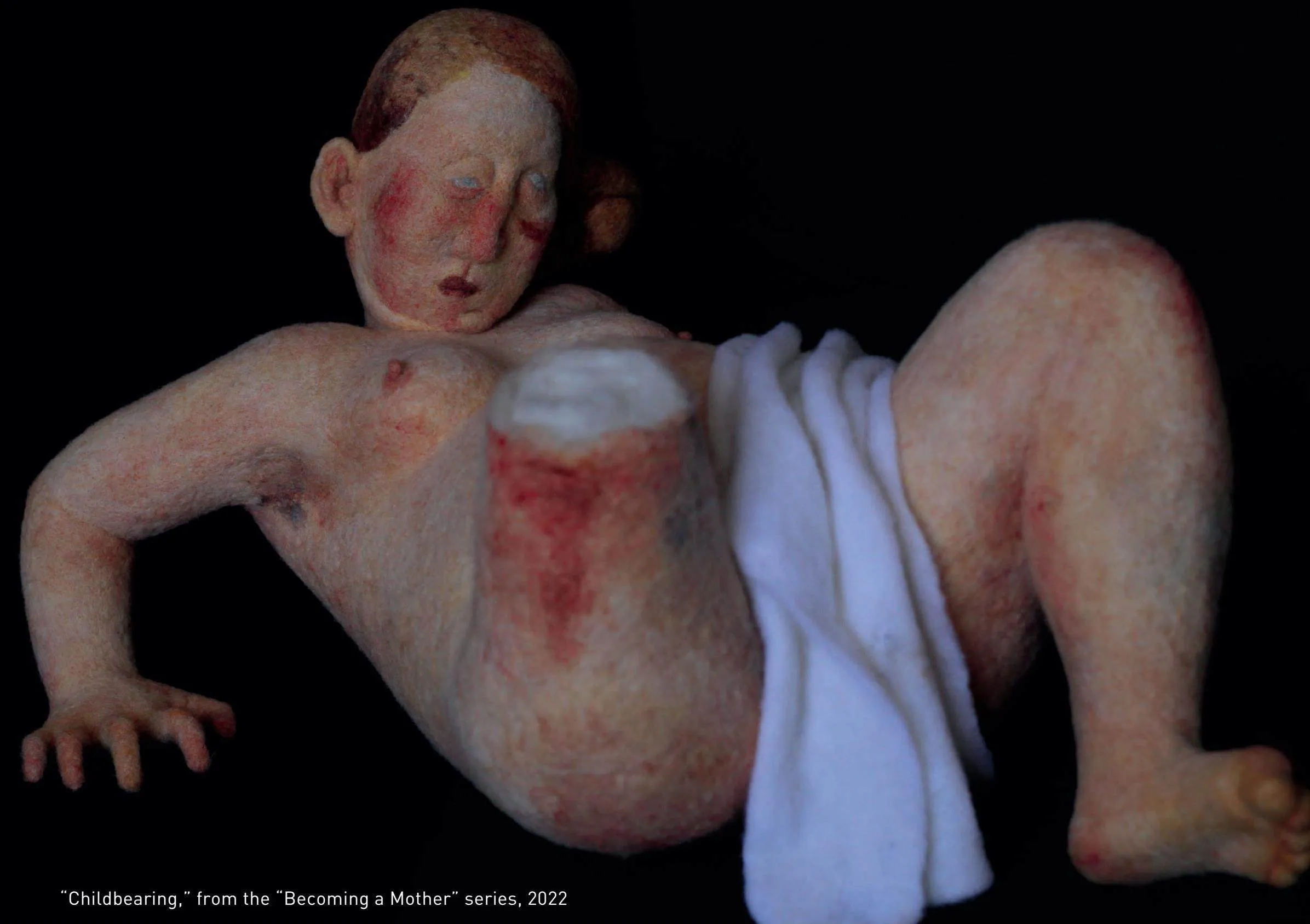
In the years that followed, Zhang, a needle felt artist from northern China’s Hebei province, often thought about the disabled woman as she struggled with postpartum depression. The haunting imagery inspired her piece titled “Childbearing”—a wool figure of a woman with clenched fists, her face twisted in agony, and her body barely held up by the ground as her mid-length hair rolled up in swirling waves, mirroring the convulsive nature of childbirth.
This poignant piece is one of the two dozen works by Zhang currently on display in Luoyang, central China’s Henan province, as part of her solo exhibition “Focus on Myself,” running from October 2 to December 30. Many of these works explore the multifaceted experience and emotions associated with childbearing and motherhood, and reflect her struggles with her identity over the past two years.
The exhibition has been well-received, especially among young mothers. A video featuring her work on the Chinese lifestyle platform Xiaohongshu has received over 45,000 likes, and many mothers have expressed in the comments how they see themselves in Zhang’s artwork. Some have even reached out to her directly to share their personal experiences.
“Many mothers grapple with varying degrees of depression, and it’s difficult to get out of it,” the artist, now 35, tells TWOC. “I am fortunate to have found a way to process and convey these emotions.”
According to the World Health Organization, about one in five women experience a mental health condition during pregnancy or in the first year postpartum. In China, the 2022 National Blue Book on Depression, a study done by several depression research and medical institutions and state media People’s Daily, shows that over 63 percent of women have experienced postpartum depression.
Zhang is no exception, having experienced some of her darkest moments postpartum. Despite her initial excitement about the arrival of a new life, childbirth proved to be far more arduous and painful than she had anticipated. The physical toll was unrelenting, compounded by how the newborn upended her life and relationships. For a long time, she walked as if her bones could fracture. It took a whole year for her body to adjust.
In addition to the physical pain, Zhang felt incredibly alone, even when her family was around. “No one can help you in those most difficult times because it’s you who’s breastfeeding, you who gave birth, and you who’s going through sleepless nights,” says Zhang.
There was nothing to distract her from the pain either, especially as her career ground to a halt. She found out she was pregnant after the Beijing gaming company where she worked as a UI designer shut down. After giving birth, Zhang struggled to return to an increasingly competitive workplace, and pandemic lockdowns made finding job opportunities even harder. She became a stay-at-home mom by default.
“Humans are social animals, and you need to receive some recognition from your family or society. But being a stay-at-home mother doesn’t seem to bring you anything,” says Zhang.
The stigma of being a stay-at-home mother and the fear of being “worthless” at home, as well as the enduring physical pain and plummeting hormone levels, overwhelmed Zhang. She often found herself crying while staring into space. However, she didn’t realize she had postpartum depression until her husband and mother-in-law caught her talking to herself, much like the protagonist in the popular 2019 film Kim Ji-young, Born 1982, which depicts a Korean woman’s struggles as a stay-at-home mom. But unlike Kim Ji-young, Zhang didn’t seek professional help from a therapist or discuss her feelings with her family, given the traditional Chinese cultural expectations to only report good news rather than personal struggles.
It was during these trying times that she began to experiment with needle felt handicrafts. “Since I was struggling to find employment, I started thinking about pursuing my passion for crafting to see if I could make a living from it,” says Zhang, who studied painting from a young age. She set to work at a small table cluttered with tools and materials in the living room, mostly at night when her son was asleep.
The first few years were hard. She started by making small animal ornaments. While selling her work online brought in some income, it wasn’t much, as needle felt figures typically sold for no more than 30 yuan each on e-commerce platforms like Taobao. “Every morning when I woke up, I’d tell myself, ‘Hang in there a little longer.’ But every night before bed, I’d think, ‘I just want to give up,’” she recalls.
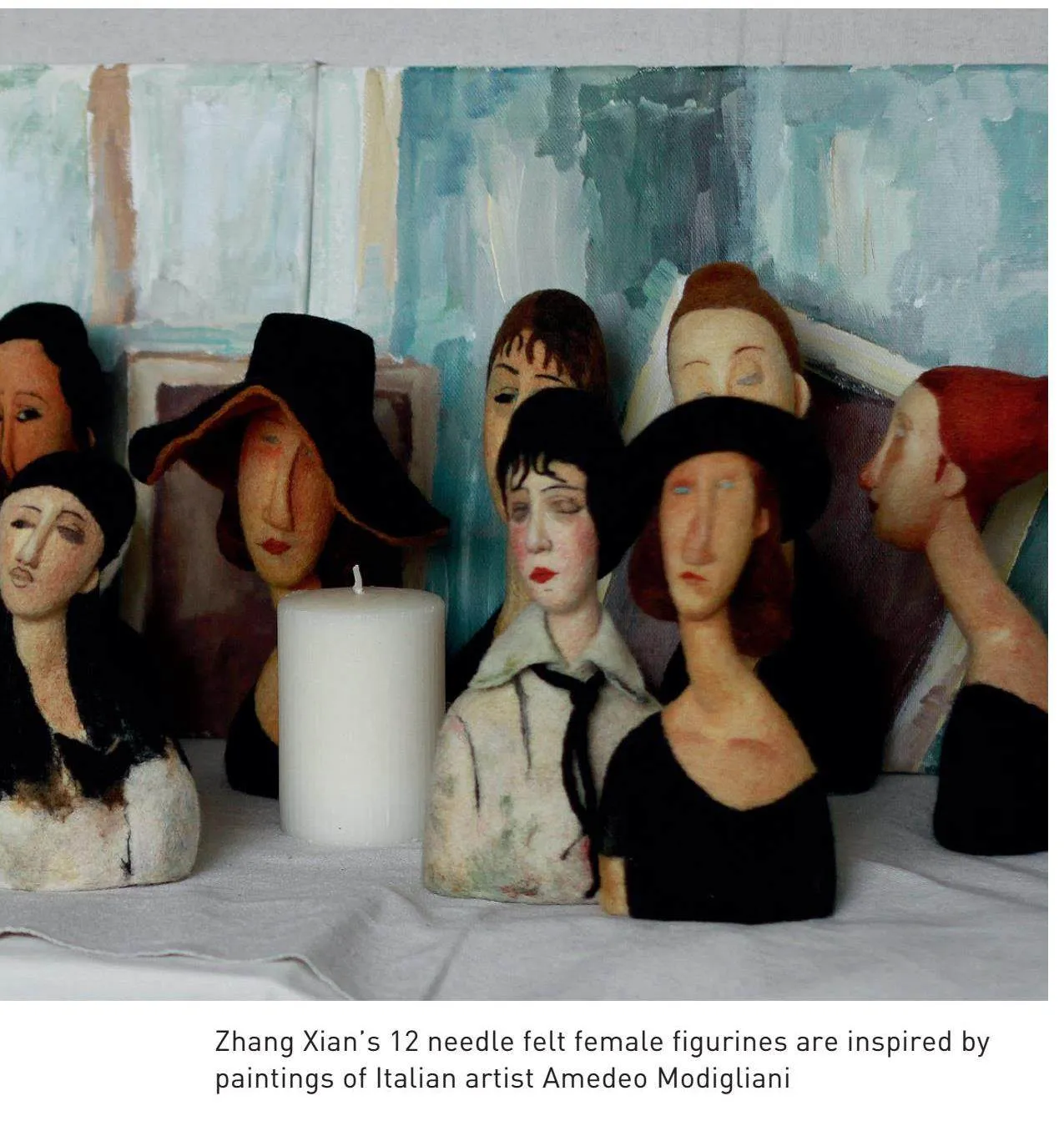
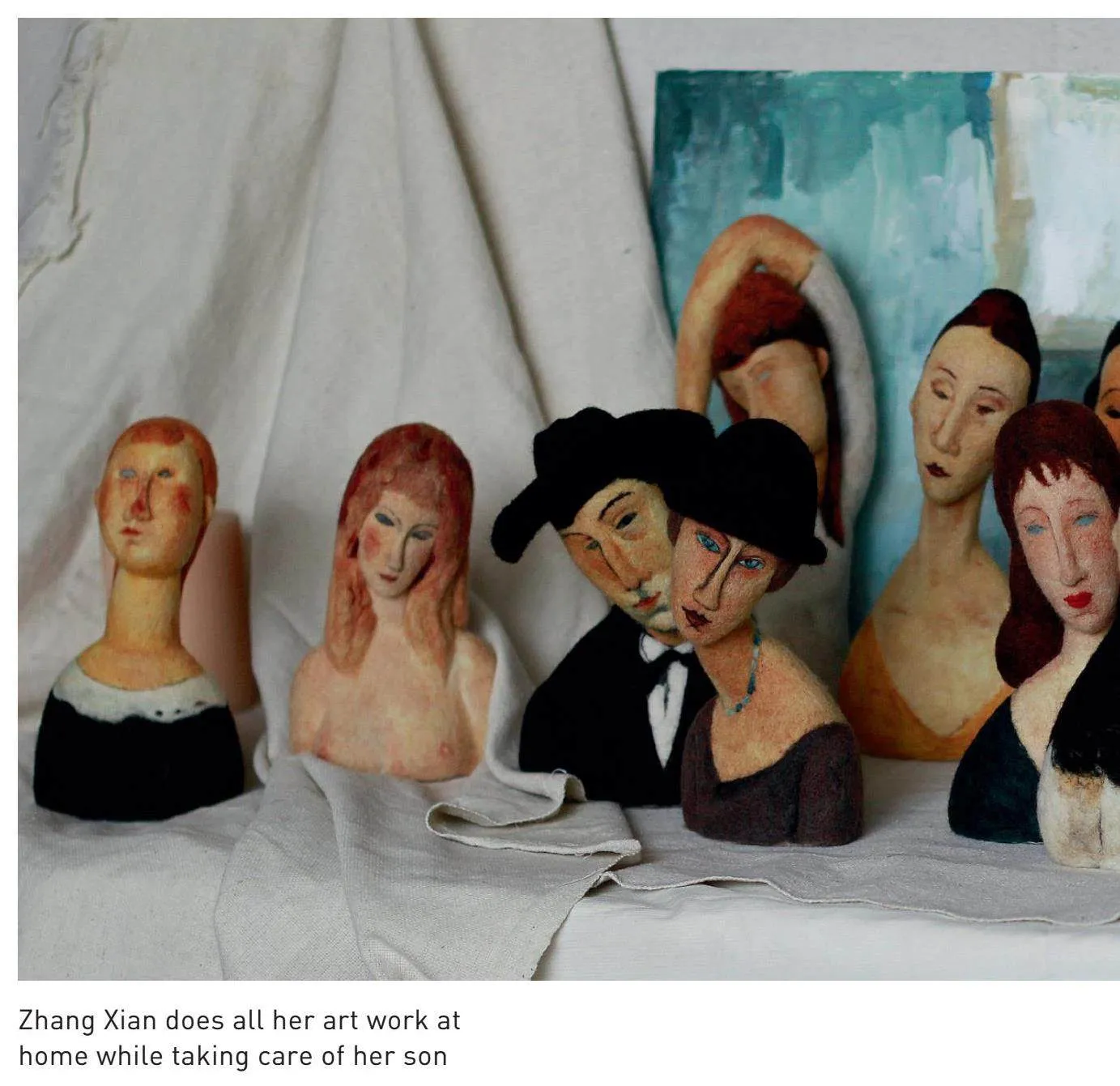
Zhang’s persistence paid off. In 2020, her collection of over a dozen needle felt female figures based on paintings by the Italian artist Amedeo Modigliani (also on display at the Luoyang exhibition) sold for 800 to 900 yuan per piece.
As her felting skills improved, she felt an urge to express the pain that haunted her. Her very first installment, titled “Lactation,” is a wool statue depicting a woman with multiple breasts, inspired by her own experience with breastfeeding.
She recalls many sleepless nights when she would secretly cry while feeding, a process marked by cracked and bleeding nipples that she says made her “feel like a cow,” all while her husband was sound asleep.
While breastfeeding is not an unfamiliar subject in art, it is often depicted in a celebratory light, showcasing the beauty of motherhood, as seen in paintings of breastfeeding women. But, as Zhang says, “breastfeeding is very painful,” and many artworks overlook the discomfort, pain, and isolation that many women endure during the process.
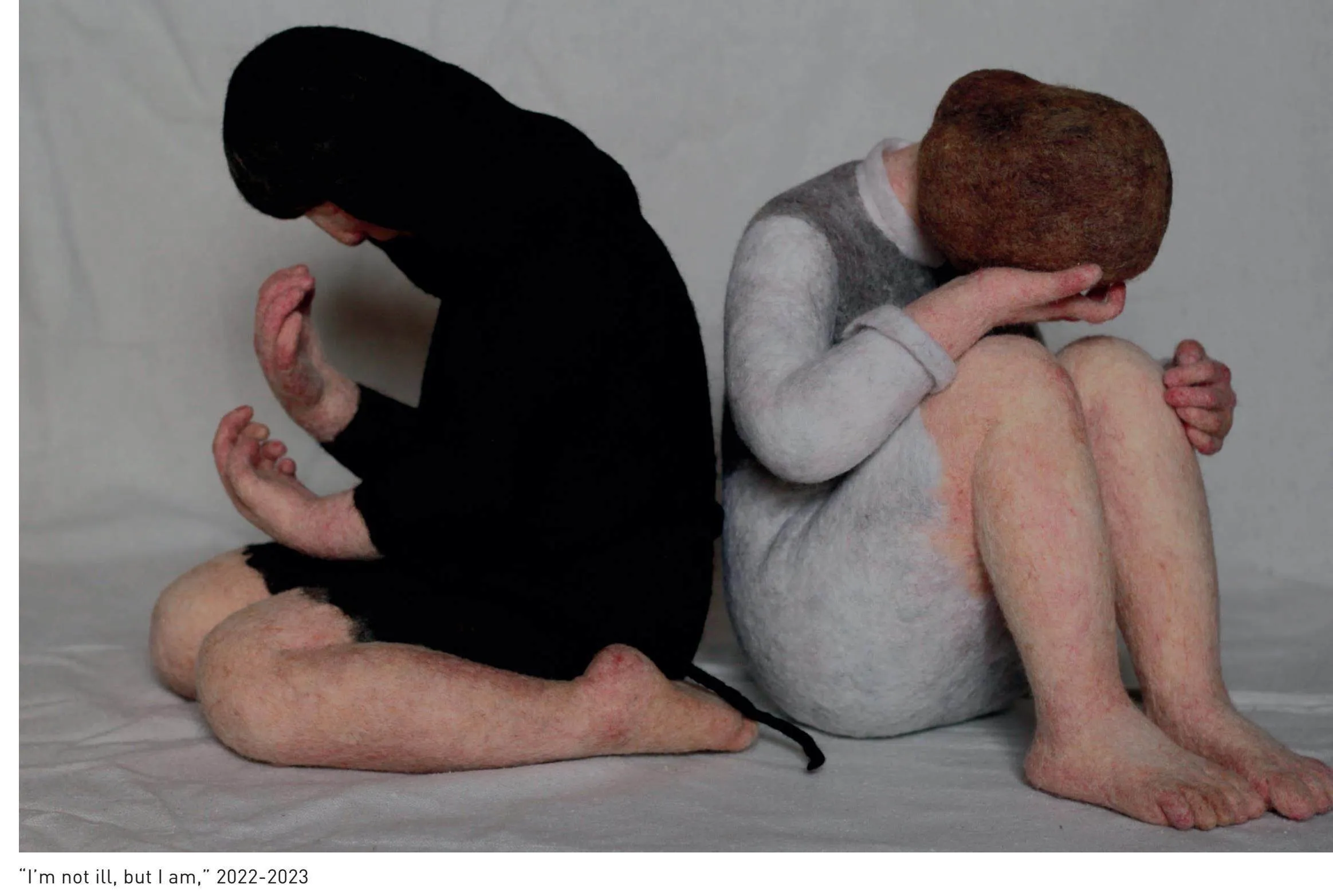
She continues to create with wool felt. Her works range from a woman unbalanced by her large belly to a struggling, depressed mother in her “Becoming a Mother” series. Through the rustic and warm texture of wool felt, she shapes figures that evoke the most intimate sensations of motherhood.
Art has healed her in the process. “My work reflected my mental and physical state during that difficult time. Placing the pieces before me felt liberating, as it allowed me to distance myself and examine that phase of my life from a different perspective,” says Zhang.
Zhang no longer feels the crushing loneliness she once did, as she now shares her experiences with the world through art. Some of her old friends, now mothers themselves, have also contacted her after seeing her work either online or at the exhibition, to share their experiences. “It’s like I’ve turned into a therapist, listening to them cry as they pour their hearts out,” Zhang says.
But not everyone appreciates Zhang’s efforts. Some Chinese social media users have criticized the exhibition for discouraging women from having children. Even Zhang’s husband, a landscape designer, made a similar comment when he saw her “Becoming a Mother” series for the first time.
“I understand that [the artworks] might be considered ugly from a conventional standpoint. But I am making an artistic expression here, and I think expression is far more important than being pretty or not,” she says.
Reflecting on her postpartum depression, Zhang says she realized that many mothers, including herself, were not in a safe and supportive environment during those difficult times. Many Chinese mothers tend to shy away from sharing the most private feelings about their bodies, keeping the pain to themselves. She recalls that she couldn’t even confide in her mother or mother-in-law, as they would see pain as a natural part of motherhood. “They believed breastfeeding is something that must be done, just like eating and sleeping. It’s painful, but everyone goes through it—it’s not just you,” says Zhang.
According to a report released by the Public Health Commission of Shenzhen in southern China, many people with outdated views in China dismiss postpartum depression as “being melodramatic.” Many mothers don’t even realize they have postpartum depression or delay seeking help due to the stigma associated with it. As a result, fewer than one-third of those affected receive proper treatment.
Zhang recalls being surprised at the opening ceremony of her Luoyang exhibition when she found that a 19-year-old young man had come on his own to see her works, since her audiences were mostly women or mothers. “He told me that his mother killed herself due to postpartum depression, and he felt that my subject was good because he was trying to understand his mother,” says Zhang.
Zhang now believes in the power of self-expression and hopes that her works can make more women feel seen in modern society. Some of her male friends have called her a feminist, but she herself hasn’t given the label much thought. “All of my work is essentially a form of self-expression. It’s just this self-expression is rooted in my identity as a woman and as a mother,” says Zhang. Compared to being an artist, she sees herself more as an artisan, someone who plays with wool felt while taking care of her son, now turning 6.
She is still working with wool felt, finding not only serenity and strength, but also financial independence in the process. The additional income she now brings in has allowed her to regain her footing in an unbalanced family power dynamic, where she previously bore most of the child-rearing and household responsibilities, earning herself more alone time for art creation.
However, Zhang is hardly free from the societal constraints and expectations placed on women. Communication with her husband remains a challenge, as she feels that Chinese fathers do not progress as much as their female counterparts, maintaining that, while women are adaptive and learn quickly, men tend to experience a developmental lag.
“Sometimes, I find my husband’s emotions less stable than my son’s,” she jokes, “or perhaps he is simply more immature.”
“Childbearing,” from the “Becoming a Mother” series, 2022
Zhang Xian does all her art work at home while taking care of her son
Zhang Xian’s 12 needle felt female figurines are inspired by paintings of Italian artist Amedeo Modigliani
“Change” from the “Becoming a Mother” series, 2022
“I’m not ill, but I am,” 2022-2023
猜你喜歡
風流一代·經典文摘(2018年1期)2018-02-22 09:00:43
黨的生活(黑龍江)(2017年12期)2017-12-23 17:01:20
求學·文科版(2017年10期)2017-12-21 11:55:48
求學·理科版(2017年10期)2017-12-19 13:42:05
民生周刊(2017年19期)2017-10-25 07:16:27
少年博覽·小學高年級(2016年12期)2017-01-16 12:48:35
特別文摘(2016年19期)2016-10-24 18:38:15
爆笑show(2016年3期)2016-06-17 18:33:39
37°女人(2016年5期)2016-05-06 19:44:06
爆笑show(2016年1期)2016-03-04 18:30:28