From China to Peru
2024-12-09 00:00:00CHINATODAY
CHINA TODAY 2024年12期
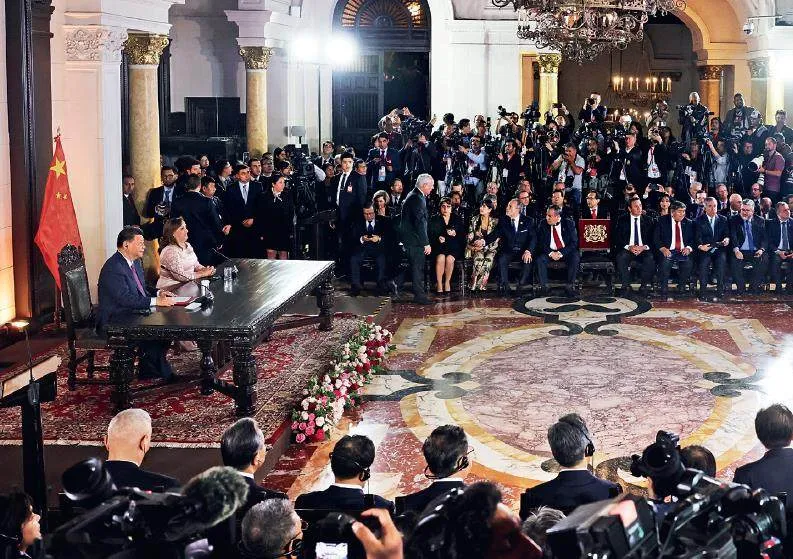
At the APEC Economic Leaders’ Meeting in Peru,President Xi Jinping promises open cooperationand development, providing assurance in anera of uncertainties, trade protectionism, andgeopolitical tension.
CHINA’S development will bring more newopportunities for the growth of the Asia-Pacificand the rest of the world as it deepensreform and opening up, develops new qualityproductive forces, and advances its modernization.And with Donald Trump going to take chargeof the White House in January as the 47th American president, China is ready to engage in dialogue, expandcooperation, and manage differences with theUnited States to sustain the hard-won momentumtoward stability in China-U.S. relations.
This was the much-awaited message fromPresident Xi Jinping in Lima, Peru, at the 31st Asia-Pacific Economic Cooperation (APEC) EconomicLeaders’ Meeting last month.
An Asia-Pacific Miracle
“Over the decades, APEC has been instrumentalin leading Asia and the Pacific to great success indevelopment, prosperity, and connectivity, makingthe region the most dynamic economy and primaryengine of global economic growth,” Xi said at theAPEC meeting on November 16.
Founded in 1989, APEC is a major engine ofglobal economic growth, with its 21 members accountingfor approximately 40 percent of the world’spopulation, nearly half of global trade, and around60 percent of global GDP.
Xi had acknowledged APEC’s role at the 30thAPEC summit in San Francisco, U.S., saying, “APEChas always stood at the global forefront of opennessand development. It has played a robust rolein promoting Asia-Pacific trade and investmentliberalization and facilitation, economic growth andtechnological progress, and the flow of goods andpeople. It has helped create the ‘Asia-Pacific miracle’that has staggered the world.”
China joined APEC in 1991 and today, is thelargest trading partner of 13 APEC economies,contributing 64.2 percent to economic growth in theAsia-Pacific, 37.6 percent of the region’s goods tradegrowth, and 44.6 percent of its service trade growth.
In addition, according to the General Administrationof Customs, China’s trade with other APECeconomies reached a record high of RMB 21.27trillion in the first 10 months of 2024, up 2.7 percentcompared with the same period last year. It accountedfor 59.1 percent of China’s total trade.
Xi used the sweet potato as a metaphor to describeChina’s relationship with the Asia-Pacific:“Though the vines of the sweet potato spread in alldirections, they all grow out of their roots. Similarly,no matter how far it develops, China will remainrooted in the Asia-Pacific, contribute to the Asia-Pacific, and benefit the Asia-Pacific.”
Kasemsit Pathomsak, a member of the APECBusiness Advisory Council, told Xinhua that China’sdevelopment creates opportunities for the world:
“It has actively promoted the building of an openglobal economy and strengthened economic andtrade cooperation with other countries. It will playa key role in further advancing regional economicintegration.”
Open Cooperation
Xi has repeatedly pledged China’s commitmentto APEC’s development. “The Asia-Pacific is a bigfamily, and China is a member of this family,” he saidat the APEC CEO Summit in Bali, Indonesia, in 2013.“China’s development is inseparable from the Asia-Pacific, and the prosperity of the Asia-Pacific is alsoinseparable from China. China’s continued healthyeconomic development will bring greater opportunitiesfor the growth of the Asia-Pacific region.”
At this year’s APEC CEO Summit on November 16,he repeated that China’s development is inseparablefrom the Asia-Pacific and will benefit the regionand called for solidarity and cooperation to tackleglobal challenges. “As long as we uphold the spirit ofopenness and connectivity, the Pacific can become apathway to prosperity and growth,” he said.
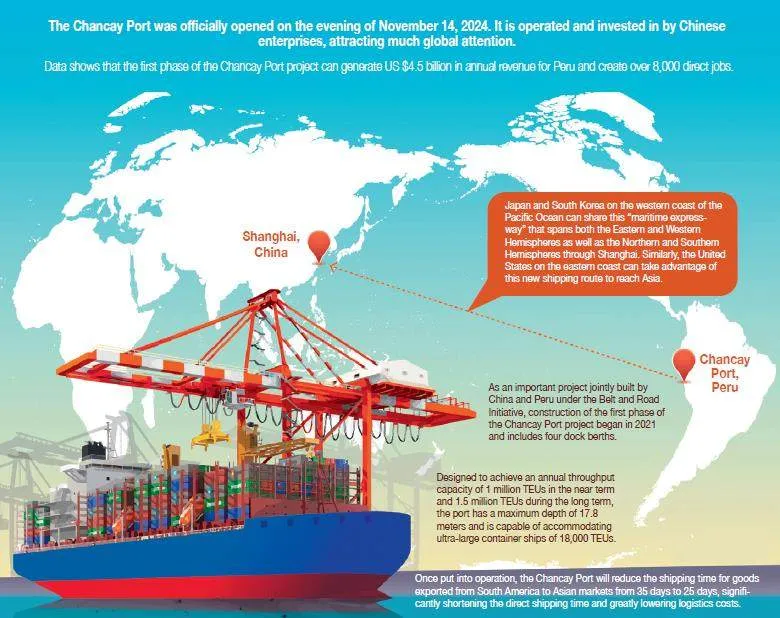
While pursuing high-quality development, Chinahas shared its development opportunities andsought mutually beneficial cooperation with APECmembers, with tangible results. One example is theChancay Port, located about 80 kilometers fromLima on its Pacific coast. The deepwater port is aflagship project under the Belt and Road Initiative.Constructed by Chinese enterprise COSCO Shipping,it is the first smart and green port in South America.
The first phase of the port started in 2021. Whencompleted, it is expected to almost halve shipping time from Peru to China from 40 to 23 days, cuttinglogistics costs by at least 20 percent. It’s also estimatedto generate US $4.5 billion in yearly revenuefor Peru and create over 8,000 direct jobs.
When Peru’s President Dina Boluarte visitedChina in June, Xi discussed timely completion of theport with her, saying establishing it as a new landsearoute between China and Latin America willmake the “Chancay to Shanghai route a true path ofprosperity, promoting the common development ofChina and Peru.”
The port was inaugurated by Xi and Boluarteonline on November 14, with Xi reiterating that itwill consolidate Peru’s position as a gateway connectingland and sea, Asia and Latin America. Chinais ready to work with Peru to build a new land-seacorridor between China and Latin America with theChancay Port as the starting point, he said.
Eduardo Salhuana, President of Peru’s Congress,told Xinhua that the Chancay Port is a real caseof how China promotes the development of othercountries while developing itself. “The Chinesefundedport will shorten direct shipping time fromPeru to Asia. This will further boost trade betweenPeru, Chile, Argentina, Brazil, and other Latin Americancountries with China and other Asian countries,creating tremendous market opportunities forLatin America’s agriculture, mining, and manufacturingindustries, and energizing the region’s economicvitality,” he said.
Salhuana added that the project is not justabout trade. “China’s investment has also broughtadvanced technologies. The modern, green, lowcarbonsmart port will operate in an intelligent andefficient manner, creating more job opportunitiesfor locals and bringing tangible benefits to the Peruvianpeople,” he said. “Peru will embrace a betterphase of development.”
China’s U.S. Policy Unchanged
Perhaps the most globally anticipated momentat this year’s APEC summit was the meeting betweenXi and outgoing U.S President Joe Biden, whowill hand over the reins of power to President-electDonald Trump in January 2025. It was the first timethey met in person following last year’s APEC summitin San Francisco. China-U.S. relations, describedas the most important bilateral relationship in the world, are critical to global development, and thetwo leaders’ talks gave an indication of where theyare headed.
Xi said China's goal of a stable, healthy andsustainable China-U.S. relationship remains unchanged,as well as its commitment to mutualrespect, peaceful coexistence and win-win cooperationas principles for handling the relations. Itsposition of safeguarding its sovereignty, security anddevelopment interests remains unchanged; so doesits desire to carry forward the traditional friendshipbetween the Chinese and American peoples. Chinais ready to engage in dialogue, expand cooperation,and manage differences with the United States tosustain the hard-won momentum toward stabilityin their relations.
Xi also paid a tribute to Biden, saying “China-U.S.relations over the past four years have gone throughups and downs, but under the joint stewardship ofthe two presidents, the two sides have also been engagedin fruitful dialogue and cooperation, and theirrelationship has remained stable on the whole.” Hethen stressed the importance of the U.S. and Chinatreating each other as equals: “As two major countries,neither China nor the United States shouldseek to remodel the other according to one's ownwill, suppress the other from the so-called ‘positionof strength,’ or deprive the other of the legitimateright to development so as to maintain its leadingstatus.”
Red Lines Should Not Be Crossed
It is important not to challenge red lines andparamount principles. Contradictions and differencesbetween two major countries like China and theUnited States are unavoidable but the core interestsof each other should not be undermined, or conflictor confrontation chosen. The one-China principleand the three China-U.S. joint communiques arethe political foundation of China-U.S. relations andthey must be observed, Xi said. “The Taiwan question,democracy and human rights, China's path andsystem, and China's development right are four redlines for China. They must not be challenged. Theseare the most important guardrails and safety netsfor China-U.S. relations.”
He also emphasized that “neither decouplingnor supply-chain disruption is the solution; only mutually beneficial cooperation can lead to commondevelopment,” adding that a major countryshould not pursue “small yard, high fences;” onlyopenness and sharing can advance the well-being ofhumanity. For that, more dialogue and cooperationis needed. With common interests between Chinaand the United States expanding, their cooperationis crucial not only for the economy, trade, agriculture,counternarcotics, law enforcement and publichealth, but also for handling global challenges ofclimate change and artificial intelligence as well asinternational issues. The two sides should expandthe list of cooperation and make a bigger pie ofcooperation for win-win results.
Xi also met other leaders of the region, stressingChina’s commitment to free trade and opposingprotectionism. For example, he told Japanese PMShigeru Ishiba, “As China’s and Japan’s economicinterests and production and supply chains aredeeply integrated, both sides should adhere tomutual benefit and win-win cooperation, safeguardthe global free trade system as well as stable andsmooth production and supply chains.”
As APEC members work toward the blueprintdrawn in Malaysia in 2020, the Putrajaya Vision 2040to build an open, dynamic, resilient, and peacefulAsia-Pacific community, China will play its uniquerole by promoting mutually beneficial cooperationand rejecting trade protectionism, contributing toan Asia-Pacific community with a shared future.