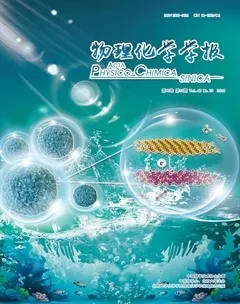
二維S型異質結光催化劑
2024-10-14 00:00:00閆俊濤韋良
物理化學學報 2024年10期
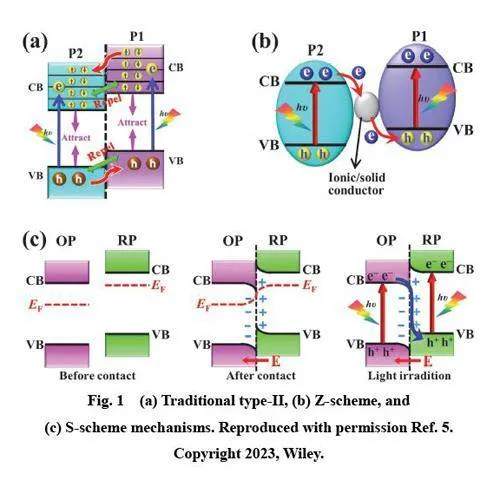
The application of photocatalytic technology in H2production, CO2 reduction, H2O2 production, and pollutantdegradation provides a promising approach to the alleviation ofenergy shortage and environmental issues 1–3. However,hindered by the easy recombination of electron-hole pairs,single-component photocatalysts usually exhibit inferiorperformance. Constructing heterojunction photocatalysts is avalid method which can improve charge separation and attainhigh catalytic efficiencies 4. In the initial works, researchersadopted a type-II mechanism to expound the migration routes ofcharge carriers in heterojunction composites. As shown in Fig.1a 5, photogenerated electrons in the conduction band (CB) ofphotocatalyst 1 (P1) migrate to the CB of photocatalyst 2 (P2).Meanwhile, holes migrate from the valence band (VB) of P2 tothe VB of P1. However, this traditional mechanism is faced withenormous challenges: (1) energy loss in the charge transferprocess; (2) weakened redox ability of the charge carriers; (3)impeded charge transfer dynamics by the electrostatic repulsionbetween holes (or electrons) in P1 and those in P2. Alternatively,various Z-scheme heterojunctions were developed, includingtraditional Z-scheme and all-solid-state Z-schemeheterojunctions. In traditional Z-scheme heterojunctions, redoxion pairs act as the mediators for charge carriers, whereas, in allsolid-state Z-scheme photocatalysts, metals, typically in theform of nanoparticles, are employed as the conductor. In Zschemephotocatalytic systems, the electrons in the CB of P2 arecaptured by the conductor and further delivered to the VB of P1(Fig. 1b). Nevertheless, this charge transfer route is problematic 6.First, the conductor tends to capture the photogeneratedelectrons in P1, because these electrons have stronger reductioncapability, and the captured electrons tend to migrate to the VBof P2 because the holes in P2 have higher oxidation capability"than those in P1. Second, for traditional Z-schemephotocatalysts, the charge transfer between photocatalysts andionic charge conductors is extremely difficult because of thescarcity of free electrons in water, which is further hampered dueto random motion-induced fluctuation in the interparticledistances. Third, for all-solid-state Z-scheme photocatalysts, it isa challenging task to accurately emplace a conductor between P1and P2. In addition, the interfacial Schottky barrier establishedbetween the semiconductor photocatalysts and metal conductorswill hamper the assumed electron transfer process.
To address the issues with single-component photocatalysts aswell as type-II and Z-scheme heterojunctions, Yu’s groupinitiated a novel conception—S-scheme heterojunction 7, whichconsists of a reduction photocatalyst (RP) and an oxidation"photocatalyst (OP) (Fig. 1c). Upon formation of theheterojunction, electrons in the RP move to the OP, which has alower Fermi level (EF) than the RP. As a result, the EF and bandedges of RP present downward and upward bending,respectively, because of electron depletion. Meanwhile, the EFand band edges of OP exhibit upward and downward bending,respectively, due to electron accumulation. Therefore, an internalelectric field (IEF) is established. After photoexcitation, the CBelectrons of the OP migrate to the VB of the RP under the jointimpacts of IEF, band bending, and electrostatic attraction,consequently preserving charge carriers with high reduction andoxidation capability.
Thereafter, the S-scheme mechanism attracts extensiveattention. A myriad of S-scheme photocatalysts consisting ofdiverse materials are prepared and applied in variousphotocatalytic reactions 8. Particularly, two-dimensional (2D)photocatalytic materials are widely employed as the componentsof S-scheme heterojunction composites 9,10. Recently, Zhu et al.published a review on 2D S-scheme photocatalysts 5. To beginwith, the problems with the type-II and Z-schemeheterojunctions were discussed. Notably, an original viewpointwas proposed to substantiate the impeded charge migrationdynamics in type-II heterojunction. Specifically, the finitenumber of molecular orbitals in the CB of P2 are filled ofphotogenerated electrons under light irradiation. Therefore,there is no available space to accommodate the electrons fromP1. Interestingly, a vivid analogy was used to describe thissituation: an occupied hotel room cannot accommodate newguests until the original guests have checked out.
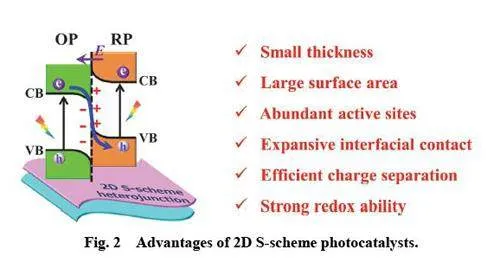
Next, the advantages of 2D S-scheme photocatalysts wereanalyzed (Fig. 2). The structure of 2D materials features smallthickness and large surface area. The small thickness enablescharge carrier migration within a short distance from the interiorof the materials to the surface, whereas the large surface areaendows the material with abundant active sites available toadsorb and convert reactant molecules. Meanwhile, an S-schemeheterojunction has the merits of high charge separationefficiency and redox capability. Thus, employing 2D materialsto fabricate S-scheme photocatalysts can integrate theadvantages. Moreover, the hybridization of a 2D architecturewith another structure results in expansive interfacial contact,which is indispensable for efficient interfacial charge transfer.Therefore, a synergetic enhancement of photocatalytic"performance can be achieved in 2D S-scheme photocatalysts.
After an overview of the methods for preparing andcharacterizing 2D S-scheme photocatalysts, the latestadvancements were systematically summarized, with thephotocatalysts categorized according to the constituentmaterials, including metal oxides (e.g., TiO2, WO3, and Fe2O3),metal sulfides (e.g., CdS and ZnIn2S4), bismuth compounds(e.g., bismuth oxyhalides and Bi-containing multi-metal oxides),organic photocatalysts (e.g., g-C3N4, covalent organicframeworks, metal-organic frameworks), and black phosphorus.Notably, some representative research works were highlighted tointerpret the structure-activity relationship and reveal theperformance enhancement mechanism. Finally, the priorityfuture research directions in developing 2D S-schemephotocatalysts toward practical applications were suggested.
This review refreshes our understanding of the drawbacks oftraditional type-II and Z-scheme photocatalysts, and elucidatesthe enhancement effect of 2D-structured materials on thephotocatalytic activity of S-scheme heterojunctions, which willexpedite the development of highly efficient heterojunctionphotocatalysts.
References
(1) Wu, X. H.; Chen, G. Q.; Wang, J.; Li, J. M., Wang, G. H. Acta
Phys. -Chim. Sin. 2023, 39, 2212016. [吳新鶴, 陳郭強, 王娟,
李金懋, 王國宏. 物理化學學報, 2023, 39, 2212016.]
doi: 10.3866/PKU.WHXB202212016
(2) Wang, L. X.; Zhu, B. C.; Zhang, J. J.; Ghasemi, J. B.; Mousavi, M.,
Yu, J. G. Matter 2022, 5, 4187. doi: 10.1016/j.matt.2022.09.009
(3) Jiang, Z. C.; Long, Q.; Cheng, B.; He, R. G, Wang, L. X. J. Mater.
Sci. Technol. 2023, 162, 1. doi: 10.1016/j.jmst.2023.03.045
(4) Zhu, B. C.; Cheng, B.; Fan, J. J.; Ho, W. K., Yu, J. G. Small Struct.
2021, 2, 2100086. doi: 10.1002/sstr.202100086
(5) Zhu, B. C.; Sun, J.; Zhao, Y. Y.; Zhang, L. X., Yu, J. G. Adv. Mater.
2023, 35, 2310600. doi: 10.1002/adma.202310600
(6) Wang, L. X.; Bie, C. B., Yu, J. G. Trends Chem. 2022, 4, 973.
doi: 10.1016/j.trechm.2022.08.008
(7) Fu, J. W.; Xu, Q. L.; Low, J. X.; Jiang, C. J., Yu, J. G. Appl. Catal. BEnviron.
2019, 243, 556. doi: 10.1016/j.apcatb.2018.11.011
(8) He, B. W.; Xiao, P.; Wan, S. J.; Zhang, J. J.; Chen, T.; Zhang, L. Y.,
Yu, J. G. Angew. Chem. Int. Ed. 2023, 62, e202313172.
doi: 10.1002/anie.202313172
(9) Luo, C.; Long, Q.; Cheng, B.; Zhu, B. C.; Wang, L. X. Acta
Phys. -Chim. Sin. 2023, 39, 2212026. [羅鋮, 龍慶, 程蓓, 朱必成,
王臨曦. 物理化學學報, 2023, 39, 2212026.]
doi: 10.3866/PKU.WHXB202212026
(10) Cheng, C.; Zhang, J. J.; Zhu, B. C.; Liang, G. J.; Zhang, L. Y., Yu, J.
G. Angew. Chem. Int. Ed. 2023, 62, e202218688.
doi: 10.1002/anie.2022186