“Symbols of China” Series
2024-05-14 09:22:38
中國新書(英文版) 2024年2期
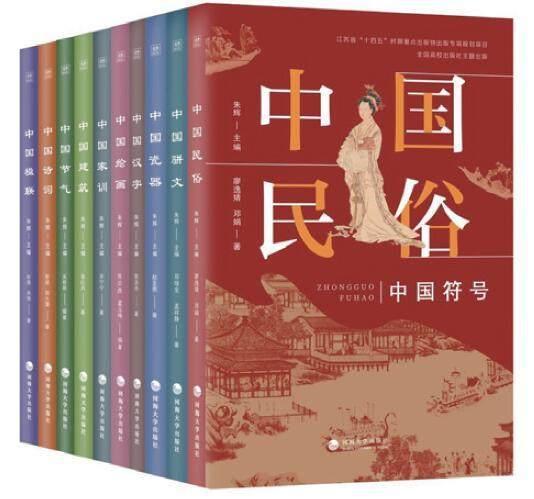
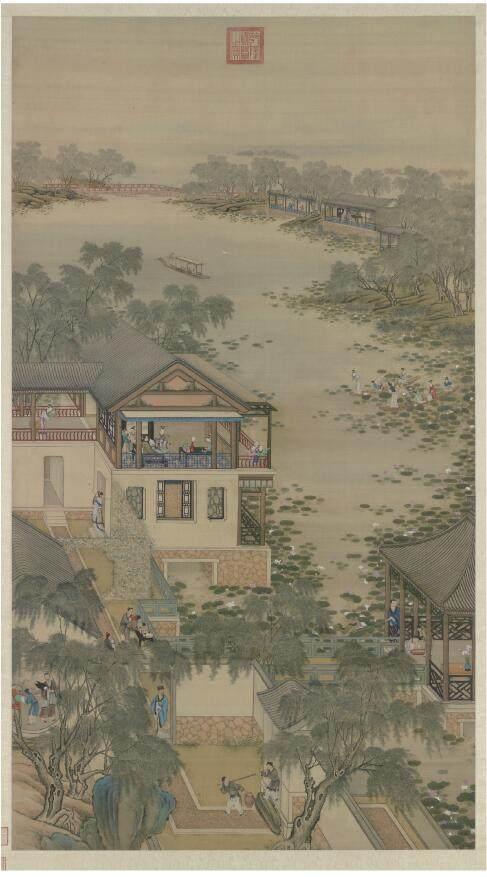
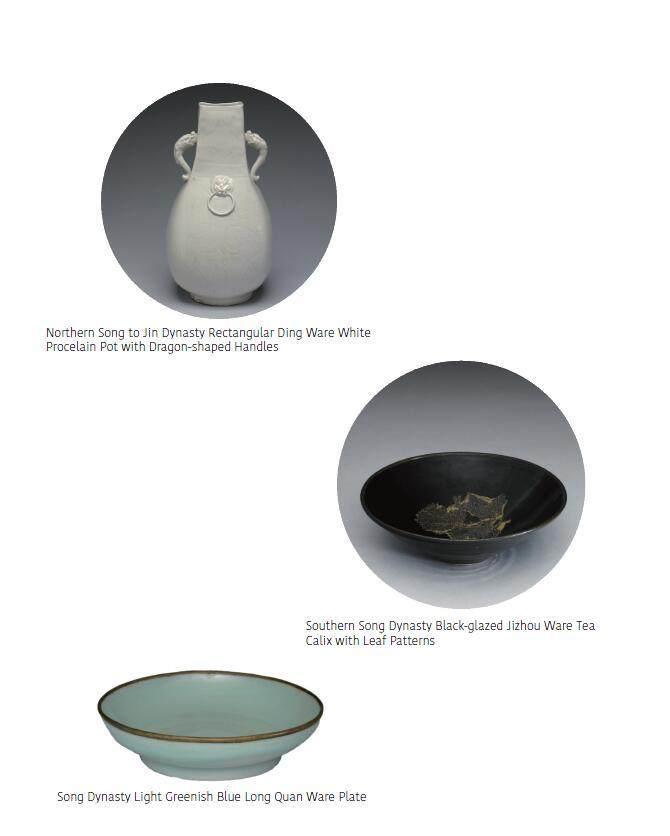
The “Symbols of China” Series (10 volumes in total) is a set of popular readings that embody the characteristics of traditional Chinese culture. This series selects Chinese cultural symbols with global influence, such as folklore, solar terms, porcelain, architecture, poetry, parallel prose, family instructions, Chinese characters, paintings, and couplets. It interprets the spirit of traditional Chinese culture contained within in plain language, elaborates on their development history and ideological evolution, and strives to present the humanistic spirit and unique charm of excellent traditional Chinese culture from multiple perspectives.
“Symbols of China” Series
Zhu Hui
Hohai University Press
June 2023
598.00 (CNY)
Zhu Hui
Zhu Hui, a top-tier writer (second-tier in liberal arts), serves as the vice-chair of the Writers Association of Jiangsu Province (WAJS) and the editor-in-chief of Yuhua magazine. He is a young and middle-aged expert who has made outstanding contributions to Jiangsu Province. He enjoys special government allowances from the State Council and is a recognized cultural celebrity and “One of the Four Batches” of talent by the Publicity Department of the Communist Party of China. He has won the Purple Mountain Literature Prize for long and short stories multiple times. His short story The Seven-Story Pagoda won the seventh Lu Xun Literary Prize.
A symbol is a type of identifier or mark. It is the accumulation of human life activities, possessing a clear and conspicuous objective form; and a mode of spiritual expression, carrying rich meanings. Cultural symbols can be said to be the face of a nation.
The distinction between one country and another lies importantly in spirit and culture. Despite thousands of years of history, encountering countless wars and disasters, China has always been able to revive from desperate situations, continuously thrive, and remain vibrant today, because we possess a powerful cultural gene that runs deep in our blood and is passed down through generations.
Chinese culture has continued uninterrupted for thousands of years, just like Chinese characters, with a long and flowing history. From knot tying to the creation of characters by Cang Jie, the origin of Chinese characters is shrouded in a mystical veil. But since the discovery of oracle bone inscriptions in the Yin ruins of Anyang, Henan Province, over a hundred years ago, the source of Chinese characters has been largely clarified. Oracle bone inscriptions already had a symmetrical and stable pattern and the function of representing meaning. From oracle bone inscriptions to bronze inscriptions to small seal script, to clerical script, to regular script, to the running script, and the present, Chinese characters have been integrated into computers, gaining the so-called “typed form.” Nowadays, it seems that except for students and calligraphers, the rest of us hardly need to use a pen anymore; being able to type is enough. Despite this, we still speak and think in Chinese, with the data chains in our brains still being strings of Chinese characters.
Chinese characters are a type of cultural symbol. Chinese characters like 福 (pronounced “fu,” meaning fortune) and 壽 (pronounced “shou,” meaning longevity) can be written in many styles, either square or flowing. We may not recognize all variations, but we can identify them at a glance as our Chinese characters, a recognition shared even by foreigners. Chinese characters are the root of our culture, growing and extending along with the passage of days and months and the changes of the times. Chinese culture pervades every aspect of our lives, whether it is daily life that trickles like water or spiritual activities that explore the utmost limits. Chinese culture is in our blood.
Language is one of the foundations of culture. The beauty of Chinese characters, in their form, symmetry, and phonetics, has become the foundation of our aesthetic appreciation. Parallelism and symmetry have permeated our aesthetics, without which our ancient poetry and couplets would not be the same. Pictographs have subtly influenced our naming of landscapes, with many places named “Elephant Trunk Mountain” and “Camel Peak” serving as clear evidence. There is a deep but hard-to-fully-articulate connection between our Chinese characters and the architectural forms of ancient Chinese palaces.
We created culture, and in turn, culture nourishes us. The shaping of the Chinese spirit through ancient poetry, starting with expressions of love and agricultural life in The Book of Songs, has been profound. From “Cooing ospreys on the river isle. The fair lady, a fine match for the gentleman,” to “Giant rats, do not eat our grain,” to the stirring boldness and solemnity of Wen Tianxiangs “Who has not died since ancient times? Let my loyal heart illuminate the annals of history.” The influence and discipline of folk customs, seasonal festivals, and family proverbs on Chinese people are undeniable.
Culture is profound, rich, and complex. It is resilient and tenacious, yet also lively and thriving, constantly renewing itself, day by day, anew. As culture develops and becomes more concentrated, it naturally acquires symbolic functions, generating meanings as symbols. Based on its profound and rich connotations, Chinese culture has always been the external image that enables the Chinese nation to stand tall among the nations of the world, possessing a strong influence. With the strengthening of national power and the expansion of national influence, Chinese symbols have spread far and wide, increasingly appearing all over the world: porcelain, tea, silk, calligraphy, guqin, erhu, Spring Festival couplets, papercutting, dumplings, Chinese knots, kung fu, Chinese folk songs, flying eaves and bucket arches, the Gods of Wealth and Luohan (Buddist arhat), lion dances, dragon dances, imposing drums and gongs, a spectacular array, vast and diverse. Whether we are in the midst of these or witness them through media, we immediately feel a sense of kinship and pride well up within us.
The world is interconnected, and Chinese culture and symbols have already entered other cultural spheres, not only appearing on the stage of global cultural exchange but also permeating into the minutiae of other cultures. We are called “China” possibly because of porcelain; although this is not definitively settled, the term “kung fu” has indeed made its way into English dictionaries. Chinese artist Xu Bing, in his renowned Book from the Sky Series, designed and printed thousands of “new Chinese characters,” using powerful imagery and symbolism to present and explore the essence and thought patterns of Chinese culture, highlighting Chinese symbols shining moments in the world art scene. These all attest to the influence of Chinese culture and symbols, as well as the communicative function of cultural symbols. Symbols are carriers of culture, tools of communication, and messengers of friendship. Immersed in Chinese culture and surrounded by Chinese symbols, we may take them for granted and overlook them, but our ancestors legacy is the crystallization of wisdom forged by countless generations. Being Chinese, we are the inheritors, the students, and even more, the creators and promoters.
From a certain perspective, some cultures or symbols may have lost their practical use, such as a museum-level bowl or vase, which can no longer be used to hold water or flowers, but they emit an aura and strength. They are displayed in showcases, and at the moment when the spotlight shines upon them, they come to life, radiating the brilliance and vitality of culture and spirit. They reach deeply into our hearts, boundless and omnipresent. They belong to China; they belong to us.
Chinese symbols externalize the Chinese spirit, standing out as the eternal carriers of Chinese culture with their striking and vivid objective forms. Chinese symbols are also the inner driving force that propels the Chinese nation forward.
Chinese culture is broad and profound, with many aspects that can be dubbed “Chinese symbols.” The Symbols of China Series delves into the Chinese culture inherent in solar terms, family instructions, folklore, poetry, couplets, porcelain, architecture, parallel prose, Chinese characters, and painting, displaying the unique allure of Chinese culture from multiple perspectives, such as history, development, classification, and features, with substantial contributions from numerous experts and scholars. This series aims to promote excellent traditional Chinese culture, assisting readers, especially young students, in understanding the essence of excellent traditional Chinese culture, thereby proving to be beneficial.