Chinese and Western Civilizations: Concentric Circles and Jigsaw
2024-05-14 09:22:38
中國(guó)新書(shū)(英文版) 2024年2期
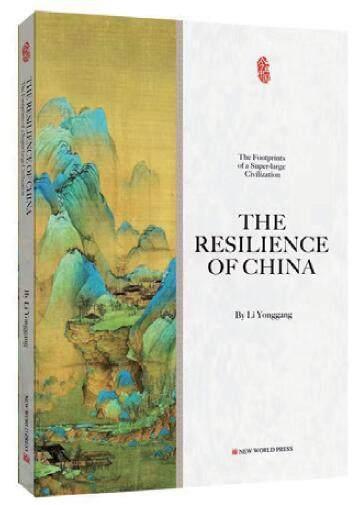
Focusing on factors contributing to the lasting unity of China, this book explores several important historical periods and transitions in past dynasties. It elaborates on the ways of life, values, and thinking modes of the Chinese in preserving and passing along the civilization, with the conclusion that the long history and vitality of Chinese civilization relies on its superb resistance, exceptional tolerance, and flexibility, as well as the collective will, determination, and capacity in looking for solutions. These qualities are also reflected in Chinas code of conduct in contemporary society, including consolidating the community consciousness of the Chinese nation and building a community with a shared future for mankind.
The Resilience of China: The Footprints of a Super-large Civilization
Li Yonggang
New World Press
January 2022
128.00 (CNY)
Li Yonggang
Li Yonggang was born in Langzhong County, Sichuan Province in December 1981. He graduated with a doctoral degree in Chinese Philosophy from the Department of Philosophy at Peking University. Currently, he is an associate professor and director of Traditional Chinese Culture Research Section of the Academy of Chinese Culture. In recent years, he has published multiple articles and papers in Peoples Daily, Study Times, Journal of the Central Institute of Socialism, and so on.
During modern times, Western civilization has exerted an ever-increasing influence on the Chinese civilization. To better understand the Chinese civilization, its necessary to first briefly compare Chinese and Western civilizations.
1. Division vs. Unification
More than 2,500 years ago, the situation was as follows:
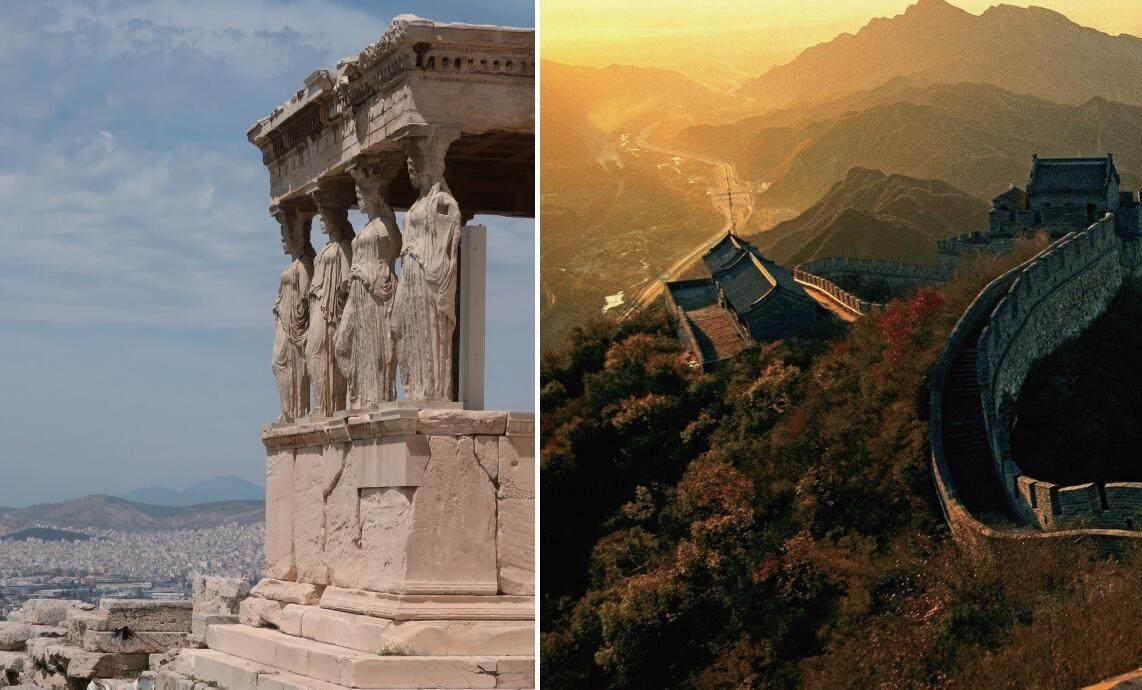
Ancient Greece dazzled with its civilization in the West while China was in its splendid Spring and Autumn and Warring States periods. Both the Athens Academy in Greece and the contention of various schools of thought in China were fascinating. Those giants of thought were as brilliant as stars, and their incisive insights that penetrated history have become a precious treasure of human civilization. As time passed, the West and East took quite different paths. Ancient Greece was once prosperous, but it broke apart in the end. Its glorious civilization dimmed for a time at the southern tip of the Balkan Peninsula, having to rely on limited inheritance to regenerate in another place after thousands of years. China, after the split of the Spring and Autumn Period and the Warring States Period, moved toward unity in the Qin Dynasty. Although many dynasties came and went, the glory of its civilization has never been extinguished on the East Asian continent.
More than 2,000 years ago:
On the western end of the Eurasian continent, the Roman Empire, with its overwhelming power, established its reign across Asia, Africa, and Europe, even treating the Mediterranean Sea like its inland lake. On the eastern end of the Eurasian continent, the Qin and Han empires were equally impressive. The long-term division during the Warring States Period was put to an end. In addition, the western regions and Central Asia were explored and connected. The famous Silk Road, due to the existence of these two great empires, had its starting and end points established.
More than 1,600 years ago:
The two empires reached turning points. As the world entered the Little Ice Age, northern nomads, having no way out, continued to move south. At nearly the same time, both China and the Roman Empire were attacked from the north. The Western Roman Empire, which survived after the split of the Roman Empire, broke up, leaving Europe with many small kingdoms built by barbarians. These kingdoms constantly attacked each other, leaving little chance for Europes reunification. Even mighty figures like Charlemagne (in the middle-ages) and Napoleon (in modern times) could only temporarily integrate local areas that were soon overthrown by regional resistance forces. In contrast, China, which had experienced nearly 400 years of division, and with ethnic minorities successively going south to establish their own countries, achieved great national integration and laid the foundation for reunification. The Sui and Tang empires, after ending the division, not only inherited the ruling systems of the Qin and Han dynasties, but also expanded their reign: Even the emperors themselves had the blood of ethnic minorities. During the Song Dynasty, although Liao and Jin established countries separately, they all advocated for the Chinese political and religious systems. After the Song Dynasty, there was no longer a long-term, large split in China.
Today, the situation is as follows:
As the stronghold of Western civilization, Europe has managed to establish the European Union after many hardships. However, the United Kingdom has staged the protracted “Brexit” drama, which has finally materialized. China has achieved modern transformation as an integrated country. Sitting at the east of the world, China has the worlds largest population united in a single country.
The famous historian, Toynbee, said:
On the whole, the history of the Chinese Empire, which still survives in the form of the present Peoples Republic, has been a political success story. It contrasts dramatically with the history of the Roman Empire, which tried and failed to give lasting political unity and peace to the West.
2. The West: Oceans and Centrifugal Force
The most time-honored stronghold of Western civilization is Europe. Europe is surrounded by peninsulas and islands. Large islands include Scandinavia in the north, the British Isles in the northwest, the Iberian Peninsula in the southwest, the Apennines in the south, and the Balkans in the southeast. Peninsulas and islands mean “centrifugal force.” The reason is not complicated: Inconvenient transportation. As peninsulas are surrounded by water on three sides, they are connected to the main continent by only one narrow path, and there may even be mountains between the peninsula and continent. For example, the Iberian Peninsula, where Spain and Portugal are located, is separated from the main continent by the Pyrenees Mountains. At the northern Apennine Peninsula, where Italy is located, stands the towering Alps. An island is surrounded by water on all sides. Considering the barriers of mountains and seas, the inconvenience of transportation is not difficult to imagine.
Statistics show that peninsulas and islands account for one-third of the total area of Europe. Over time, the dominance of the European political and economic power center was weakened. In contrast, Chinas peninsulas and islands only account for 1.6% of its territory.
Due to these geographic factors, Europes centrifugal force was inevitable. In addition, it was further strengthened by climatic factors.
The equatorial region is exposed to direct sunlight year-round, and water vapor from the surrounding seas evaporates particularly rapidly. When the vapor evaporates into the air, a powerful air current is formed. Under the force of the earths rotation, airflow will be deflected to the right in the northern hemisphere and to the left in the southern hemisphere. Therefore, on the sea surface in the northern hemisphere, a strong air current flows above the equatorial area from southeast to northwest, which is called a “severe tropical cyclone” in meteorology.
When a strong tropical cyclone from the Pacific Ocean hits the southeast coast of China, it forms what is known as a “typhoon.” The severe tropical cyclones from the Atlantic Ocean that hit the southeast coast of the United States are called “hurricanes.” In early ancient times, when backward navigational technology faced turbulent waves brought by typhoons, it was difficult for people along the coast of China to go to sea on a large scale, so they fished only at intervals. Typhoons come every year, so it is difficult for marine civilization to gain effective accumulation in this area. In contrast, seas around Europe are much calmer. Severe tropical cyclones originating in the Atlantic Ocean generally hit the southeastern coast of North America: These are less likely to turn and hit Europe. For severe tropical cyclones originating in the Pacific or Indian Ocean, even if they do cross the vast Eurasian continent to reach Europe, they will be very weak. Therefore, it is much easier for Europe to gain a highly developed marine civilization. The Mediterranean Sea, which is comparatively calm, can even be regarded as a vast “inner lake” of Asia, Africa, and Europe.
The large and small peninsulas and islands surrounding Europe facilitated formation of centrifugal force. Meteorological conditions helped form a highly developed marine civilization in these peninsulas and islands. This resulted in further accumulation of political, economic, and cultural factors in Europe that further aggravated this centrifugal force. The European continent lacked sufficient centripetal force to counter this centrifugal force.
3. China: Farming and Centripetal Force
From 80 million to 3 million years ago, the Indian plate kept drifting northward and diving beneath the Asian plate. After complex geological movements, the Qinghai-Tibetan Plateau gradually uplifted, and the overall terrain pattern of high in the west and low in the east was basically formed. The southern edge of the Qinghai-Tibetan Plateau is the Himalayas, running east to west, and the Qinghai-Tibetan Plateau itself is large enough to block the effective northward movement of the warm, humid air mass from the Indian Ocean, resulting in a temperate continental climate in northwestern China. The area features severe aridity and little rain, which gradually formed the vast deserts including the Gobi Desert.
The Qinghai-Tibetan Plateau sits in the mid-latitude, westerly zone in the northern hemisphere. Winter winds blowing from northwest to southeast pass through the desert and Gobi in the northwest. Yellow sand in the wind obscures the sky, forming the sandstorms that people are familiar with today.
Modern sandstorms cause environmental pollution. However, in ancient times, they were a great “gift” to Chinese civilization. Driven by wind, the yellow sand generally moved from northwest to southeast. The terrain it pasted was not completely flat. To the east, there is the Taihang Mountains; to the south, the Qinling Mountains. Blocked by the mountains, the wind slowed and the yellow sand settled there. After millions of years, Mother Nature completed a masterpiece known as the vast Loess Plateau. At present, the settlement theory is the mainstream theory explaining the formation of the Loess Plateau.
On this vast plateau, the loess is 80—120 meters thick on average, with the thickest part being over 400 meters. What a feat of nature! Unlike the red clay in the south, which is hard due to its iron content, or the black soil in the northeast, which is fertile, but only one meter thick, this layer of loess formed by sand and dust is soft and deep. In the primitive age of underdeveloped technology, our ancestors could easily cultivate plants on it with tools made of wood, stone, and bones.
Rainfall is indispensable for agriculture. The Loess Plateau receives warm, humid air in summer from the Pacific Oceans southeast monsoon due to the heat source effect caused by the uplifting of the Qinghai-Tibetan Plateau.
In addition to soil and precipitation, suitable temperature is indispensable for agriculture. According to Zhu Kezhen (1890--1974), the famous Chinese meteorologist, about 8,000 to 3,000 years ago, the earth was in the Holocene Warm Period, with average temperatures 2--4°C higher than those of today. This means temperatures in the Yellow River basin were comparable to temperatures in the Yangtze River basin today. It was very warm and humid and, thus, suitable for farming. The Yangtze River basin, at that time, was probably like Southeast Asia today, with too much heat and humidity. In an era when agricultural tools were still relatively primitive, it was difficult to effectively farm on a large scale in the Yangtze River area with its dense forests. Thanks to the unique conditions of soil, precipitation, and temperature, agriculture took the lead in developing the Loess Plateau, which resulted in a highly developed farming civilization. Consequently, the Loess Plateau became the cradle of early Chinese civilization.