The Origins of the Project Exploring the Roots of Chinese Civilization
2024-05-14 09:22:38
中國新書(英文版) 2024年2期
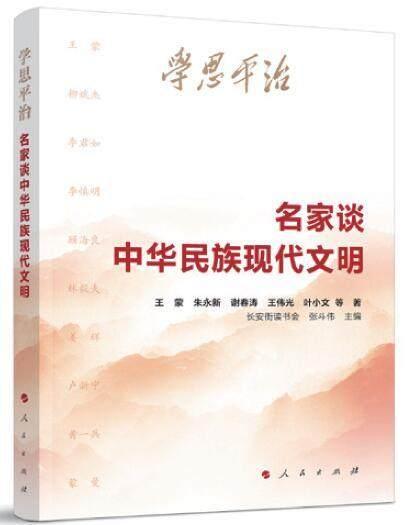
Guided by Xi Jinpings cultural thought, this book carefully selects articles from various esteemed authors to systematically explain the profound connotations and practical pathways of the modern civilization of the Chinese nation across four dimensions: “Civilization Origins,” “Civilization Characteristics,” “Civilization Exchange,” and “Civilization Development,” offering strong intellectual, practical, and readability values.
Learning, Thinking, and Governing: Insights from Distinguished Scholars on Modern Civilization of the Chinese Nation
Written by Wang Meng, Zhu Yongxin, Xie Chuntao, Wang Weiguang, Ye Xiaowen, et.al
Edited by Changan Avenue Reading Club
Peoples Publishing House
December 2023
75.00 (CNY)
Ancient Chinese documents regard the era of the Yellow Emperor and the Yan Emperor as the dawn of Chinese civilization, but ancient records about this period are filled with mythological elements that belong to legendary history rather than verifiable facts. Until the end of the last century, some scholars, both domestic and international, doubted or even denied the Chinese nations claim to over 5,000 years of civilization. Many scholars in Chinese history consider the Xia Dynasty, which was recorded as the first dynasty in Chinese history, to mark the beginning of Chinese civilization. However, some scholars abroad and a few within China question or even deny the existence of the Xia Dynasty. They argue that ancient Chinas entry into a civilized society should be marked only from the late Shang Dynasty, as it meets the criteria of civilization (metallurgy, writing, and urbanization) confirmed by oracle bone inscriptions.
Suppose we want to dispel doubts in society and the academic world about the origins and formation of Chinese civilization. In that case, it is crucial to rely on new data obtained from archaeological discoveries to research and verify the process of the origin, formation, and early development of Chinese civilization. Therefore, after the conclusion of the “Xia Shang Zhou Chronology Project,” scholars suggested continuing the multidisciplinary approach initiated by the project to study the historical context of the origins, formation, and development of Chinese civilization. At the end of 2001, the “Comprehensive Research on the Origins and Early Development of Chinese Civilization” project (hereinafter referred to as the Chinese Civilization Origins Project) was launched.
The Implementation Process of the Chinese Civilization Origins Project
The mission of the Chinese Civilization Origins Project is to study the origins, formation, and early development of Chinese civilization through a multidisciplinary, multi-angle, multi-level, and comprehensive approach while exploring the background, causes, developmental paths, and characteristics of this process. Multidisciplinary means the organic combination of various disciplines. Multi-perspective means studying the origins of civilization from various angles, such as environmental conditions, the state of productive forces (including agriculture and handicrafts), spiritual life, and social structure. Multi-level means studying not only the conditions of urban sites and the aristocracy but also the lives of people in medium- and small-sized settlements near these urban centers and those from lower and middle layers of society. Comprehensive means studying the political, economic, cultural, and social development and changes of that time and their interrelations. To date, the Chinese Civilization Origins Project has been divided into preparatory research and five phases.
Preparatory Research for the Chinese Civilization Origins Project (2001--2003). Due to the projects wide temporal and spatial scope, the diversity of participating entities and disciplines involved, and the complexity of the research content, organizing and implementing the project presented considerable challenges. Therefore, from 2001 to 2003, preliminary research was conducted. This preparatory study included nine topics: “Study of Historical Documents and Ancient Myths,” “Astronomical Archaeology,” “Collection and Study of Prehistoric Symbols and Their Relationship with Writing,” “Research on Dating Techniques for Key Archaeological Sites,” “Metallurgy Studies,” “Research on Resources and Trade During the Formation of Civilization,” “Study of Economic Conditions During the Formation of Civilization,” “Research on Settlements and Social Structures During the Formation of Civilization,” and “Study of Environmental Change and Its Impact on the Evolution of Civilization.” Through the research, various topics achieved different degrees of progress. The most significant outcome of the preparatory research was the initial development of a multidisciplinary approach to studying the origins and early development of Chinese civilization, laying a solid foundation for the formal launch of the Chinese Civilization Origins Project.
The First Phase of the Chinese Civilization Origins Project (2004—2005). This phase focused on the study of the civilization forms in the Central Plains area from 2500 BCE to 1500 BCE. This period extends from the late phase of the Longshan Culture to the early years of the Shang Dynasty. The main discussions included the environmental background, economic and technological development, and their roles in the civilization formation process, the dating of various urban sites, the social structure reflected by the settlement patterns during the civilization formation period in the Central Plains area, and the early civilization forms in this area. The choice to start with the Central Plains area is due to its well-established archaeological cultural sequence and the abundance of historical documents and ancient legends, which make it easier to advance related research.
The Second Phase of the Chinese Civilization Origins Project (2006—2008). Based on the first phase, this phase expanded the research time frame from 3500 BCE to 1500 BCE, and the spatial scope from the middle reaches of the Yellow River to its upper, middle, and lower reaches, the middle and lower reaches of the Yangtze River, and the Liao River basin. It focuses on studying the dates, environmental changes, economic and technological development, and social structure changes of urban and regional central sites and their associated archaeological cultures within this timeframe.
The Third Phase of the Chinese Civilization Origins Project (2009--2012). Continuing the research from the previous phase, still covering the time frame of 3500 BCE to 1500 BCE, this phase emphasized studying the chronological sequence of archaeological cultures in the Yellow River, Yangtze River, and Western Liao River basins, the dating of significant events in the civilizational process, the relationship between regional environmental changes and civilization evolution, the development of technology and livelihoods, and the relationship between important resources like copper, jade, and salt, and the formation of civilization. It researches the social structure reflected by urban settlements and regional central settlements and the development of spiritual culture during the civilization formation process, and is a holistic study of the formation and early development of Chinese civilization.
The Fourth Phase of the Chinese Civilization Origins Project (2013--2018). In this phase, the focus was on continuing the research on chronology, environment, livelihoods, the social structure reflected by urban and settlement patterns, and integrated studies established in the third phase, leading to the formation of the fourth phases final report.
The Fifth Phase of the Chinese Civilization Origins Project (2020--2024). This phase continues the guidelines and technical routes of the previous four phases of the project, incorporating important sites discovered in recent years that date back 5500 to 3500 years ago, and has strengthened the theoretical interpretation aspect.