砂梨新品種金花早的選育
2024-04-30 04:49:07王文明賈兵朱立武劉文琴張均明童秋云吳宗政鮑利平
果樹學(xué)報(bào) 2024年3期
王文明 賈兵 朱立武 劉文琴 張均明 童秋云 吳宗政 鮑利平
摘? ? 要:金花早屬砂梨(Pyrus pyrifolia)品種,為安徽歙縣上豐鄉(xiāng)徽州雪梨地方梨優(yōu)良品系。果實(shí)呈扁圓形,硬度中等,果肩部有褐色銹斑,果肉乳白色,果心中等大,為5心室,肉質(zhì)緊密;果皮綠色,平均單果質(zhì)量350.6 g,可溶性固形物含量(w,后同)為10.8%,有機(jī)酸含量為0.05%。與主栽梨品種秋黃、豐水相比,其果實(shí)貯藏性良好,常溫下貯藏30 d左右,適應(yīng)性強(qiáng),抗早期落葉病。在歙縣地區(qū)3月10日萌芽,3月20日初花,3月24日盛花,3月30日末花,落葉期為11月2日,成熟期為8月下旬。嫁接苗第5年平均每株產(chǎn)量可達(dá)25.3 kg,每666.7 m2產(chǎn)量高達(dá)2 125.2 kg,產(chǎn)量高而穩(wěn)定。鮮食與加工兼用。適合長(zhǎng)江流域和皖南山區(qū)栽培。
關(guān)鍵詞:梨;新品種;金花早
中圖分類號(hào):S661.2 文獻(xiàn)標(biāo)志碼:A 文章編號(hào):1009-9980(2024)03-0547-05
Breeding of a new sand pear cultivar Jinhuazao
WANG Wenming1, JIA Bing2*, ZHU Liwu2, LIU Wenqin3, ZHANG Junming4, TONG Qiuyun5, WU Zongzheng6, BAO Liping6
(1Science and Technology Experimental Station of She County, Huangshan 245200, Anhui, China; 2College of Horticulture, Anhui Agricultural University, Hefei 230036, Anhui, China; 3Service Center of Zhengcun Town, She County, Huangshan 245200, Anhui, China; 4Agro-Tech Extension and Service Center of She County, Huangshan 245200, Anhui, China; 5Huangshan Comprehensive Experimental Station, Huangshan 245200, Anhui, China; 6Honglinhua Family Farm in She County, Huangshan 245200, Anhui, China)
Abstract: Jinhuazao is an excellent strain of local sand pear (Pyrus pyrifolia) cultivars in Shangfeng town, She county, Anhui province. In 2008, we surveyed the sand pear germplasm resources in Anhui province and discovered five distinct self-rooted mother trees with moderate fruit size, round fruit shape and outstanding fruit quality, as well as tolerance to early defoliation disease and long storage period. During the preliminary selection, it was temporarily named as Jinhuazao pear. To confirm the hypothesis that these five plants were unprecedented local pear cultivars, we re-investigated the local sand pear germplasm resources during 2009—2010 and successfully constructed a SRAP genetic map for them. According to the phylogenetic tree analysis and DNA electrophoresis results, we revealed that these five plants were distinctive from other surveyed pear strains. Therefore, we subsequently consulted the relevant information and conducted fruit quality evaluation and genetic molecular identification on them, and two of them were selected for further study. After that, we monitored and comparatively analyzed the biological and physiological characteristics and resistance to abiotic stresses between the two selected strains and other pear strains. Fortunately, we obtained a new excellent local sand pear cultivar, which was early maturing, highly yielding, strongly adaptable and more tolerant to early defoliation disease. These support our assumption that Jinhuazao was a characteristic local pear variety that was unrecorded before in Anhui province. A regional evaluation was performed from 2015 to 2020 in Anhui province, and the biological characteristics, phenological period and main economic traits of Jinhuazao were systematically investigated. The results showed that Jinhuazao was a kind of strong and upright pear tree, which was recognized by its strong branching potential but weak branching power in the field. Jiangzaohua sprouted on March 10, and the flowers began to open on March 20, full bloom occurred on March 24, and flowering ended on March 30. Their flowers consisted of 5?6 white petals, where the internal stamens were date-red or red, with 20?22 individual whorled filaments. In addition, corymb-shaped clusters were observed in full bloom, which was composed of 5?7 flowers. At the same time, we found that the 1-year-old branches of Jinhuazao were brown, and were spirally attached by green and oblong oval-shaped leaves, which were distinguishable by their long and acute leaf tips, rounded leaf bases, and bluntly serrated leaf margins. Moreover, we noticed that the leaf surface was smooth and glossy, slightly curved inward on both sides, and the pedicels were thin. The transverse and the vertical diameters of the leaves were approximately 12.59 cm and 7.52 cm, respectively, while the petiole length of them was roughly 4.22 cm. Beyond those, we discovered that Jinhuazao was highly fruit-setting, whose fruits matured earlier than other local pear varieties in Anhui province, and in the Huangshan region of Anhui province, the fruit maturity occurred in late August. The fruit of Jinhuazao was round, and the flesh was creamy white and compact with a 5-ventricle-denoted medium fruit core. It displayed medium hardness and exhibited a green pericarp accompanied by brown rust spots on the shoulder. According to our analysis, the average fruit weight was 350.6 g, the soluble solid content of the fruit was 10.8%, and the organic acid content was 0.05%. Importantly, compared to the local pear cultivars Chuwhangbae and Housui, Jiangzaohua seemed to be more tolerant to the early defoliation disease that arose on November 2 in the field, and the fruit was equipped with a better storage property, with a storage period of approximately 30 days at room temperature. Jinhuazao could be grafted on the Duli rootstock to achieve greater economic value. The planting density in the orchard should be set as 2 m between trees and 4 m between rows. The trees should be trained into sparsely-layered or open-central system. To guarantee the yields of the coming year, the structure of the canopy and the composition of the branches should be strictly controlled through winter pruning, which ought to be performed between 20?25 days after leaf drop. If available, bees can be released at full bloom period to promote pollen dispersal, hence improving the fruit set. As for fertilizer management, sufficient fertilizer must be applied to the trees in the juvenile period, with a single-use of fast-acting fertilizer before the emergence of new shoots. During this period, foliar fertilizer can be sprayed to promote the growth of branch tips. Upon entering adulthood, special attention should be paid to the application of basal, pre-flowering and fruit-harvesting fertilizers, where organic manure should be the main fertilizer, and its reasonable combination with medium-, and trace-elements is needed. Noteworthily, the amount of organic manure application should account for more than 70% of the annual amount of fertilizer. However, despite the strong resistance of Jinhuazao to multiple diseases, more attention should still be paid to prevent it from disease in the field in the southern rainy season, with an emphasis on the governance towards the black spot, anthracnose and Gymnosporangium asiaticum of pear. To reduce the rate of pests and diseases, prediction and forecasting should be strengthened, and agricultural, biological, physical and chemical control should be integrated and adopted under the principle of “prevention first, green governance”. The grafted trees of Jinhuazao could bear abundant fruit in the fourth year and harvested in the fifth year after grafting, the yield of grafted trees was consistent and highly productive, and it reached more than 2 125.2 kg per 666.7 m2, which is higher than that of Chuwhangbae and Housui. It is appropriate for cultivation in the Yangtze River basin and mountainous area of southern Anhui, and it can grow well in any area where it is warm and humid with cool summers. In 2021, it was approved by the Anhui Forest Variety Approval Committee (Accession No.: Wan S-SV-PP-004-2021).
Key words: Pear; New cultivar; Jinhuazao
中國(guó)是世界梨的重要發(fā)源地,有悠久的栽培歷史,擁有豐富的品種資源和深厚的文化根基,是世界第一梨果生產(chǎn)國(guó)。各梨產(chǎn)區(qū)具有許多特色的地方優(yōu)良品種,對(duì)中國(guó)梨種質(zhì)創(chuàng)新與產(chǎn)業(yè)發(fā)展起到重要作用[1]。梨樹適應(yīng)性強(qiáng),除海南省、港澳地區(qū)外其余各省(自治區(qū)、直轄市)均有栽培,且形成具有地方特色和地域特征的優(yōu)勢(shì)生產(chǎn)區(qū)域,在農(nóng)業(yè)種植業(yè)結(jié)構(gòu)調(diào)整和農(nóng)民增收致富中具有重要意義[2-3]。據(jù)羅愿《新安志》記載:歙縣上豐鄉(xiāng)為徽州雪梨的原產(chǎn)地,栽培始于南宋,已有近千年的歷史,并形成了獨(dú)特的栽培技術(shù),如傳統(tǒng)果袋制作工藝和套袋技術(shù)。據(jù)民國(guó)《歙縣志》(1937)載:“雪梨”舊產(chǎn)文公舍(今五村東南),今北鄉(xiāng)豐源一帶及東鄉(xiāng)之汪岔皆產(chǎn)之;名金花早者為早梨,味美,吾邑梨初結(jié)實(shí)時(shí),用柿漆紙就樹上色裹之,故色白,不裹則青而皮粗。徽州雪梨的傳統(tǒng)品系有30多個(gè),選育耐貯藏、抗早期落葉的優(yōu)良地方品種對(duì)種質(zhì)資源的保存和利用具有重要意義。
1 選育過(guò)程
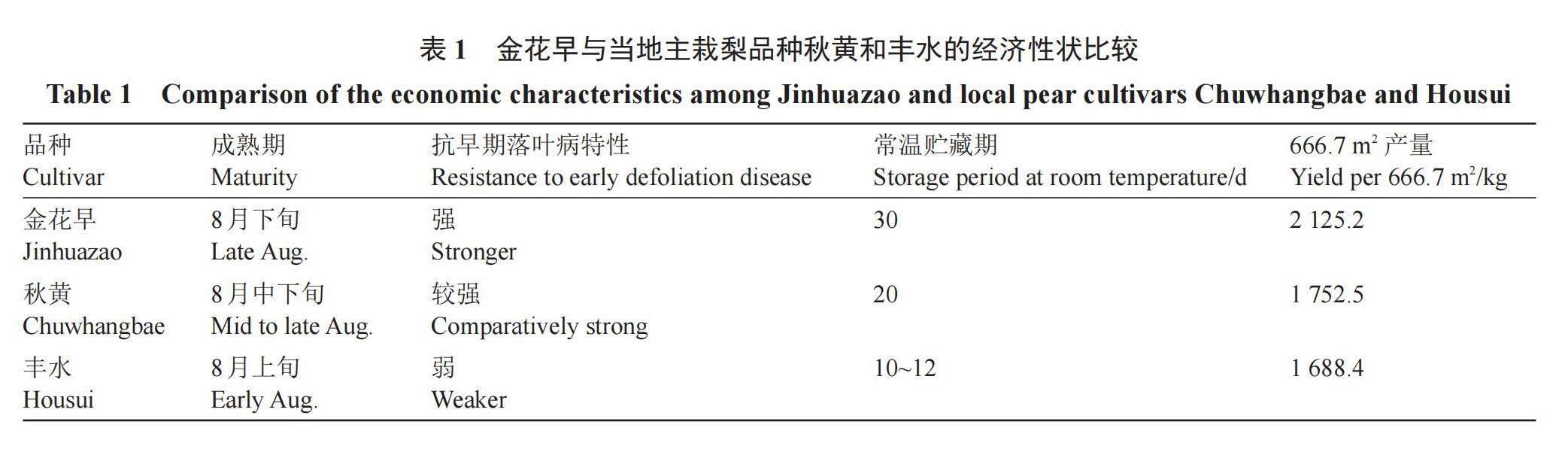
2008年,徽州雪梨種質(zhì)資源調(diào)查時(shí),通過(guò)初選,發(fā)現(xiàn)金花早優(yōu)良實(shí)生母株5個(gè),其果個(gè)適中,果形圓整,品質(zhì)優(yōu),且其早期落葉病抗性和貯藏周期均較當(dāng)?shù)刂髟云贩N秋黃和豐水有所改善(表1)。
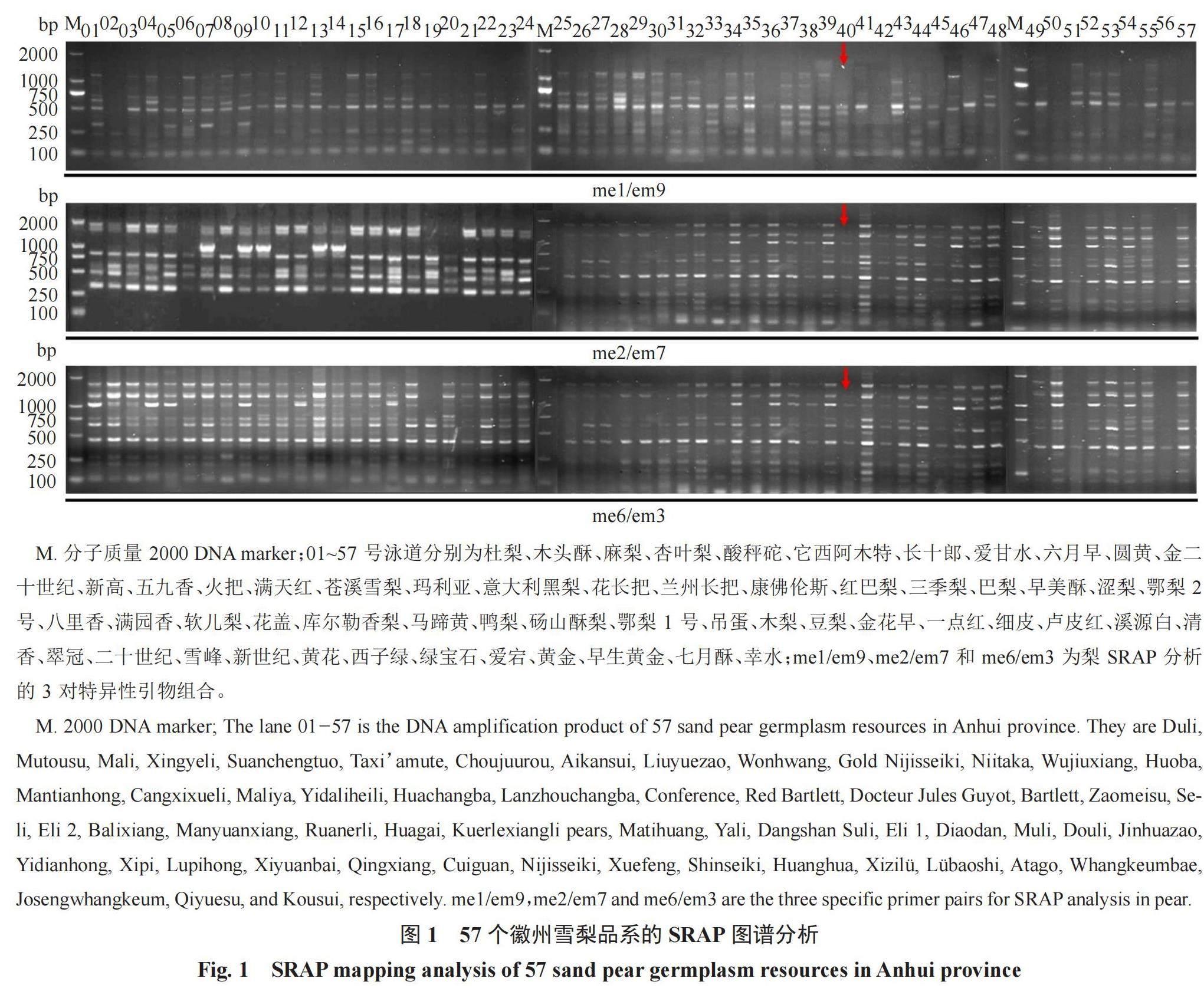
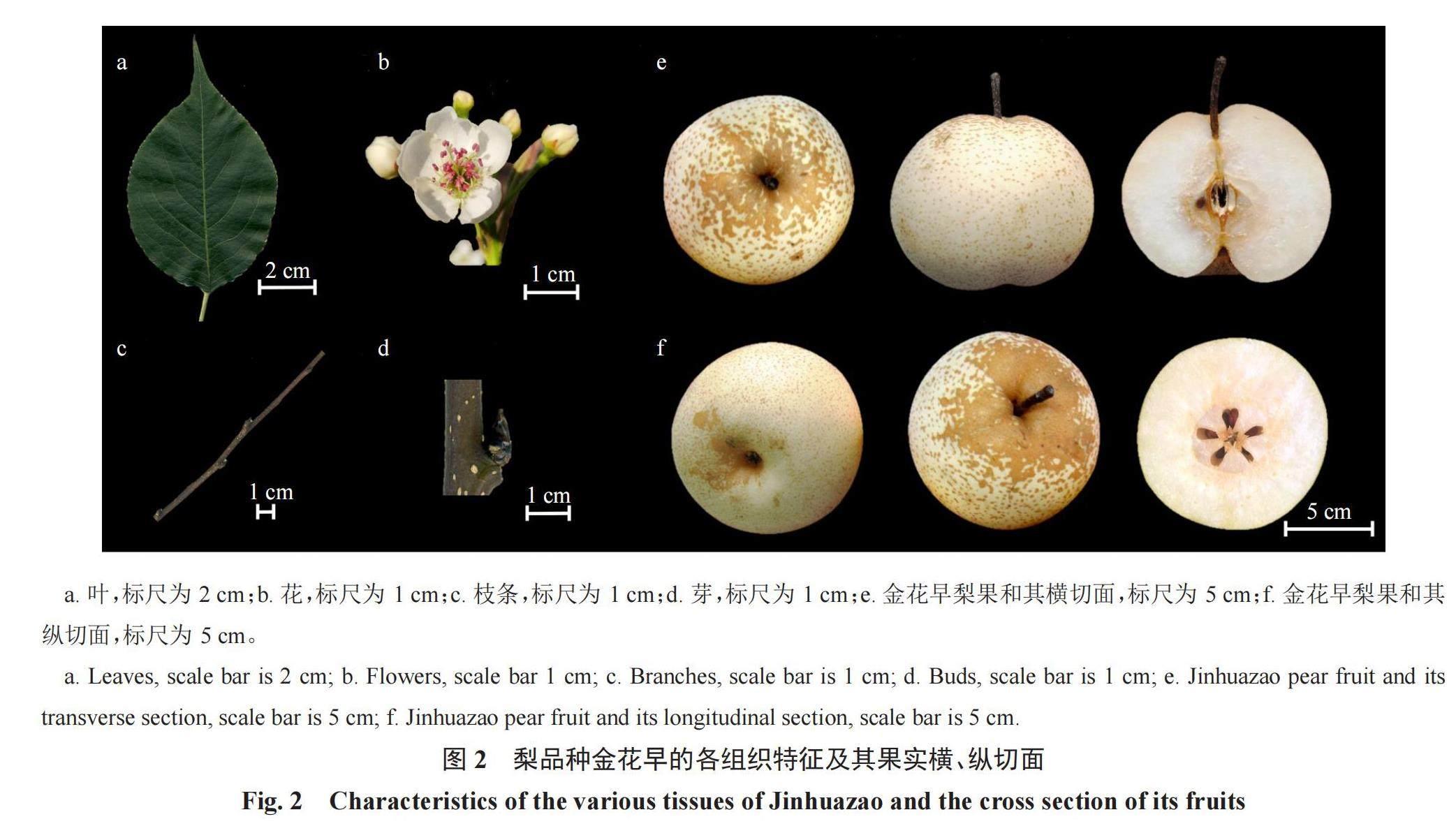
2009—2010年,進(jìn)行復(fù)選,構(gòu)建了徽州雪梨種質(zhì)資源SRAP遺傳圖譜,其分析結(jié)果表明,金花早的DNA遺傳物質(zhì)與其雪梨品種有明顯差異(圖1),最終通過(guò)查閱資料、果實(shí)品質(zhì)測(cè)定、遺傳分子鑒定,確定優(yōu)良實(shí)生母株2個(gè)。2013—2014年,進(jìn)行了決選,通過(guò)生物學(xué)特性、性狀穩(wěn)定性連續(xù)觀察,經(jīng)濟(jì)性狀比較,田間抗早期落葉病調(diào)查,確定優(yōu)良品系1個(gè)。2015—2020年,進(jìn)行區(qū)域試驗(yàn),對(duì)其生物學(xué)特性、物候期進(jìn)行觀察,對(duì)果實(shí)主要經(jīng)濟(jì)性狀進(jìn)行測(cè)定分析(圖2)。2021年通過(guò)了安徽省林木品種審定委員會(huì)審定(編號(hào):皖S-SV-PP-004-2021)。
2 主要性狀
2.1 植物學(xué)特征
金花早樹勢(shì)強(qiáng)旺,萌芽力強(qiáng),成枝力弱。1年生枝棕褐色;葉片呈長(zhǎng)橢圓形,葉尖長(zhǎng),急尖,葉基圓形,葉全緣、葉緣有鈍鋸齒,葉梗細(xì)。葉長(zhǎng)12.59 cm,葉寬7.52 cm,葉柄長(zhǎng)4.22 cm。花瓣為白色、5~6枚,雄蕊20~22枚,分離輪生,棗紅色或紅色;傘房花序,每花序一般為5~7朵花;花序坐果率高。
2.2 果實(shí)經(jīng)濟(jì)性狀
金花早果實(shí)扁圓形,平均單果質(zhì)量350.6 g,縱徑8.5 cm,橫徑10.0 cm,果皮綠色、套袋黃白色,果肩部有褐色銹斑;果心中等,5心室;果肉乳白色,肉質(zhì)致密、較硬,汁液中等,味甜,無(wú)香氣;可溶性固形物含量(w,后同)10.8%,可滴定酸含量0.05%,8月下旬成熟。
2.3 物候期
在安徽歙縣地區(qū),金花早萌芽期3月10日,初花期3月20日,盛花期3月24日,終花期3月30日,果實(shí)成熟期8月30日,落葉期11月2日。金花早嫁接苗第4年可大量結(jié)果,5年生嫁接苗平均株產(chǎn)可達(dá)25.3 kg,每666.7 m2產(chǎn)量可達(dá)2 125.2 kg。
2.4 適應(yīng)性及抗逆性
該品種適應(yīng)性強(qiáng),其耐旱、耐澇性也較秋黃和豐水強(qiáng),抗火疫病,特別是抗早期落葉病。
區(qū)域試驗(yàn)結(jié)果表明,金花早適宜長(zhǎng)江流域、皖南山區(qū)栽培。常溫下可貯藏30 d左右。與引種的其他日韓梨品種相比,明顯抗早期落葉病。生產(chǎn)上最好選用杜梨作為砧木,適宜有機(jī)質(zhì)含量高、微酸性土壤,土層深厚、排水良好的地塊建園。
3 栽培技術(shù)要點(diǎn)
3.1 整形修剪
該品種生長(zhǎng)勢(shì)旺、成枝力較強(qiáng),栽植密度以2 m×4 m為宜,可采用“開心形”“Y形”樹形。定干高度50~60 cm,“Y形”在基部選出2個(gè)主枝,方向與行向垂直,“開心形”3個(gè)主枝,向3個(gè)不同方向生長(zhǎng),主枝間水平夾角以120°為宜,樹高一般控制在3.0 m以內(nèi)。幼樹要輕剪,多采用摘心、扭梢、拿枝、拉枝、以果壓枝的方法培養(yǎng)樹形,控制樹體旺長(zhǎng),調(diào)節(jié)葉果比,促進(jìn)果實(shí)膨大和花芽分化。除延長(zhǎng)枝外,以疏枝、長(zhǎng)放為主,促使形成花芽,提早結(jié)果,盡量少短截。落葉后至萌芽前可進(jìn)行冬季修剪,以培養(yǎng)結(jié)果枝組,調(diào)整花芽量,促進(jìn)通風(fēng)透光。
3.2 肥水管理
幼樹施肥需薄肥勤施,適當(dāng)增施氮肥,增加根外追肥。生長(zhǎng)季節(jié)每隔20 d追施尿素或復(fù)合肥20~50 g·株-1,也可葉面噴施0.3%尿素和0.1%磷酸二氫鉀。成年樹施肥以有機(jī)肥(主要為農(nóng)家肥)為主,注重有機(jī)肥與中微量元素合理搭配,有機(jī)肥的施入量占全年的70%以上。秋季,可在株間或行間圍開挖平行溝或環(huán)狀溝,向外深翻擴(kuò)穴50~60 cm,深度以60 cm為宜。土壤回填時(shí)混以有機(jī)肥,表土放在底層,底土放在上層。可在行間套種三葉草、紫云英和毛葉苕子等綠肥作物。通過(guò)定期翻壓、覆蓋等方法將其轉(zhuǎn)變?yōu)槔鎴@有機(jī)肥培肥土壤,或采用自然生草定期割草覆蓋樹盤。
3.3 花果管理
栽植該品種時(shí),按照(3~4)∶1配置授粉樹,要求花期相遇,授粉品種花粉量大,以徽州雪梨品系的細(xì)皮和回溪為佳。盛花期進(jìn)行花期放蜂,能顯著提高坐果率,且果個(gè)大、果形圓整。
一般在落花后20 d進(jìn)行疏果,25 d內(nèi)完成疏果工作。留果的標(biāo)準(zhǔn)為每隔20~30 cm留1果,其余全部疏除。可選用外黃內(nèi)黑雙層專用袋或本地自制的柿漆袋進(jìn)行套袋,一般在落花后25~30 d內(nèi)完成,套袋前1~3 d,全園要細(xì)致噴灑1遍殺蟲劑和殺菌劑,藥劑一般選擇70%甲基托布津1000倍液加10%吡蟲啉2500倍液,雨后要及時(shí)補(bǔ)噴。
3.4 病蟲害防治
堅(jiān)持“預(yù)防為主、防治為輔、綜合防治”原則。采取農(nóng)業(yè)防治、生物防治、物理防治和化學(xué)防治相結(jié)合的綜合防治方法。做好病蟲害預(yù)測(cè)預(yù)報(bào),提高防治效果。
農(nóng)業(yè)防治采取剪除病蟲枝、清除枯枝落葉、刮除樹干翹裂皮、深翻樹盤等農(nóng)業(yè)栽培措施,達(dá)到增強(qiáng)樹勢(shì)、提高抗病蟲能力、減輕病蟲基數(shù)的目的。
生物防治通過(guò)施放性誘劑、懸掛糖醋液,誘殺梨小食心蟲,并結(jié)合使用頻振式殺蟲燈等物理防治措施誘殺吸果夜蛾、梨小食心蟲等害蟲。
化學(xué)防治重點(diǎn)做好冬季清園工作,萌芽前用5 °Bé石硫合劑全園消毒,生長(zhǎng)季節(jié)可用80%全絡(luò)合態(tài)代森錳鋅800倍液,配合70%甲基托布津800~1000倍液、50%多菌靈600倍液、40%福星乳油8000~10 000倍液等藥劑分別防治輪紋病、炭疽病、黑斑病等主要病害;用2.5%功夫3000倍液、0.3%苦參堿800~1000倍液、1.8%阿維菌素2500倍液、10%吡蟲啉5000倍液等藥劑防治梨大食心蟲、梨小食心蟲、梨木虱、蚜蟲和葉螨等主要蟲害。
4 綜合評(píng)價(jià)
金花早適合于長(zhǎng)江流域和皖南山區(qū)栽培。其他溫暖濕潤(rùn)、夏季陰涼、適宜砂梨生長(zhǎng)的地區(qū)均可栽培金花早。該品種適應(yīng)性強(qiáng),耐旱耐澇,抗早期落葉病和火疫病,果實(shí)潔白、汁多味甜,鮮食與加工兼用。
參考文獻(xiàn) References:
[1] 張紹鈴,謝智華. 我國(guó)梨產(chǎn)業(yè)發(fā)展現(xiàn)狀、趨勢(shì)、存在問題與對(duì)策建議[J]. 果樹學(xué)報(bào),2019,36(8):1067-1072.
ZHANG Shaoling,XIE Zhihua. Current status,trends,main problems and the suggestions on development of pear industry in China[J]. Journal of Fruit Science,2019,36(8):1067-1072.
[2] 滕元文,柴明良,李秀根. 梨屬植物分類的歷史回顧及新進(jìn)展[J]. 果樹學(xué)報(bào),2004,21(3):252-257.
TENG Yuanwen,CHAI Mingliang,LI Xiugen. A historic retrospect and the progress in the taxonomy of the genus Pyrus[J]. Journal of Fruit Science,2004,21(3):252-257.
[3] 滕元文. 梨屬植物系統(tǒng)發(fā)育及東方梨品種起源研究進(jìn)展[J]. 果樹學(xué)報(bào),2017,34(3):370-378.
TENG Yuanwen. Advances in the research on phylogeny of the genus Pyrus and the origin of pear cultivars native to East Asia[J]. Journal of Fruit Science,2017,34(3):370-378.