
Unilateral branch retinal artery occlusion in association with COVlD-19: a case report
2024-04-11 03:52:26KunihikoHirosawaTakenoriInomataJaemyoungSungYukiMorookaTianxiangHuangYasutsuguAkasakiYuichiOkumuraKenNaginoKahoOmoriShintaroNakao
Kunihiko Hirosawa, Takenori Inomata,3,4,5, Jaemyoung Sung, Yuki Morooka, Tianxiang Huang, Yasutsugu Akasaki, Yuichi Okumura,3, Ken Nagino,3,4, Kaho Omori, Shintaro Nakao
1Department of Ophthalmology, Juntendo University Graduate School of Medicine, 2-1-1 Hongo, Bunkyo-ku, Tokyo 113-0033,Japan
2Department of Digital Medicine, Juntendo University Graduate School of Medicine, 2-1-1 Hongo, Bunkyo-ku,Tokyo 113-0033, Japan
3Department of Telemedicine and Mobile Health, Juntendo University Graduate School of Medicine, 2-1-1 Hongo,Bunkyo-ku, Tokyo 113-0033, Japan
4Department of Hospital Administration, Juntendo University Graduate School of Medicine, 2-1-1 Hongo, Bunkyo-ku,Tokyo 113-0033, Japan
5AI Incubation Farm, Juntendo University Graduate School of Medicine, 2-1-1 Hongo, Bunkyo-ku, Tokyo 113-0033, Japan
6Department of Ophthalmology, Tulane University School of Medicine, New Orleans, LA 70112, USA
Dear Editor,
I am Kunihiko Hirosawa of the Department of Ophthalmology at Juntendo University Hospital.I am writing to present a case of concomitant Coronavirus Disease 2019 (COVID-19) with branch retinal artery occlusion(BRAO).BRAO presents as a sudden, painless loss of vision on the afflicted side and is most often focal in nature[1].The pathophysiology of BRAO is concerned with ischemic events in a branch of the central retinal artery owing to a variety of causes that result in hypoperfusion of retinal foci supplied by the affected arterial branch.This may result in irreversible visual deficits that correspond with the affected retinal areas[2-3].Frequent sources of hypoperfusion include endogenous and exogenous emboli, hypercoagulable states, and vascular diseases.Underlying hypertension and atherosclerosis are common factors in middle-aged and elderly populations, while systemic vasculitis or inflammation is a common cause in younger populations[4-5].Conversely, a known retinal artery occlusion (RAO) event can be suggestive of future risk of other fatal systemic diseases, such as cerebrovascular accidents and myocardial infarctions[1,6].Therefore, a comprehensive evaluation of risk factors and medical history associated with embolic events, vasculitis, and atherosclerosis in patients with RAO is recommended[7-8].
COVID-19 has rapidly impacted global society since the first reported index case in December 2019[9].Although rare, there is an association between COVID-19 vaccination and an immunemediated prothrombotic state[10-11].Ocular comorbidities related to COVID-19 vaccination include corneal transplant rejection[12], uveitis[13], and RAO[14].Additionally, direct COVID-19 infection may dysregulate multiple components of the Virchow’s triad, including vascular endothelial injury, by inducing proinflammatory cytokines[15-16].Several reports of arterial and venous embolic events in patients with COVID-19 support this association[17-19].Retinal arteries and veins are no exception[20-21], raising concerns about the potential correlation between COVID-19 infection and RAO.Although cases of comorbid RAO and COVID-19 have been reported in Europe,North America, and the West and South Asian regions[22], there are no reports of RAO in patients with COVID-19 from East Asia, where COVID-19 is believed to have originated[23].
This case report adds to the current limited body of literature on RAO and COVID-19 by detailing the occurrence of BRAO in a middle-aged female patient with confirmed recent COVID-19 infection in Japan.This study was approved by the Ethics Committee of our hospital (approval number,JHS23-013) and adhered to the principles of the Declaration of Helsinki.Written informed consent was obtained from the patient for the publication of this case report and the accompanying images.
Case PresentationA 43-year-old woman presented to the Juntendo University Hospital, Department of Ophthalmology,Tokyo, Japan with a sudden loss of vision in her right eye.Notably, she had recently tested positive for severe acute respiratory syndrome coronavirus 2 (SARS-CoV-2) infection through polymerase chain reaction test 33d prior to our initial encounter.Her COVID-19 symptoms were mild and she did not require hospitalization.Additionally, an acute urticarial rash was noted 26d prior to our initial encounter.A comprehensive review of the patient’s medical and family history yielded unremarkable results, including factors related to cigarette use, alcohol consumption, obesity, and systemic coagulopathy.Best-corrected visual acuity was 20/25 OD and 20/20 OS, and intraocular pressures were 16 mm Hg OD and 17 mm Hg OS.No relative afferent pupillary defects were detected in either eye.A wide focal retinal whitening in the superior macular hemisphere was observed during fundus examination of the right eye (Figure 1A).Fluorescein angiography of the right eye revealed delayed vascular filling caused by occlusion in the superior macular branch artery (Figure 1B).Optical coherence tomography of the right eye revealed thickening and hyperreflectivity of the inner retinal layers in the superior macular hemisphere (Figure 1C).Goldmann perimeter testing indicated a central-inferior visual field defect in the right eye(Figure 2).Based on these findings, the patient was diagnosed with BRAO in the right eye.
A comprehensive investigation was performed to determine the underlying cause of the BRAO.Blood pressure and heart rate were within normal ranges, with minimal concern regarding recent incidents of hemodynamic instability.Chest radiography and electrocardiogram revealed no abnormalities.Carotid ultrasonography revealed normal blood flow with normal intima-media thickness, peak systolic velocity, and enddiastolic velocity; a class Ⅱa plaque of 2.1 mm in thickness was visualized in the right carotid artery.Coagulation and hematologic tests demonstrated no congenital predisposition to thrombosis, including antithrombin deficiency, protein C deficiency, protein S deficiency, or hyperhomocysteinemia.The patient denied any known history of acquired thrombophilia, such as antiphospholipid antibody syndrome or lupus anticoagulant syndrome.Fibrinogen and D-dimer levels were also within the normal limits (fibrinogen, 278 mg/ dL; D-dimer, 0.62 μg/mL).Following the complete blood count, an elevated white blood cell count with elevated eosinophil count on cell differential was observed (11.7×10⁹/L and 5148/μL, respectively).As the patient presented with minimal concern and had a history of associated risk factors for carotid occlusive and thromboembolic diseases, she was diagnosed with COVID-19-related BRAO.For BRAO management, patient was treated with alprostadil 10 μg/day for 4d.However, upon subsequent follow-up examinations, retinal inner layer thinning(Figure 3A) and visual field defects in areas corresponding with the observed retinal ischemia (Figure 3B) persisted after 6mo.For the treatment of eosinophilia, a daily regimen of levocetirizine hydrochloride 5 mg was initiated for a presumed allergic response, with a confirmed return to the normal range on follow-up.
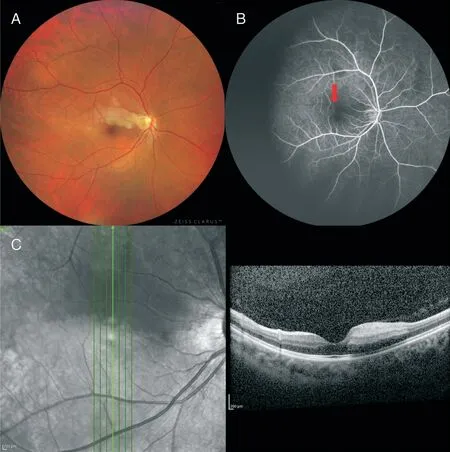
Figure 1 Findings of right retina at first time A: Fundus photograph showing retinal whitening in the superior macular hemisphere.B:Fluorescein angiography indicating delayed filling in the superior macular branch artery (red arrow).C: Optical coherence tomography showing hyperintense reflection and thickening of the inner retinal layer.
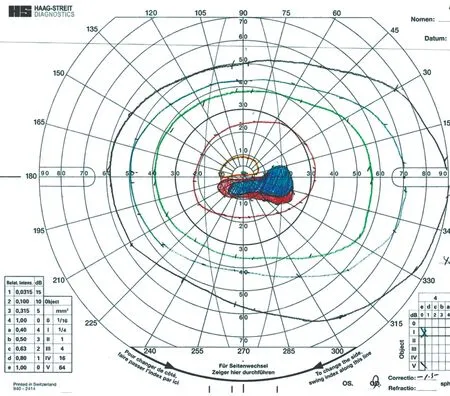
Figure 2 Findings of right visual field at the initial consultation Goldmann perimeter test showing a central lower visual field defect on the right eye.
DISCUSSION

Figure 3 Findings at 6mo follow-up A: Optical coherence tomography showing the retinal inner layer thinning in areas consistent with retinal ischemia.B: Humphrey field analyzer showing the central lower visual field defect.

Table 1 Characteristics of branch retinal artery occlusion in patients with COVID-19
BRAO is a retinal disease characterized by a sudden painless loss of vision in the affected eye owing to ischemia of the central retinal artery branch.To prevent recurrence and other associated cerebrovascular and cardiovascular ischemic events,a thorough evaluation of risk factors for vascular ischemia is vital.Vascular ischemia following COVID-19 has been reported, raising awareness of their possible association.In this case report, we present a comprehensive evaluation and the subsequent findings of a patient with newly diagnosed BRAO in association with a recent COVID-19 infection, and a minimal history and risk factors for hypercoagulability,thromboembolic diseases, and systemic vasculitis.Following a thorough review of our findings, COVID-19-related BRAO was diagnosed.This case report raises the question of whether BRAO could potentially manifest as a sequela of COVID-19.This case report outlines the comprehensive diagnostic journey a newly diagnosed BRAO subsequent to a recent COVID-19 infection.Hypercoagulability and an increased risk of thromboembolic events as complications of COVID-19 are referred to as COVID-19 associated coagulopathy (CAC)[16,24].These manifestations are believed to arise from diverse pathological disruptions observed in patients with COVID-19, including vascular endothelial damage, proinflammatory reactions, and facilitation of coagulation cascades induced by physiological interactions with SARS-CoV-2.A review revealed only two reported cases of COVID-19-related BRAO in Table 1[25-26].Notably, these cases exhibited serological indications of CAC,such as elevated fibrinogen and D-dimer levels, which were not observed in our study.Coagulation markers (fibrinogen and D-dimer) are reported to be positively correlated with the severity of COVID-19[27-28], likely reflecting their simultaneous roles as acute-phase reactants.It is uncommon for these markers to surpass normal levels in mild disease[29].Given the absence of primary serologic evidence of hypercoagulability,further evaluation of BRAO risk factors, including chest radiography, electrocardiography, and carotid ultrasonography,was performed.These investigations revealed no significant findings, ultimately leading to a diagnosis of COVID-19-related BRAO.This report represents, to the best of our knowledge, the first known case of COVID-19-related BRAO with no serological evidence of hypercoagulability frequently observed in CAC.
On May 5th, 2023, the World Health Organization (WHO)declared COVID-19 a global health emergency[30].However,exposure to COVID-19 remains high due to the ongoing emergence of SARS-CoV-2 variants.Therefore, the ophthalmic sequelae of COVID-19, such as conjunctivitis[31], optic neuropathy[32], and central serous chorioretinopathy[33], should continue to be considered, despite the official conclusion of the pandemic.COVID-19 starts with the cellular entry of SARSCoV-2, which binds to membrane-associated angiotensinconverting enzyme 2 (ACE2) in human hosts[34].ACE2 is expressed in various organs, including the lungs, small intestine, and heart[35].Recent studies have also confirmed the presence of ACE2 in neuroretinal cells and retinal vasculature[36], with subsequent research confirming SARSCoV-2 presence in retinal cells through post-COVID-19 infection retinal biopsies[37-38].The accumulating evidence confirming the interaction between SARS-CoV-2 and the retinal vasculature supports the hypothesis that COVID-19 infection can induce retinal ischemia through ACE2 interaction,leading to endothelial dysfunction in the vasculature and the subsequent release of proinflammatory cytokines, which may facilitate the coagulation cascade at various stages[39].Clinically, however, the incidences of RAO related to COVID-19 infection primarily only exists as isolated case reports, with limited studies on their association.Additionally,two cohort studies[40-41]that compared the incidence of RAO before and after the onset of the COVID-19 pandemic yielded conflicting results, underscoring the necessity for additional data collection and investigation to better elucidate the relationship between the two diseases.Our case report is notable due to its paucity of risk factors for BRAO and the absence of serological findings frequently associated with CAC, introducing another facet to the potential interplay between the pathophysiology of COVID-19 and BRAO.Clinicians evaluating sudden painless vision loss in otherwise healthy adolescents and young individuals with no known risk factors should consider COVID-19-related RAO as part of the initial differential diagnosis[42-43].
It is essential to acknowledge the limitations of this case report.Prior instances of idiopathic BRAO (i.e., RAO without underlying disease) have been reported[44-45], suggesting that this BRAO case associated with recent COVID-19 infection may not be directly attributed to the infection itself.Therefore,this case report should primarily function as a point of inquiry for further exploration and should promote future investigations with a more robust dataset.
In conclusion, we present a case of newly diagnosed BRAO in the context of COVID-19, featuring minimal risk factors and serological indicators.Despite the official conclusion of the pandemic, COVID-19 maintains a global prevalence.Recent reports of potential COVID-19-related BRAO should prompt clinicians to consider COVID-19 as a potential risk factor when assessing cases of newly diagnosed BRAO.
ACKNOWLEDGEMENTS
The authors thank the orthoptists at Juntendo University Hospital, Department of Ophthalmology, for collecting and measuring the data for this case report.
Conflicts of Interest: Inomata T,reports non-financial support from Lion Corporation and Sony Network Communications Inc., grants from Johnson & Johnson Vision Care, Inc., Kandenko, Co., Ltd., Yuimedi, Inc., Rohto Pharmaceutical Co., Ltd., Kobayashi Pharmaceutical Co.,Ltd., Kandenko Co., Ltd., and Fukoku Co., Ltd., personal fees from Santen Pharmaceutical Co., Ltd., InnoJin, Inc., and Ono Pharmaceutical Co., Ltd., outside the submitted work;Okumura YandNagino K,report personal fees from InnoJin,Inc., outside the submitted work;Nakao S,reports grants from Kowa Company.Ltd., Mitsubishi Tanabe Pharma Corporation,Alcon Japan, Ltd., Santen Pharmaceutical Co., Ltd., Machida Endoscope Co., Ltd., Wakamoto Pharmaceutical Co., Ltd.,Bayer Yakuhin, Ltd., Senju Pharmaceutical Co., Ltd.Nippon Boehringer Ingelheim Co., Ltd., Chugai Pharmaceutical Co.,Ltd., Hoya Corporation, and Novartis Pharma K.K., outside the submitted work;Hirosawa K,None;Sung J,None;
Morooka Y,None;Huang T,None;Akasaki Y,None;Omori K,None.
CORRIGENDUM
Combined application of ClRCLE Software and Topo-LASlK for SMlLE enhancement
Bing-Qing Sun, Hai-Peng Xu, Xing-Tao Zhou, Mei-Yan Li
(Int J Ophthalmol2024;17(1):206-209.DOI: 10.18240/ijo.2024.01.26)
The authors would like to make the following change to the above article:
“Prior to surgery, the five best corneal tomography scans obtained from the Topolyzer Vario (WaveLight, Erlangen, Germany)were used to plan the Topo-LASIK treatment” on page 206 should be changed to “Prior to surgery, the five best corneal tomography scans obtained from the ATLAS 9000 (Carl Zeiss Meditec AG, Germany) were used to plan the Topo-LASIK treatment”.
The authors apologize for any inconvenience caused by this error.
登錄APP查看全文
 International Journal of Ophthalmology
2024年4期
International Journal of Ophthalmology
2024年4期
- International Journal of Ophthalmology的其它文章
- Comment on: Recurrence after spontaneous separation of epiretinal membrane in a young woman: a case report
- When to repair a retinal detachment?
- Bilateral iridocorneal endothelial syndrome-Chandler’s syndrome: a case report and literature review
- Penetrating canaloplasty in corticosteroid-induced glaucoma: a report of two cases
- On-spot preparation of EDTA solution for the treatment of band keratopathy: a case report
- Non-contact wide-field viewing system-assisted scleral buckling surgery for retinal detachment in silicone oilfilled eyes