白星花金龜取食葡萄枝條的高效腐解條件和轉化參數優化
2024-02-20 00:00:00徐安東張廣杰付嬈孟卓顏宇李保國馬德英
新疆農業科學 2024年12期
摘 要:【目的】研究白星花金龜取食葡萄枝條的高效腐解條件和轉化參數優化,為葡萄枝條的資源化利用提供新路徑。
【方法】以粉碎的葡萄枝條為主要原料,開展腐解菌劑、牛糞配比(%)和酵化天數(d)的3因素5水平正交試驗,測定幼蟲對物料的轉化力,篩選并驗證白星花金龜幼蟲取食葡萄枝條的最優組合。
【結果】牛糞配比在第10、15、25和30 d達到顯著差異水平,牛糞配比越高,其溫度越高,酵化速度越好,添加菌劑和牛糞對物料的酵化有較好的促進作用;每120 g的葡萄枝條原料,輔加80 g的牛糞,添加1‰VT菌劑,發酵25 d后,獲得配合飼料96 g,經白星花金龜3齡幼蟲轉化后,蟲砂量為(77.53±22.43) g,蟲體轉化率(37.16%±0.04%),蟲砂轉化率為(84.99%±0.01%),蟲砂收獲系數(59.47%±0.04%),有機物料利用率在(61.17%±0.02%)。
【結論】白星花金龜3齡幼蟲對發酵葡萄枝條飼料具有較好的轉化力,添加1%VT菌劑、40%牛糞,酵化25 d為最佳酵化方案。
關鍵詞:葡萄枝條;白星花金龜幼蟲;腐解菌劑;生物轉化;資源化利用
中圖分類號:S432"" 文獻標志碼:A"" 文章編號:1001-4330(2024)12-3067-11
0 引 言
【研究意義】新疆是我國葡萄的主產區,種植面積均居全國首位,每年修剪產生大量葡萄枝條[1]。2020年,全國葡萄栽培面積72.62×10⁴ hm2,新疆葡萄栽培面積12.29×10⁴ hm2[2],占全國葡萄栽培面積的16.9%;全國葡萄產量1 431.41×10⁴ t,新疆葡萄產量(304.90×10⁴ t),占全國葡萄產量的21.3%。按照平均修剪枝葉干重5.25 t/hm2計算,每年輸出葡萄修剪枝葉等園林廢棄物約381.3×104 t[3]。因此,合理有效處理葡萄殘枝,進行葡萄枝條資源化利用,使其變廢為寶[4]。白星花金龜 Protaetia brevitarsis Lewis,屬鞘翅目 Coleoptera,花金龜科 Cetoniidae[5]分布廣泛,危害農林果業發展。白星花金龜幼蟲為腐食性,可以取食自然界酵化的畜禽糞便以及漚爛的作物枝條[6-7]。通過白星花金龜幼蟲轉化有機廢棄物的生態功能和潛力,使白星花金龜幼蟲處理葡萄枝條可望成為一條新的廢物資源化利用途徑。
【前人研究進展】張廣杰等[8]研究表明,白星花金龜幼蟲轉化棉稈發酵物料的能力達27.41倍,是黑水虻的近6倍,其飼料利用率(80.07%±0.65%)和蟲砂轉化率(84.55%±0.53%)。其飼料的產率為62.85%。白星花金龜產業發展迅猛,尤其是和微生物產業聯合發展方向,具有廣闊的應用前景[9]。【本研究切入點】白星花金龜轉化廢棄物又可產出具有高價值的昆蟲蛋白及蟲砂有機肥產品[10-11]。另一方面,其幼蟲蟲體是優質昆蟲蛋白,還可被開發用于醫藥和畜禽飼料領域[12-16]。目前白星花金龜轉化葡萄枝條的研究未見文獻報道,需研究提高白星花金龜對有機廢棄物的轉化力方法。【擬解決的關鍵問題】選用白星花金龜幼蟲轉化效果好的牛糞作為輔料,開展腐解菌劑、牛糞比例和發酵天數的3因素5水平正交試驗,優化白星花金龜對葡萄枝條的轉化力,探究白星花金龜對葡萄枝條轉化力的影響。
1 材料與方法
1.1 材 料
試驗地選取位于新疆昌吉回族自治州(簡稱昌吉州)瑪納斯縣包家店鎮新疆農業大學瑪納斯科研基地(44°13′49″ N,86°23′3″ E)。
白星花金龜幼蟲(基地自繁自育)、葡萄枝條回收混合物(瑪納斯縣樂園農業發展專業合作社)、牛糞(基地周邊農牧民)、菌劑、鐵鍬等試驗材料和工具(購于石河子市老街農貿市場)。五層貨架(規格1 m×0.4 m×1.8 m,購于烏魯木齊市華凌市場)、塑料盒(38 cm×50 cm×14 cm),殘渣和幼蟲分離篩(38 cm×50 cm×13.5 cm,側孔徑0.8 cm×0.8 cm,底孔徑1.0 cm×0.8 cm),電子天平(LT3002,常熟市天量儀器有限責任公司),電熱鼓風干燥箱(北京市永光明醫療儀器有限公司),溫度計等。
1.2 方 法
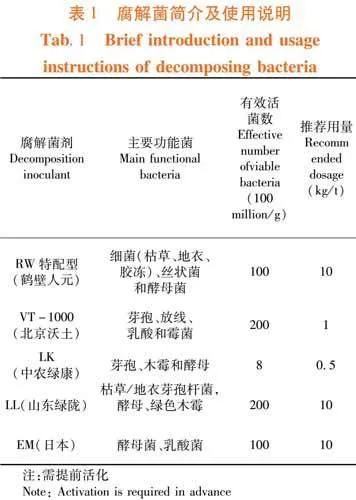
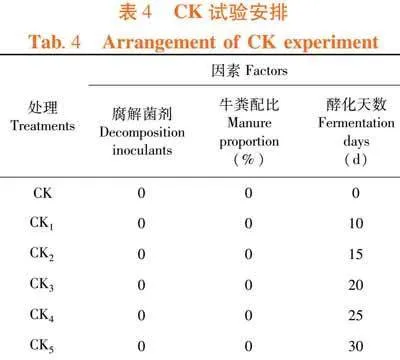
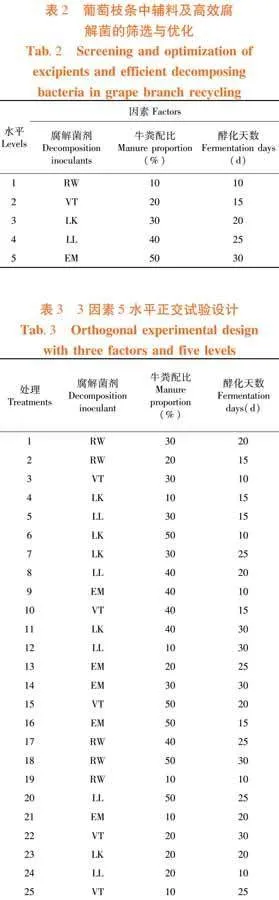
腐解菌劑、牛糞輔料和酵化天數3因素5水平正交試驗,處理共安排31(25+6)個。表1~4
(1)每個堆體(25+6)原料總量為120 kg,腐解菌劑按照使用說明規定的量添加,調節物料含水量為(65%±5%),堆體堆成饅頭狀,每天記錄堆體溫度,每5 d翻堆1次,5點取樣法,取堆體表面下方20~30 cm處的3 kg左右的物料作為樣品,共計31份樣品,放到冰箱冷凍保存備用。
(2)取自然解凍的31份樣品,測定其物料含水量;3齡期15日齡幼蟲作為供試蟲源;每個養殖盒(4 L)放20頭3齡幼蟲,測定其重量,每個養殖盒取折干重約為200 g的鮮物料500 g,開展12 d的飼喂試驗,每個處理重復5次。
(3)第13 d稱量白星花金龜幼蟲的增重量、取食量、蟲砂量,蟲砂收獲系數,參考劉玉升等[17](2012)計算飼料利用率、蟲砂轉化率和死亡率。計算有機物料量、各處理中葡萄枝條重量以及有機物料利用率,重量均以干重計算。
蟲增重(g)=取食后蟲重-初始蟲重;(1)
取食量(g)=取食前總干重-葡萄枝條重-殘渣重;(2)
蟲體轉化率(%)=蟲增重/(取食量-蟲砂重)×100%;(3)
蟲砂轉化率(%)=蟲砂重/(取食量-蟲重)×100%;(4)
蟲砂收獲系數(%)=(蟲砂重/總干重)×100%;(5)
有機物料利用率(%)=(取食量/有機物料量)×100%。(6)
1.3 數據處理
運用SPSS 26.0進行單因素方差分析(One-Way ANOVA),對不同處理間的差異進行Duncan多重比較分析(Plt;0.05)。應用Microsoft Excel 記錄、整理數據和繪制表格,用Origin 2022作圖。
2 結果與分析
2.1 三因素對各處理物料溫度變化的影響
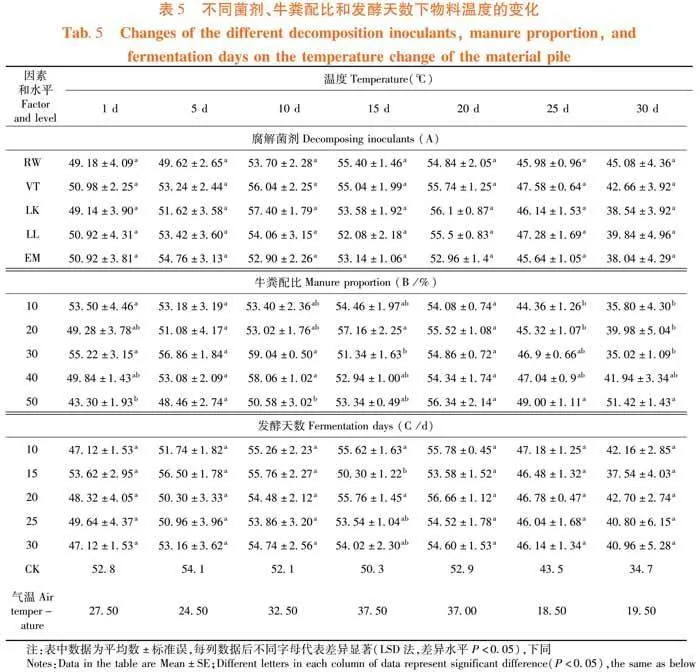
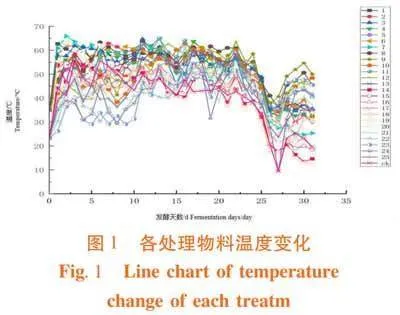
研究表明,各處理之間溫度均是先急劇升高,然后隨著每次的翻堆波動性下降,最高溫度超過60℃,到30 d發酵結束,除對照處理外,溫度均在30℃以上,高于同天平均氣溫。所有處理在15 d時,堆體溫度均出現下降情況,但是只有對照比較明顯。牛糞配比越高的,其溫度越高,酵化速度越好。添加菌劑和牛糞對物料的酵化有較好的促進作用。圖1
在每5 d一個發酵周期下,腐解菌劑對物料發酵溫度的影響未達到顯著差異水平,整體比較平穩。牛糞配比在第10、15、25和30 d達到顯著差異水平,前10 d以牛糞配比為30%的溫度最高,以牛糞配比為50%較低,20 d后,則呈現相反的趨勢。在發酵天數上,發酵25 d時表現出顯著差異水平,應是物料發酵溫度的拐點。至30 d發酵結束,除CK組外,25個處理的堆體溫度均在35℃以上,遠高于同天環境溫度。CK組前期溫度較高,25 d后溫度出現急劇下降的情況,25個處理的堆體溫度在發酵25 d后才有一個較為明顯的下降,這與物料發酵程度進入后期有關,也與環境溫度較低有一定的關系(20 d后平均氣溫低于20℃)。添加菌劑和牛糞可以維持物料堆體溫度在一個較高而平穩的范圍內,進而促進葡萄枝條的發酵。表5
2.2 三因素對白星花金龜轉化葡萄枝條的影響
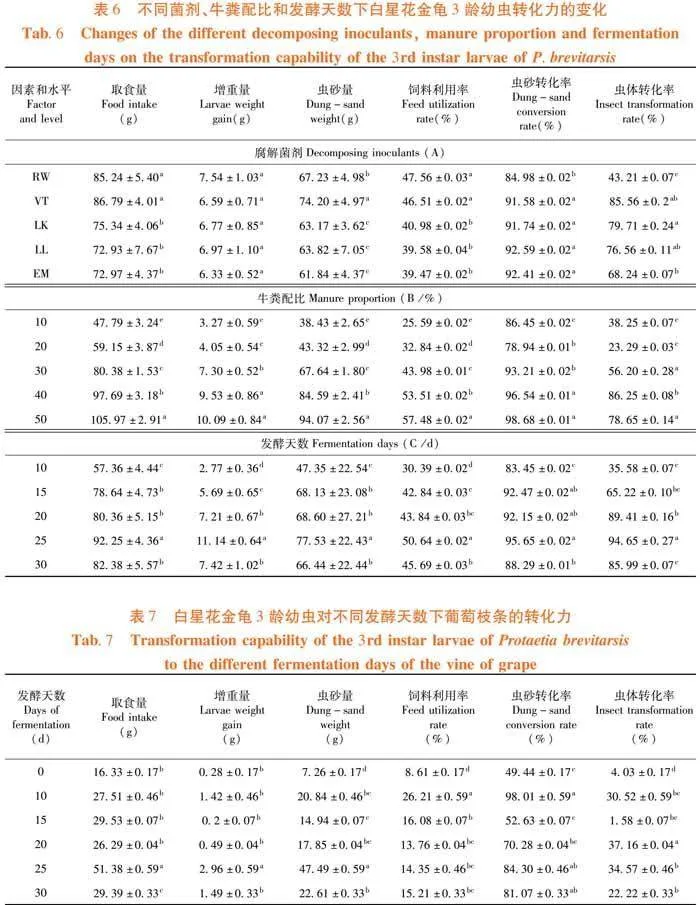
研究表明,白星花金龜幼蟲對物料的轉化力數據在各處理之間差別較大,平均增重量在2.77~11.14 g,平均取食量在47.79~105.97 g,蟲體轉化率23.05%~72.69%,蟲砂轉化率為67.28%~96.06%,蟲砂收獲系數6.08%~59.47%,有機物料利用率在8.51%~68.71%。平均增重量、平均取食量、蟲砂轉化率、砂收獲系數和有機物料利用率均是以第24組(菌劑、牛糞配比、酵化天數分別為LL菌劑、20%、10 d)最差;第20組(菌劑、牛糞配比、酵化天數分別為LL菌劑、40%、25 d)最優;蟲體轉化率第24組(菌劑、牛糞配比、酵化天數分別為LL菌劑、20%、10 d)最差,以第7組(菌劑、牛糞配比、酵化天數分別為LK菌劑、30%、25 d)最優;蟲砂轉化率以第24組最差,第7組最優。腐解菌劑對白星花金龜3齡幼蟲的轉化力,蟲砂轉化率和蟲體轉化率指標上達到顯著差異水平,在其他4個指標上未達到顯著差異水平,VT菌劑表現最佳。在牛糞配比上,以40%和50%表現最佳,并在取食量、蟲砂量、飼料利用率和蟲砂轉化率指標上與10%和20%差異顯著。發酵天數對白星花金龜3齡幼蟲的轉化力上,以25 d和30 d 2個水平表現最佳,并在取食量、蟲砂量、飼料利用率3個指標上顯著高于發酵15 d處理。表6
白星花金龜3齡幼蟲對不同發酵天數下葡萄枝條的轉化力差異較大。取食量、增重量、蟲砂量指標均為發酵25 d處理最優;飼料利用率、蟲砂轉化率均為發酵10 d處理最優;蟲體轉化率為發酵20 d處理最優。純葡萄枝條發酵25 d,白星花金龜對葡萄枝條的轉化力最佳。表7
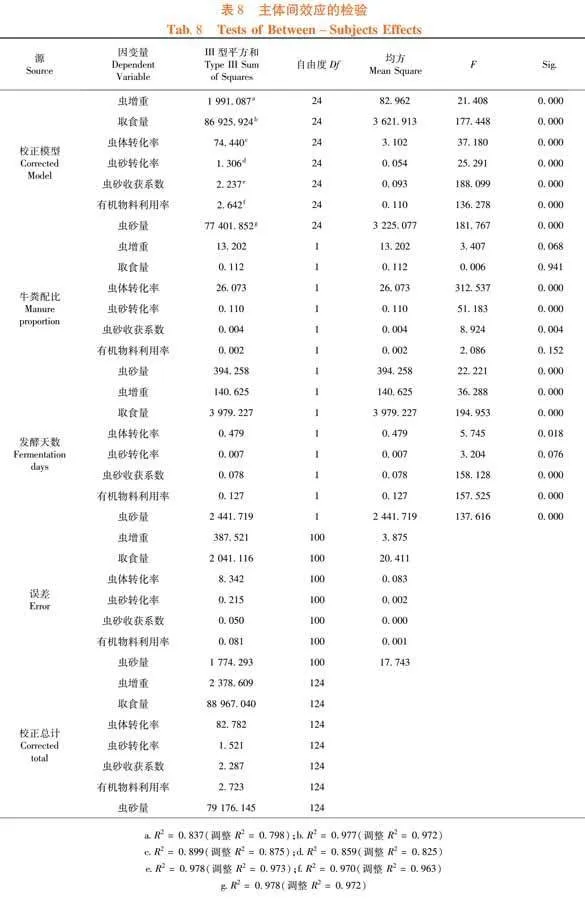
2.3 主體間效應
研究表明,白星花金龜3齡幼蟲對不同發酵天數下葡萄枝條的轉化力差異較大。取食量、增重量、蟲砂量指標均為發酵25 d處理最優;飼料利用率、蟲砂轉化率均為發酵10 d處理最優;蟲體轉化率為發酵20 d處理最優。純葡萄枝條發酵25 d,白星花金龜對葡萄枝條的轉化力最佳。表8
2.4 直觀分析和Tukey檢驗
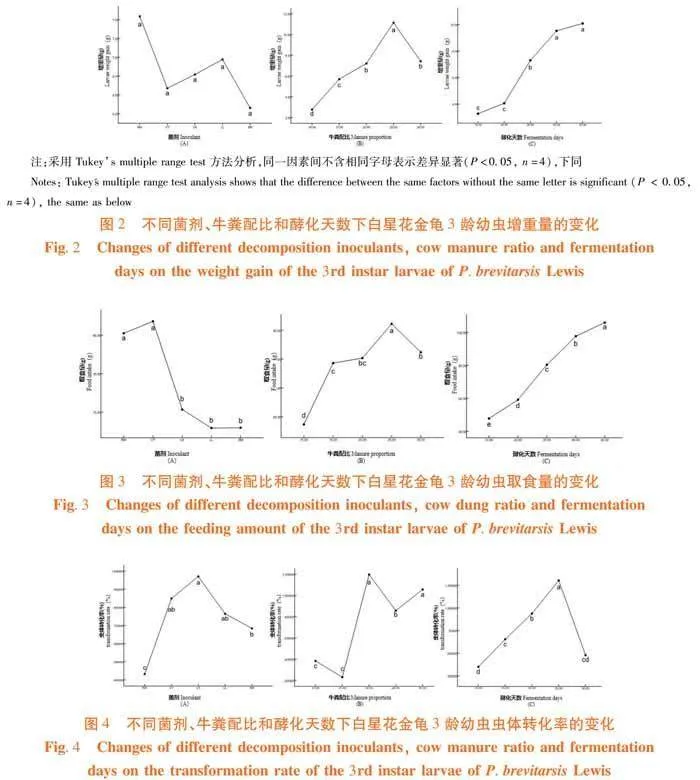
研究表明,在以增重量為篩選指標時,菌劑、牛糞配比和酵化天數的最優組合為RW菌劑、牛糞配比為40%和酵化25 d。圖2
在以取食量為篩選指標時,菌劑、牛糞配比和酵化天數的最優組合為VT菌劑、牛糞配比為50%和酵化25 d。圖3
在以蟲體轉化率為篩選指標時,菌劑、牛糞配比和酵化天數的最優組合為VT菌劑(LK菌劑)、牛糞配比為30%和酵化25 d。圖4
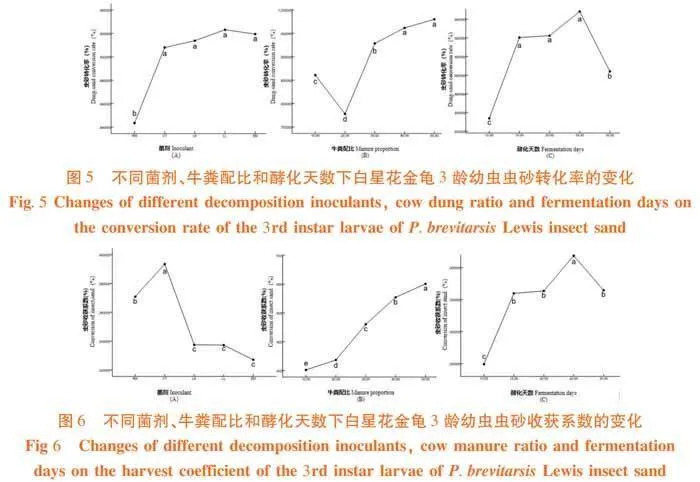
在以蟲砂轉化率為篩選指標時,菌劑、牛糞配比和酵化天數的最優組合為VT菌劑(LK菌劑、LL菌劑、EM菌劑)、牛糞配比為40%和酵化25 d。圖5
在以蟲砂收獲系數為篩選指標時,菌劑、牛糞配比和酵化天數的最優組合為VT菌劑、牛糞配比為50%和酵化25 d。圖6
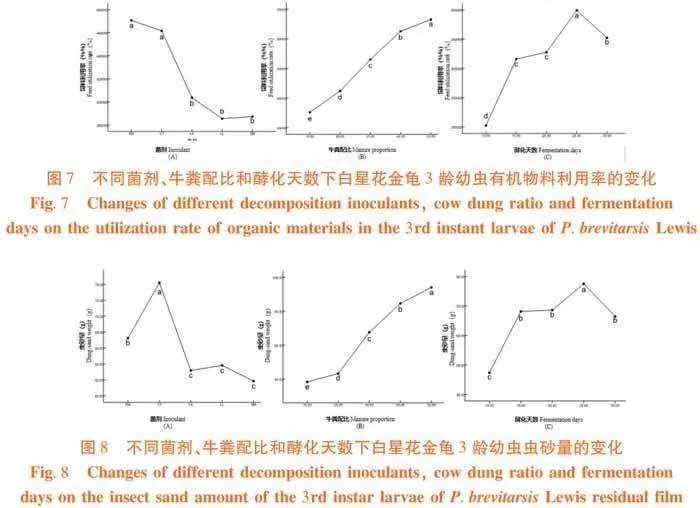
在以有機物料利用率為篩選指標時,菌劑、牛糞配比和酵化天數的最優組合為VT菌劑(RW菌劑)、牛糞配比為40%和酵化25 d。圖7
在以蟲砂量為篩選指標時,菌劑、牛糞配比和酵化天數的最優組合為VT菌劑、牛糞配比為50%和酵化25 d。圖8
菌劑在各項指標中,表現不一,最佳的菌劑還是VT菌劑。牛糞配比以40%最佳,但50%也表現較好。酵化天數25 d為最佳,30 d表現良好。根據7個指標和考慮盡量減少牛糞添加比例、縮短酵化天數、降低物料處理成本的原則,并參考白星花金龜3齡幼蟲轉化不同酵化天數的棉田殘膜回收混合物的結果,綜合選定3因素的最優組合為VT菌劑、牛糞比例40%和酵化天數為25 d。
3 討 論
3.1
白星花金龜幼蟲對作物秸稈和酵化的畜禽糞便均有較好的分解能力[14],玉米秸稈、平菇和大球蓋菇菌糠、生活濕垃圾、腐熟沼渣、豬糞、牛糞等均可進行取食分解[18],且白星花金龜幼蟲為很好的昆蟲源蛋白飼料原料[19-20]。前期研究表明,相比較于豬糞、雞糞以及尿素等,牛糞與棉稈混合,白星花金龜幼蟲對其有較高的轉化能力[21]。相較于之前的研究,葡萄枝條富含木質素、纖維素,且兩者質量占比均在280~500 mg/g范圍以內,由此葡萄枝條表現出柔韌的物理特性,針對酵化方面的關鍵數據進行相關的探索和研究,確定了葡萄枝條的可被白星花金龜幼蟲取食最佳效果的酵化方案。
3.2
通過白星花金龜對葡萄枝條的生物轉化,可輔助轉化牛糞得到昆蟲蛋白和蟲砂[17,22-23],但是在其他農業廢棄物的應用需要繼續研究。白星花金龜生長周期短、繁殖力、轉化力和適應性強,并且技術建設周期短、可復制、易推廣[24-25]。試驗中仍有葡萄枝條與牛糞粘結成塊導致白星花金龜幼蟲無法取食的情況出現,可能與粉碎程度和酵化的翻攪程度有關,后期可在酵化時使用機械充分翻攪堆體以嘗試解決問題。
4 結 論
利用白星花金龜幼蟲轉化處理堆積發酵葡萄枝條具有可行性,且效果較佳。取食葡萄枝條的3齡幼蟲累計增重量、蟲砂量均為最佳。每120 g的葡萄枝條原料,輔加80 g的牛糞,添加1‰VT菌劑,發酵25 d后,獲得配合飼料96 g,經白星花金龜3齡幼蟲轉化后可獲得86.79 g的蟲砂,蟲體增重6.59 g,剩余21.85 g殘渣。白星花金龜幼蟲轉化發酵物料的能力達23.84倍(飼料轉化率(FCR)=取食量/增重量),飼料利用率(61.17%±0.02%)和蟲砂轉化率(81.55%±0.01%)。
參考文獻(References)
[1]滿保德. 新疆吐魯番地區葡萄產業發展對策研究[D]. 石河子: 石河子大學, 2017.
MAN Baode. Research on the development strategy of grape industry in Turpan, Xinjiang[D]. Shihezi: Shihezi University, 2017.
[2] 雷天翔, 施維新, 宋敏, 等. 新疆生產建設兵團葡萄產業發展問題與對策[J]. 中國果樹, 2023,(9): 117-121.
LEI Tianxiang, SHI Weixin, SONG Min, et al. Problems and countermeasures for the development of grape industry in Xinjiang Production and Construction Corps[J]. China Fruits, 2023,(9): 117-121.
[3] 楊明昊, 張藝燦, 王孝娣, 等. 葡萄枝條堆肥對設施栽培葡萄園土壤和87-1葡萄生長發育的影響[J]. 中國果樹, 2023(4): 78-81, 86.
YANG Minghao, ZHANG Yican, WANG Xiaodi, et al. Effects of grape branch compost on soil and ‘87-1’ grape growth in protected cultivation vineyard[J]. China Fruits, 2023(4): 78-81, 86.
[4] 劉文政, 平鳳姣, 白雪冰, 等. 葡萄枝條資源化利用研究現狀及進展[J]. 農業工程學報, 2022, 38(16): 270-283.
LIU Wenzheng, PING Fengjiao, BAI Xuebing, et al. Status and prospect of resource utilization for grape vine stalks[J]. Transactions of the Chinese Society of Agricultural Engineering, 2022, 38(16): 270-283.
[5] 張廣杰. 蟲菌復合技術轉化棉稈還田對棉花生長發育及黃萎病發生的影響[D]. 烏魯木齊: 新疆農業大學, 2022.
ZHANG Guangjie. Effects of conversion of cotton stalk to field by insect-bacteria composite Technology on cotton growth and development and occurrence of verticillium wilt[D] Urumqi: Xinjiang Agricultural University, 2022.
[6] 劉玉升, 駱洪義, 葉保華. 餐廚廢棄物的環境昆蟲處理途徑及資源化利用探討[J]. 再生資源與循環經濟, 2013, 6(4): 35-37.
LIU Yusheng, LUO Hongyi, YE Baohua. The treatment and utilization approach of kitchen waste by environmental insects[J]. Recyclable Resources and Circular Economy, 2013, 6(4): 35-37.
[7] 周婷, 趙威, 趙傳岳, 等. 靈芝菌糠對白星花金龜幼蟲生長性能的影響[J]. 山東農業大學學報(自然科學版), 2022, 53(6): 868-873.
ZHOU Ting, ZHAO Wei, ZHAO Chuanyue, et al. Effects of the spent substrate of ganodorma lucidum on the growth performance of Protaetia brevitarsis lewis larvae[J]. Journal of Shandong Agricultural University (Natural Science Edition), 2022, 53(6): 868-873.
[8] 張廣杰. 白星花金龜對有機廢棄物的轉化技術研究[D]. 泰安: 山東農業大學, 2019.
ZHANG Guangjie. Research on the conversion technology of organic waste by Protaetia brevitarsis[D]. Taian: Shandong Agricultural University, 2019.
[9] 張廣杰, 王倩, 劉玉升. 白星花金龜人為條件生物學與應用潛力[J]. 環境昆蟲學報, 2020, 42(2): 257-266.
ZHANG Guangjie, WANG Qian, LIU Yusheng. Biology under artificial condition and utilization potential of Potosia brevitarsis (Coleoptera: Cetoniidea)[J]. Journal of Environmental Entomology, 2020, 42(2): 257-266.
[10] 秦銘潞. 白星花金龜幼蟲蛋白的提取、分離純化及抗炎性研究[D]. 泰安: 山東農業大學, 2020.
QIN Minglu. Study on extraction, isolation and purification of protein from larva of the Protaetia brevitarsis and its anti-inflammatory[D]. Taian: Shandong Agricultural University, 2020.
[11] 史長旭, 張廣杰, 徐業山, 等. 白星花金龜蟲糞砂混配基質對黃瓜和辣椒育苗效果的影響[J]. 新疆農業大學學報, 2021, 44(6): 443-447.
SHI Changxu, ZHANG Guangjie, XU Yeshan, et al. Effects of Protaetia brevitarsis lewis larvae dung-sand mixture matrix on cucumber and pepper seedling[J]. Journal of Xinjiang Agricultural University, 2021, 44(6): 443-447.
[12] Yoon H S, Lee C S, Lee S Y, et al. Purification and cDNA cloning of inducible antibacterial peptides from Protaetia brevitarsis (Coleoptera)[J]. Archives of Insect Biochemistry and Physiology, 2003, 52(2): 92-103.
[13] Lee D G, Park J H, Shin S Y, et al. Design of novel analogue peptides with potent fungicidal but low hemolytic activity based on the cecropin A-melittin hybrid structure[J]. Biochemistry and Molecular Biology International, 1997, 43(3): 489-498.
[14] 楊誠, 劉玉升, 徐曉燕, 等. 白星花金龜幼蟲資源成分分析及評價[J]. 山東農業大學學報(自然科學版), 2014, 45(2): 166-170.
YANG Cheng, LIU Yusheng, XU Xiaoyan, et al. Analysis and evaluation of resource components of Protaetia brevitarsis(lewis) larvae[J]. Journal of Shandong Agricultural University (Natural Science Edition), 2014, 45(2): 166-170.
[15] Li Y M, Fu T, Geng L L, et al. Protaetia brevitarsis larvae can efficiently convert herbaceous and ligneous plant residues to humic acids[J]. Waste Management, 2019, 83: 79-82.
[16] Manning P, Slade E M, Beynon S A, et al. Functionally rich dung beetle assemblages are required to provide multiple ecosystem services[J]. Agriculture, Ecosystems amp; Environment, 2016, 218: 87-94.
[17] 劉玉升, 張大鵬. 基于白星花金龜幼蟲轉化玉米秸稈的微循環農牧場模式研究[J]. 安徽農業科學, 2015, 43(31): 85-87.
LIU Yusheng, ZHANG Dapeng. Study on the model of microcirculation farm and ranch on the corn straw transformed by larval of Potosia brevitarsis lewis[J]. Journal of Anhui Agricultural Sciences, 2015, 43(31): 85-87.
[18] Zhang G J, Xu Y S, Zhang S, et al. Transformation capability optimization and product application potential of proteatia brevitarsis (Coleoptera: Cetoniidae) larvae on cotton stalks[J]. Insects, 2022, 13(12): 1083.
[19] 何笙, 周澤容, 吳趙平, 等. 白星花金龜發生與防治技術研究初報[J]. 中國農學通報, 2006, 22(6): 314-316.
HE Sheng, ZHOU Zerong, WU Zhaoping, et al. A study on the occurrence of postosia brevitarsis leiwis and its prevention amp; control technology[J]. Chinese Agricultural Science Bulletin, 2006, 22(6): 314-316.
[20] 王佳男. 基于白星花金龜幼蟲活體篩選高致病力白僵菌菌株[D]. 泰安: 山東農業大學, 2019.
WANG Jianan. Screening of high-virulence strains of Beauveria bassiana based on Protaetia brevitarsis larvae[D]. Taian: Shandong Agricultural University, 2019.
[21] 郭勇. 鄆城縣農業有機廢棄物資源調查和環保昆蟲轉化處理模式探究[D]. 泰安: 山東農業大學, 2020.
GUO Yong. Yuncheng County Investigation of agricultural organic waste resour-ces and exploration of Environmental protection insect transformation treatment model[D]. Taian: Shandong Agricultural University, 2020.
[22] 張倩. 取食平菇菌糠的白星花金龜生物學研究[D]. 泰安: 山東農業大學, 2015.
ZHANG Qian. Biological study of Protaetia brevitarsis feeding on oyster mush-room bran[D]. Taian: Shandong Agricultural University, 2015.
[23] 孫晨可. “小麥秸稈—大球蓋菇—白星花金龜” 循環模式研究[D]. 泰安: 山東農業大學, 2018.
SUN Chenke. Study on the cycle pattern of \"wheat straw - large ball mushroom - Protaetia brevitarsis\"[D]. Taian: Shandong Agricultural University, 2018.
[24] Gossner M M, Lachat T, Brunet J, et al. Current near-to-nature forest management effects on functional trait composition of saproxylic beetles in beech forests[J]. Conservation Biology, 2013, 27(3): 605-614.
[25] Zhang X F, Wang L Y, Liu C Q, et al. Identification and field verification of an aggregation pheromone from the white-spotted flower chafer, Protaetia brevitarsis lewis (Coleoptera: Scarabaeidae)[J]. Scientific Reports, 2021, 11(1): 22362.
[26] 徐業山. 蟲菌復合技術分離棉田殘膜回收混合物研究[D]. 烏魯木齊: 新疆農業大學, 2022.
XU Yeshan. Study on separation of residue film recovery mixture from cotton field by insect-bacteria composite technology[D]. Urumqi: Xinjiang Agricultural University, 2022.
Optimization of high-efficiency decomposition conditions and transformation parameters of grapevine branches eaten by the Protaetia brevitarsis Lewis
XU Andong1,ZHANG Guangjie1,FU Rao1,MENG Zhuo1,YAN Yu1, LI Baoguo2, MA Deying1
(1." Key Laboratory of Monitoring and Safety Prevention and Control of Agriculture and Forest Pests/ College of Agriculture, Xinjiang Agricultural University ,Urumqi 830052, China; Urumqi 830052, China; 2. Tianfeng Animal Husbandry Development Co., Ltd. of the 83th Regiment, the 5th Division, Jinghe Xinjiang 833303, China)
Abstract:【Objective】 Optimization of high-efficiency decomposition conditions and transformation parameters of grapevine branches eaten by the Protaetia brevitarsis Lewis,which has provided a new way for the resource utilization of grape branches.
【Methods】" Crushed grape branches were taken as the main raw materials, the orthogonal experiment of 3 factors and 5 levels was performed, which included the decomposition inoculants, the ratio of cow dung (%) and the number of fermentation days (d).By measuring the conversion power of larvae to the materials, the optimal combination of feeding grape branches by the larva was screened and verified.
【Results】" The results showed that the proportion of cow dung reached a significant difference level at the 10 th, 15 th, 25 th and 30 th days.The higher the proportion of cow dung, the higher the temperature, indicating the better fermentation rate, and the addition of decomposition inoculants and cow dung had a better promotion effect on the fermentation of materials.After fermentation for 25 days, 96 g of compound feed was obtained from each 120 g of raw grape branches, supplemented with 80g of cow dung and 1‰ VT decomposition inoculants.After the conversion of the 3rd larva, the insect sand content was (77.53±22.43)g, the insect body conversion rate was (37.16%±0.04%), and the insect sand conversion rate was (84.99%±0.01%).The harvest coefficient of insect sand was (59.47%±0.04%), and the utilization rate of organic materials was (61.17%±0.02%).
【Conclusion】" The 3rd instar larvae of the Protaetia brevitars has a good conversion ability to ferment grape branch feed.Adding 1%VT decomposition inoculants, 40% cow dung and after 25 d fermentation is the best fermentation scheme.
Key words:grape branches; larvae of Protaetia brevitarsis Lewis; decomposing inoculants; biotransformation; resource utilization
Fund projects:Shuanghe City Samp;T Project of the Fifth Division, XCPP (21XM03) ;Key Scientific R amp; D Program Project of Xinjiang Uygur Autonomous Region (2022B02046)
Correspondence author: MA Deying(1968-), female, from Urumqi, Xinjiang , professor,Ph.D.,master supervisor/doctoral supervisor, research dirction:green control of pests research, (E-mail)mdynd@163.com
基金項目:新疆生產建設兵團第五師雙河市科技項目(21XM03);新疆維吾爾自治區重點研發專項(2022B02046)
作者簡介:徐安東(1998-),新疆喀什人,碩士研究生,研究方向為資源昆蟲及廢棄物資源化利用,(E-mail)1625461918@qq.com
通訊作者:馬德英(1968-),女,新疆烏魯木齊人,教授,博士,碩士生/博士生導師,研究方向為有害生物綠色防控,(E- mail)mdynd@163.com