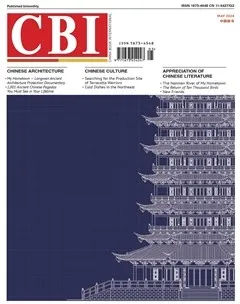
1,001 Ancient Chinese Pagodas You Must See in Your Lifetime1
2024-01-01 00:00:00WuKai
中國(guó)新書(英文版) 2024年3期


1,001 Ancient Chinese Pagodas You Must See in Your Lifetime
Wu Kai, Wang Xuebin
China Pictorial Publishing House
October 2023
328.00 (CNY)
Wu Kai
Wu Kai graduated from Tsinghua University with a Bachelor’s degree and a Master’s degree. He has a soft spot for ancient towers and has made special trips visiting hundreds of ancient towers across the country for more than ten years.
Wang Xuebin
Wang Xuebin serves as a chief editor. Wang once worked as a reporter and editor on Zhengzhou Evening News and at Zhengzhou Daily and is currently the vice president of the Central Plains Research Institute of the Yellow River University of Science and Technology.
Throughout the thousands of years of our nation’s glorious ancient civilization, pagodas have been a unique treasure. They embody people’s beautiful wishes, encapsulate the wisdom of artisans, integrate advanced technology, and carry the soul of cities. Pagodas are undoubtedly one of the most important and fascinating aspects of Chinese cultural heritage and serve as a polished business card of Chinese culture during international exchanges. Since my student days, I have developed a profound interest in ancient pagodas -- each one weathered and mysterious, like exquisite jade or a beautiful woman, exuding endless charm. Over the years, wherever I go, I make a special trip to visit the local ancient pagodas. Standing before them, I meticulously observe every detail, feeling the sincere faith and outstanding skills of the craftsmen who built them centuries ago. I capture detailed, comprehensive images and, upon returning home, record every bit of information about each pagoda, systematically organize the photographs, and sequentially add them to my personal ancient pagoda archive database. After more than a decade of relentless effort, I have compiled firsthand graphic and textual information on nearly 5,000 ancient pagodas. Under the editorial planning of the China Pictorial Publishing House, 680 sites comprising approximately 2,400 pagodas were selected for publication. About 960 of these pagodas are individually showcased with texts and images, while over a thousand others are presented in groups or clusters. The “1,001” in the book title is a figurative number. The “1” at the end represents an endless possibility of new beginnings. Among all the pagodas in the book, readers can choose the one that is most special to them.
During these years of visiting pagodas and organizing materials, what has brought me the most joy is meeting a group of friends who also love ancient pagodas. Among them are professionals in ancient architecture and art, as well as many amateurs. After learning about my idea to create a national archive of ancient pagodas, these friends from across the country generously provided me with a vast array of precious and spectacular photos of ancient pagodas. Many ancient pagodas are located in remote areas or perched on cliffs, making them challenging to access. Some photos were obtained only after arduous efforts, like those by Liu Xiaohua, a photographer from Gansu, who carried heavy camera equipment and hiked for hours without a guide through an uninhabited forest to photograph the Ta’erzhuang Pagoda from the Five Dynasties Period. Jia Fei, a civil engineering expert, endured freezing cold winter winds in southern China, waiting for sunrise to capture an ancient pagoda against the dawn sky, causing his hands to crack from the cold. Similarly, Wang Wenbo from Shanghai, at an altitude of over 4,000 meters on the Qinghai-Tibet Plateau, repeatedly ran up and down slopes with an oxygen tank to find the best shooting angle. Gao Junqing, a veteran ancient architecture photographer, was attacked by poisonous insects while photographing an ancient pagoda in the wilderness in Shaanxi and had to be rushed to the hospital for emergency treatment. The list goes on, and I have had numerous experiences searching for pagodas alone in torrential rain or desolate wilderness. Moreover, many ancient pagodas have been damaged beyond recognition by earthquakes, hurricanes, and human destruction. So many images in the photos can no longer be presented in their original form. Of the more than 1,700 photos included in this book, over 300 have become rare out-of-print treasures. Each photo in the book is accompanied by the name of the pagoda, the photographer’s name, and the date of capture to help readers understand the era of the photos. Without the hard work of the members of the ancient pagoda photography team, the quality of this book would indeed be greatly diminished.
In earlier years, scholars such as Liang Sicheng, Zhang Yuhuan, Luo Zhewen, and Xiao Mo published systematic studies on Chinese ancient pagodas, like History of Chinese Architecture, Chinese Ancient Pagodas, Chinese Pagodas, Collection of Chinese Ancient Pagodas, and History of Chinese Architectural Art. These were unrivaled classics at the time but mostly limited to pagodas well-known to the general public, leaving out many valuable but obscure pagodas located in remote areas with poor access. Additionally, in the last 20 years, with the dramatic development of information retrieval capabilities and widespread high-speed transportation networks, the subject of ancient pagodas has attracted a large number of professional researchers. Advances in architecture, civil engineering, history, archaeology, religious studies, and folklore studies related to pagodas have been unprecedented, with new research findings continuously emerging. Many previously widely accepted views on pagoda styles, construction techniques, and dating have been proven inaccurate and require revision. Many pagodas previously considered unique or solitary in style and decoration have now found similar “companions.” Moreover, many previously inconspicuous pagodas have been discovered to have significant new meanings and values, and it is necessary to update this information for readers.
Some might say, “Aren’t’ ancient pagodas just some old bricks and rubble? How valuable can they be?” Besides, if all the pagodas look similar, what’s the point of doing this tedious organizing work? In my eyes, ancient pagodas are not just piles of bricks or stones but living beings, long-lost old friends. Every visit to an ancient pagoda is not just about experiencing the cultural heritage that has survived for thousands of years or understanding the essence of creation. It is also about reconnecting with the simple heart that pursues perfection and respects nature, now buried under the hustle and bustle of modern cities. Though originally derived from ancient India, Chinese pagodas are vastly different from their Indian prototypes. The greatest charm of Chinese pagodas lies in their rich diversity. Pagodas from different periods and regions each have their unique characteristics, leading to a myriad of forms over nearly two thousand years of development in China. On China’s 9.6 million square kilometers of land, there are over ten thousand ancient pagodas, and no two are exactly alike. Additionally, due to soil erosion and foundation subsidence, the majority of existing pagodas in China are somewhat tilted, with some even more inclined than the Leaning Tower of Pisa, a world-renowned tourist attraction in Italy. Examples include the Daxiangsi Pagoda in Heyang County, Shaanxi Province, the Huzhu Pagoda in Songjiang District, Shanghai, and the Linglong Pagoda in Xinxiang City, Henan Province, standing tall for a millennium and rightfully considered architectural wonders in human history. Who doesn’t have a pagoda in their hometown? I truly hope that every Chinese person can appreciate this rich and outstanding cultural heritage.
A towering tree must have its roots; a mountainous spring must have its source. All history and culture are rooted in skills and civilization, with history serving as a vital carrier for the culture of ancient pagodas. China has always been highly creative since ancient times. Its ancient inventions, as brilliant as a star-studded sky, have illuminated the vast expanse of human culture and left behind many immovable cultural relics, including ancient pagodas. All history stems from geography; A region’s people are nurtured by its terrain. It is the distinct landscapes that have shaped the diversity of Chinese pagodas, with each region’s pagodas embodying unique cultural traits, revealing little-known codes and sources of power within Chinese culture and continuing the legacy of “national treasures.”