Xanadu: The Golden Deserted City
2024-01-01 00:00:00
中國新書(英文版) 2024年3期

Exploring Ancient Cities: The Seen and Unseen History
Tang Keyang
CITIC Press Group
January 2019
58.00 (CNY)
Tang Keyang
Tang Keyang obtained a Ph.D. in Design Studies from Harvard University, and is a researcher in architecture and urban studies, writer, and architectural designer. He also curated exhibitions like “Living Chinese Gardens” (German National Museum Collection, 2008), China National Pavilion at the Venice Biennale (Venice, Italy, 2010), and “Climate” (Wuhan Art Museum, 2014).
Visitors to Xanadu see a city in a Chinese style, with square walls and familiar street layouts, yet the interior is utterly desolate, filled with an unfamiliar “nature” to Chinese cities. As Calvino described Marco Polo or perhaps his imagined version of the city in Invisible Cities: “Dusk falls, and the air after the rain smells of elephants.”
Setting out from Beijing along the Jingzang Expressway and heading northwest leads one towards the ruins of Xanadu in Inner Mongolia’s Xilin Gol League. This ancient city lies almost directly north of Beijing, hence a sharp turn to the northeast is made, making nearly a right angle. Historically, Xanadu was where Kublai Khan “submerged the dragon” or “resided in the provinces,” actually predating the capital city. Before becoming the heir to the throne, Kublai Khan established the “Jinlian Chuan Military Headquarters” here, fostering the power he relied on for life-and-death struggles with competitors like Ariq B?ke. Hence, the Khan had a special affection for Xanadu. “Jinlian Chuan” remains a fittingly beautiful name to this day, long after Kublai Khan and the later Mongol emperors vanished, Xanadu (or Kaiping Prefecture) slowly faded from the sight of northern residents and nomads, yet the golden lotus flowers continue to bloom across the southern grasslands every July and August. The golden lotus, an herbaceous plant from the Ranunculaceae family, has flowers slightly larger than a fingernail cap, “gold in color, with seven petals circling the heart, multiple blossoms per stem, resembling a small lotus. At a glance, the field is a brilliant gold.”
Xanadu was first, then the great capital city. If you draw a line from the midpoint of the central axis of the Forbidden City’s three main halls and extend it indefinitely northward, you’ll find that Beijing’s central axis is not perfectly north-south but veers slightly west by two degrees, and this skewed line points straight to Xanadu. Why do these two cities have such an astonishing alignment? Some suggest the planning of “Khanbaliq” was a tribute to Xanadu, as if reversing the order, mistaking priority: Even though the Mongols came later, “Beijing” has a longer, illustrious past, from Tang Youzhou to Liao Nanjing and Jin Zhongdu, each a grand city in their own right. If indeed the capital learned from Xanadu, then the teacher was the latecomer, and the student had been seated there for centuries.
Thus, this mysterious and unexplained connection remains a topic worth exploring.
Even among the many cities I’ve painstakingly listed over the years, some places like Xanadu remain blank. Not because I’ve never been there, but because I’m entirely ignorant of these questions and unable to provide any rational “welding points” for my research -- though also considered a masterpiece of ancient Chinese capitals, the civilization of the Han people seems to have rarely reached further north than this, even though places like New York and Paris don’t seem so far away now. Yet the issues of our time often stem from the dark, those past and present conflicts not yet discerned, perhaps unknown, but still distinctly felt. “Tradition” concerns not only the well-trodden paths of history but also those hidden and obscure memories.
If Xanadu has left nothing else behind, it at least pertains to fantasies, within which its name remains familiar to the other half of the world. In English, Shangdu is spelled “Xanadu,” not the modern pinyin, and for Westerners looking east since the Mongol conquests, this X-starting word, like Xerxes, sounds both familiar and odd. During his acquaintance with William Wordsworth and his sister Dorothy, the 18th-century English poet Coleridge, in a trance, wrote a long poem, Kublai Khan, in which he dreamed of Xanadu:
Kublai Khan at Xanadu
Ordered to build a dome of grand acclaim,
Where the sacred river Alph ran
Through caverns vast, unseen by man,
To a sea where sunlight never came…
Marco Polo’s Travels vividly describes Xanadu: “Traveling northeast for three days brings you to Xanadu. It was the capital built by Kublai Khan, who also used marble and various beautiful stones to construct a palace. This palace was intricately designed and luxuriously decorated, making the entire structure awe-inspiring. All the halls and rooms of the palace were gilded, decorated in regal splendor...” It seems that Coleridge’s fantastical dreams were quite accurate; at least one dream sounded like another. Besides mentioning the “broad sixteen miles” of comparable city walls, he emphasized Xanadu city’s “springs and streams flowing within, with many grasslands,” corresponding to Coleridge’s poem’s “fertile soil,” “gardens, winding rivers,” and “fragrant expanse” descriptions of blossoming flowers, forests, and mountains. He didn’t write about a city teeming with people; he saw sunny grasslands here.
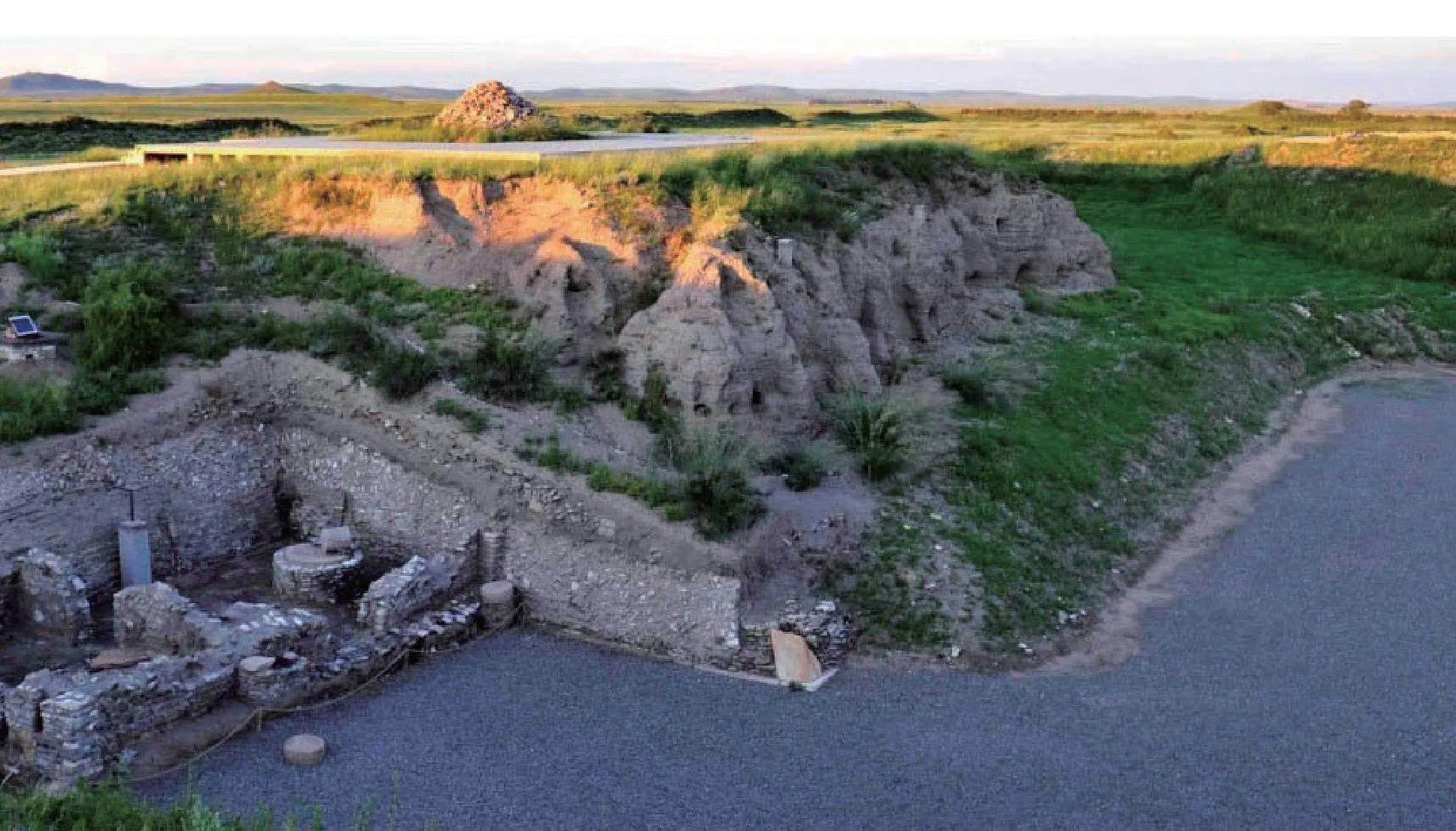
The correspondence of texts from dubious sources may be coincidental, but when all “documentation” remains imaginative, such “fiction” curiously gains historical value. It’s worth noting that archaeological findings confirm that there were indeed many “springs and streams” in Xanadu, with the city built over these naturally scenic landscapes, which differ significantly from the bustling “metropolis” as imagined by modern people. Folklore ties Liu Taibao (Liu Bingzhong) to the nation’s founding, requesting from Kublai Khan “land from the dragon” because of “a dragon pool on the site that couldn’t be dried up.” The reality is that the Xanadu area is near swamps, making water drainage difficult and large-scale construction a challenge, requiring human effort to overcome nature, “the palace foundations boiled with spring water, constructed with ten thousand wooden pegs, costing a fortune.” The vibrant scenery within the Xanadu ruins today may well reflect its original character, though reduced by the ravages of war, yet not completely reversing its essence, “the nation is broken, yet the rivers and mountains remain” takes on a new meaning. What corresponds to this is the Mongolians’ mythical “wild” city, vastly different from the urban civilizations familiar to the Central Plains. The immense walled city isn’t bustling with ordinary urban life but resembles a vast royal garden of the Khan, more precisely, his hunting grounds. Marco Polo said that here, during the summer, the Great Khan often released leopards to chase their prey, yet the emperor himself did not partake in this prey, which was ultimately fed to eagles and hawks, making the Mongolian hunt merely a game.
The nomadic nation’s capital was initially further north in the steppe, and books like The Journey of Rubruquis to the East mention the exotic customs that likely resulted from the Great Khan’s blend of various cultures; Xanadu’s planner Liu Bingzhong, although a Han Chinese and the main designer of the capital, was also influenced by the nomadic tastes of the foreign rulers: “Another palace in the grasslands was built purely from bamboo stems, coated inside with gold, quite skillfully decorated. The tops of the stems were varnished very densely, so rain couldn’t corrode them. The stems were about three palms thick and ten to fifteen palms long, cut at each joint.” What kind of city could emerge from such tastes? It seems the exquisite craftsmanship of the conquered Southerners and the fixed methods of the Mongolian yurt came together, creating strange and prominent landmark buildings in the northern capitals. This period also marked the beginning of extensive use of colored glaze, the colorful glazes transforming and achieving the familiar “Forbidden City” in today’s China, a departure from the solemn grandeur of the palaces since the Sui and Tang dynasties.