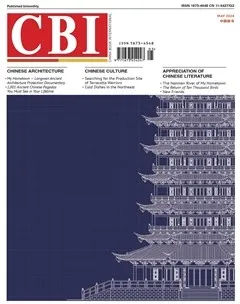
My Hometown - Longwan Ancient Architecture Protection Documentary
2024-01-01 00:00:00
中國新書(英文版) 2024年3期


My Hometown — Longwan Ancient Architecture Protection Documentary
Chen Zuo
Huang Shan Publishing House
July 2022
228.00 (CNY)
Chen Zuo
Chen Zuo is a member of the Chinese Calligraphy Association and the Chinese Couplet Society, honorary professor of Zhejiang Oriental Vocational College, and president of the Luo Feng Art Association.
Architecture is a vital carrier of human culture, a microcosm of historical changes, and a symbol of urban spirit. Longwan, nestled between mountains and the sea, boasts a wealth of historical and cultural resources, solidifying its reputation with its four cultural pillars: notable figures, folk customs, ancient castles, and calligraphy. It has produced historical figures such as Zhao Jianda, the Minister of Public Works during the Southern Song Dynasty, Zhang Cong, the chief advisor in the Ming Dynasty cabinet known as “Elder Zhang,” Wang Zan, a vice minister in the Ministry of Rites during the Ming Dynasty, and Jiang Ligang, a master of calligraphy.
The ancient buildings of Longwan are structurally timber-framed and inherently fragile. Surviving natural and man-made disasters through the Tang and Song dynasties, it was not until the Ming Dynasty, with the rise of the salt industry and consecutive imperial examination successes, that clusters of civilian dwellings emerged. In the second year of the Qiandao era under the Song dynasty, Longwan experienced the worst flood in Wenzhou’s history, leaving corpses strewn across the fields. In the early Qing Dynasty, as boundaries within the region were redrawn, another devastating disaster occurred, leaving few buildings standing, as sparse as stars at dawn. By the late Qing Dynasty, as the Ouhai port opened and Western influences crept in, the ancient architectural styles began to integrate and embrace diverse elements. A century ago, Longwan craftsmanship shone brilliantly, creating seamless grand designs and fostering a unique architectural culture that aspired for a better life and embraced new things, engraving Longwan’s profound transformations and cultural evolution over a century.
In recent years, Longwan has initiated urban village renovations, sparking significant debates over the fate of historical buildings. The Longwan district government, committed to its guardianship duties, has seized the opportunity for major demolition and reorganization, protecting many heritage sites and valuable traditional buildings in collaboration with various local agencies. By employing the “Longwan model” of on-site preservation, relocation, and dismantling for component preservation, this strategy revitalizes cultural heritage, uncovers deep cultural layers, and embodies President Xi Jinping’s vision of a place where one can see mountains, waters, and remember the nostalgia of home.
Today, Longwan is shaping its city brand around the concept of “New Center, Great Future.” The city’s future development hinges on culture, with ancient architecture serving as the city’s “roots” and “soul,” embedding within the urban fabric a unique memory and identity, shaping both its historical narrative and development trajectory. These ancient buildings of Longwan, gifts from our ancestors, have been well preserved for over a century, resonating with history.
This book, My Hometown — Longwan Ancient Architecture Protection Documentary, documents the architectural characteristics and stories of Longwan’s civilian buildings since the late Qing Dynasty, archiving Longwan’s ancient architecture and retaining the city’s heritage, reflecting our cultural workers’ dedication to sustaining wisdom, ensuring community well-being, and fostering peace for generations — a mission entrusted to us by our era.
Located on the southeastern coast of Wenzhou, Longwan has a rich history as part of ancient Ou-Yue, traditionally known as Yongjia Place, a historically significant and culturally rich region known as the prosperous “land of fish and rice” in southern Zhejiang. Especially during the Ming Dynasty, the area enjoyed a cultural peak, leaving behind numerous valuable and distinctive historical and cultural artifacts and buildings.
Each brick and tile of Longwan’s ancient buildings reveals a distinctive era’s style, regional features, and rich value, representing cultural treasures left by our ancestors. From site selection and overall layout to exterior design, interior structure, and artistic embellishments, these buildings not only demonstrate the craftsmanship of their builders but also embody the ancient philosophy of “unity of heaven and man,” reflecting concepts of harmony between people and their environment, imbued with the traditional cultural spirit, customs, and aesthetic preferences of Yongjia Place through different periods, also offering significant insights for modern urban development.
The traditional residences of Longwan primarily feature timber frame structures, with courtyard layouts typically being long strips or enclosed quadrangles, and some villages feature large mansions with four-sided courtyards and three-section compounds, collectively forming layouts like the characters “一,” “回,” “口,” and “日.” The architectural layout is clear and orderly, reflecting the influence of ancient societal norms and rituals on building design. Characterized by front porches with timber frames, the primary roof styles are gable and hanging gable, with simple and rustic facades, deep overhangs, and gently sloping eaves, which are practical for rest and work, providing shelter, and aiding rainwater drainage and typhoon resistance during the rainy seasons of southern Zhejiang; they also possess aesthetic qualities, featuring rhythmic beauty, curved elegance, symmetrical balance, harmonious contrasts, and proportionate grace. These ancient architectural crafts are well-preserved, with a wide variety of types, such as the residential buildings in Dilingsha, Houzhaidi, Jiali Liufang, and Wang Haichao, all representative of different historical periods. Due to its location on the southeastern coast, Longwan faced severe threats from Japanese pirates during the Ming Dynasty, with structures like Yongchang Fort built through community fundraising to resist these attacks, along with other historical buildings like the Anti-Japanese Martyrs’ Tower, Martyrs’ Temple, Wang De’s Tomb, Yunting Mountain Fort, Longwan Battery, and Wuxi Militia Outposts, which are key components of Longwan’s anti-pirate culture.
Historically, Longwan has suffered three major natural and man-made disasters that have significantly impacted its living environment. The first was the flood of the Qiandao era in 1166, which left corpses covering the river, with only eleven survivors. The second was during the Jiajing period of the Ming Dynasty when pirate raids devastated towns and cities. The third was in the early Qing Dynasty when boundary changes almost led to the complete destruction of local communities. As a result, stone structures like city sites, pagodas, bridges, and wells from the Song, Yuan, Ming, and Qing dynasties are still preserved, while most wooden structures date from the late Qing and Republican Periods.
From a preservation standpoint, most of Longwan’s villages still maintain their original water town layout, roads, and water systems. Longwan is typically a place of migration and settlement, with most villages composed of single-surname clans living together, forming a “clan-based society.” The feudal dynasties adhered to a governance principle of “royal authority not extending beyond the county, with counties governed by clans, clans governing autonomously, autonomy based on ethics, and ethics forming the basis of the local gentry,” making each village a stable mini-society, with gentry pooling clan resources to build homes, schools, bridges, roads, and wells, evidenced by numerous inscriptions. While many of the village’s public buildings, like ancestral halls and temples, have been renovated, they still retain traditional architectural forms. Pure wooden ancestral halls and temples are now rare. Each village still preserves several ancient buildings from the Ming and Qing dynasties onwards, with Qing architecture continuing the traditional styles of earlier Chinese dynasties, representing the last peak of feudal society architecture in China.