
Welcome to China’s Most International Small City
2023-09-15 09:59:40TextandphotographybyRomanKierst
漢語世界 2023年3期
Text and photography by Roman Kierst

Illustration by Wang Siqi
A gIimpse into the Iives of Yiwu’s 10,000 permanent foreign residents“國際縣城”義烏的“中漂”們
It’s easy to get lost inside the world’s largest small commodities market, but Mohamed Alsalami knows the place like the back of his hand.The 50-year-old businessman originally from Yemen marches through the halls of the vast, maze-like market, passing power drills, LED lights, and plastic wall ornaments for Christmas, stopping only to negotiate for his client:
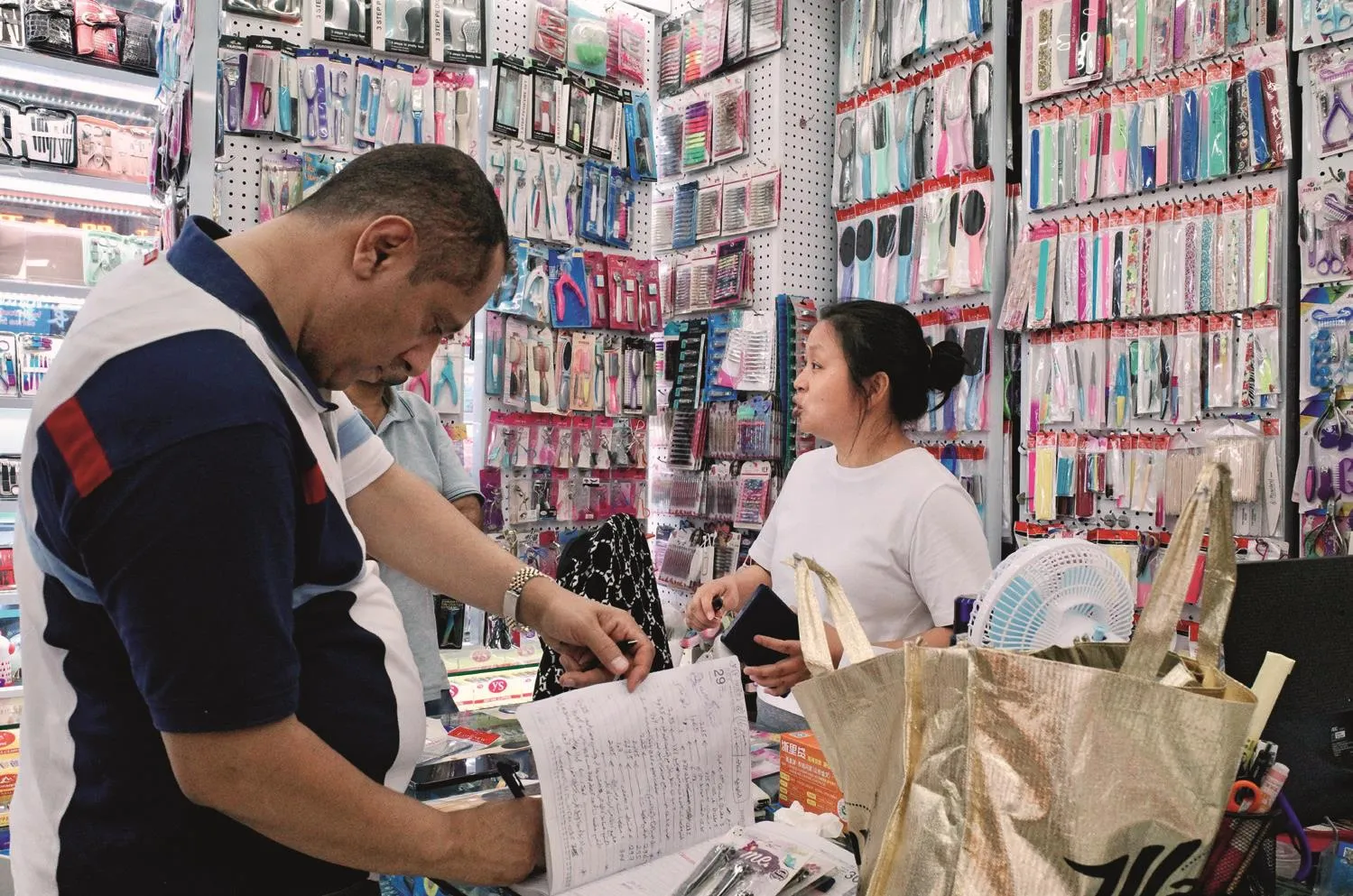
“This buyer is not just ordering one box of this stuff, alright? He’s looking to buy 100 to 150 boxes of each, so you better get that price down a bit,” Mohamed says, in pitch-perfect Chinese, to one store owner, pointing at different cosmetics items like nail clippers and files neatly laid out on the floor for his client, also from Yemen, to inspect.
“I’m not ripping you off, that’s the lowest I can do, I’m not making any profit!” the seller retorts, pointing at the prices she has written in black marker on the floor next to the items.But Mohamed is stubborn—after living in the area for over 20 years, he knows how to get a good deal.“Let me take that pen of yours and write the prices for you, then you take a moment to consider, we’ll be out of here in a minute,” he says.
Mohamed is one of over 10,000 permanent foreign residents from more than 100 countries living in Yiwu, a county-level city of around 2 million people in Zhejiang province, about 300 kilometers southwest of Shanghai.This thriving community of foreigners sets Yiwu apart from most other small cities in China.For comparison,Hangzhou, the provincial capital, has six times the total population of Yiwu, but a similar number of non-Chinese calling it home.

Yiwu’s large foreign community exists because the city is a vital international trading hub.Its vast indoor market complex features over 75,000 stores selling Chinese-manufactured Christmas baubles, umbrellas, children’s toys,and pretty much everything else in between for export.China’s “trinket town” attracts buyers and traders from around the world for business trips where they source suppliers and find goods to send to their home countries.But Yiwu has also become a permanent home to a diverse population of foreign residents like Mohamed,who play various roles as global commercial agents, cultural ambassadors, and ordinary people contributing to the unique culture of their adopted home.
Born in Yemen in 1973, Mohamed graduated from high school in 1989 and won a scholarship to study Chinese language and later civil engineering in China, but found his way into the world of international trade in Yiwu while working as a translator for foreign businessmen in the country around the year 2000.
“Yiwu 20 years ago and Yiwu now is a difference like heaven and earth,” Mohamed tells TWOC in Chinese, a language he feels most comfortable with after his native Arabic.Yiwu’s market began as a small bartering bazaar in the 1980s and has since grown into a massive commercial hub with multiple floors and different areas (numbered one through five)for specific categories of goods, all connected by kilometers of pathways lined with one showroom storefront after another.If you spent only 10 seconds in each shop, it would take you over a week to see the whole market—but thanks to middle-men and women like Mohamed,visitors that don’t know their way around can still get insider tips on where to find the best suppliers, or how to get the best prices.
If you spent only 10 seconds in each shop,it would take you over a week to see the whole market.
“Pakistanis were among the first to do business here and the market was a lot smaller and more run-down back then.Sellers only had small stalls with barely any room to show samples, so the foreign buyers would stay at the Honglu Hotel,”Mohamed reminisces.“The sellers would line up in front of the hotel rooms with samples to present.They would just rush inside and try to show off their goods,” he remembers.“I was almost like a bouncer for these foreign buyers.”
After a long day of cutting deals, Mohamed likes to wind down at his favorite Yemeni restaurant, opened by a fellow long-time Yemeni trader in Yiwu six years ago.The atmosphere is lively.Arabic chatter between mostly male patrons fills the room.The tables are covered with thin disposable plastic sheets because the food here—grilled mutton, chicken served on mounds of pilaf rice, and other Yemeni specialties—is eaten in the traditional style with hands only.
Every few minutes, Mohamed is recognized and greeted by patrons.He was chairman of the Yemeni Trade Council in Yiwu between 2011 and 2014, a grassroots community organization helping Yemeni businesspeople with tasks like visa applications and registering businesses.Due to its multinational population, Yiwu has been the site of multiple pilot projects aiming to facilitate business and residence for its foreign population.In 2016, the city began issuing Foreign Citizen Cards for foreigners to use as personal identification in lieu of passports and has since upgraded its function so that the cardholder may use it for credit checks and cash-free payments.
In another part of town, Claudia Moreno,originally from Mexico, is donning her dance shoes for a salsa session.What began as casual dances among friends five years ago are now bi-weekly workshops for anyone interested in Latin dance.There are only a handful of Mexicans in Yiwu, Moreno reckons, but the dance classes have attracted local Chinese and foreigners alike.“It’s just for the spirit and the soul.We didn’t have many things like this before, things not related to business,just for enjoyment,” she tells TWOC.The 37-year-old businesswoman, who holds a degree in pharmacology, has been in the world of Yiwu trade since the age of 15, when her family’s jewelry business began sourcing goods from China.
Besides taking care of the family business,Moreno also recently opened a Mexican restaurant, organizes weekly charity events for a local orphanage, and teaches Spanish at the Yiwu Industrial & Commercial College.“I was the first Spanish teacher at the college, but there are more and more these days since Spanish is becoming a more popular second foreign language choice,” she explains.“Most Chinese students here do it for business of course.”

Yiwu is a hub for the world’s Christmas decorations, which are on sale for export all year round
People from around the world come to Yiwu to purchase goods from Chinese sellers
At schools like the Yiwu Industrial &Commercial College, droves of aspiring Chinese students are majoring in business-related fields and foreign languages.They are drawn by favorable business conditions that arose through the entrepreneurial spirit of locals and support from local authorities, researcher Mark Jacobs writes in his 2016 study on the city and its market.“There is this saying at our school: You’ll arrive on campus riding a bike, and by the time you get off campus you’ll be driving a BMW,”one undergraduate student, who majors in marketing, tells TWOC.“Some of my classmates already started their own business.Sometimes you’ll see them in class working through orders.”
Yiwu’s unique position in the global market has also given it some unusual features compared to similar-sized cities in China.It’s one of the top 10 wealthiest county-level Chinese cities and has been served by its own airport since 1991.Around half its Chinese population—over 880,000 people—are internal migrants from elsewhere in the country, drawn by the opportunity to work in manufacturing, logistics,service, and other sectors in the booming trade hub.There are multilingual signs, from Arabic to Korean, in the market and the streets, and several international schools, though Mohamed says one of them, the Modern Arabic School,closed down during the pandemic and hasn’t reopened.
Business volume and the foreign population numbers also took a hit during the pandemic,but Elias Mbugi still found himself working through orders—of a different kind.The 36-year-old trader from Kenya, whose main business is exporting women’s apparel and household goods back to Africa, started cooking at home during the lockdowns.He then began sending meals to friends, before selling his dishes via the food delivery app Meituan.“There are no Kenyan restaurants in Yiwu…so during the lockdowns I started to cook traditional Kenyan food,” Mbugi tells TWOC, including ugali, a type of corn meal usually eaten with cooked vegetables or stew.
Mbugi first came to China in 2012 looking for a job in education, but within a month he found out about trade in Yiwu and never looked back.“When I first came to China, there were no translation apps, it wasn’t like it is now, you had to learn everything the hard way,” he tells TWOC over the phone from Nairobi, where he is currently on holiday.
It was not just the language barrier that made living in Yiwu difficult—Mbugi also faced racist stereotypes in the marketplace.“Some shopkeepers see you’re Black and they’ll tell you they don’t have Black customers,” Mbugi says, bringing back to mind widely reported discrimination against Black residents in Guangzhou during the pandemic.“And the Chinese believe the Arabs have a lot of money,so even if they’re talking to you, as soon as an Arab walks in, the shopkeeper will tell you to come back later.”
When he comes back from Kenya, Mbugi may make what began as a lockdown pastime into his main business.“I’m thinking about applying for a work visa to open a Kenyan restaurant.”“Exotic Street,” a road close to Yiwu’s market renowned for its foreign stores, is already full of restaurants selling diverse cuisine from around the world—though Mbugi’s would be Yiwu’s first Kenyan restaurant.
“These restaurants are run by foreigners; it’s quite common for us locals to go there,” one local man from Yiwu tells TWOC.“But, of course, this internationalization of the city, the permanent foreign residents doing business here...it all affects the housing prices considerably.The prices are quite high, considering this is just a small county-level town.”
Yiwu’s market, however, prospers via foreign trade.One seller reveals that a plastic wall ornament with golden letters that read “Feliz Navidad” (Spanish for “Merry Christmas”) is one of her best sellers to customers in South America.Further down the hallway of shop fronts, a man showcases robot humanoid toys to Chinese and foreign customers, while nearby, two Russian-speaking customers examine Christmas decorations.For Mohamed and the rest of Yiwu’s foreign community, the connection of this small,unassuming town to a vast international trading network couldn’t be more important.

Mohamed and his client negotiate for products with the seller.Prices are written on the floor.
